

How Much Weed Does One Plant Produce? What Grow Trials Measured
How much weed does one plant produce? Trials measured about 10 to 50 g per crowded indoor plant and over 600 g for a plant with room to spread.

Professor High
Written by Professor High, our AI guide. See how we research and correct articles.
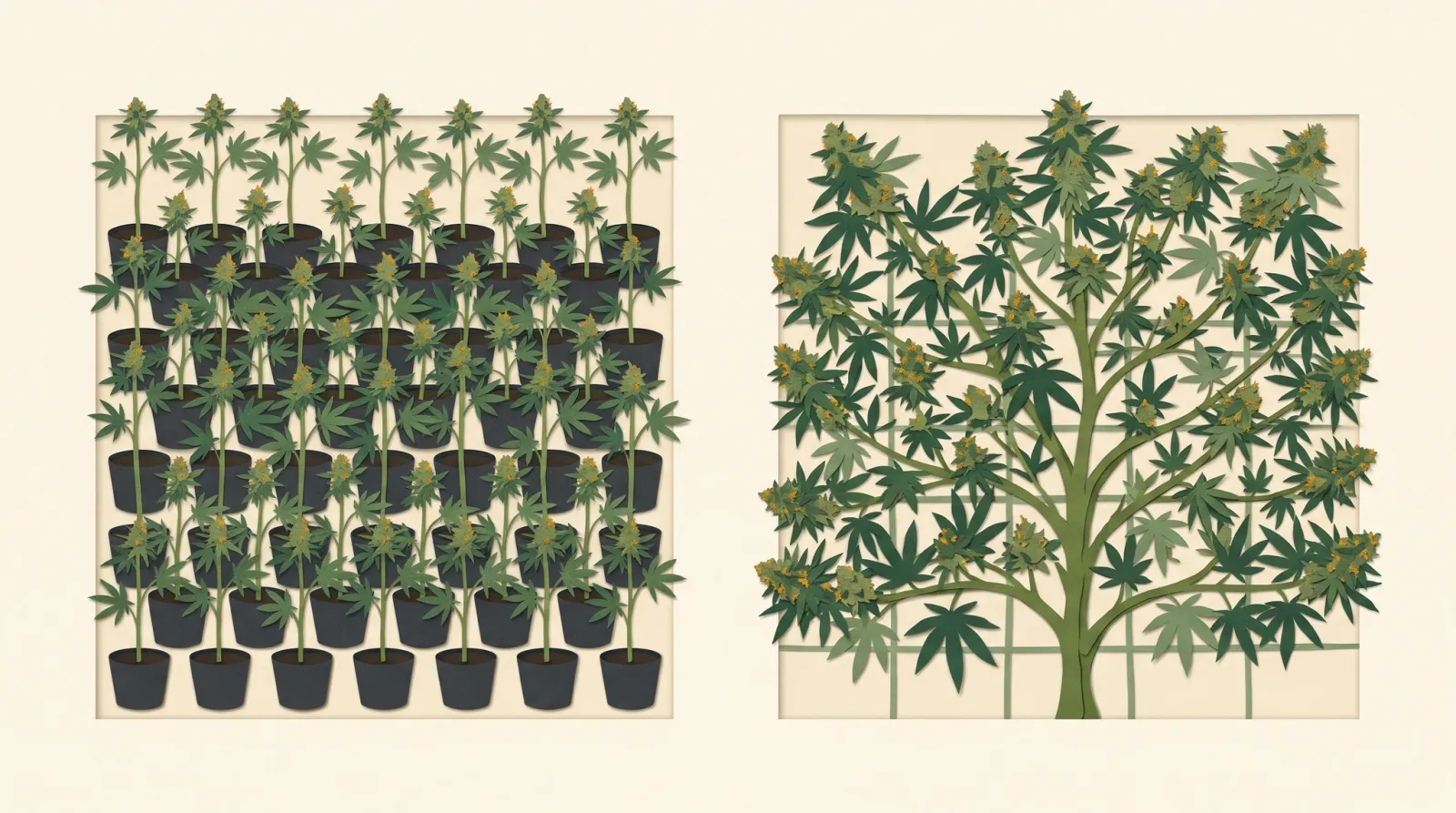
In published grow trials, one cannabis plant produced anywhere from about 10 grams to about 880 grams of dry flower, and the biggest reason for that spread is how much floor space each plant had. Crowded indoor plants, 10 to 15 per square metre, gave roughly 10 to 50 g each (about 0.4 to 1.7 oz). A plant with a square metre or more to itself gave roughly 160 to 880 g (about 6 to 31 oz).
Here is the rule that settles most arguments: yield per plant is yield per square metre divided by the number of plants sharing that square metre. The trials below made roughly 120 to 570 g of flower per square metre. Split that between 12 plants and each one looks small. Give it all to one plant and that plant looks huge. Same lit floor, different crowding.
That is why the numbers you see online disagree by about ten times. This guide lays out what the trials actually measured, what changes the answer, and where the evidence runs thin. It reports research results, not a forecast of what your own plant will do.
Sources opened and checked October 29, 2026. Weights are dry flower unless noted. 1 oz = 28.35 g.
How much weed does one plant produce indoors?
It depends on the setup, so here are the setups side by side. Rows marked “derived” are our arithmetic: the paper reported grams per square metre, and we divided by plants per square metre.
| Setup | Plants per m² | Dry flower per m² | Dry flower per plant |
|---|---|---|---|
| Indoor chamber, low light, 1-gal pots (Rodriguez-Morrison et al. 2021) | 11 | 116 g | 10 g (0.4 oz), derived |
| Same trial, very bright light | 11 | 519 g | 47 g (1.6 oz), derived |
| Indoor rockwool, three light levels (Llewellyn et al. 2022) | about 10 | not reported | 28 to 45 g (1.0 to 1.6 oz) |
| Seized Dutch grow rooms, modelled (Toonen et al. 2006) | 15 | 505 g | 34 g (1.2 oz) |
| Small pots, CBD-type plants, untopped vs topped (Massuela et al. 2022) | 14.4 | not stated | 16 g vs 18.5 g (0.6 oz vs 0.7 oz) |
| Greenhouse, CBD-type, 1 to 4 weeks of veg (Schober et al. 2024) | 17 | 295 to 571 g | 17 to 38 g (0.6 to 1.3 oz) |
| Greenhouse, CBD-type, 2 plants per m² (Danziger and Bernstein 2022) | 2 | 321 g | about 160 g (5.7 oz), derived |
| Same trial, 1 plant per m² | 1 | 222 g | 222 g (7.8 oz), derived |
| Hydroponic screen of green, six plants in about 15 m² (Knight et al. 2010) | about 0.4 | about 274 g, derived | 687 g average (24.2 oz); best cycle 881 g (31.1 oz) |
Two patterns jump out. First, the crowded rows cluster at 10 to 50 g a plant, and the roomy rows jump to hundreds of grams. Second, the per-square-metre column moves far less than the per-plant column. Toonen’s crowded Dutch rooms (505 g per m²) actually out-produced Danziger’s single plant (222 g per m²) per unit of floor, even though each Dutch plant weighed about a sixth as much.
A few honest caveats belong beside that table. Four of the trials used CBD-type plants, so they show how density and light behave, not what a high-THC cultivar yields. The Dutch figure is a regression model built from plants police seized, not a trial. The plot size for the New Zealand screen-of-green study comes from a Washington State yield report that summarized it, and the study was run by researchers as a forensic reference. Its authors called the result likely conservative, but it is still one trained plant per roughly 2.5 m², which few home growers match.
If you want to picture the weights, our visual guide to grams, eighths and ounces shows what an ounce actually looks like.
Why do yield-per-plant numbers disagree so much?
They disagree because “per plant” hides the variable that matters most. A 2019 meta-analysis by Backer et al. found that light intensity, plant density, fertilizer and variety all shape yield. It also found that “plant density was not an effective predictor of yield per square meter.” In plain words, packing more plants in does not reliably add more flower to the floor. It spreads roughly the same harvest across more stems.
The trials that tested density head-on agree on the per-plant side. Schober and colleagues found that raising plant density “led to a linear decrease in inflorescence yield per plant,” while yield per square metre went up in their small, low-light plants (Schober et al. 2024). Danziger and Bernstein saw the same trade: two plants per m² made more flower per area than one, but each plant made less (Danziger and Bernstein 2022). Area yield is not perfectly fixed, but per-plant yield swings far harder.
The width of published claims is another clue. The same meta-analysis lists commercial projections ranging from “3.36 to 3590 g dry flower m-2.” Its authors also note that yield per square metre in scientific studies “remains much lower” than what industry reports. So when two pages quote 30 g and 500 g per plant, they may both be describing real plants. They are just describing different floors.
Even identical setups vary. The Washington State report cites expert growers whose identical crops differ by 10 to 20 percent, and it reports a coefficient of variation of 0.53 within one growth condition from an earlier Belgian experiment (Washington State yield report). That Belgian trial itself concluded that light, density and variety interact, so a yield estimate needs all three (Vanhove et al. 2011).
Growers use both extremes on purpose. Many small plants is the idea behind the sea of green method; one large plant trained flat is closer to the screen of green method. The studies above do not crown either one. They show why the per-plant number changes.
How much does light change yield per plant?
Light is the biggest lever the trials measured. In a University of Guelph chamber trial, “Cannabis yield increased linearly from 116 to 519 g m-2 (i.e., 4.5 times higher)” as light at the canopy rose from 120 to 1,800 µmol m⁻² s⁻¹ (Rodriguez-Morrison et al. 2021). At 11 plants per m², that works out to about 10 g a plant at the dim end and 47 g at the bright end (derived).
A follow-up from the same group found the same direction at more typical intensities. Dry flower per plant was 27.6 g at 600, 37.2 g at 800 and 44.7 g at 1,000 µmol m⁻² s⁻¹ (Llewellyn et al. 2022). Adding ultraviolet light did not change yield.
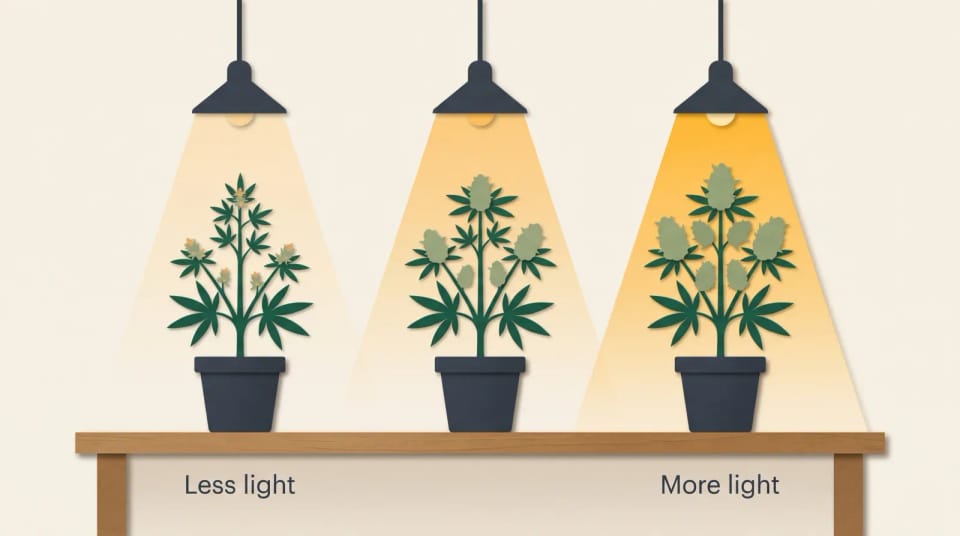
In the Guelph trials, flower per plant rose steadily as canopy light increased across the tested range. The trials did not test every lamp type or every intensity.
What about the famous “one gram per watt” rule? It has a real but narrow basis. Under high-pressure sodium lamps, Potter and Duncombe measured “0.9 to 1.6 g/W,” with the best grams per watt “achieved in the lowest irradiance regime” (Potter and Duncombe 2012). That means more light added more flower but less flower per watt. Those figures come from HPS lamps only. We found no peer-reviewed grams-per-watt measurement for consumer LED fixtures, so do not stretch the rule to them. Our grow light buyer’s guide covers how to choose a light.
Does topping or training add ounces per plant?
Topping helped a little in the one controlled trial we found. In small pots at 14.4 plants per m², topped CBD-type plants gave 18.5 g each versus 16.3 g for untouched plants, about 13 percent more. Lollipopped plants gave 15.7 g, which was not better than leaving them alone (Massuela et al. 2022).
Pruning results depended on density. At one plant per m², pruning raised yield from 222 to 255 g per m². At two plants per m², pruning lowered it from 321 to 232 g (Danziger and Bernstein 2022). So a technique that helps a spread-out plant can cost you in a crowded one.
Two timing choices moved the numbers more than training did:
- Harvest week. In the Massuela trial, flower per plant rose from 7.7 g at five weeks of flowering to 25.1 g at eleven weeks. Our guide to harvest timing covers how growers read ripeness.
- Vegetative time. In the Schober trial, each extra week of vegetative growth added about 3.3 g per plant.
We found no peer-reviewed yield data for low-stress training, screen of green, sea of green, mainlining or pot size in home-style setups. For how those methods work, see our guide to topping, LST and SCROG. Just know that any specific “this adds X ounces” claim for them is not backed by the trials we opened.
How much does an autoflower plant produce?
The one measured figure we found is modest: about 20 to 29 g per plant. A Cornell Cooperative Extension study in a New York commercial greenhouse weighed dry mass on autoflower plants grown in 3-gallon coco bags. One cultivar averaged 19.83 g and the other 28.62 g, each with a spread of about 11 g either way (Vergara and Ruterbories 2026).
That is one facility at one time, and the authors say so. The paper’s photoperiod yields were assumed values for its cost model, not measurements, so they cannot be compared directly. If you are choosing between plant types, our autoflower versus photoperiod guide and the week-by-week autoflower guide cover the trade-offs.
How much can one plant produce outdoors?
Outdoor plants can get big, but the evidence for outdoor per-plant yield is the weakest in this article. We found no controlled field trial of drug-type cannabis outdoors that reported dry flower per plant.
What does exist is a compilation of older figures in the Washington State yield report:
- A 1990 grower source: 227 to 454 g (8 to 16 oz) per plant at 0.66 plants per m².
- A 2002 source: about 500 g (17.6 oz) per plant at one plant per m².
- United Nations figures from Morocco: 76 g (2.7 oz) per rain-fed plant at one plant per m², but only 4 g per irrigated plant packed at 30 per m².
That Morocco pair is the density rule again, outdoors this time. We could not open those original sources, so treat these as compiled estimates, not measurements.
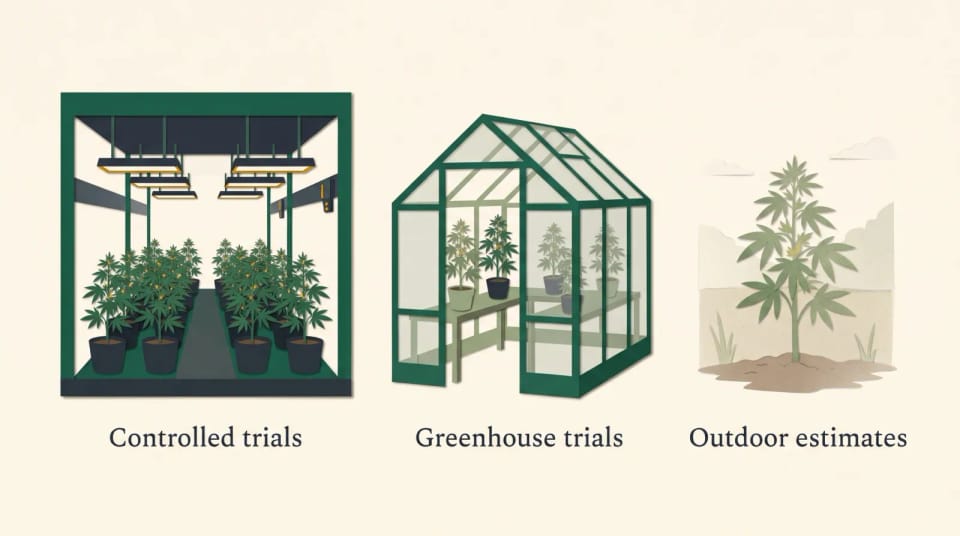
Indoor yield figures come from controlled trials. Outdoor per-plant figures rest mostly on older compiled estimates, so they carry the widest uncertainty.
One peer-reviewed data point comes close. In an outdoor foil tunnel in Germany, three CBD-rich genotypes at five plants per m² yielded between 76 and 598 g per m², depending on genotype and irrigation (Buser et al. 2025). That is about 15 to 120 g a plant (derived). One genotype varied five-fold by water treatment alone.
You may have seen claims of two pounds or more from one outdoor plant. None of the sources we opened supports a figure that high; the largest outdoor per-plant estimates we found sit near 454 to 500 g. For the wider trade-offs of growing inside versus outside, see indoor versus outdoor growing.
How many plants does it take to make a pound?
This is division, not a prediction. A pound is 453.6 g. Using the per-plant figures above:
| Per-plant figure used | Source setup | Plants for one pound (arithmetic) |
|---|---|---|
| 34 g | Crowded Dutch rooms, 15 per m² | about 13 |
| 222 g | One plant per m², greenhouse | about 2 |
| 687 g | Screen of green, about 0.4 per m² | less than 1 |
Notice what the table really says: the pound comes from the floor and the light, not the plant count. Thirteen crowded plants and two roomy ones can land in the same place.
Plant counts are also a legal question. Home-grow limits vary by state, and some places allow no home growing at all. Check the rules where you live in our state-by-state cannabis laws guide. If you are starting your first grow, the beginner’s grow guide walks through the basics, and our micro-growing guide covers very small spaces.
Sources
- Backer R, et al. (2019). Closing the yield gap for cannabis: a meta-analysis of factors determining cannabis yield. Frontiers in Plant Science, 10:495. doi:10.3389/fpls.2019.00495
- Toonen, Ribot, Thissen. (2006). Yield of illicit indoor cannabis cultivation in the Netherlands. Journal of Forensic Sciences, 51(5). doi:10.1111/j.1556-4029.2006.00228.x
- Vanhove, Van Damme, Meert. (2011). Factors determining yield and quality of illicit indoor cannabis (Cannabis spp.) production. Forensic Science International, 212(1-3). doi:10.1016/j.forsciint.2011.06.006
- Potter, Duncombe. (2012). The effect of electrical lighting power and irradiance on indoor-grown cannabis potency and yield. Journal of Forensic Sciences, 57(3). doi:10.1111/j.1556-4029.2011.02024.x
- Rodriguez-Morrison, Llewellyn D, Zheng Y. (2021). Cannabis yield, potency, and leaf photosynthesis respond differently to increasing light levels in an indoor environment. Frontiers in Plant Science, 12:646020. doi:10.3389/fpls.2021.646020
- Llewellyn D, et al. (2022). Indoor grown cannabis yield increased proportionally with light intensity, but ultraviolet radiation did not affect yield or cannabinoid content. Frontiers in Plant Science, 13:974018. doi:10.3389/fpls.2022.974018
- Crispim Massuela D, et al. (2022). Impact of harvest time and pruning technique on total CBD concentration and yield of medicinal cannabis. Plants, 11(1):140. doi:10.3390/plants11010140
- Danziger, Bernstein. (2022). Too dense or not too dense: higher planting density reduces cannabinoid uniformity but increases yield/area in drug-type medical cannabis. Frontiers in Plant Science, 13:713481. doi:10.3389/fpls.2022.713481
- Schober T, et al. (2024). The effects of plant density and duration of vegetative growth phase on agronomic traits of medicinal cannabis (Cannabis sativa L.): a regression analysis. PLoS One, 19(12):e0315951. doi:10.1371/journal.pone.0315951
- Knight G, et al. (2010). The results of an experimental indoor hydroponic Cannabis growing study, using the “Screen of Green” (ScrOG) method. Forensic Science International, 202(1-3):36-44. doi:10.1016/j.forsciint.2010.04.022
- Vergara D, Ruterbories KA. (2026). High-THC Cannabis sativa in a New York greenhouse: yield and economic factors. Journal of Cannabis Research, 8:85. doi:10.1186/s42238-026-00429-5
- Buser, Hartung, Graeff-Hönninger. (2025). Subsurface drip irrigation reduces weed infestation and irrigation water use while increasing inflorescence and cannabinoid yield in an outdoor tunnel Cannabis sativa L. production system. Journal of Cannabis Research, 7:41. doi:10.1186/s42238-025-00302-x
- BOTEC Analysis for the Washington State Liquor Control Board. Estimating adequate licensed square footage for production (cannabis yields report). lcb.wa.gov PDF
Key takeaways
- Trials measured about 10 to 50 g per plant when 10 to 15 plants shared a square metre, and about 160 to 880 g when one plant had a square metre or more.
- Per plant equals per square metre divided by plants per square metre. That one rule explains most of the disagreement online.
- More light raised yield in every indoor trial we opened; under HPS lamps, grams per watt fell as intensity rose.
- Topping added about 13 percent in one small-pot trial. Harvest week and vegetative time moved weight more.
- Outdoor per-plant figures rest on older compiled estimates. No source we opened supports multi-pound outdoor plants.
FAQ
Do bigger pots mean bigger yields?
We could not find a trial that tested pot size alone for high-THC plants. The studies above changed pot size and plant density at the same time, so their results cannot separate the two. A bigger pot usually goes with fewer plants per square metre, which raises per-plant yield on its own.
What is the average yield per plant under a 600 W light?
There is no honest single answer, because the light is shared by however many plants sit under it. Under HPS lamps, one study measured 0.9 to 1.6 g per watt, which would mean roughly 540 to 960 g for a 600 W lamp’s whole footprint (derived, HPS only). Divide that by your plant count for a per-plant figure. No comparable peer-reviewed figure exists for LED.
How much can you yield in a grow tent?
Think in area first. The indoor and greenhouse trials above made about 116 to 571 g per square metre, so a 1.2 m by 1.2 m tent (about 4 by 4 ft) would hold about 170 to 820 g by simple arithmetic. That spread comes mostly from light intensity, and it is not a promise for any particular setup.
Is indoor or outdoor yield higher per plant?
Outdoor plants are often given far more space, so their per-plant numbers can be larger. The compiled outdoor estimates reached about 454 to 500 g per plant at one plant or fewer per square metre. Per square metre, though, the evidence does not show outdoor growing clearly beating indoor, and outdoor figures are the least reliable.



