Are There 100% Indica or 100% Sativa Strains? What DNA Tests Found
A strain sold as 100% sativa matched a reported 100% indica in a DNA study. What pure indica or sativa can mean, and why a menu label cannot prove it.

No menu can prove a strain is 100% indica or 100% sativa: plant groups with those names exist in landraces and in botany, but the label on a retail jar is a claim nobody verifies, and strains sold as 100% that were genotyped did not reliably match it. Some names held up in testing. Others did not. Nothing on the jar tells you which kind you are holding.
Here is the result to send to the friend who swears by their “pure indica.” In the first genome-wide survey of strain names, a sample of Jamaican Lamb’s Bread, reported as 100% sativa, was nearly identical to a reported 100% indica strain from Afghanistan. Their identity-by-state score was 0.98 on a scale where 1.0 means the same genotype. The authors say a sample mix-up cannot be ruled out, so this does not show that Lamb’s Bread “is” an indica. It shows that a 100% label failed the first direct genetic check it got. Sawler et al., PLOS ONE, 2015
This class covers what “100%” can mean, what genotyping found, and what is still fair to call pure. For why the labels do not predict your high in the first place, see our lesson on why indica and sativa labels do not predict effects.
What does 100% indica actually mean?
It can mean three different things, and only one of them shows up on a menu.
- A botanical group. Taxonomists have named Cannabis sativa and Cannabis indica for centuries. They still disagree about whether cannabis is one species or as many as four. Piomelli and Russo, 2016
- A documented landrace. A local plant population, grown in one region for generations, that was never crossed with imported breeding stock.
- A breeder or seed-catalog claim. A percentage typed into a product listing, usually copied from a lineage story.
The trap is that the menu words do not match the botanical words. Botanists John McPartland and Geoffrey Guy found that the everyday “Sativa” and “Indica” do not line up with the scientific names C. sativa and C. indica. In the classification they favor, both street types sit inside one subspecies, C. sativa subsp. indica. McPartland and Guy, 2017
So a jar that says “100% indica” uses a botanical-sounding word for something that is not a botanical measurement.
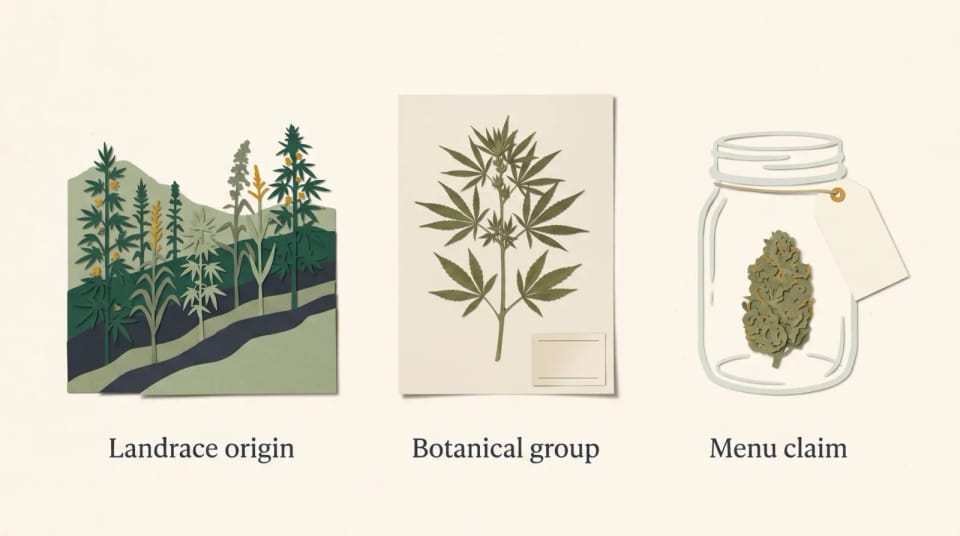
Pure can mean a place, a plant group in botany, or a line on a product listing. Only the last one reaches a dispensary menu, and no one verifies it there.
| What “100%” could mean | How you would check it | What a jar label can show |
|---|---|---|
| A botanical species or subspecies | Compare the plant to reference populations with genetic markers | Nothing. No retail label reports this. |
| A documented landrace | Trace the seed to a named region, with passport records and genotyping against local samples | A region name, if the seller supplies one. You cannot check it at the counter. |
| A breeder or catalog claim | Ask for the breeding records | The claim itself, repeated. |
Has anyone tested a strain sold as 100% sativa?
Yes, and the results were mixed at best. The 2015 survey genotyped 81 marijuana samples and 43 hemp samples at about 14,000 DNA markers. Reported sativa ancestry explained only part of the genetic pattern; the correlation was moderate, with an r² of 0.36. Sawler et al., 2015
Names did not hold steady either. In 6 of 17 comparisons between samples sharing a strain name, a sample was genetically closer to a differently named strain than to its namesake. That is 35% of those comparisons. It is not “35% of all strains,” a version you will see repeated online.
The ancestry percentages in that study came from online sources, not breeders’ records. That is the point: the published percentage is the thing being tested, and it did not track the DNA well.
A 2021 study in Nature Plants went further. It used samples from a Dutch pharmaceutical-grade supplier, a hemp seed company and Dutch coffee shops, coded on a five-point scale from “100% Sativa” to “100% Indica.” Genome-wide, the Sativa-labelled and Indica-labelled samples were genetically indistinct. The labels did line up with a small number of aroma compounds controlled by terpene synthase genes. The authors propose, as a hypothesis, that growers assign labels by smell and expected effect rather than ancestry. Watts et al., 2021
We cover the wider tour of strain-name genetics in what DNA studies found about strain names. Here, the takeaway is narrow: the two ends of the label scale did not behave like two genetic groups.
Do any strains sold as 100% hold up?
Some did, in one study, and that is exactly why a label cannot settle it. A 2019 study bought 30 strains from dispensaries in three states and genotyped 122 samples. It compared them against the Sativa, Hybrid and Indica percentages a public strain database reported. Schwabe and McGlaughlin, 2019
- Durban Poison, reported as 100% Sativa: 7 of 9 samples sorted strongly into one genetic group.
- Purple Kush, reported as 100% Indica: 3 of 4 samples sorted strongly into the other group.
- Grape Ape, reported as 100% Indica, and Hawaiian, reported as 90% Sativa: no consistent pattern.
Overall, the two genetic groups the study found did not match the reported types, and most strains had at least one genetic outlier. The authors also wrote that there are “currently no baseline genotypes for any strains.” Without a reference genotype, nobody can say what a pure version of a strain should look like.
This does not make Durban Poison or Purple Kush “pure” in our book. It means those names sorted with their labels in that sample, from those stores, in 2019. The next jar with the same name may come from a different plant.
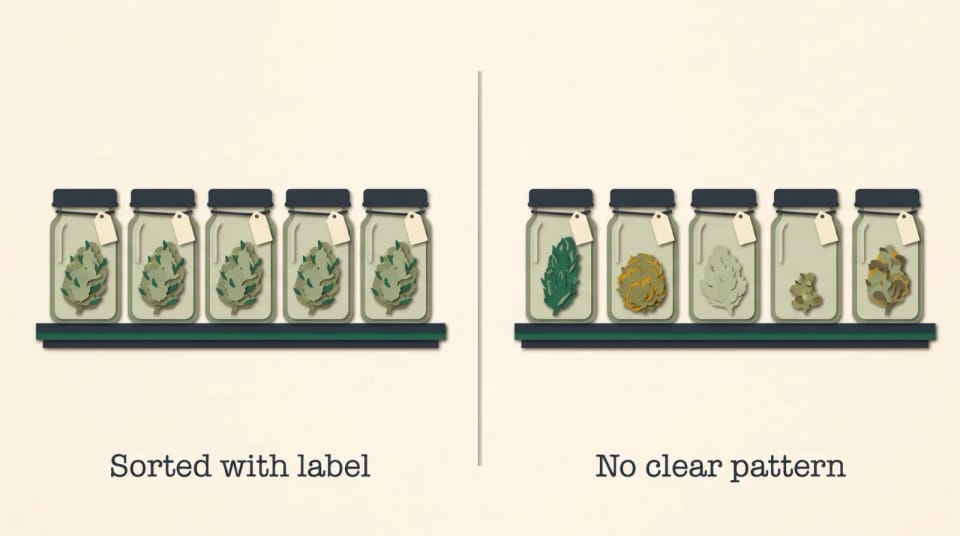
In a 2019 dispensary sample, Durban Poison and Purple Kush samples mostly grouped with their labels; Grape Ape and Hawaiian did not. The tags on the jars looked the same either way.
What does landrace actually narrow down?
It narrows down where a plant came from, not which label it earns. Crop scientists describe a landrace as a cultivated, genetically varied population adapted to one region and its traditional farming. Landraces stay “in a constant state of evolution” and keep mixing with neighbors. Casañas et al., 2017 Varied and evolving is the opposite of a fixed 100%.
Landraces also do not sort neatly into the menu pair. A 2005 study of 157 cannabis accessions found two gene pools that no earlier species concept fit. Narrow-leaf drug landraces from southern Asia, Africa and Latin America landed in the same “indica” gene pool as wide-leaf drug plants from Afghanistan and Pakistan. Hillig, 2005 In other words, the Thai and Colombian types a seed catalog would call pure sativa fell into the study’s indica pool.
The best-supported genetic split is by leaf shape. A 2016 analysis of 340 varieties separated hemp, narrow-leaflet drug types and broad-leaflet drug types. The broad-leaflet group clustered with Afghan Kush landrace samples, and the two drug groups were each other’s closest relatives. Lynch et al., 2016 That is a real pattern, centered on landraces. It is still not what a menu label measures.
A 2025 study of wild and herbarium cannabis went further. It supports one species, grouped by geography rather than by use. It notes that distinctions among drug strains are now “blurred because of crossing and inconsistent labelling practices.” Balant et al., 2025
For the history and regions, see what landrace means. To follow a modern strain back toward those roots, try tracing a strain’s family tree.
Are there any true 100% indicas left?
Possibly, in unhybridized wild and landrace populations, but not in a way a shopper can confirm. McPartland and Ernest Small reported that unhybridized landraces were already “difficult to obtain in the USA and Europe” 35 years before their 2020 paper. They name four taxa as critically endangered reservoirs of that original genetic diversity. McPartland and Small, 2020
Their verdict on the market is blunt. Widespread crossing over the past 50 years “obliterated” the differences between hybridized “Sativa” and “Indica.” Strains on the market are “usually based on THC/CBD ratios of plants with undocumented hybrid backgrounds.”
Even “pure” depends on what you compare against. A 2024 study of nine cannabis collections found anywhere from three to seven genetic clusters, depending on the collection. Halpin-McCormick et al., 2024
Global sampling is still thin, and the 2025 cannabis pangenome points to wild relatives in Asia that remain unsampled. Lynch et al., 2025 There is no agreed pure reference yet.
What does “indica” on a dispensary menu mean?
It is a description, not a test result. The Los Angeles Department of Cannabis Regulation’s consumer page says a California label shows indica, sativa or hybrid. It describes them by effect: indica “tends to provide a relaxing effect,” sativa “a more sociable, uplifting experience,” and hybrid “somewhere in between.” LA Department of Cannabis Regulation That page explains the label. It does not describe any purity check behind it.
The newest evidence review backs the caution. A systematic review published October 24, 2026, pooled 28 reports. It concluded that the labels are not reliable guides to a product’s composition. Zoobi et al., 2026 Our lesson on what else is wrong on a dispensary label covers the other lines worth doubting.
A “pure indica” list, then, is a list of claims. That is why we do not publish one.
What should you read instead?
Read the chemistry the jar does report. The lab panel lists cannabinoids and, often, terpenes. Those are measurements, and our guide on how to read a terpene profile shows you where to start. That is the idea behind High Families, which group strains by chemical families instead of labels. They are a classification, not a promise about how you will feel.
Your own notes beat any label. In the High IQ app, you can log how a strain actually worked for you and compare it with the next jar that carries the same name.
If you are choosing cannabis because of sleep, pain, anxiety or another health concern, a label is not a treatment plan. Talk to a clinician, especially if you take other medicines or your symptoms are new or getting worse.
Key takeaways
- “100% indica” and “100% sativa” are catalog claims. No menu or regulator verifies them.
- A strain reported as 100% sativa matched a reported 100% indica in a 2015 DNA study, with a possible sample mix-up noted.
- In 2019, Durban Poison and Purple Kush samples sorted with their labels; Grape Ape and Hawaiian did not.
- Landrace narrows down a place of origin. It does not guarantee purity, uniformity or a predictable effect.
- Read the lab panel and track your own results instead of trusting the label.
FAQ
Can a pure indica or sativa be verified?
Not at the dispensary. Genetic tests can compare a plant with reference samples, but results depend on which markers and which reference set the lab uses. Researchers report there are no baseline genotypes for any strain, so there is no agreed standard to test “pure” against.
Does landrace mean 100% indica or 100% sativa?
No. A landrace is a varied, still-evolving local population, not a fixed type. Genetic work places some landraces a catalog would call sativa in the same gene pool as Afghan indica types. Landrace tells you where a plant came from, not which menu label it deserves.
Is pure sativa hard to get?
Unhybridized landraces were already scarce in the US and Europe by the 1980s, according to botanists who study them. What you can buy today is mostly crossed stock with undocumented backgrounds. A seller may still call it pure sativa, but that is a claim, not a test result.
What is a hybrid, if pure strains are rare?
On a menu, “hybrid” usually means the seller describes the strain as a mix of indica and sativa ancestry. Botanists describe most market cannabis as coming from undocumented hybrid backgrounds, whatever the label says. Our lesson on indica-dominant and sativa-dominant hybrids explains what the “dominant” labels claim.
Does a pure indica make you sleepy?
No study we found links “pure” status to a reliable effect. A 2026 systematic review found human studies of label effects inconsistent, and many did not account for THC dose. Effects vary from person to person, so the label alone tells you little.
Sources
- Sawler J, Stout JM, Gardner KM, et al. “The Genetic Structure of Marijuana and Hemp.” PLOS ONE, 2015. doi:10.1371/journal.pone.0133292
- Schwabe AL, McGlaughlin ME. “Genetic tools weed out misconceptions of strain reliability in Cannabis sativa: implications for a budding industry.” Journal of Cannabis Research, 2019. doi:10.1186/s42238-019-0001-1
- Watts S, McElroy M, Migicovsky Z, et al. “Cannabis labelling is associated with genetic variation in terpene synthase genes.” Nature Plants, 2021. doi:10.1038/s41477-021-01003-y
- McPartland JM, Small E. “A classification of endangered high-THC cannabis (Cannabis sativa subsp. indica) domesticates and their wild relatives.” PhytoKeys, 2020. doi:10.3897/phytokeys.144.46700
- McPartland JM, Guy GW. “Models of Cannabis Taxonomy, Cultural Bias, and Conflicts between Scientific and Vernacular Names.” The Botanical Review, 2017. doi:10.1007/s12229-017-9187-0
- Piomelli D, Russo EB. “The Cannabis sativa Versus Cannabis indica Debate: An Interview with Ethan Russo, MD.” Cannabis and Cannabinoid Research, 2016. doi:10.1089/can.2015.29003.ebr
- Hillig KW. “Genetic evidence for speciation in Cannabis (Cannabaceae).” Genetic Resources and Crop Evolution, 2005. doi:10.1007/s10722-003-4452-y
- Lynch RC, Vergara D, Tittes S, et al. “Genomic and Chemical Diversity in Cannabis.” Critical Reviews in Plant Sciences, 2016. doi:10.1080/07352689.2016.1265363
- Casañas F, Simó J, Casals J, Prohens J. “Toward an Evolved Concept of Landrace.” Frontiers in Plant Science, 2017. doi:10.3389/fpls.2017.00145
- Balant M, Vitales D, Wang Z, et al. “Integrating target capture with whole genome sequencing of recent and natural history collections to explain the phylogeography of wild-growing and cultivated cannabis.” Plants, People, Planet, 2025. doi:10.1002/ppp3.70043
- Halpin-McCormick A, Heyduk K, Kantar MB, et al. “Examining population structure across multiple collections of Cannabis.” Genetic Resources and Crop Evolution, 2024. doi:10.1007/s10722-024-01928-1
- Lynch RC, Padgitt-Cobb LK, Garfinkel AR, et al. “Domesticated cannabinoid synthases amid a wild mosaic cannabis pangenome.” Nature, 2025. doi:10.1038/s41586-025-09065-0
- Zoobi G, Marco M, Foraida KJ, et al. “Do consumer-facing ‘Indica,’ ‘Sativa,’ and ‘Hybrid’ labels predict cannabis composition or effects? A systematic review.” Journal of Cannabis Research, 2026. doi:10.1186/s42238-026-00528-3
- City of Los Angeles Department of Cannabis Regulation. “Reading a California Product Label.” Accessed October 29, 2026. cannabis.lacity.gov





