

Chimmy Tech: Does Sifting Your Weed Really Make a Better Joint?
Chimmy Tech sifts ground weed through a matcha sifter for white ash. You smoke what falls through. Here is what it changes: ash, pull, potency and waste.

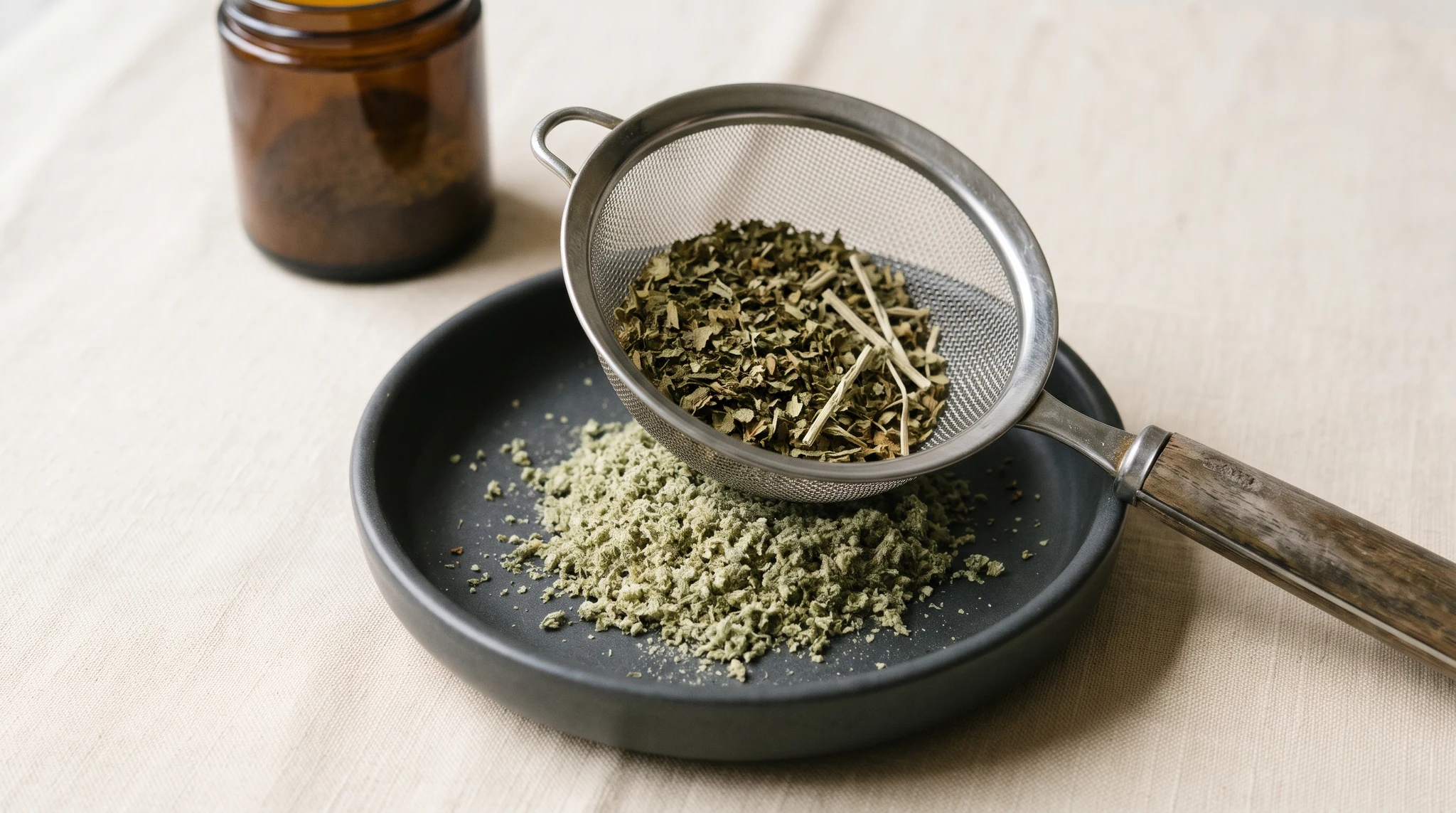
Chimmy Tech gives a joint whiter ash and a more even burn, but no evidence shows it makes the smoke smoother or less tarry, and it usually makes the joint harder to pull. The method is simple: grind your flower, push it through a fine matcha sifter, and smoke only the fine material. One detail that many people get backwards: you smoke what falls through the sifter, not what stays in it.
That detail matters, because it changes what the trend actually is. A matcha sifter’s holes are wider than the resin glands that hold most of the THC. So the resin falls through with the fine flower, and the leaf and stem stay on top. A Chimmy Tech joint is not “cleaned” weed. It is weed with the low-potency parts removed, closer to a light kief joint than a filtered one.
Here in High School, we like a trend that can be tested. This one can. Let’s take it apart.
What is Chimmy Tech?
Chimmy Tech is a joint-prep method named after the Instagram creator Chimmy Win (@chimmywin). It went wide after the Los Angeles brand Imperial Club posted “The Chimmy Tech” on X on August 31, 2026. ADCANN reported that the post was close to one million views a week later (ADCANN, 2026).
Chimmy has not written the method down. As he shows it, the steps are: grind the flower, shake and press it through a fine sieve, roll what falls through, and set aside what does not. Cannabis writer Ben Owens bought the exact matcha sifter set linked in Chimmy’s bio and replicated the method. He notes that the listing calls the mesh “fine” and gives no mesh number (Owens, 2026).
The goal was always the ash. In an IPTV interview quoted by Owens, Chimmy says the idea came from seeing a white-ash joint on Instagram and wondering how it was possible. He then experimented until he got it. Claims about smoother, cleaner smoke came later, mostly from other people.
The technique is not completely new. Commercial pre-roll makers already sift ground flower to remove stems and get an even fill (Custom Cones USA). Hash makers have used the same screens for centuries to collect kief and dry sift. Chimmy Tech sits between the two: a finer screen than a pre-roll factory uses, and a coarser one than a hash maker uses.
Which part do you smoke: what falls through or what stays?
You smoke what falls through. The fine material in the dish below the sifter goes into the joint. The coarse material left on the mesh is set aside.
It is easy to picture this the other way around. A matcha sifter seems to catch the “good stuff” and let the dust escape. But the numbers say otherwise.
| Item | Typical size | Passes a matcha sifter? |
|---|---|---|
| Matcha sifter opening (60 to 100 mesh) | 150 to 250 µm | — |
| THC-rich gland head on cannabis flower | About 40 to 130 µm | Yes |
| Fine ground bud | Varies, much of it under 250 µm after a fine grind | Mostly |
| Leaf flakes and stem pieces | Several hundred µm to a few mm | No |
Mesh openings come from the ASTM E11 sieve standard as listed by Nagori Ware. Gland heads measured 40 to 110 µm in a microscopy study of two high-THC genotypes (Punja, 2023).
A survey of licensed high-THC flower estimated an average fresh gland head size near 129 µm (Small, 2015). Gland heads also shrink as flower dries, so cured flower sits toward the small end.
The gland heads, called trichomes, are smaller than the holes. They fall through with the fine flower. Hash makers rely on exactly this: a top screen near 140 µm lets the resin heads through and holds most plant matter back (Bubbleman, High Times).
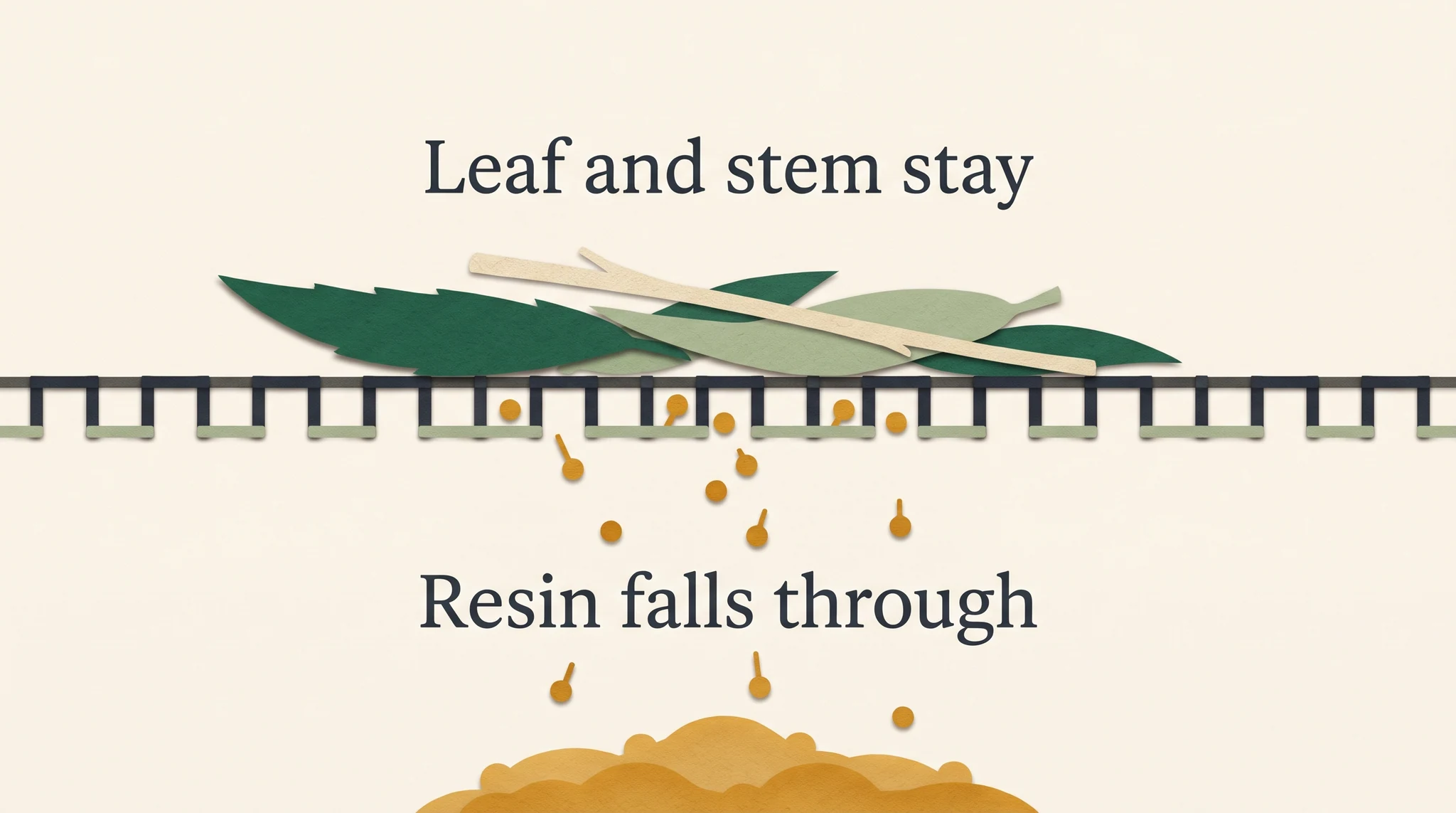
So the claim “everything the sifter catches is stuff you don’t need” is half right. The caught pile is mostly leaf and stem, and those parts carry far less cannabinoid than flower. In one lab profile of three chemovars, flower held 15.8 to 20.4 percent total cannabinoids. Leaf held 1.1 to 2.1 percent, and stem bark under 0.01 percent (Jin, 2020). But “stuff you don’t need” is not the same as “stuff that makes smoke harsh”. That second claim is a separate question.
Why does a sifted joint burn with white ash?
A sifted joint burns white mostly because the fill is small and even, so it burns more completely. It does not burn white because the weed got “cleaner”.
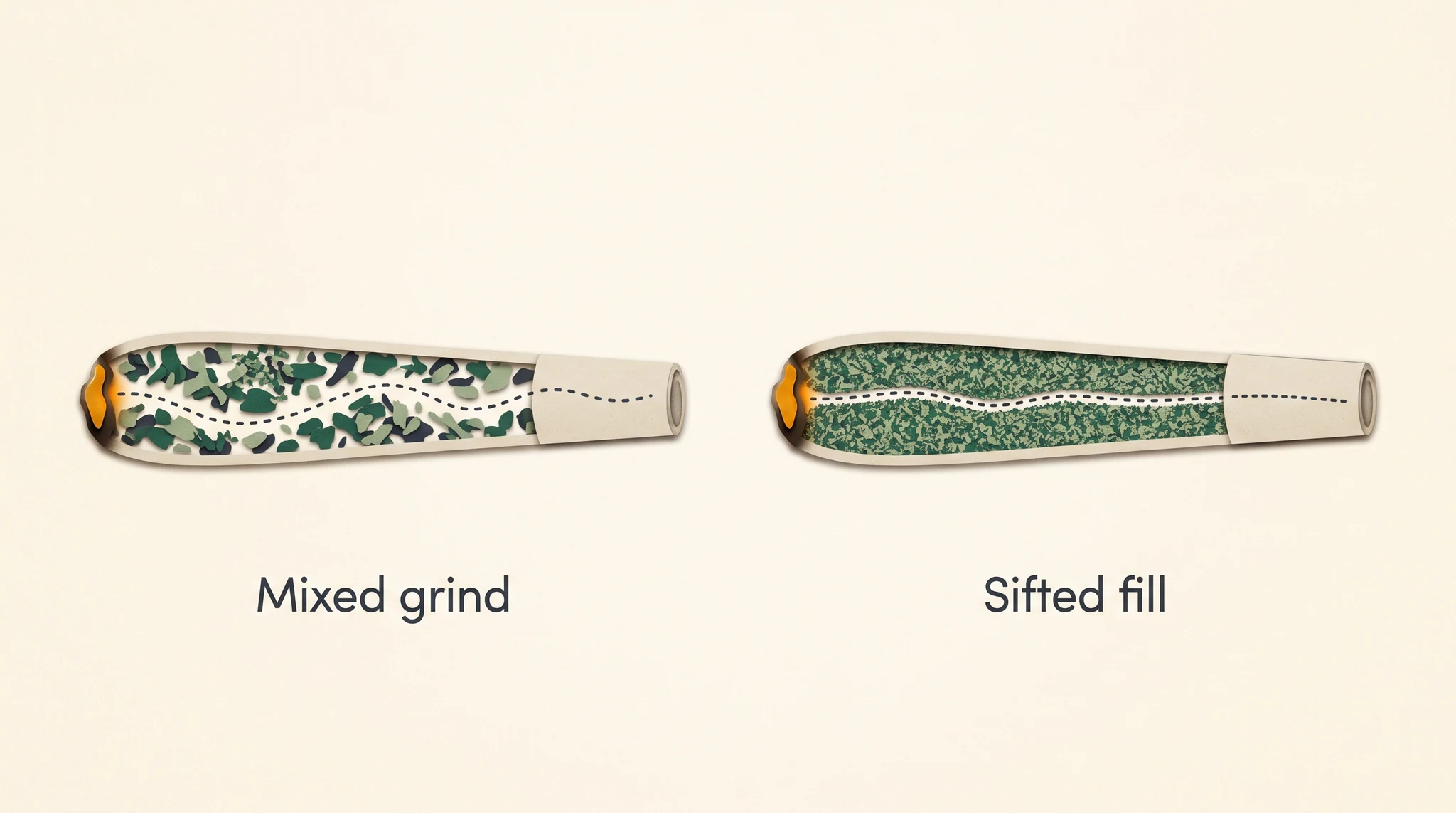
Think about what a normal grind holds: fine powder, medium crumbs, a few chunky bits and some stem. Small pieces catch and burn through fast. Large pieces char on the outside and leave black carbon behind. Stems burn unevenly and can make a joint run or canoe. Remove the big pieces and every particle burns at about the same rate. The cherry stays even, and more of the carbon finishes burning before it drops off as ash.
The sifted fill also holds more resin per gram, because the gland heads stay in and the leaf comes out. That is why testers see a fat resin ring. The ring is resin and tar collecting ahead of the cherry. It shows there is a lot of resin in the joint. It is not a separate sign of quality.
This is why Chimmy Tech is a good lesson in why white ash is not a quality test. The same flower can give salt-and-pepper ash in a normal joint and snow-white ash after sifting. Nothing about the grow changed. Only the particle size did.
Does sifting make the smoke smoother or less harsh?
No study has tested it, and the closest evidence points the other way. Nobody has measured harshness, tar or toxicants in a sifted versus unsifted cannabis joint. Here is what we do know.
- The best hands-on test found no taste difference. Owens compared sifted and normal joints from the same flower across several varieties. He could not taste a difference, and the friends he handed joints to without explanation said nothing about smoothness. They said the joints were hard to hit (Owens, 2026).
- Finer filler did not make tobacco smoke cleaner. In a cigarette-making study, narrower tobacco cuts raised the dust content and increased carbon monoxide, tar, total particulate matter and nicotine in the smoke (Zhou, 2023). Tobacco is not cannabis, and the cut sizes differ. Still, it is a warning against assuming “finer” means “cleaner”.
- Tar comes from burning plant matter and resin, not only from stems. A sifted joint concentrates resin. More resin burning can mean more flavor. It does not mean less smoke.
- Smoke is still smoke. Cannabis smoke contains many of the same irritants and toxicants as tobacco smoke (Moir, 2008), and the CDC notes that smoking cannabis can damage lung tissue (CDC). Whiter ash does not change that.
Some smokers do report a gentler hit, and that report is worth taking seriously as a report. Two things can explain it without “cleaner” smoke. A joint that burns evenly does not get hot runs or a hot, harsh last third. And a joint that is hard to pull forces smaller, slower puffs, which feel softer on the throat. Both are real effects on comfort. Neither shows that the smoke carries less tar.
Why is a Chimmy Tech joint so hard to pull?
Fine, uniform material packs tightly and leaves less air space, so air has a harder time getting through. This is the most consistent complaint about the method.
Tobacco engineers measure this as draw resistance. Their studies on cut width alone give mixed results: in slim cigarettes, one study found a 0.7 mm cut pulled easier than a 0.8 mm cut (Zhao, 2021).
The factor that stays consistent is empty space. A micro-CT study that scanned the inside of cigarettes found that the less empty space a cigarette held, the harder it pulled (Shen, 2026).
Sifted cannabis is far finer than any cut tobacco: powder under about 0.25 mm against strands of 0.7 to 1.2 mm. Fine powder settles into the gaps and packs tight. Every tester who has tried the method reports the same result: a harder pull.
When a customer said a Chimmy Tech collab pre-roll barely gave any smoke, Chimmy’s advice was to “hit it like you are sipping a straw and let the cherry catch up” (as reposted to his story and quoted by Owens). That works. But if a joint needs a technique to smoke, it is not a fit for most sessions.
You can soften the pull. Pack a little looser than you normally would, use a wider crutch or filter tip, and keep the cone short and wide rather than long and thin.
Is a sifted joint stronger?
Probably a little stronger per gram, but nobody has lab-tested one. Removing low-cannabinoid leaf and stem raises the share of resin in what remains. How much depends on your flower, your grinder and your mesh.
Do not assume a big jump, either. The leftover pile is not pure leaf. It also holds chunks of bud with trichomes still attached. So a sifted gram sits somewhere between your normal flower and kief. If you are not sure how much THC is in a joint, take smaller first hits with a sifted one.
Note that some commercial “Chimmy Tech” pre-rolls are also infused with concentrate (THE TENCO). Any extra strength in those comes from the infusion, not from the sifting. Our comparison of infused and standard pre-rolls explains that difference.
How much weed does Chimmy Tech waste?
In the best public test, about half of the ground flower stayed on the screen. Owens reported that the leftover pile was roughly 50 percent of the input (Owens, 2026). Your number will differ.
Four things move it:
- Grind. A finer grind sends more bud through the mesh. A sharp grinder helps more than a second pass through a dull one.
- Mesh size. A 60 mesh screen passes more than a 100 mesh screen. Below about 100 mesh, you end up pressing everything through with a spoon.
- Dryness. Dry flower sifts well. Sticky, resinous or humid flower gums up the mesh.
- Trim quality. Well-trimmed bud leaves less leaf behind. Larf and sugar-leaf-heavy flower leave more.
“Waste” only applies if you throw the pile away. It still holds cannabinoids, so do not.
How to try Chimmy Tech without wasting half your flower
- Start with dry flower. It snaps rather than bends. Do not over-dry good flower just for this, because terpenes leave with the moisture.
- Grind it fine. One pass with a sharp grinder is enough.
- Shake it through a 60 to 80 mesh sifter. Hold it over a clean dish. Tap and shake first, then press gently with the back of a spoon. Stop when only fluffy leaf and stem bits remain.
- Roll or pack what fell through. Pack a bit looser than usual. For a joint, a wide filter tip helps.
- Save the leftovers. Put the coarse pile in a jar for later use.
A gentler version that some rollers use: put the sifted fill in the front of the joint for a clean light and even burn, and the unsifted grind near the filter for easier airflow. You get much of the visual effect and lose less flower.
Can you do Chimmy Tech in a bowl?
Yes, but you need a screen. Fine sifted material falls through a bowl’s hole and gets pulled toward your mouth. Put a fine metal or glass screen in the bowl, or lay a small layer of normal grind at the bottom as a base, with the sifted fill on top.
Pack it loosely. Fine powder packed tight in a bowl chokes airflow just like it does in a joint. Light the edge of the top layer and take slow pulls. Our guide on how to pack a bowl covers the basics.
If you like this direction, sprinkling kief on top of a normal bowl gets you a similar result with less work. See what to do with kief for that and other uses.
What can you do with the leftover pile?
The leftover pile is low-grade material, but it is not nothing. For more on what leaf holds, see can you smoke weed leaves.
- Infuse it. Leaf and stem add little alone, but mixed with other trim it can go into butter or oil. Decarboxylate it first, and label the result, because its strength is hard to predict.
- Regrind and mix it. Grind the pile again and mix it into a normal joint or a spliff.
- Use it as a base layer. As above, use it in the base of a bowl or near the filter of a gradient joint.
- Compost the stems. Stem bark tested under 0.01 percent cannabinoids in the Jin study. Stems are not worth smoking.
Who should actually try Chimmy Tech?
- Anyone with flower that burns badly. Stems, seeds, black ash and uneven cherries are where sifting helps the most. This is the most practical use.
- Rollers who enjoy the craft. If a perfect ash column is part of the fun, sifting gets you there.
- Pre-roll makers. Sifting already helps commercial fill. A finer screen improves the look, but customers may find the result hard to hit.
Skip it for everyday smoking if you want an easy pull, if your flower is sticky or fresh, or if losing a large share of your jar bothers you. And do not use it as a health upgrade. Whiter ash is a burn result, not a cleaner smoke.
FAQ
Do you smoke what’s left in the sifter for Chimmy Tech?
No. You smoke what falls through the sifter. The mesh holes are larger than the resin glands, so the THC-rich material ends up in the dish below. The coarse leaf and stem left on the mesh is set aside.
What mesh size do you need for Chimmy Tech?
Chimmy’s own sifter lists no mesh number. Common matcha sifters are 60 to 100 mesh, which is about 250 to 150 µm openings. A 60 to 80 mesh screen is a practical start, because finer mesh is slow and clogs with sticky flower.
Does Chimmy Tech get you higher?
A sifted joint probably has somewhat more THC per gram, because low-cannabinoid leaf and stem are removed. No lab has measured how much. Take smaller first hits.
Why won’t my Chimmy Tech joint hit?
Fine, even material packs densely and leaves little air space. Pack looser, use a wider filter tip, roll a shorter and wider cone, or put normal grind near the filter.
Does white ash mean the weed is better?
No. Chimmy Tech shows this clearly: the same flower can burn salt-and-pepper or snow-white depending only on particle size. Ash color tells you about the burn, not about the grow, potency or safety.
Key takeaways
- Chimmy Tech is a size filter. The resin falls through the mesh and gets smoked. Leaf and stem stay on top.
- White ash is real. Small, even particles burn more completely.
- Smoother smoke is unproven. No test supports it, and finer tobacco filler increased tar and CO.
- The pull gets harder. Dense fill leaves less air space.
- Expect to set aside a large share of your flower, about half in the best public test. Keep it for butter, oil or a gradient joint.
Sources
- Owens, B. (2026, October 12). Throwing away 50% of your weed for white ash? Substack. One reviewer’s informal side-by-side and blind session test; not a controlled study.
- Bambury, C. (2026, September 8). What is Chimmy Tech? The viral cannabis rolling trend. ADCANN. Trend report.
- Jin, D., Dai, K., Xie, Z., & Chen, J. (2020). Secondary metabolites profiled in cannabis inflorescences, leaves, stem barks, and roots for medicinal purposes. Scientific Reports, 10, 3309. DOI. Three chemovars from one producer.
- Punja, Z. K., Sutton, D. B., & Kim, T. (2023). Glandular trichome development, morphology, and maturation are influenced by plant age and genotype in high THC-containing cannabis inflorescences. Journal of Cannabis Research, 5, 12. DOI. Two genotypes.
- Small, E. (2015). Size matters: evolution of large drug-secreting resin glands in elite pharmaceutical strains of Cannabis sativa (marijuana). Genetic Resources and Crop Evolution. DOI. Fresh head size extrapolated from dried samples.
- Nagori Ware. Do you need a matcha sifter? The mesh is 25x wider than the powder, 2026. Mesh-to-micron values from ASTM E11; kitchen sifters are not certified to the standard.
- Bubbleman. Tricks and tips to make full-melt dry sift hash, High Times, 2016. Practitioner method.
- Zhao, Y., et al. (2021). Effect of the width of cut tobacco on the quality of slim cigarette. Journal of Physics: Conference Series, 1748, 062060. DOI. Tobacco, machine-made cigarettes.
- Zhou, K., et al. Effects of cut tobacco width and drying methods on cigarettes with different sizes, Food & Machinery, 2023. Tobacco; abstract only; no DOI found.
- Shen, K., et al. (2026). Research on the effect of shredding width on the comprehensive performance of conventional cigarette sticks. Proc. SPIE. DOI. Tobacco; micro-CT.
- Moir, D., et al. (2008). A comparison of mainstream and sidestream marijuana and tobacco cigarette smoke produced under two machine smoking conditions. Chemical Research in Toxicology, 21(2), 494–502. PubMed. Machine smoke chemistry.
- Centers for Disease Control and Prevention. Cannabis and lung health.
- Custom Cones USA. Pre-roll master class part II: grinding and sifting fundamentals. Manufacturer blog; its internal test figures are not independently verified.
- THE TENCO. Infused prerolls by TENCO x Chimmytech. Seller page.


