How to Pack a Bowl: What Grind Size and Airflow Really Do
To pack a bowl, grind evenly to medium-coarse, fill loosely, test with a dry pull, and light one edge. Here is why airflow decides how it burns.

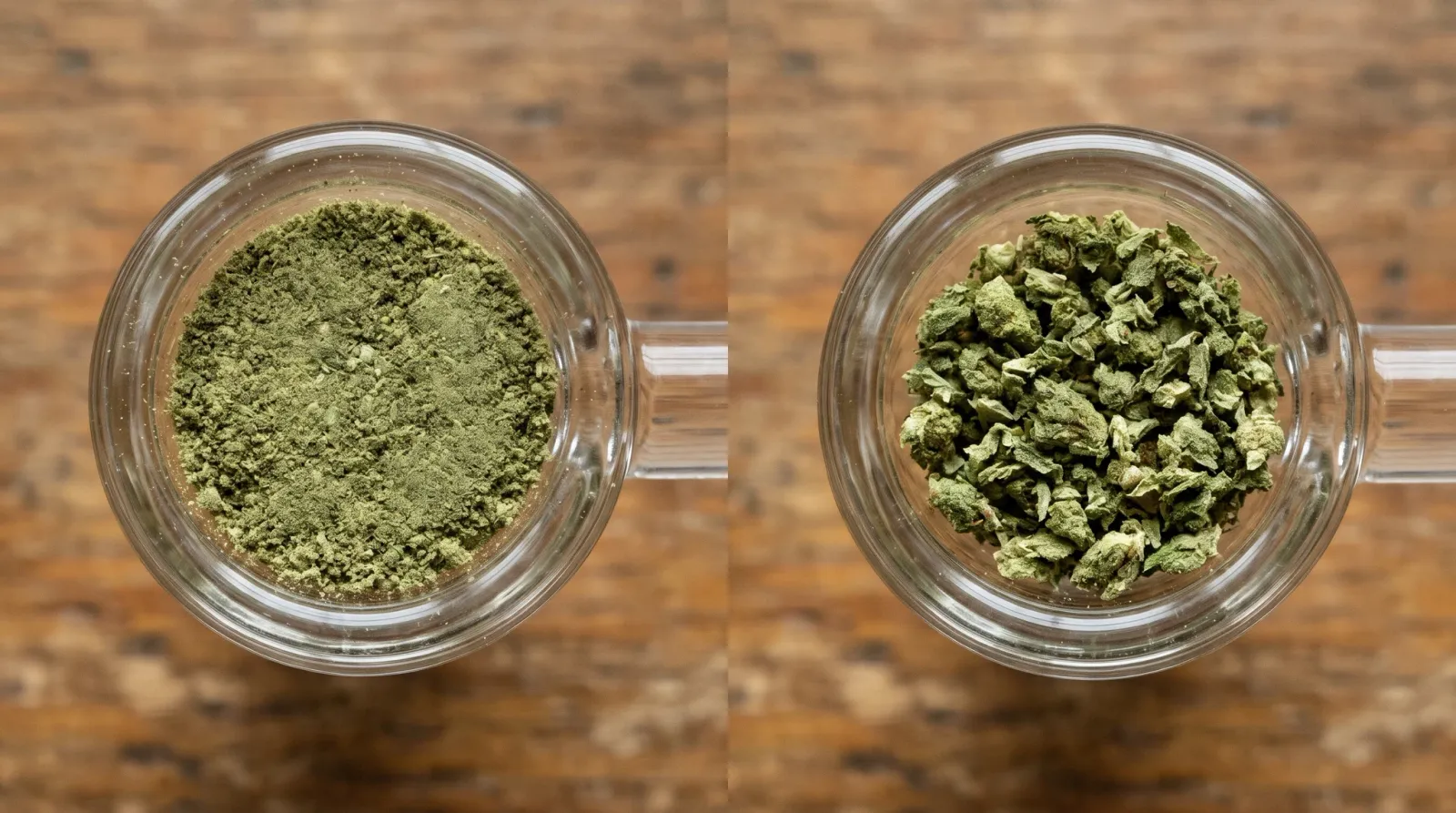
To pack a bowl well, grind the flower to an even, medium-to-coarse size, fill the bowl loosely, take a dry pull to check the airflow, and light one edge. Every one of those steps does the same job: it controls how easily air moves through the flower. That airflow decides whether the bowl lights evenly, keeps burning, or sends a hot ember into your mouth.
Here is the detail most packing guides skip. In engineering models of packed beds, halving the particle size makes air roughly two to four times harder to pull through, with everything else held the same. That is my calculation from the standard packed-bed equations, which scale with 1/d² in slow flow and 1/d in fast flow (packed-bed pressure drop reference). Those equations assume smooth, uniform beads. Ground flower is irregular, rough and squishy, and roughness raises resistance further (Papkov and colleagues, 2025). So treat the multiple as a direction and a rough size, not a measurement. The direction is the point: powder chokes a bowl.
This High School guide covers the steps, what each one does, and which parts are tested physics versus craft habit. Nobody has published a study of packing a cannabis bowl itself, so the mechanisms below come from flow and combustion research on other materials.
How do you pack a bowl, step by step?
- Grind evenly. Aim for even, medium-to-coarse pieces, not dust. Pick out stems and seeds. A grinder that gives an even grind helps more than any packing trick.
- Cover the hole. Put one piece bigger than the hole at the bottom, or use a clean screen.
- Fill loosely. Drop in small pinches until the flower sits level with the rim or a little below.
- Press lightly. A gentle press with a clean tool settles the top. Do not mash it down.
- Take a dry pull. Before you light, cover the carb if there is one and draw through the mouthpiece. Air moves with light effort if the pack is right.
- Light one edge. Hold the flame just above one edge of the surface and pull slowly.
- Clear and stop. Release the carb or lift the bowl to clear the chamber. Take the flame away between pulls.
The rest of this guide explains why each step works, so you can fix a bowl that does not.
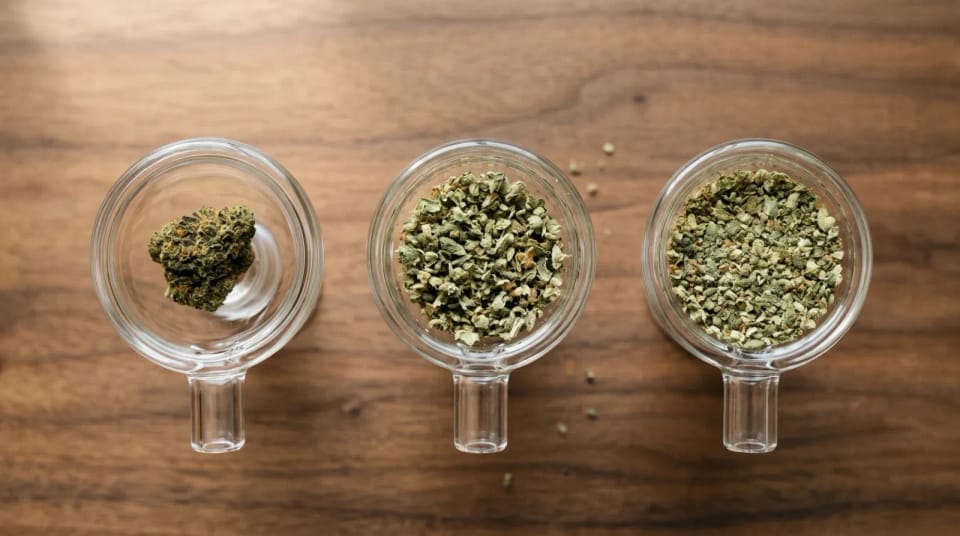
Block the hole, fill loosely, settle the top. The bigger bottom piece keeps small bits out of the hole.
What grind size is best for a bowl?
Even and medium-to-coarse is the safe target for a pipe or bong bowl. Our grinder guide recommends coarse for pipes and bongs, and the reason is airflow. Smaller particles leave smaller gaps between them, and in packed-bed models resistance climbs steeply as particle size falls (packed-bed reference). Fine dust also slips through the hole more easily.
Evenness matters as much as size. A mix of dust and chunks lets the dust fill the gaps between the chunks, which closes the bed up like a fine grind would.
There is one claim I will not make: that a finer grind burns faster. In a laboratory study of fixed fuel beds, airflow and moisture strongly changed the burning rate, while particle size had only a slight effect (Tao and colleagues, 2010). That was waste fuel, not flower, but it is a warning against tidy rules.
Flower condition changes the grind too. Very dry flower crumbles into dust, and very sticky flower clumps. How you store your flower shows up in your bowl.
How tight should you pack a bowl?
Loose enough that air moves with light effort on a dry pull, and firm enough that bits do not fly. In packed-bed models, a denser bed has less open space, and resistance rises fast as that space shrinks (packed-bed reference).
A tight pack also changes how the fuel burns. In a computer model of smouldering plant-fibre fuel, a denser bed smouldered more slowly and at a higher peak temperature (Jayasuriya and colleagues, 2022). Peat experiments point the same way: oxygen reaching the burning zone controls how smouldering spreads (Huang and Rein, 2016). A bowl packed too hard starves its own ember of air, which is one reason it keeps going out.
Packing guides disagree on everything finer than that: a tight bottom or a tight top, one press or none. No study tests any of those recipes. Your dry pull is a better guide than any of them.
| What you feel on the dry pull | What it means | What to do |
|---|---|---|
| Hard to draw, cheeks strain | Pack too tight, grind too fine, or resin in the hole | Loosen the top with a clean tool, or repack with a coarser grind |
| Air rushes through with no effort | Pack too loose or too shallow, or a gap down one side | Add a pinch and press lightly |
| Light, steady effort | Air moves through the whole bed | Light it |
| Hard to draw even with an empty bowl | The piece is clogged | Clean it before you pack |
If an empty piece is hard to draw through, no packing will fix it. Resin narrows the hole and stem, so clean the bowl and downstem first.
Why does my bowl pull ash into my mouth?
Small burnt or unburnt pieces are carried by the air you pull, and anything smaller than the hole can pass through it. Strong suction, fine grind and a bare hole make it worse.
That is why the bigger piece at the bottom works. Research on grains leaving a container through an opening found that grains much smaller than the opening flow through, while grains close to the opening’s size tend to jam and block it (Zuriguel and colleagues, 2005). That study used beads falling under gravity, not a bowl under suction, so take it as a geometric analogy. The common-sense version holds: a piece bigger than the hole cannot go through it. A clean metal or glass screen does the same job.
What about the popular layered pack, bigger pieces at the bottom and finer grind on top? It is a common habit, and the bottom layer has the reason above behind it. No study tests the finer top layer, and guides disagree about which layer to pack tighter. Try it if you like, and let the dry pull judge it.
Pull slowly, too: a gentle draw lifts fewer loose bits. If you are wondering what grey or black ash says about your flower, here is what ash colour does and does not tell you.
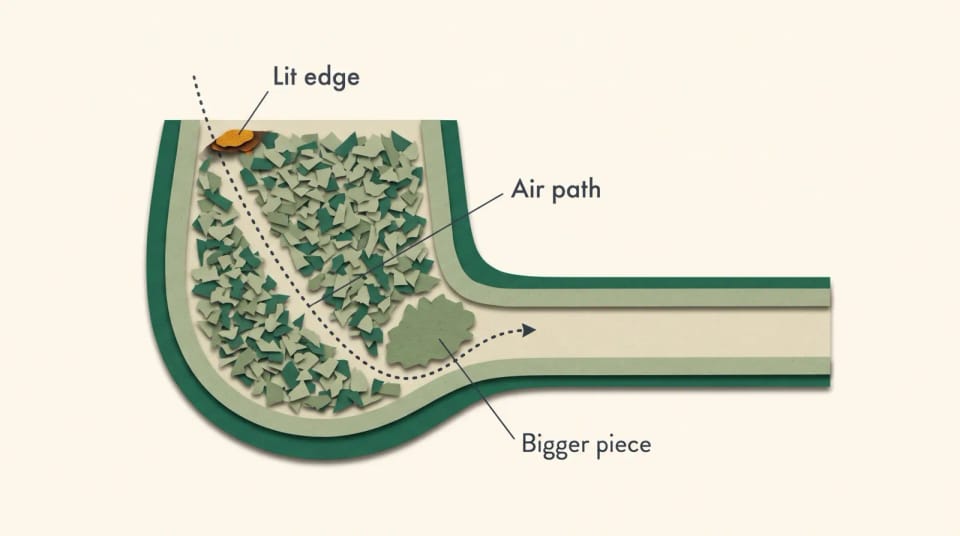
Air follows the easiest path from the lit edge to the hole. A larger bottom piece blocks fragments that would otherwise ride that air into the stem.
What is cornering a bowl, and does it save weed?
Cornering means lighting one edge of the bowl instead of the whole surface, so only part of the flower burns on each pull. It leaves the rest green for the next person or the next pull.
How much it saves has never been measured. What is known is that burning flower is wasteful. In a 1972 smoking-machine study of cannabis cigarettes, more airflow slightly raised how much THC reached the smoke, but even complete combustion recovered only about 60 percent of it (Fehr and Kalant, 1972). Flower that smoulders between pulls also makes sidestream smoke. You do not inhale that directly, and machine tests found it carries known harmful compounds (Moir and colleagues, 2008). Lighting a smaller area and taking the flame away between pulls means less flower burns while nobody is drawing.
Cornering also changes the experience over the bowl. In cigarette experiments, smoke composition shifted as the burn moved along, with lighter aromatic compounds arriving earlier and cannabinoids later (Eyal and colleagues, 2024). A shallow bowl is not a long cigarette, so the same pattern may not hold. Still, the first and last pulls of one bowl may differ.
Why does my bowl burn on one side or keep going out?
An uneven burn or a bowl that dies usually means air is not reaching the ember evenly. Common causes, from most to least likely:
- A channel. Air takes the easiest path. A gap down one side carries the flame there and leaves the rest unlit. Press the top level and fill any gap.
- Too tight a pack. The ember is starved of oxygen, as the smouldering research above describes. Loosen the top.
- A clogged hole or stem. The dry pull on an empty piece tells you.
- Damp flower. Moisture strongly changed the burning rate in fixed fuel beds (Tao and colleagues, 2010). Storage that keeps flower in a steady humidity range helps.
If you roll as well, the same airflow logic applies, with paper added. Here is the joint version of an uneven burn.
Should you pack a bong bowl differently from a pipe bowl?
The steps are the same, but a bong adds water, and pulling air through water takes effort of its own. Some people pack a bong bowl a little looser for that reason. It is a reasonable idea from the airflow model, and no one has tested it. The dry pull settles it for your piece.
| Hand pipe | Bong or water pipe | |
|---|---|---|
| Clearing the smoke | Release the carb hole | Lift the bowl or release the carb |
| Resistance on the draw | Bowl and stem only | Bowl, stem and water |
| Packing | Even grind, loose fill, dry pull | Same, and loosen it if the dry pull is hard |
| What water changes | Nothing | It cools the smoke; see bong versus dry pipe |
Water cools smoke, but cooling is not cleaning; bong water temperature covers what ice and cold water do and do not change. If your piece is a chillum, spoon or bat, the carb and loading work a little differently. Read small pipe shapes and carb holes, or the press-and-twist loading for a bat.
How much weed goes in a bowl?
Start small: a light pinch that fills a small bowl loosely, and check the draw. No study measures a typical bowl load, so I will not give you a gram figure for a bowl.
For scale, an online survey of 1,824 adults found the median self-reported flower hit was about 0.04 grams for a small hit and about 0.09 grams for a large one (Habib and colleagues, 2025). That is self-report, not weighed bowls. It does suggest that a full bowl is often several hits, which is another reason to light one edge and stop between pulls.
Is a hemp wick better than a lighter?
Use whichever you like, but no study shows a hemp wick is cleaner or cooler for lighting flower. Some people prefer the taste. I found no measurement comparing the smoke from the two.
Whatever you light with, the glowing ember and the bowl itself get hot enough to burn skin. Do not press down a lit bowl with a bare finger. Use a tool, and let metal or glass cool before you touch it.
When should you talk to a clinician?
Packing technique does not make smoke safe, and none of the research above measures what reaches your lungs. Pull slowly if smoke makes you cough, and read why cannabis makes you cough. Talk to a clinician if you have a cough that lasts for weeks, wheezing, chest pain, shortness of breath, coughing up blood, or a burn that blisters or does not heal. Get emergency care for trouble breathing.
If you want to remember which flower suited you, the High IQ app lets you log how a strain worked so the next bowl is an informed choice.
Key takeaways
- An even, medium-to-coarse grind keeps air moving; powder chokes a bowl.
- In packed-bed models, half the particle size means roughly two to four times the resistance. That is an idealized estimate, not a bowl measurement.
- A piece bigger than the hole, or a screen, keeps ash and bits out of the stem.
- The dry pull is your test. Trust it over any layering recipe.
- Light one edge and take the flame away between pulls so less flower burns unused.
FAQ
Do you need a screen to pack a bowl?
No. A single piece of flower larger than the hole does the same job for most bowls. A clean metal or glass screen helps when your grind is fine or the hole is large. Either way, a piece bigger than the opening cannot pass through it.
Why does my bowl taste harsh after the first hit?
Smoke can change as a burn goes on. In cigarette experiments, lighter aromatic compounds reached the smoke early and other compounds later (Eyal and colleagues, 2024). A bowl is not a cigarette, so this is a possible reason, not a proven one. Lighting one edge at a time leaves fresh flower for later pulls.
What is a cherry in a bowl?
A cherry is the glowing ember on top of a lit bowl. It stays alive while air reaches it. A tight pack, a clogged hole or damp flower starves it and it goes out.
Can you pack a bowl without a grinder?
Yes. Break the flower apart by hand into even, pea-sized or smaller pieces, and keep the dust down. Hand-broken flower is uneven, so the dry pull matters even more. Our starter kit guide covers grinders, pieces and lighters.
Sources
- Fehr KO, Kalant H. Analysis of cannabis smoke obtained under different combustion conditions. Canadian Journal of Physiology and Pharmacology, 1972.
- Moir D, and colleagues. A comparison of mainstream and sidestream marijuana and tobacco cigarette smoke. Chemical Research in Toxicology, 2008.
- Eyal AM, and colleagues. Inconsistency in the composition of the smoke of a cannabis cigarette as smoking progresses. Cannabis and Cannabinoid Research, 2024.
- Huang X, Rein G. Thermochemical conversion of biomass in smouldering combustion across scales. Bioresource Technology, 2016.
- Jayasuriya WJ, Mulky TC, Niemeyer KE. Smoldering combustion in cellulose and hemicellulose mixtures. Combustion Theory and Modelling, 2022.
- Neutrium. Pressure drop through a packed bed. Engineering reference on the Carman-Kozeny and Ergun equations.
- Papkov V, Quinn HM, Pashchenko D. Flow through randomly packed beds of rough particles. Physics of Fluids, 2025.
- Habib MI, and colleagues. Estimating cannabis consumption in milligrams of THC from self-reported hit size. Cannabis, 2025.
- Zuriguel I, and colleagues. Jamming during the discharge of granular matter from a silo. Physical Review E, 2005.
- Tao L, and colleagues. Combustion characteristics of particles of hazardous solid waste mixtures in a fixed bed. Journal of Hazardous Materials, 2010.





