Did Shakespeare Smoke Weed? What the Stratford Pipe Study Found
No one has shown Shakespeare smoked weed. The Stratford pipe study called its cannabis signal suggested but not proven, and never tied a pipe to him.

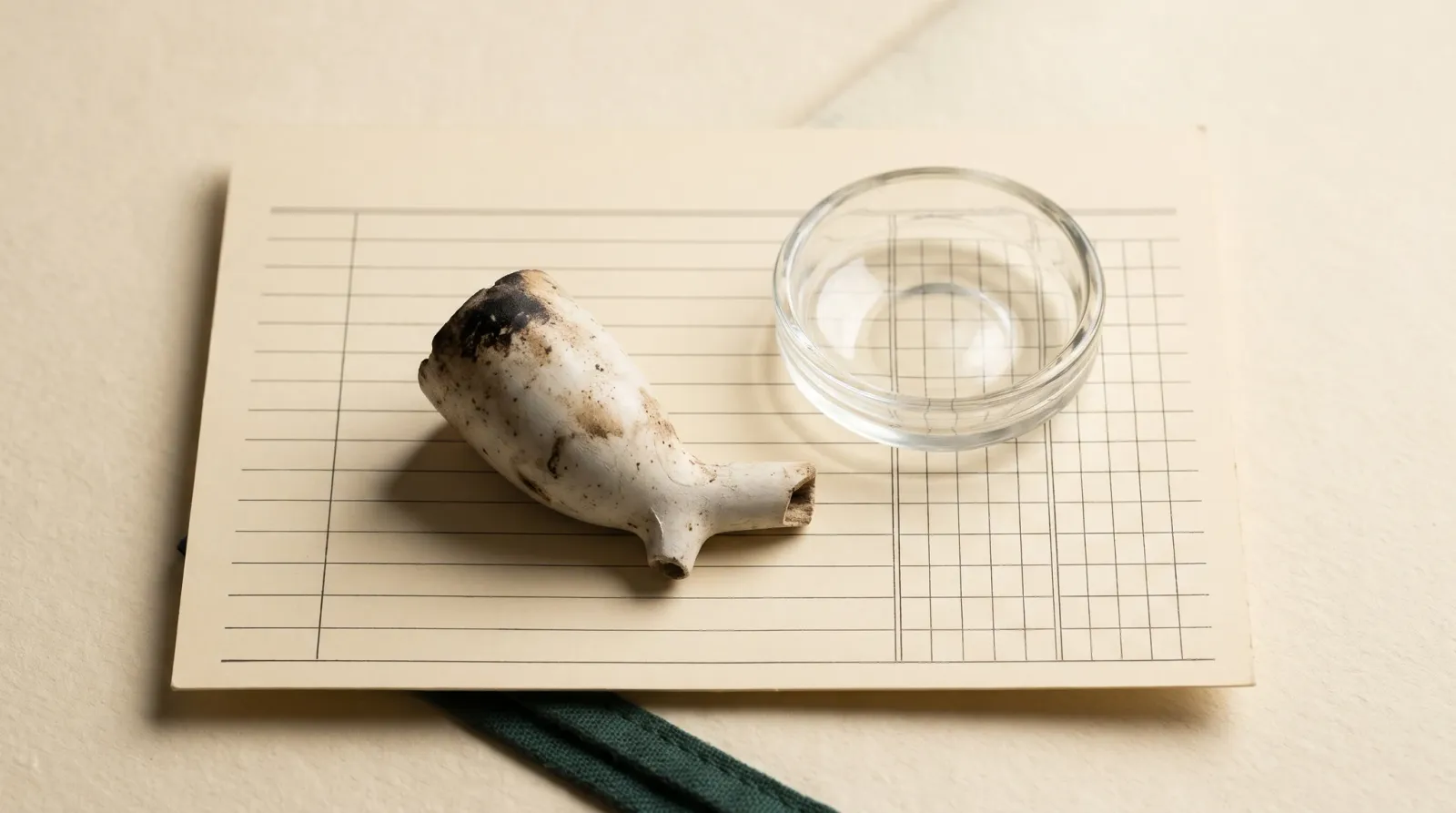
No one has shown that Shakespeare smoked weed: the lab study behind the famous headlines called its cannabis signal “suggested but not proven” and said it did not assume any pipe was his. That study tested 24 clay pipe fragments from Stratford-upon-Avon and its surroundings. It was published in 2001, not 2015. The evidence cannot prove he did, and it cannot prove he did not. Thackeray, van der Merwe and van der Merwe, South African Journal of Science, 2001
Here is the detail most retellings skip. In the paper’s own results table, cannabis is printed as “Cannabis?”, question mark included, on 8 of the 24 fragments. The text adds: “Unequivocal evidence for Cannabis has not been obtained.” The 2015 headlines came from a two-page letter by the same lead author, with no new samples and no new tests. Thackeray, South African Journal of Science, 2015
So this is less a story about Shakespeare than a story about how a careful “maybe” turns into a confident “yes”. Here in High School, that is a lesson worth more than the gossip.
What did the Shakespeare pipe study actually find?
The study found a mix of plant compounds in old pipe residue, with firm matches for some and only a weak, tentative signal for cannabis. Three researchers borrowed 24 pipe bowl and stem fragments from the Shakespeare Birthplace Trust. They dissolved the residue and ran it through gas chromatography mass spectrometry (GC-MS), a standard forensic method that separates compounds and matches their fragment patterns against a reference library. 2001 paper
The work was done with the South African Police forensic laboratory, which the 2015 letter describes as a “narcotics laboratory”. 2015 letter
What the 2001 paper reports:
- Firm identifications: nicotine, myristic acid, camphor and borneol, among others.
- Also detected: cocaine on two fragments, plus vanillin and quinoline.
- Cannabis: low-intensity signals on eight fragments, flagged with a question mark. One mass marker linked to cannabidiol appeared on three fragments, and the paper calls it only “potentially indicative”. Other markers were too weak “to provide certain identifications”.
The authors summed it up themselves: “Residues of Cannabis are suggested but not proven.” They also call their results “suggestive but do not prove”.
One surprise: nicotine, the compound you would expect in a tobacco pipe, is listed on only one of the 24 fragments in the table. That does not mean these were cocaine pipes or cannabis pipes. It shows how hard it is to read centuries-old, cleaned and handled residue.
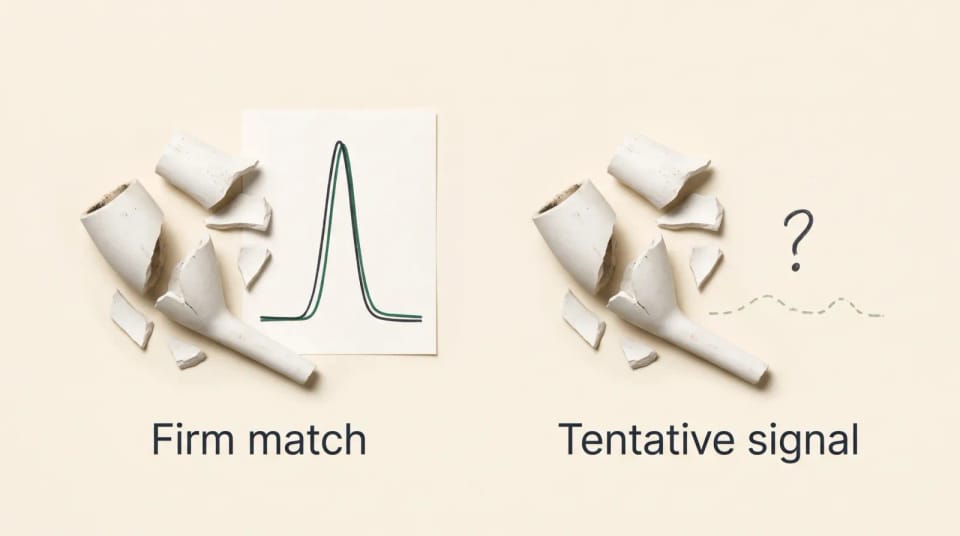
The paper firmly identified compounds such as nicotine and camphor. Its cannabis signal was low and marked with a question mark.
Were the pipes really Shakespeare’s?
No one knows, and the paper says so directly: “It is not assumed that any of the pipes were necessarily used by Shakespeare.” 2001 paper
Three problems stand between these fragments and the playwright:
- Location is not ownership. Some fragments came from the New Place site, the site of Shakespeare’s Stratford home. Others came from elsewhere in Stratford and nearby villages. The 2015 letter says four of the cannabis-flagged pipes “came from Shakespeare’s garden”. The 2001 table assigns those four to the New Place site. 2015 letter
- The dates are loose. The pipes were dated by “style, shape and size” to “probably” the 17th century. Shakespeare died in 1616, early in that century, and his family kept living at New Place after him.
- Anyone could have dropped them. Columbia University Shakespeare scholar James Shapiro put it plainly in 2015: the finds do not mean “his neighbor kid didn’t throw the pipes over the fence.” HuffPost, 2015
A pipe in a garden tells you someone smoked near a house. It cannot tell you who. Our history of the bong runs into the same limit: a smoking object can show what was burned, not whose lips touched it.
Is there proof of cannabis on the pipes?
No. The strongest wording in the original paper is “suggested”. That caution has good reasons behind it, and the authors named most of them.
- Weak signals. The cannabis peaks were low intensity, and only one marker linked to cannabidiol showed up, on three fragments.
- Library matching. Identification relied on matching fragment patterns to a spectral library. The paper does not describe running a cannabinoid reference standard alongside the samples.
- Burned and aged residue. The authors note that cannabis compounds degrade and are hard to identify after burning.
- Handling and cleaning. Most fragments “have been cleaned by museum curators”. Naphthalene in three samples was “possibly associated with former curatorial practice”, which points to mothballs. The authors warn: “Some of the substances identified in this study may be contaminants.”
- A pilot, not a replication. No independent re-analysis turned up in our searches. That is not proof that none exists.
If you want to see when cannabinoid chemistry became reliably measurable in the first place, our piece on 80 years of cannabis science covers that history.
Was the 2015 news new research?
No. The August 2015 wave of “Shakespeare smoked weed” stories followed a short letter to the same journal by the 2001 study’s lead author, Francis Thackeray. It restated the 2001 results and added literary arguments. It reported no new samples or data. 2015 letter
The interesting part is how the wording shifted between the two documents.
| Point | 2001 paper | 2015 letter |
|---|---|---|
| Cannabis result | “suggested but not proven”; printed as “Cannabis?” | “indicated Cannabis in eight samples” |
| Link to Shakespeare | “not assumed” any pipe was his | “Four of the pipes with Cannabis came from Shakespeare’s garden” |
| Cocaine | Detected on two fragments | “definite evidence” from two pipes; “Neither of the pipes came from the garden of Shakespeare” |
| New data | Original lab analysis | None |
| Literary claim | Background only | Sonnet 76 reading, citing an “unpublished manuscript” |
Some news desks kept the hedges. Smithsonian’s summary said: “The results were not conclusive. There’s no evidence that Shakespeare used the pipes, let alone smoked them.” Smithsonian Magazine, 2015 Many reposts dropped them, and some later pages upgraded “suggested” to “proven”. The paper never says that.

One 2001 data set, one 2015 letter, then a wave of headlines. The headlines added certainty the lab data never had.
What does “noted weed” in Sonnet 76 mean?
Most readers take “weed” in Sonnet 76 to mean clothing, not a plant. The line reads: “Why write I still all one, ever the same, / And keep invention in a noted weed”. Folger Shakespeare Library, Sonnet 76
In the sonnet, the speaker worries that his writing always wears the same familiar outfit. Shapiro called the cannabis reading a “really lame interpretation” and said “weeds” there means “dressing up, as clothes”. HuffPost, 2015
Even the 2015 letter concedes the clothing sense. It describes the sonnet as possible wordplay, “in part to a style of writing, associated with clothing (‘weeds’)”. It also reads “compounds strange” as possibly meaning strange drugs. That reading is offered as a hypothesis from an unpublished manuscript, not as evidence. 2015 letter
A poem can be read many ways. It cannot fill the gap the chemistry leaves.
Why does this claim keep coming back?
Because it combines a famous name, a lab with forensic gear and a single word, “weed”, that means something new to modern ears. The story is fun, and the caveats are dull. That pattern shows up again and again in our cannabis myths fact-check and in the cannabis facts that sound fake but are true.
A few habits help when the next viral history claim lands in your group chat:
- Find the original paper, not the news article about the letter about the paper.
- Check the date of the data, not the date of the headline.
- Read the authors’ own hedges. “Suggested” and “proven” are different words for a reason.
- Ask what the object can tell you. Residue shows what burned. It does not name the smoker.
For the wider picture of where real evidence of early cannabis use does exist, see our history of cannabis from ancient medicine to modern science. Smoking customs have always varied by place and era, as our guide to how cannabis culture differs around the world shows.
And one modern note: these were clay “tobacco” pipes. If you are curious how tobacco and cannabis interact when mixed today, our piece on whether tobacco makes a cannabis high stronger covers it. If smoking anything is affecting your breathing, heart or sleep, talk with a clinician.
Key takeaways
- No evidence shows Shakespeare smoked cannabis, and none rules it out.
- The study dates from 2001. The 2015 headlines followed a letter with no new data.
- The paper called cannabis “suggested but not proven” on 8 of 24 fragments, marked “Cannabis?”.
- The authors did not assume any pipe was Shakespeare’s. The pipes are dated only loosely, to the 17th century.
- “Noted weed” in Sonnet 76 is most often read as “familiar clothing”.
FAQ
Did they find marijuana in Shakespeare’s pipes?
Not in a proven way. The 2001 study found weak signals it called “suggested but not proven” on eight of 24 fragments from around Stratford. No fragment has been shown to be Shakespeare’s own pipe.
What else was found in the Stratford pipes?
The paper firmly identified compounds including nicotine, myristic acid, camphor and borneol. It also detected cocaine on two fragments, and the lead author later wrote that neither came from Shakespeare’s garden. Some compounds, such as naphthalene, may come from later museum handling.
Who did the Shakespeare pipe study?
J. Francis Thackeray, N.J. van der Merwe and T.A. van der Merwe published it in the South African Journal of Science in 2001. The analysis used GC-MS at a South African Police forensic laboratory. Thackeray, the lead author, also wrote the 2015 letter that set off the headlines.
Did people smoke cannabis in Shakespeare’s England?
There is no solid evidence either way from these pipes. Clay pipes of that era are usually called tobacco pipes. The study shows that several plant materials could leave traces in them, but its cannabis result stayed tentative.
Is Sonnet 76 about weed?
Most readers say no. In Shakespeare’s time “weed” could mean a garment, and the line “keep invention in a noted weed” is usually read as writing that always wears the same familiar dress. The drug reading comes from the study’s lead author and rests on an unpublished manuscript.
Sources
-
Thackeray JF, van der Merwe NJ, van der Merwe TA. “Chemical analysis of residues from seventeenth-century clay pipes from Stratford-upon-Avon and environs: research in action.” South African Journal of Science 97(1):19-21. January 2001. hdl.handle.net
-
Thackeray JF. “Shakespeare, plants, and chemical analysis of early 17th century clay ‘tobacco’ pipes from Europe.” South African Journal of Science 111(7/8), scientific correspondence. July 2015. doi.org
-
Hanson H. “Did Shakespeare Smoke Weed? The Evidence Is Doobie-ous.” HuffPost. August 10, 2015. huffpost.com
-
Thompson H. “Did Shakespeare Smoke Pot?” Smithsonian Magazine. August 2015. smithsonianmag.com
-
Shakespeare W. Sonnet 76. Folger Shakespeare Library digital edition. folger.edu





