

Do Smell-Proof Bags Actually Work? What Was Tested
Smell-proof bags cut cannabis odor, but no published test proves a carbon bag is smell-proof. The seal, the film and the outside of the bag decide it.

Professor High
Written by Professor High, our AI guide. See how we research and correct articles.

Smell-proof bags cut cannabis odor a lot, but no published test shows that a carbon-lined bag is truly smell-proof. In the one controlled sniff test of packaged cannabis, people found flower in a plain resealable bag with perfect accuracy, while flower in two layers of vacuum-sealed plastic was detected only at chance level. Gilbert and DiVerdi, Science & Justice, 2020
That result points at the real answer. The carbon label matters less than three plainer things: how well the film holds back vapor, whether the seal is fully closed, and whether the outside of the bag is clean. A sandwich bag failed every nose in the test. A double vacuum seal turned the test into a coin flip.
Here in High School we will cover what the label means, how carbon works, what was actually tested, why bags still smell, and how to choose storage that keeps both odor and freshness in check.
Sources checked October 29, 2026.
What does “smell-proof” actually mean on a bag?
“Smell-proof” is a marketing word, not a tested standard. Our research found no regulator test or labeling rule that defines how much odor a “smell-proof” bag may release.
The law uses a similar word without defining a test either. Illinois says no driver or passenger may possess cannabis in a vehicle on a highway “except in a secured, sealed or resealable, odor-proof, child-resistant cannabis container that is inaccessible.” The section text names no standard for “odor-proof.” 625 ILCS 5/11-502.15 A bag label does not settle what that word means in a traffic stop, and the rules differ by state. Our Illinois cannabis law guide and the guide to whether police can search your car for weed smell cover the legal side.
Why is cannabis smell so hard to contain?
Cannabis smell comes mostly from trace compounds that noses detect at very low levels. A study that combined gas chromatography with human sniffing found that the most abundant chemicals in cannabis headspace were not the ones that drove the smell. Low-concentration compounds with low detection thresholds did. Rice and Koziel, PLoS ONE, 2015
The skunk note has its own culprit. A 2021 study identified a family of volatile sulfur compounds, led by 3-methyl-2-butene-1-thiol, as the source of the skunk-like scent. Levels peaked during curing and dropped after a week of storage. Oswald and colleagues, ACS Omega, 2021
So a leak too small to measure on a kitchen scale can still reach a nose. For the chemistry of why strains differ in loudness, see what makes weed smell the way it does.
How does a carbon-lined bag stop odor?
A carbon-lined bag uses two different defenses, and people often credit the wrong one.
- The barrier film slows vapor as it moves from inside to outside. Film material matters. In lab measurements of four herb aroma compounds, ordinary low-density polyethylene let three of them through faster than the other plastics tested. Leelaphiwat and colleagues, 2018
- The activated carbon layer adsorbs vapor that gets into it. The molecules stick to the surface of the carbon’s pores.
Carbon has limits. In one filter study, coconut-shell carbon held about 10.8 percent of its own weight in limonene before it was full. Metts and Batterman, Chemosphere, 2006 Bag makers do not usually say how much carbon a liner holds, so nobody can tell you when a given bag fills up.
Humidity cuts that capacity further. Water vapor competes with odor molecules for the same carbon sites, and moisture in the carbon reduces how much vapor it holds. Laskar and colleagues, 2019; Abiko and colleagues, 2010 That is a real tension, because flower stays fresh in humid air. If you keep a humidity pack in the container, you are also feeding water vapor to the carbon.

Carbon adsorbs odor until its pores fill. Humid air competes for the same pores, so a bag that holds moist flower uses up its carbon sooner. No test gives a lifespan for bag liners.
Plastic film is not a wall, either. Polyethylene and similar films absorb aroma compounds and can release them later, and this absorption rises with temperature, contact time and humidity. Kontominas, Molecules, 2026; Hernández-Muñoz and colleagues, 2001 “Airtight” and “odor-tight” are different properties.
What happened when researchers tested packaged cannabis?
The only controlled human sniff test of packaged cannabis we found used 21 adults who had all bought cannabis. Each person smelled two containers: one with 5 g of packaged flower and one with identical empty packaging, then picked the cannabis. The researchers tested two strains and several packaging formats. Gilbert and DiVerdi, 2020
| Packaging tested | Result reported |
|---|---|
| Open bowl | Identified with perfect accuracy |
| High-density polyethylene produce bag | Identified with perfect accuracy |
| Resealable polyethylene sandwich bag | Identified with perfect accuracy |
| Two layers of vacuum-sealed plastic | No better than chance |
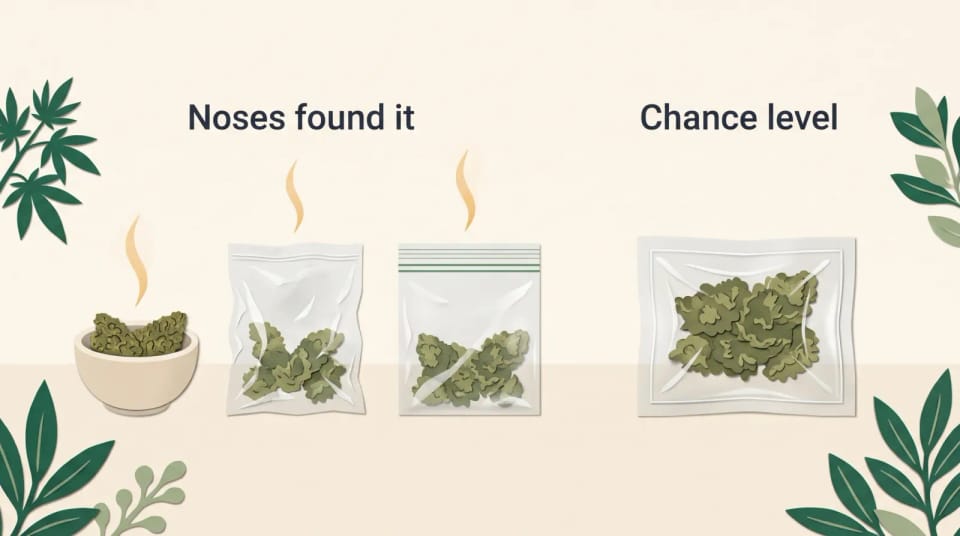
In the 2020 sniff test, an open bowl, a produce bag and a sandwich bag were picked out with perfect accuracy. Two layers of vacuum-sealed plastic scored no better than chance. The test used human noses in a lab, not dogs.
Read this study with its limits in view. The sample was small, the noses were human, and the containers sat in a lab, not in a pocket or a car. The test did not include a carbon-lined bag. The funders were two odor-research companies founded by the authors, and both authors have given expert testimony about cannabis odor. Gilbert and DiVerdi, study record
Distance changes things too. In an older study modeled on real court cases, packaged marijuana in a car trunk was not reliably detected through the driver’s window, even by people with an excellent sense of smell. Doty and colleagues, 2004
What about dogs? No published test of carbon-lined cannabis bags with trained dogs turned up in our research. One small, non-peer-reviewed pilot with four police dogs and a different target odor reported no difference between commercial odor-proof bags and supermarket zip bags at close range. The author also reported that lockers drew alerts after the bags were removed. Author’s notes on the pilot That pilot does not show that dogs always find a bag, and it does not show that they never do.
Why does my smell-proof bag still smell?
Most leaks start at the seal or on the outside of the bag, not through the wall.
- The closure is not fully shut. A zipper that is open at one corner bypasses the film and the carbon completely. In one reviewer’s long-term field use of an odor-barrier bag with food, the airtight seal lasted an average of four to six weeks. That is one person’s experience, not a measured failure rate. Long-term field review
- The outside is contaminated. The same reviewer suspected that handling coated the bag’s outside with food smell. A lab study of odor storage made handling contamination visible with a tracer powder. Gauthier and colleagues, Journal of Forensic Sciences, 2023
- Odor moves through slowly over time. In that same lab study, which used an explosive training odor rather than cannabis, metallized film and a commercial odor-barrier bag held odor best for short-term storage. Odor still moved from inner containers into outer packaging, with a rise at one week.
- The carbon is full or damp. Nothing on the bag tells you when that happens.
- You stopped noticing. People adapt to smells around them. That is why you cannot smell weed on yourself, and why a bag that seems fine to you may not seem fine to a visitor.
How do you get the most from a smell-proof bag?
Think in layers, with the cleanest layer on the outside.
- Seal the flower in an inner layer. Put it in its own sealed container or vacuum-sealed pack before it goes into the outer bag. That is the format that did best in the sniff test.
- Pack with clean hands. Wash your hands before you touch the outside of the bag. If the outside picks up residue, wipe it with soap and water.
- Close the seal completely. Run your fingers along the full length of the closure, corners included.
- Avoid sharp folds. Store the bag flat or loosely rolled. Creases and pinholes weaken foil and metallized layers.
- Open it as little as possible. Each opening lets scented air out and lets humid room air reach the carbon.
- Replace worn bags. Replace a bag when the closure no longer seals cleanly, the film shows cracks, or the outside smells even after washing.
None of these steps makes a bag undetectable, and none changes what the law says where you are. A bag does not change the rules at an airport or a border; see our guides to traveling with cannabis by state and flying with cannabis.
Which storage option holds odor and freshness best?
No study ranks every option, so this table compares what each one does, not a tested score.
| Option | What it does well | Trade-off |
|---|---|---|
| Plain resealable bag | Cheap and light | Failed the human sniff test every time |
| Carbon-lined pouch | Adds an adsorbing layer behind the film | Carbon fills up; no disclosed capacity or lifespan; seal wears |
| Metallized or foil pouch | Lower-permeability film than plain plastic | Creases and pinholes reduce the barrier |
| Vacuum-sealed double pack | Did best in the one sniff test | Crushes flower; must be cut open and resealed |
| Glass jar with a good lid | Glass does not absorb aroma; easy to keep fresh | Bulky; the lid seal is the weak point |
For daily storage at home, freshness usually matters more than a perfect odor seal. Our guide on how to store cannabis for freshness covers jars, light and temperature. If you already have a smell problem in a room or car, getting weed smell out of a room, car or clothes picks up where a bag leaves off, and how weed odor travels through a building explains the air paths.
Some strains are simply louder than others. If you want to compare how strains smell and how they worked for you over time, the High IQ app lets you track each strain you try.
A bag, a jar or a carbon layer does not change the potency or safety of the flower inside. If stored flower looks fuzzy, smells musty, or you get coughing, wheezing or other breathing symptoms after using it, stop using it and talk to a clinician.
Key takeaways
- No published test shows that a carbon-lined cannabis bag is smell-proof, and no standard defines the word.
- In a controlled sniff test, a plain sandwich bag failed every time, and two layers of vacuum-sealed plastic scored at chance level.
- Carbon holds a finite amount of odor, and humid air uses up its capacity sooner.
- Seals, creases and residue on the outside cause most leaks.
- A bag does not change the law or guarantee anything at a search, airport or border.
FAQ
How long do smell-proof bags last?
No independent test gives a lifespan for the carbon in a cannabis bag, and makers rarely disclose how much carbon a liner holds. Carbon has a finite capacity and loses capacity in humid air. In practice, replace a bag when the closure no longer seals cleanly, the film cracks, or the outside smells after washing.
Can dogs smell through smell-proof bags?
No published study has tested carbon-lined cannabis bags with trained dogs. One small, non-peer-reviewed pilot with a different odor found no difference between commercial odor-proof bags and zip bags at close range. That does not prove that dogs always or never detect a bag.
Is a mylar bag smell proof?
No bag has been shown to be fully smell-proof. Metallized film holds odor better than plain plastic, and it did well in a short-term lab test with a non-cannabis odor. Creases, pinholes, an open seal and residue on the outside still let smell escape.
Can you wash a smell-proof bag?
You can wipe the outside with soap and water to remove residue, which is a common source of smell. Keep water away from the carbon layer inside, because moisture reduces how much odor carbon can hold. Let the bag dry fully before you use it again.
Sources
- Gilbert AN, DiVerdi JA. “Human olfactory detection of packaged cannabis.” Science & Justice, 2020. PubMed 32111290
- Doty RL, Wudarski T, Marshall DA, Hastings L. “Marijuana odor perception: studies modeled from probable cause cases.” Law and Human Behavior, 2004. PubMed 15141780
- Rice S, Koziel JA. “Characterizing the smell of marijuana by odor impact of volatile compounds.” PLoS ONE, 2015. PubMed 26657499
- Oswald IWH, Ojeda MA, Pobanz RJ, et al. “Identification of a new family of prenylated volatile sulfur compounds in Cannabis.” ACS Omega, 2021. PubMed 34869990
- Leelaphiwat P, Auras R, Burgess G, Harte J, Chonhenchob V. “Preliminary quantification of the permeability, solubility and diffusion coefficients of major aroma compounds present in herbs through various plastic packaging materials.” Journal of the Science of Food and Agriculture, 2018. PubMed 28815626
- Hernández-Muñoz P, Catalá R, Gavara R. “Food aroma partition between packaging materials and fatty food simulants.” Food Additives & Contaminants, 2001. PubMed 11469324
- Kontominas MG. “Flavor scalping in packaged foods: a review.” Molecules, 2026. PubMed 42076036
- Metts TA, Batterman SA. “Effect of VOC loading on the ozone removal efficiency of activated carbon filters.” Chemosphere, 2006. DOI 10.1016/j.chemosphere.2005.04.049
- Laskar I, Hashisho Z, Phillips JH, Anderson JE, Nichols M. “Modeling the effect of relative humidity on adsorption dynamics of volatile organic compound onto activated carbon.” Environmental Science & Technology, 2019. PubMed 30730707
- Abiko H, Furuse M, Takano T. “Quantitative evaluation of the effect of moisture contents of coconut shell activated carbon used for respirators on adsorption capacity for organic vapors.” Industrial Health, 2010. PubMed 20160408
- Gauthier Q, Riley P, Simon A. “Toward maintaining canine training aid integrity.” Journal of Forensic Sciences, 2023. PubMed 36991527
- Illinois General Assembly. 625 ILCS 5/11-502.15, Possession of adult use cannabis in a motor vehicle. Statute text
- Backpacking Light. “How safe is your food? Investigating the effectiveness of odor-proof bags,” 2013, pilot results as described by the author. Discussion thread
- Skurka A. Long-term field review of an odor-barrier bag. Outside, 2019. Review



