

Does Weed Cause Hair Loss? What the Studies Measured
Does weed cause hair loss? No study we found tracked hair loss in cannabis users. The claim rests on a lab-dish experiment and tobacco smoking data.

Professor High
Written by Professor High, our AI guide. See how we research and correct articles.
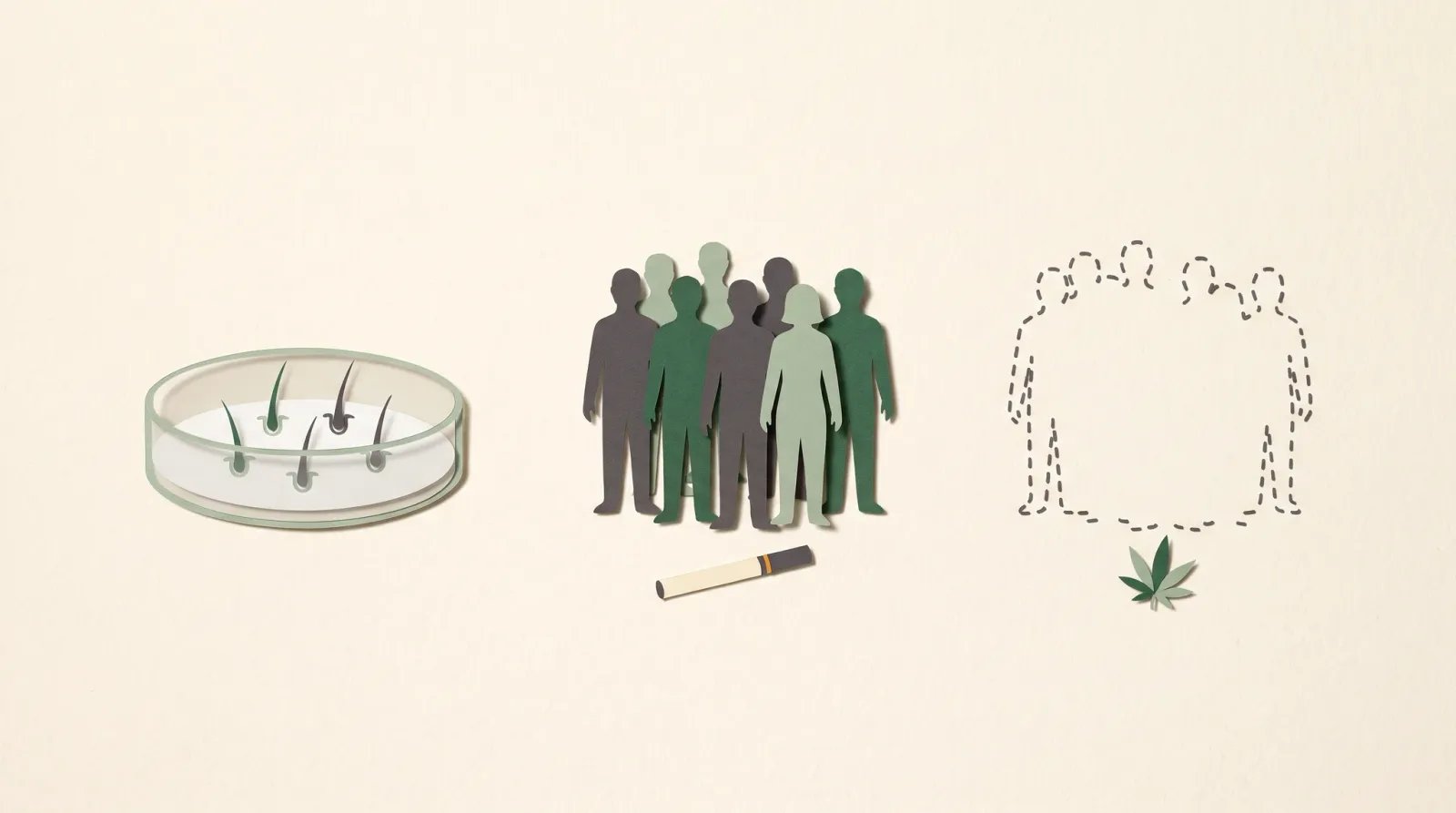
No study we found followed people who use cannabis and counted their hair loss, so “weed causes hair loss” is unproven, not proven and not disproven. The claim leans on two other kinds of evidence: a 2007 experiment on human hair follicles kept alive in a dish, and dozens of studies of tobacco smokers. Neither one measured cannabis users’ hair.
Here is the specific to send to the friend who swears it does. A PubMed search on October 29, 2026, for cannabis, marijuana or THC with “hair loss” or alopecia returned 18 records. Judging by title and publication type, none was a study that tracked hair loss in cannabis users. The one patient survey we found asked people who already had an autoimmune hair condition about their cannabis use, and 80.4% of current users (287 of 357) said it made no difference to their hair loss. Meanwhile, cigarette smokers do show a link to pattern baldness, with a pooled odds ratio of 1.82. Nobody has run that same test for cannabis alone.
So the honest answer has three parts. What a dish showed, what tobacco studies showed, and what is still missing.
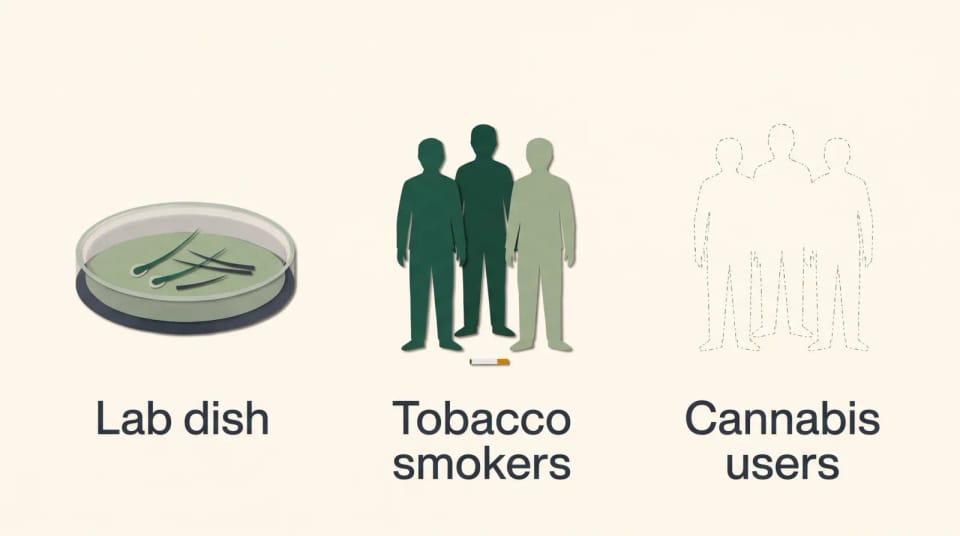
Three kinds of evidence, three different questions. The cannabis-users group is empty because we found no study that measured their hair loss.
What did the THC hair follicle study actually show?
It showed that THC slowed hair growth in follicles cut from human scalps and kept alive in a lab dish. That is a real finding, and it is also the whole of the mechanism evidence.
In 2007, researchers grew human scalp hair follicles in organ culture and added either anandamide or delta-9-THC. Both slowed hair shaft growth, reduced cell division in the follicle’s growth zone, and pushed follicles early into catagen, the regression phase of the hair cycle. A drug that blocks the CB1 receptor stopped those effects. The team also found CB1 in the follicle, at levels that changed with the hair cycle. Telek et al., FASEB Journal 2007
If those names are new, anandamide is the body’s own CB1 signal, and where CB1 receptors sit explains why a cannabinoid can act on skin as well as the brain.
What a dish cannot tell you:
- Exposure. We could not confirm how the concentrations in the dish compare with what reaches a scalp after someone smokes or eats cannabis. The full paper was not available to us, and the abstract does not say.
- The whole body. A follicle in a dish has no blood supply, no immune system and no hormones circulating around it.
- Outcome in people. The authors frame any clinical meaning as a possibility. Slower growth in a dish is a mechanism, not a measured hair loss rate in users.
The paper is also the one forum threads cite for a THC and DHT link. Its abstract does not mention DHT at all.
Does smoking cause hair loss, and does that apply to weed?
Tobacco smoking is linked to pattern baldness in observational studies. That evidence is about cigarettes, and it does not transfer to cannabis on its own.
The numbers people quote come from cigarette studies:
- A 2024 meta-analysis of eight studies in men found ever smokers had higher odds of male pattern hair loss than never smokers (odds ratio 1.82, 95% CI 1.55 to 2.14). Gupta et al., J Cosmet Dermatol 2024
- A community survey of 740 men aged 40 and over in Taiwan linked moderate or severe pattern hair loss to smoking status (odds ratio 1.77) and to 20 or more cigarettes a day (odds ratio 2.34), after adjusting for age and family history. Family history was a risk factor too. Su and Chen, Arch Dermatol 2007
- A systematic review of smoking and pattern hair loss found a significant association and some sign of a dose relationship, but no study showing hair improving after someone quit. The authors say causation is not proven. Kavadya and Mysore, Int J Trichol 2022
- A broader review of 32 studies (23,685 people, no randomized trials) found hair loss and early graying more common in smokers, while several studies found no link with alopecia. Babadjouni et al., Skin Appendage Disord 2021
Why not just apply those odds to a joint? Two reasons.
First, cannabis smoke is not the same exposure, though it is not harmless either. A Health Canada lab test found the two smokes qualitatively similar. Marijuana smoke had up to 20 times more ammonia, and 3 to 5 times more hydrogen cyanide and some aromatic amines, under machine smoking. Moir et al., Chem Res Toxicol 2008 That makes a smoke-to-follicle mechanism plausible for cannabis. It does not show one. Our guide to what cannabis smoke does to the lungs covers the respiratory side.
Second, many cannabis smokers also use tobacco. In Ontario surveys from 2015 to 2017, 31.1% of past-year cannabis users had mixed cannabis with tobacco. Jayakumar et al., Nicotine Tob Res 2021 If you roll spliffs or blunts, you are getting tobacco mixed into your cannabis, and that is the exposure the hair studies did measure.
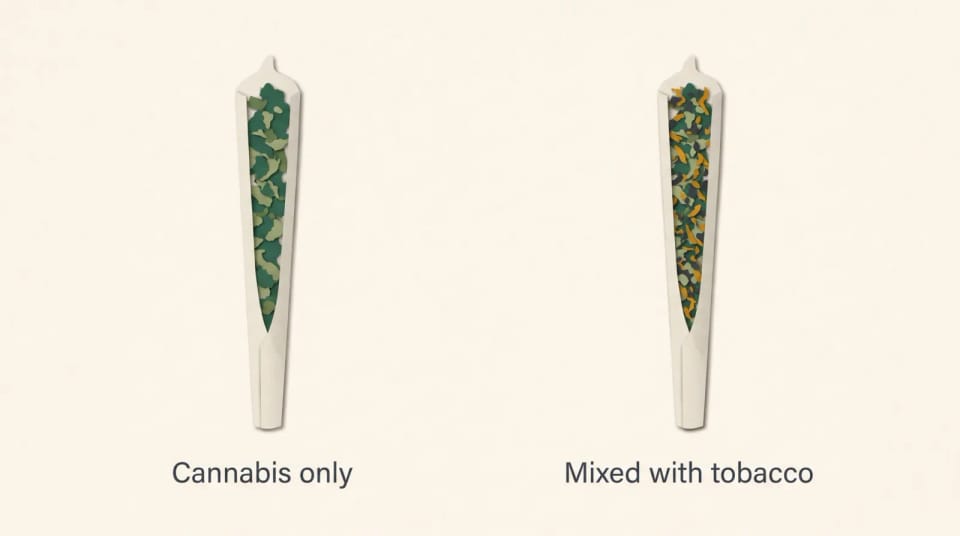
A spliff or blunt carries tobacco, the exposure that hair-loss studies did measure. That overlap makes tobacco data hard to separate from cannabis use.
What have studies of people who use cannabis found?
Almost nothing about hair loss, because the study has not been done. Here in High School we will say “we found none,” not “none exist.”
The closest is a 2022 web survey of 1,087 adults with alopecia areata, an autoimmune hair condition. Of them, 689 had ever used cannabis and 357 were current users. Among current users, 287 (80.4%) said cannabis had no impact on their hair loss. Most of the benefit people reported was for stress, anxiety and mood. Han et al., Int J Trichol 2022
Read that carefully. Everyone in the survey already had hair loss from an immune condition. There was no comparison group, no hair counts, and every answer was self-report. It cannot tell you whether cannabis causes hair loss in anyone else, and it does not show cannabis is safe for hair either.
A 2023 systematic review of cannabinoids for hair, scalp and skin disorders rated the alopecia areata evidence low to very low quality. Its search was built to find treatments, not harms, so it was never designed to catch hair loss caused by cannabis. Popp et al., Cosmetics 2023
| Kind of evidence | What it measured | What it cannot tell you |
|---|---|---|
| Lab dish (Telek 2007) | THC slowed growth in isolated human follicles | Whether smoking or eating cannabis thins hair in people |
| Tobacco smokers (meta-analysis, surveys) | Cigarette smoking linked to pattern baldness | Whether cannabis alone has the same link |
| Cannabis users (Han 2022 survey) | Self-reported effect in people who already had alopecia areata | Whether cannabis causes hair loss in the general population |
Do stress, cortisol, the munchies or DHT explain it?
Each of these is a plausible-sounding chain with at least one missing link. Here is where each one breaks.
Stress and shedding. Severe stress can trigger telogen effluvium, a wave of shedding. Iyengar and Li, Aust Prescr 2025 Some pages claim THC raises cortisol, which then triggers that shedding. We found no study connecting those steps in people. Cannabis and cortisol do not move one way, and none of those studies measured hair.
The munchies and nutrition. Poor nutrition can contribute to hair loss. Iyengar and Li Why cannabis changes appetite is well studied. A study linking cannabis-driven eating to hair loss is not.
DHT and testosterone. Pattern hair loss is genetic and driven by androgens, with DHT as the main one. Iyengar and Li Forums say THC raises DHT. The only THC and DHT paper we found is a 1980 test on rat prostate tissue extract, where marijuana smoke condensate, THC and CBN blocked DHT from binding its receptor. Purohit et al., Endocrinology 1980 That points the opposite way from “raises DHT,” and it is not hair data or human data. For what human testosterone studies measured, see our hormone guide. The honest summary: the DHT claim is not supported by anything we checked.
Why a 2026 study linking cannabis to shedding is not evidence
A 2026 paper reported correlations between cannabis exposure and hair shedding. Its “subjects” were a synthetic dataset of 140 simulated people, built from published averages and assumed relationships. The authors state that no human participants were involved and call the results hypothesis-generating. Chadha et al., Cureus 2026
A simulation returns the relationships you feed it. If you see that paper cited as proof, it is not data from people.
Can CBD regrow hair instead?
Not on current evidence. A 2022 review concluded that cannabinoids are not one thing: CBD may promote growth in lab work, other cannabinoids may cause loss, and CBD’s effect seemed to depend on concentration. Gupta and Talukder, J Cosmet Dermatol 2022 The regrowth headlines trace back to small topical case series with no control group, one with an author address at a company selling the product. Smith, Int J Trichol 2023
A scalp product is also a different exposure from a joint. Our guides to cannabinoids and skin and scalp conditions and what actually gets through skin go deeper.
What usually causes hair loss, and when should you see a clinician?
The common causes are well known: genetics and androgens in pattern hair loss, thyroid disease, severe stress or illness, pregnancy, nutritional deficiency and infection. Iyengar and Li, Aust Prescr 2025 The American Academy of Dermatology puts it plainly: the key to treating hair loss is to find out what’s causing it. AAD, Causes of hair loss
Talk to a doctor or dermatologist if you notice sudden or patchy loss, rapid or widespread shedding with no clear trigger, or a scalp that hurts, itches, burns or looks scarred. Those signs warrant a referral, according to the same primary-care review. Bring your full history, including cannabis and tobacco use. A clinician can look for the cause; this article cannot.
If you want a clearer picture of your own habits to bring along, the High IQ app lets you log what you used and how it went, which makes “how often” an easier question to answer.
Key takeaways
- No study we found measured hair loss in cannabis users. The claim is unproven either way.
- THC slowed hair growth in follicles in a lab dish. That is a mechanism, not an outcome in people.
- The “smoking causes baldness” numbers come from cigarette studies, and many cannabis smokers also use tobacco.
- The stress, munchies and DHT explanations each have a missing link; the only THC and DHT paper is rat tissue.
- New, patchy or painful hair loss is a reason to see a clinician, not to guess.
FAQ
Will my hair grow back if I stop smoking weed?
No study has tested that, so nobody can promise it either way. Even for tobacco, the review we read found no study showing hair improving after quitting. If you are losing hair, a clinician can look for the actual cause.
Do edibles cause hair loss?
There is no study of edibles and hair loss. Edibles remove the smoke and any tobacco, which are the exposures the smoking studies measured, but THC still reaches the body. For the trade-offs between routes, see our guide to vaping versus smoking.
How do I know if my hair loss is from marijuana?
You cannot tell from the pattern alone, and no test singles out cannabis as a cause. Common causes like genetics, thyroid problems, stress, illness and nutrition need checking first. A dermatologist can examine your scalp and history.
Does THC raise DHT?
Not according to anything we found. The only THC and DHT paper we found used rat prostate tissue and showed THC blocking DHT from binding its receptor, the opposite direction. No human study of cannabis and scalp DHT turned up in our searches.
Sources
- Telek A, and colleagues. Inhibition of human hair follicle growth by endo- and exocannabinoids. FASEB Journal, 2007.
- Han JJ, Faletsky A, Mostaghimi A, Huang KP. Cannabis use among patients with alopecia areata: a cross-sectional survey study. International Journal of Trichology, 2022.
- Gupta AK, Talukder M. A cannabinoid hairy-tale: hair loss or hair gain? Journal of Cosmetic Dermatology, 2022.
- Smith GL. Hair regrowth with novel hemp extract: a case series. International Journal of Trichology, 2023.
- Popp M, and colleagues. Cannabinoids for the treatment of hair, scalp, and skin disorders: a systematic review. Cosmetics, 2023.
- Kavadya Y, Mysore V. Role of smoking in androgenetic alopecia: a systematic review. International Journal of Trichology, 2022.
- Babadjouni A, and colleagues. The effects of smoking on hair health: a systematic review. Skin Appendage Disorders, 2021.
- Gupta AK, Bamimore MA, Talukder M. A meta-analysis study on the association between smoking and male pattern hair loss. Journal of Cosmetic Dermatology, 2024.
- Su LH, Chen TH. Association of androgenetic alopecia with smoking and its prevalence among Asian men. Archives of Dermatology, 2007.
- Chadha A, and colleagues. Modeling oxidative stress-linked telogen effluvium using Monte Carlo simulation. Cureus, 2026.
- Purohit V, Ahluwahlia BS, Vigersky RA. Marihuana inhibits dihydrotestosterone binding to the androgen receptor. Endocrinology, 1980.
- Moir D, and colleagues. A comparison of mainstream and sidestream marijuana and tobacco cigarette smoke. Chemical Research in Toxicology, 2008.
- Jayakumar N, and colleagues. Co-use and mixing tobacco with cannabis among Ontario adults. Nicotine and Tobacco Research, 2021.
- Iyengar L, Li J. Male and female pattern hair loss. Australian Prescriber, 2025.
- American Academy of Dermatology. Causes of hair loss.



