

Haze Strains Explained: What 'Haze' Means and Which Strains Share It
Haze is a late-flowering sativa-type line that breeders trace to 1970s Santa Cruz. See which strains are stated crosses and why the name proves nothing.

Professor High
Written by Professor High, our AI guide. See how we research and correct articles.
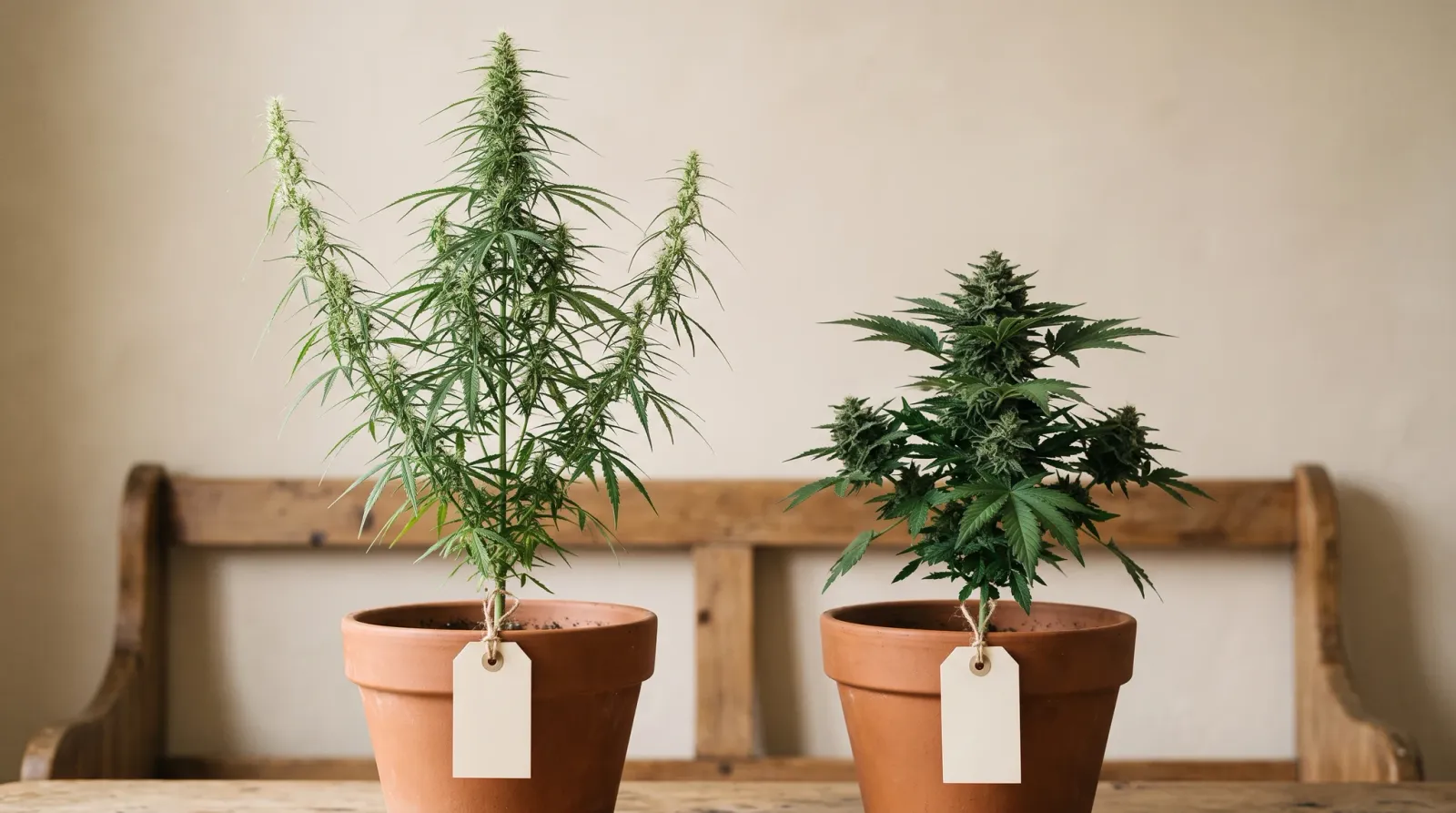
A Haze strain is a plant from, or named after, a tall, late-flowering sativa-type line that seed companies say began in 1970s Santa Cruz, California, and several famous strains, including Super Silver Haze and Jack Herer, are breeder-stated crosses of it. The name alone proves nothing. Every origin account is oral history from people who sell the seeds, and the accounts disagree.
Here is the version you can screenshot. Amnesia Haze, one of the best-known “Haze” names, lists no Haze parent at all. Its breeder, Soma Seeds, gives its origins as Southeast Asian (Laotian), Jamaican and Afghani-Hawaiian plants, according to a 2014 Soft Secrets profile and the breeder’s database listing. The same profile says that from about 2006 to 2012, much of what Amsterdam coffeeshops sold as Amnesia Haze was actually a Super Silver Haze clone. Sensi Seeds even says its own Silver Haze has no close ties to Super Silver Haze, “except that they are both Hazes” (Sensi Seeds blog). These are breeder and magazine statements, not lab results. That is exactly the point.
This lesson in High School shows the standard Haze story, where the accounts split, what one genome study found, and which family members rest on more than a name.
Sources checked October 29, 2026.
What does “Haze” mean in cannabis?
“Haze” names a breeding line, not a chemical type or a guaranteed effect. In seed-company accounts, the original Haze was a tall plant with long, wispy flowers that ripened very late in the season. Growers then crossed it with faster plants, and the word “Haze” travelled into dozens of strain names.
Our strain database holds many Haze-named entries, from Original Haze to Mango Haze and Ghost Train Haze. Their number shows how popular the word is. It says nothing about how related they are. As our guide to how strain names work explains, whoever sells the seed chooses the name.
Where did the Haze strain come from?
Nobody has a document from the 1970s that settles it. We found no catalogue, newspaper or seed list from the period. What exists are three seller accounts that overlap in places and conflict in others.
| Account | What it claims | Who tells it | What is missing |
|---|---|---|---|
| The “Haze Brothers” | Two growers known only as “R.L and G”, based in Corralitos, Santa Cruz, grew sativas from Colombian, Mexican, Thai and South Indian seed between 1970 and 1975, crossing them over three years | A seed company’s history blog (Dinafem) | Initials only. The same post admits “there are differing accounts” |
| One grower, 1969 | “Original Haze was first bred in 1969 in the Santa Cruz Mountains by a gentleman named G”, as a three-way Colombian cross that Sam the Skunkman later saved | A seller of Original Haze seeds (AG Seed Co.; Leaf Magazines, 2021) | The seller describes his own product. “Three-way” conflicts with the four seed sources above |
| Asia first | “The real Haze comes from southeast Asia”, with Mexican and Colombian added later; some doubt “that the Haze brothers ever existed” | A breeder, Dwight Diotte, as relayed on a seed bank’s blog (Sensi Seeds) | Relayed quotes, not a recording or a record |
Notice what all three share: Santa Cruz or nearby, the late 1960s to mid-1970s, and seed from tropical regions. Notice what they do not share: who made it, when, and from how many parents. The “Haze Brothers” story is the one most often told as fact, and it is the shakiest. One account gives them as two people known by initials, and another doubts they existed.
The regions in these stories are the kind of landrace genetics that most early hybrids drew on. But no account names a specific documented landrace parent, so treat “Thai” or “Colombian” in the Haze story as part of the story, not a pedigree.
How did Haze get to the Netherlands?
The accounts agree that Haze reached Dutch breeders through David Watson, known as Sam the Skunkman, and then the breeder Nevil Schoenmakers. They do not agree on the dates. One seed-bank account says Watson brought Haze to the Netherlands “in 1983” (Sensi Seeds). Another, by a writer who also sells Original Haze seeds, says Nevil received “a couple Haze males” from Sam in 1987, and that Haze hybrids first appeared in a Dutch seed catalogue in 1988 (High Times, 2023).
The same Sensi account relays Diotte’s claim that the seeds Nevil bought “were years old”, labelled ’69 Haze, and produced only six or seven plants. It also says pure Haze was “far from a successful crop” in the Netherlands, so Nevil crossed it with Northern Lights #5 to get shorter plants. Crosses with faster, shorter plants became the pattern for much of the modern family, as the table below shows. Our database also lists a Neville’s Haze.
What does DNA say about Haze?
One peer-reviewed study has placed a Haze sample on the cannabis family tree. A 2025 genome study of wild and cultivated cannabis sequenced or reused 158 samples, including 16 drug strains. It found that a “Haze drug strain” grouped with drug landraces from Thailand, Cambodia, Sri Lanka, South India and West Africa, in what the authors call the Indoafrica subgroup (Balant et al., 2025).
That fits the Asian parts of the origin story. It does not prove them, for three reasons:
- It is one sample, taken from a public sequence record. We could not confirm which Haze cut it came from.
- The authors’ sentence about Haze’s landrace origin cites a book, not a test.
- No descendant, such as Super Silver Haze or Jack Herer, was analysed beside it.
The wider DNA research is the bigger lesson. A 2015 study of 81 marijuana samples found that “marijuana strain names often do not reflect a meaningful genetic identity” (Sawler et al., 2015). A 2019 study of 30 dispensary strains named Purple Haze among strains whose same-name samples carried different levels of mixed ancestry (Schwabe and McGlaughlin, 2019). Our review of DNA studies of strain names walks through those papers in full.
Why does Haze take so long to flower?
Haze flowers late because, by every account, it comes from plants that evolved near the equator, where day length barely changes through the year. Cannabis is a photoperiod plant: most cultivars start to flower when nights get long enough. Plants from low latitudes respond to that signal differently.
The research supports the general mechanism, not a Haze figure. In a 2021 study of 27 hemp cultivars, average days to flower “was shortest among cultivars from northern latitudes and longest among those from southern latitudes” (Zhang et al., 2021). A 2023 study of ten drug-type cultivars found wide differences in how each responded to day length. Its authors note that some drug cultivars descend from “equatorial genotypes, where the minimal temporal changes in daylength are a relatively weak signal for seasonality” (Ahrens et al., 2023). Neither study grew a Haze.
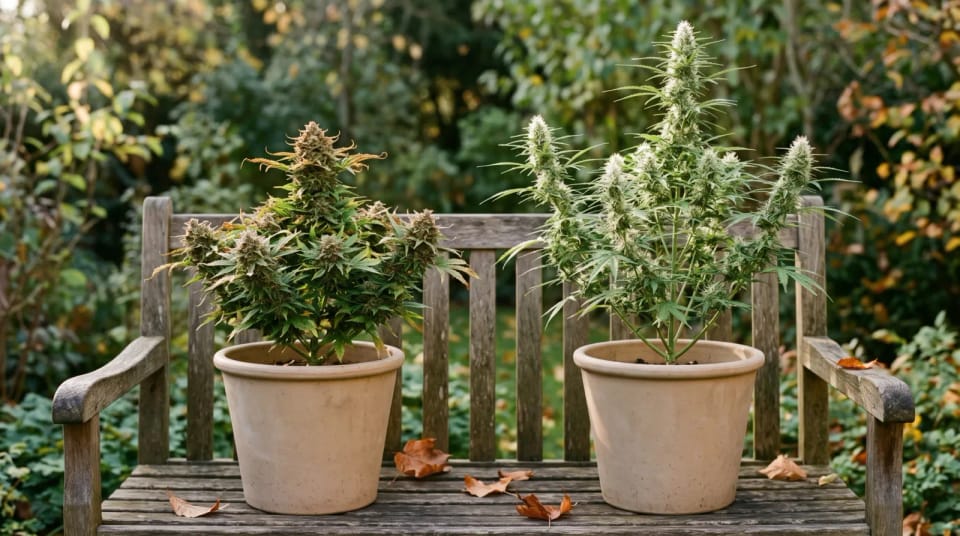
Same garden, same date, different finish. Seed companies say Haze-type plants are still flowering when faster hybrids are ready; the weeks they quote come from sellers, not trials.
How long, then? The numbers you will see are sellers’ claims, and they disagree. One seller of Original Haze gives 10 to 14 weeks of flowering (Leaf Magazines). A trade article on Skunk #1 and Haze says Haze was harvested in “November or December” outdoors, against late August for Skunk #1 (High Times). Green House Seed Co. lists Super Silver Haze at 10 to 11 weeks indoors (breeder listing). None of these comes from a growing trial. The direction is consistent: Haze lines finish later than most modern hybrids. The exact weeks are not settled.
Which strains are in the Haze family?
Here is the family in three bins. Every parentage below is what a breeder or a trade source states. No registry checks it.
| Bin | Strain | Parents, as stated | Who states it |
|---|---|---|---|
| Breeder-stated cross | Super Silver Haze | Skunk, Northern Lights and Haze | Green House Seed Co. (listing) |
| Breeder-stated cross | Super Lemon Haze | Super Silver Haze x Lemon Skunk | A seed bank’s account of the breeder (Sensi Seeds) |
| Breeder-stated cross | Purple Haze | Haze x Purple Thai | Same seed-bank account (Sensi Seeds) |
| Accepted, not documented | Jack Herer | Skunk #1, Northern Lights #5 and Haze; the breeder keeps the exact lineage secret | A trade quote on the breeder’s listing (listing) |
| Widely repeated | Blue Dream | Blueberry x Haze | We did not find a breeder source for this one |
| Name only | Amnesia Haze | Southeast Asian (Laotian) x Jamaican x Afghani-Hawaiian; no Haze parent listed | Soma Seeds, via Soft Secrets |
| Name only | Silver Haze (Sensi) | Not closely tied to Super Silver Haze, “except that they are both Hazes” | Sensi Seeds (blog) |
Two patterns stand out. First, the strongest family members are crosses of Haze with Skunk #1 and Northern Lights #5, which matches the story of Dutch breeders shortening the plant. Second, the “name only” bin is not a mistake by a few sellers. Even the breeders themselves say the name and the genes do not always travel together.
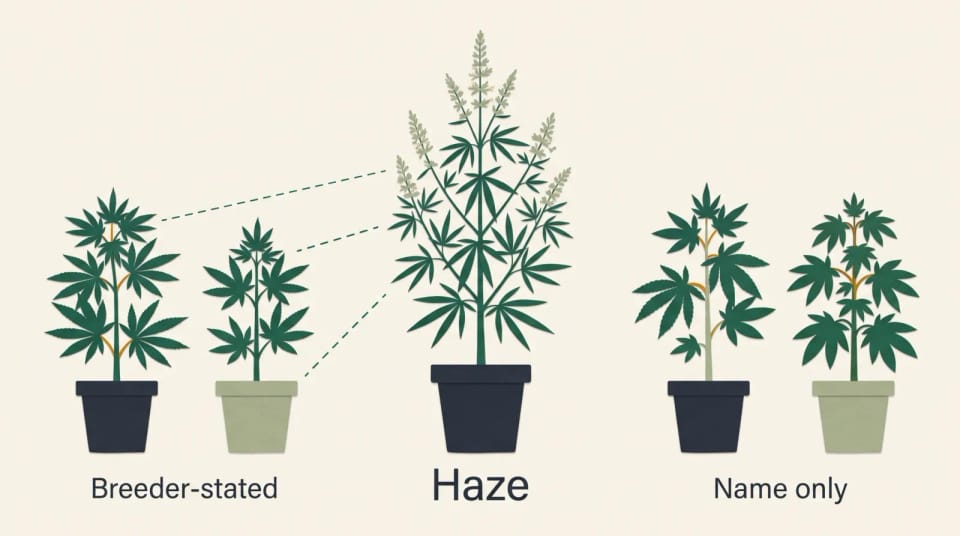
An honest Haze family chart uses dashed lines. Breeders state the links on the left; the strains on the right share the word, not a stated parent.
If you are curious how this line compares with the other pillars of modern breeding, our profile of OG Kush tells the Kush side of the story. For the general method behind tables like this one, see how to trace a strain’s family tree.
Is Haze a pure sativa?
Sellers call Original Haze a pure sativa, and one says it “contains no Afghan/Indica” (AG Seed Co.). That is a product description, not a genetic test. Research on commercial cannabis has found that sativa- and indica-labelled samples “were genetically indistinct on a genome-wide scale” (Watts et al., 2021). The labels tracked a few aroma genes instead.
Even one breeder’s percentages move. Soma Seeds’ Amnesia Haze appears as 70% sativa in a 2014 profile (Soft Secrets) and 80% sativa on its database listing (listing). Our explainer on why indica and sativa labels do not predict effects covers the wider evidence.
Do Haze strains share a terpene profile or an effect?
Not that anyone has shown. We found no lab dataset that measures the Haze family as a group. You will often see Haze-type strains described as rich in terpinolene, but the large studies point the other way for at least one family member. A 2022 analysis of 89,923 lab-tested flower samples found that 88.5% of Blue Dream products fell in a “high myrcene-pinene” cluster, and that commercial labels “do not consistently align with the observed chemical diversity” (Smith et al., 2022). A Nevada study of 2,662 samples found 396 strain names spread across just three chemical clusters, with two Super Lemon Haze samples among the outliers (Reimann-Philipp et al., 2020).
Effects are the same story. Breeders and users often call Haze “cerebral” or “energetic”, but we found no human study of any Haze-named strain. Effects vary by person, dose and product. If cannabis leaves you with panic, a racing heart or anxiety that does not settle, talk to a clinician. This article is about plant history, not about what any strain will do to you.
What helps more than the name is the label in your hand. Our High Families group strains by measured terpene profiles, which is a product classification, not a prediction of effects. If you try a few Haze-labelled strains, the High IQ app can track how each one actually worked for you.
Sources
-
Balant M, Vitales D, Wang Z, et al. “Integrating target capture with whole genome sequencing of recent and natural history collections to explain the phylogeography of wild-growing and cultivated cannabis.” Plants, People, Planet. 2025;7(6):1771-1788. doi.org/10.1002/ppp3.70043
-
Sawler J, Stout JM, Gardner KM, et al. “The Genetic Structure of Marijuana and Hemp.” PLOS ONE. 2015;10(8):e0133292. doi.org/10.1371/journal.pone.0133292
-
Schwabe AL, McGlaughlin ME. “Genetic tools weed out misconceptions of strain reliability in Cannabis sativa: implications for a budding industry.” Journal of Cannabis Research. 2019. doi.org/10.1186/s42238-019-0001-1
-
Watts S, McElroy M, Migicovsky Z, et al. “Cannabis labelling is associated with genetic variation in terpene synthase genes.” Nature Plants. 2021;7(10). doi.org/10.1038/s41477-021-01003-y
-
Smith CJ, Vergara D, Keegan B, Jikomes N. “The phytochemical diversity of commercial Cannabis in the United States.” PLOS ONE. 2022;17(5):e0267498. doi.org/10.1371/journal.pone.0267498
-
Reimann-Philipp U, Speck M, Orser C, et al. “Cannabis Chemovar Nomenclature Misrepresents Chemical and Genetic Diversity.” Cannabis and Cannabinoid Research. 2020;5(3). doi.org/10.1089/can.2018.0063
-
Zhang M, Anderson SL, Brym ZT, Pearson BJ. “Photoperiodic Flowering Response of Essential Oil, Grain, and Fiber Hemp (Cannabis sativa L.) Cultivars.” Frontiers in Plant Science. 2021;12:694153. doi.org/10.3389/fpls.2021.694153
-
Ahrens A, Llewellyn D, Zheng Y. “Is Twelve Hours Really the Optimum Photoperiod for Promoting Flowering in Indoor-Grown Cultivars of Cannabis sativa?” Plants. 2023;12(14):2605. doi.org/10.3390/plants12142605
-
Breeder, seed-company and magazine accounts, accessed October 29, 2026 (claims by the parties making them, not verified records): Dinafem history blog; AG Seed Co. on Original Haze; High Times, 2023; Leaf Magazines, 2021; Sensi Seeds blog; Soft Secrets, 2014; breeder listings for Amnesia Haze, Super Silver Haze and Jack Herer.
Key takeaways
- Haze is a tall, late-flowering sativa-type line that seed companies trace to Santa Cruz in the late 1960s or early 1970s.
- Three origin accounts conflict on who bred it, when, and from which seed; none has a period document behind it.
- One 2025 genome study grouped a single Haze sample with South and Southeast Asian landraces.
- Super Silver Haze, Super Lemon Haze and Purple Haze are breeder-stated Haze crosses; Jack Herer’s Haze parent is accepted but not documented.
- Amnesia Haze’s own breeder lists no Haze parent, so “Haze” in a name is not proof of Haze genes.
- No study shows a shared Haze terpene profile or effect.
FAQ
Is Haze indica or sativa?
Sellers describe Original Haze as a pure sativa, and most Haze crosses are sold as sativa-dominant. Those labels are product descriptions, not genetic tests. Genome-wide research finds that sativa- and indica-labelled samples are not distinct groups.
Is Amnesia Haze really a Haze?
Not by its own breeder’s account. Soma Seeds lists Southeast Asian (Laotian), Jamaican and Afghani-Hawaiian parents and no Haze. A separate, older strain called Amnesia is listed by its breeder as Afghani x Neville’s Haze, and the two are not related.
Who were the Haze Brothers?
One seed-company history names them only as “R.L and G”, growers in Corralitos, Santa Cruz, in the early 1970s. Another account credits a single grower, “G”, in 1969, and a breeder quoted on a seed bank’s blog doubts the brothers existed. No account gives full names or a period record.
Is Purple Haze named after the Jimi Hendrix song?
The name is often linked to the song, but we found no record of who named the strain or why. One seed bank describes Purple Haze as Haze x Purple Thai. Treat the name story as folklore.
Is Haze a landrace?
No. A landrace is a local variety grown in one region for generations. Haze is described as a hybrid that growers made by crossing seed from several regions, so it is a cross of landrace-type plants, by its own origin stories.



