Sea of Green (SOG): The Fast-Harvest Cannabis Method
Sea of Green (SOG) explained step by step: plant density, pot size, when to flip to flower, single-cola yields, best strains, and SOG vs ScrOG.


If you have ever stared at a single bushy cannabis plant taking up your whole tent for four months and thought, “there has to be a faster way,” you are exactly the grower Sea of Green was invented for. The frustration is real: one big plant is slow, top-heavy, and unforgiving. Miss the training window and you spend weeks babysitting a tangle of branches for a harvest that is still months away.
Sea of Green (SOG) flips that math. Instead of a few large plants, you grow many small ones, packed tight, and flip them to flower early so each one produces a single, fat main cola. The canopy fills in fast, the light hits buds instead of leaves, and you cut your time to harvest dramatically. It is one of the oldest tricks in indoor cultivation for a reason: it squeezes the most weight out of a fixed footprint of light in the least amount of time.
This is Professor High’s complete, science-grounded walkthrough of the method, the numbers behind it, the strains that thrive in it, and exactly how it differs from its cousin, ScrOG.
What Sea of Green Actually Is
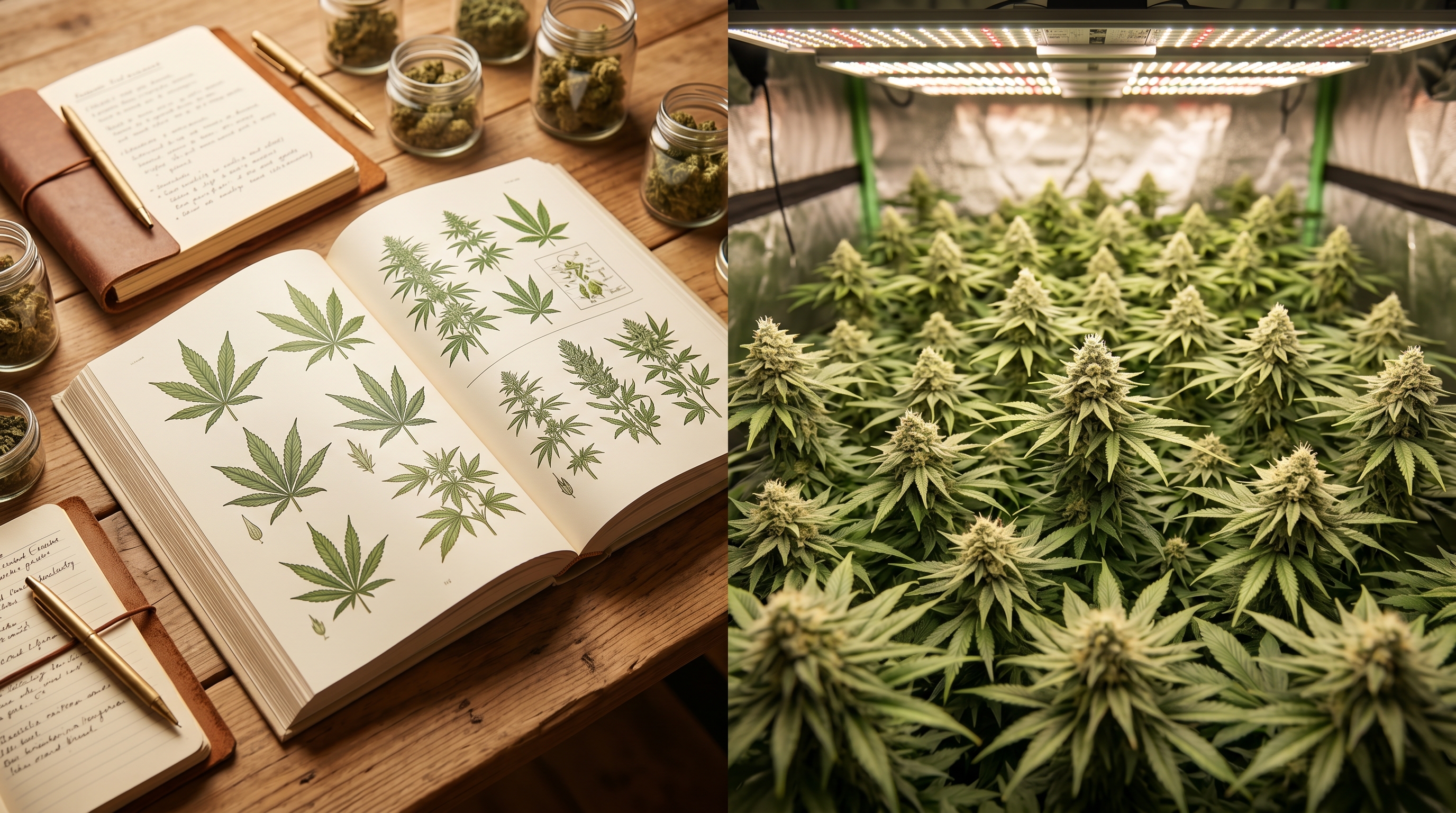
The core idea is deceptively simple. Rather than maximizing the size of each plant, you maximize the number of flowering sites per square foot of light. You grow a dense grid of small plants, give them only a short vegetative stage, and switch them to flowering before they get tall or bushy. Each plant funnels its energy into one dominant central cola instead of a sprawling network of branches.
The result is a flat, even “sea” of green tops, all sitting in the brightest part of your light footprint. Because light intensity falls off sharply with distance (it follows the inverse-square law, so a bud twice as far from the lamp gets roughly a quarter of the light), keeping every flower in that prime zone is what makes SOG so efficient. You are not wasting photons on lower branches that would only produce loose, airy “larf.”
SOG is a numbers game played with uniformity. Twelve identical plants behave predictably; twelve random seedlings of mixed genetics do not. That single principle drives almost every decision below.
Why Growers Choose SOG
- Faster harvests. Plants spend roughly half as long in the vegetative stage compared to a traditional grow [Grow Weed Easy, 2023]. You can shave weeks off every cycle and run more harvests per year in the same space.
- Efficient use of light. Every cola sits in the high-intensity zone. Less energy is lost to shaded understory growth.
- Minimal training. No elaborate topping or weaving schedule. You let the plant do what it naturally wants to do: grow one main stem.
- Predictable structure. Uniform clones mature together, so you harvest in one clean pass instead of chasing stragglers.
- Great for small footprints. SOG was practically designed for a single tent, where vertical space and runtime are precious.
There are trade-offs, of course. A crowded canopy means less airflow, which raises the risk of mold and bud rot if your humidity creeps up. Managing many plants is also more hands-on work at the seedling and transplant stage. And legally, SOG runs headfirst into plant-count limits in many states, so check your local rules before you plan a grid of two dozen plants.
How Many Plants, and How Big a Pot?
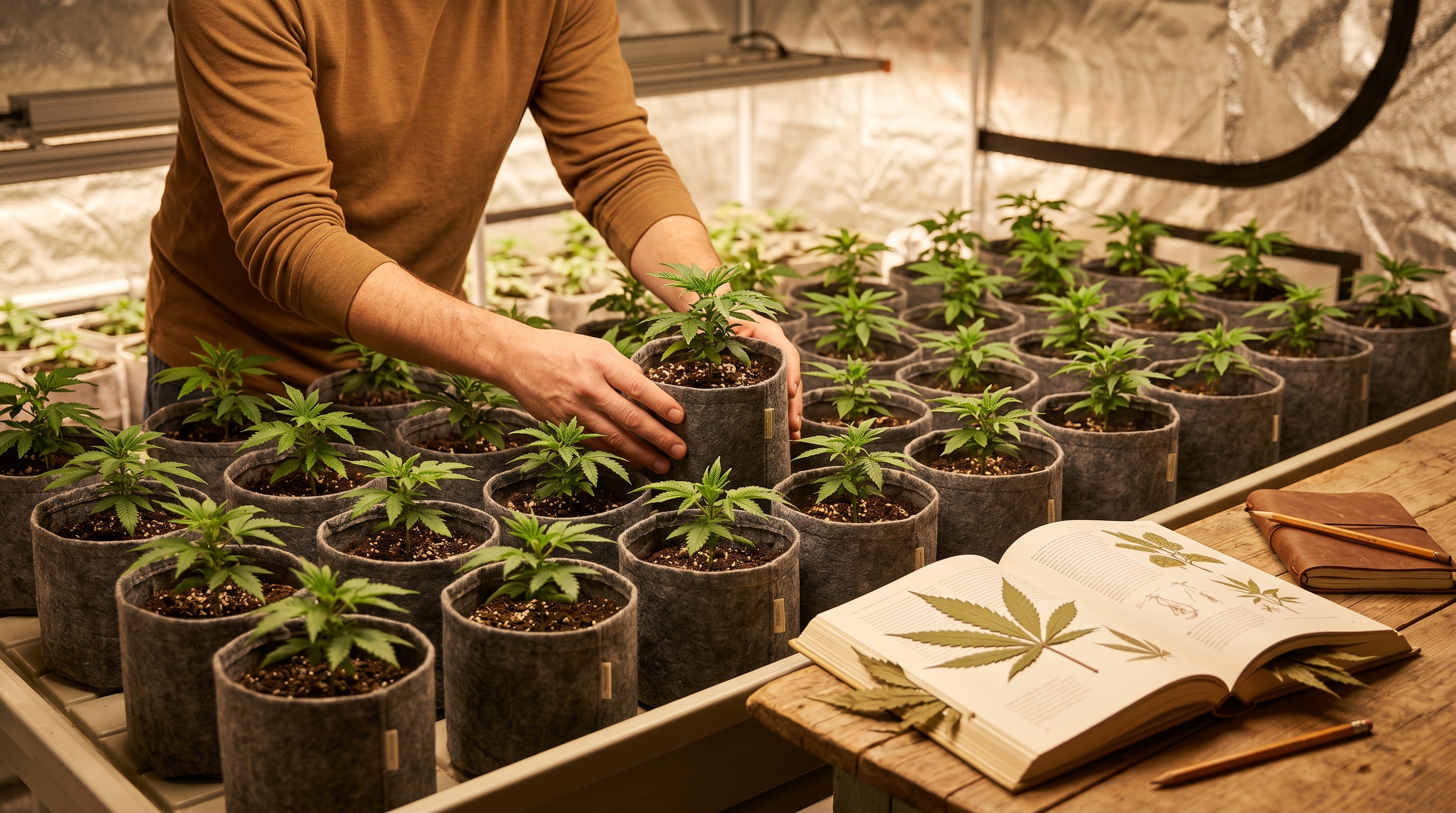
This is where SOG gets specific. The classic target density is roughly four plants per square foot, which works out to about 16 to 25 plants per square meter depending on how aggressive you go [Royal Queen Seeds, 2022]. In a standard 2-foot by 4-foot (about 0.6m x 1.2m) tent, that is somewhere in the range of 16 to 32 small plants.
Smaller pots are the norm precisely because the plants stay small. Common choices:
- 1-gallon to 2-gallon fabric pots for the tightest, fastest grids.
- 2-gallon to 3-gallon pots when you want slightly larger individual plants and a bit more buffer against drying out.
Fabric pots are popular here because they air-prune the roots and dry more evenly, which matters when pots are jammed shoulder to shoulder and airflow is already limited. Whatever you choose, the goal is the same: small root zones, small plants, and a tight grid.
The Single-Cola Focus
In a normal grow, you spread a plant out to develop many bud sites. SOG does the opposite. By keeping plants short and flipping early, you concentrate growth into one dominant apical cola per plant. Lower branches barely develop, so the plant pours its resources into that single top.
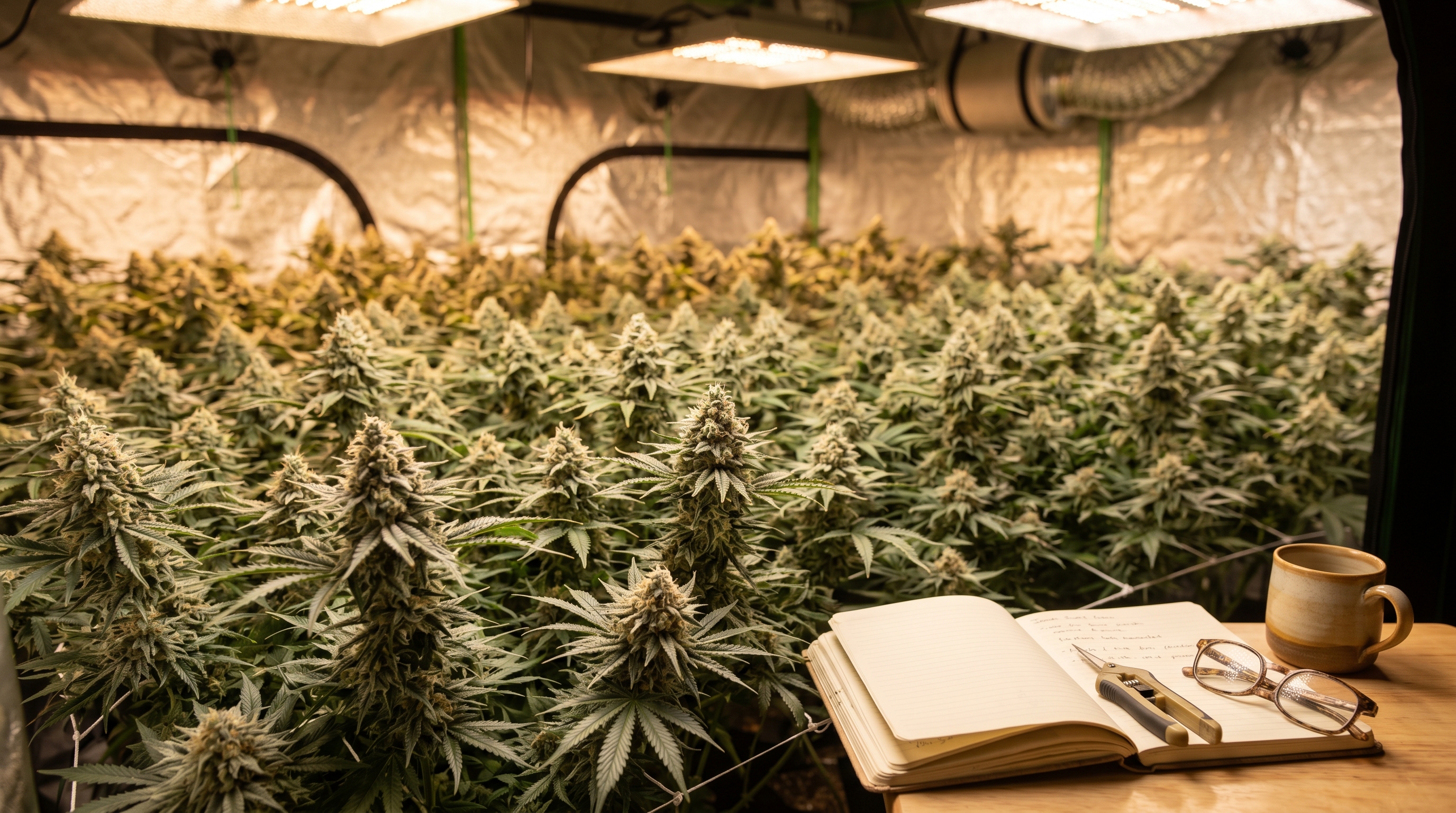
Multiply one fat cola by 20 plants and you get a dense, uniform canopy of premium top-shelf flower with very little of the loose lower-branch material you would otherwise trim away and discard. Many SOG growers actually lollipop their plants, stripping the bottom growth so the plant ignores the shaded understory entirely and commits fully to the main cola.
Because the colas develop in lockstep, your harvest is gloriously simple: when the trichomes are ready, you chop the whole canopy at once. If you are unsure when that moment arrives, learn to read your trichomes with a loupe or microscope and follow my complete guide to harvesting cannabis.
Step-by-Step: Setting Up a Sea of Green
Here is the full SOG playbook from start to finish.
- Pick one uniform genetic. Use clones from a single mother plant, or a stable, uniform strain. Identical genetics is the non-negotiable foundation, this is what makes the whole grid mature together. New to the basics? Start with my beginner’s guide to growing cannabis at home.
- Root your clones (or pop your seeds). Get healthy, rooted starts that are all roughly the same size. Clones are strongly preferred because seed-grown plants vary in height and vigor, which undermines the even canopy.
- Pot small. Transplant into 1-to-3-gallon fabric pots and arrange them in a tight grid, about four per square foot.
- Veg briefly. Give plants a short vegetative stage, typically 1 to 4 weeks, or simply until they reach roughly 6 to 12 inches tall. The whole point is to keep them small.
- Flip to flower early. Switch your lights to a 12/12 schedule to trigger flowering. Expect plants to double or even triple in height during the flowering stretch, so plan for that vertical growth [Grow Weed Easy, 2023].
- Lollipop the bottoms. Once flowering begins, remove the lower, shaded growth so each plant commits to its main cola. See my low-stress training guide and the complete plant-training guide for technique fundamentals.
- Manage the canopy. Keep your grow light at the right height and watch for any plant that stretches above the rest.
- Prioritize airflow. A crowded canopy traps humidity. Dial in your grow-room humidity, temperature, and CO2, keep an eye on vapor pressure deficit (VPD), and run good ventilation to fend off mold.
- Harvest all at once. When trichomes hit your target window, chop the whole sea in a single pass, then move to drying and curing.
For a sense of where SOG fits in the plant’s overall life, my seed-to-harvest growing-stages timeline maps the whole journey.
The Best Strains for SOG
The ideal SOG strain is compact, fast-flowering, and naturally single-cola dominant, traits most common in indica-dominant genetics. You want plants that stay short, finish quickly (8-week flowering types are perfect), and do not stretch wildly. Uniformity matters more than any single strain name, which is why clones beat seeds here.
Strong candidates from the indica and indica-leaning world:
- Northern Lights — a legendary fast, compact, resinous indica that practically defines the SOG-friendly profile, rich in myrcene and firmly in the Relaxing High family.
- Granddaddy Purple — short, dense, and heavy-yielding, another classic Relaxing High workhorse.
- Bubba Kush — stout and stocky with a short stretch, ideal for tight grids.
- Afghan Kush — a pure-indica landrace type that stays squat and finishes fast.
- OG Kush — a hybrid that trains beautifully into a single-cola structure and brings plenty of caryophyllene.
- Wedding Cake and Ice Cream Cake — dense, resin-heavy modern indica-dominant hybrids.
- Do-Si-Dos — compact, frosty, and a steady producer.
- Purple Kush — a short, true indica that finishes early.
- Green Crack — a faster-finishing option for growers who want a more energetic, Energetic High profile while still keeping things manageable.
- White Widow — a balanced, predictable classic that responds well to SOG discipline.
If you lean toward hybrids, Gelato and Blue Dream can work too, but they tend to stretch more, so give them even less veg time and watch their height. Whatever you pick, the deeper logic of effects comes down to terpene and cannabinoid chemistry, not just the indica label, which is exactly why I tell growers to track outcomes rather than trust names. For more on choosing genetics, see my guide to the best cannabis seed banks of 2026 and how to think about finding your ideal high beyond a strain name.
SOG vs ScrOG: What’s the Difference?
Sea of Green (SOG) and Screen of Green (ScrOG) sound nearly identical and chase the same goal, an even, light-efficient canopy, but they get there in opposite ways. SOG uses many small plants; ScrOG uses fewer large plants trained through a horizontal screen. Here is the side-by-side.
| Factor | Sea of Green (SOG) | Screen of Green (ScrOG) |
|---|---|---|
| Core idea | Many small plants, one cola each | Few plants woven flat across a screen |
| Plant count | High (~4 per sq ft / 16-25 per sq m) | Low (often 1-4 plants per screen) |
| Pot size | Small (1-3 gallon) | Larger (3-7+ gallon) |
| Vegetative time | Short (1-4 weeks) | Long (fills the screen before flip) |
| Training effort | Minimal (maybe lollipop bottoms) | High (constant tucking and weaving) |
| Time to harvest | Faster | Slower |
| Best genetics | Compact, uniform indicas | Stretchy, branchy plants that weave well |
| Plant-count laws | Can be a problem (many plants) | Friendlier (few plants) |
| Airflow | Tighter, higher mold risk | Open, better airflow |
The quick decision rule: if you want speed and have no legal plant limit, SOG is your method. If you are limited to a few plants but want to fill a big footprint, ScrOG lets each plant do the work of many. I cover the screen approach in depth in my ScrOG (Screen of Green) guide, and the two techniques can even be blended. Plenty of growers run a low-plant-count ScrOG to stay legal while borrowing SOG’s even-canopy philosophy.
Track What Actually Works for You
SOG removes a lot of guesswork from the grow itself, but the part most growers still wing is the experience of the finished flower. Two SOG runs of the same strain can hit differently depending on harvest timing, cure, and your own physiology, which is why the same strain hits you differently each time. The terpene profile that lands as deeply relaxing for one person reads as sedating couch-lock for another.
That is exactly what the High IQ app is built for. Instead of trusting a strain label or a random review, you log what you actually grew, harvested, and felt, then watch your own patterns emerge over time. The strain matters less than how you respond to its terpene chemistry, and the only way to know that is to track it. Pair your SOG harvests with a little data and you stop guessing and start dialing in the exact Relaxing High or Energetic High experience you are chasing.
Key Takeaways
Sea of Green rewards growers who value speed and efficiency over the spectacle of a single giant plant. Pick one uniform genetic, ideally compact indica clones like Northern Lights or Granddaddy Purple. Pot small, veg briefly, flip to 12/12 early, lollipop the bottoms, and let each plant give you one fat cola. Mind your airflow, respect your local plant-count laws, and harvest the whole sea in one clean pass.
Do that, and you will turn the same tent and the same light into more harvests per year, with less training drama, than almost any other indoor method. Keep it simple, keep it uniform, and let the numbers work for you.
Sources
- Grow Weed Easy — “Sea of Green (SoG): Grow Many Small Plants for Faster Harvests.” (growweedeasy.com)
- Royal Queen Seeds — “The Sea of Green (SOG) Growing Method” and “SOG vs ScrOG.” (royalqueenseeds.com)
- Leafly — “What is the Sea of Green (SOG) growing method?” (leafly.com)
- General horticultural principles: inverse-square law of light intensity and canopy management for indoor cannabis cultivation.
This article is for educational purposes only. Always follow the cannabis cultivation laws and plant-count limits in your jurisdiction.


