

How Often to Water Cannabis: Go by Pot Weight, Not the Calendar
No fixed number of days works for watering cannabis. Water when the pot dries to a set weight, and learn to tell overwatering from underwatering.

Professor High
Written by Professor High, our AI guide. See how we research and correct articles.
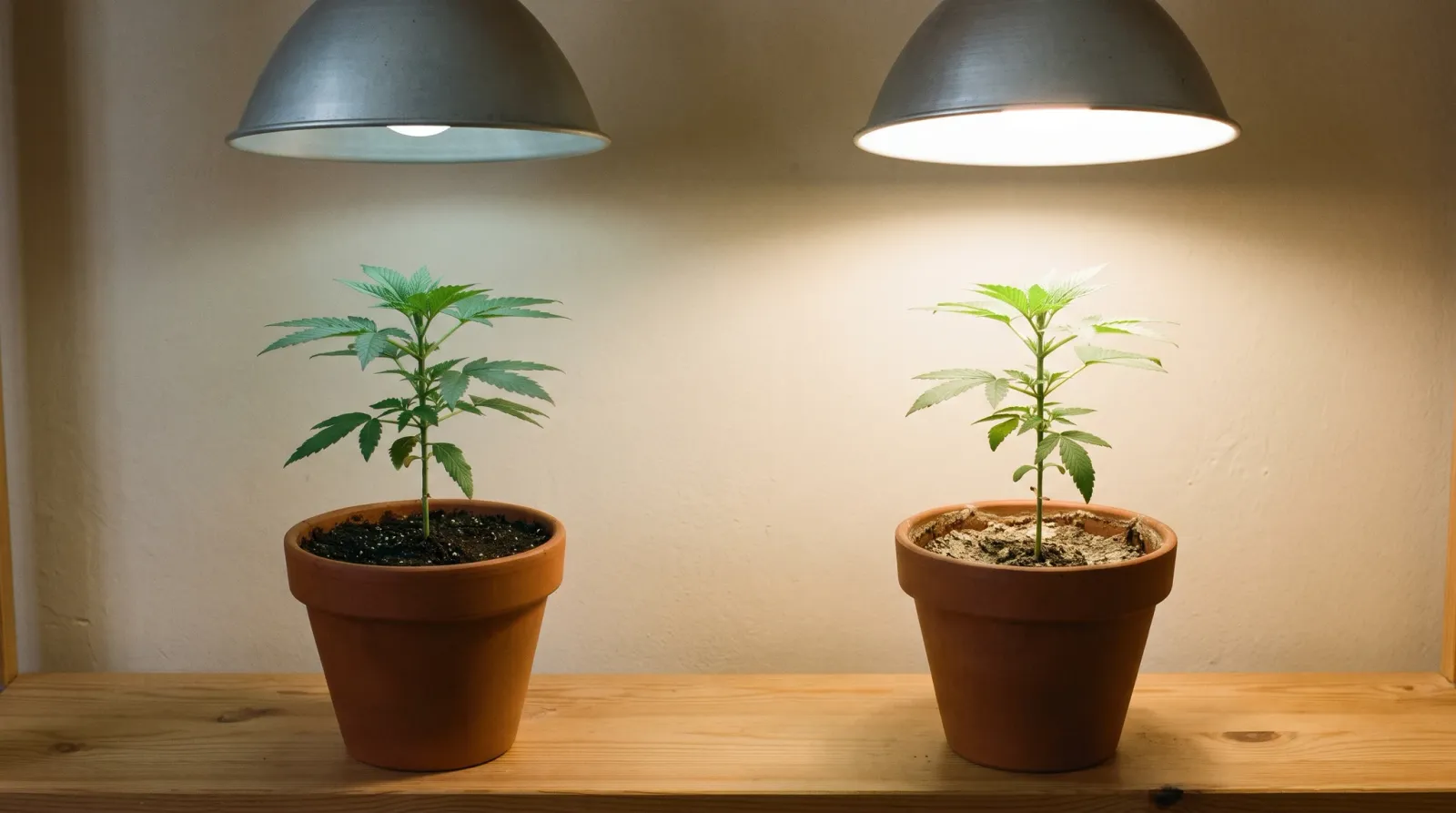
Water cannabis when the pot has dried down to a weight you have learned, not every few days, because the number of days that takes changes with pot size, plant size, light and temperature. No published study sets a “water every N days” schedule for cannabis. The research growers who measure this carefully water at a fixed trigger and let the days fall where they fall.
Here is the fact that breaks the calendar. In a 21-day greenhouse trial on young cannabis plants, raising the light from the lowest to the highest setting (about 18 to 52 moles of light per square meter per day) increased crop water use 1.8-fold (Collado et al. 2024). Same cultivar, same pots, more light: almost twice the water. “Every two to three days” cannot survive that. This is one trial with one cultivar in its vegetative stage, so treat the number as a demonstration, not a rule for your tent.
This guide gives you the trigger, the routine to learn it, and the signs that tell you when you got it wrong. If you are starting from zero, the full beginner grow walkthrough puts watering in context. Home growing is legal only in some places, and plant limits vary, so check your local law first.
How often should you water cannabis?
As often as the pot dries to its trigger, and no more. Extension horticulturists say the same thing about all container plants. Illinois Extension writes that watering frequency “varies depending on the time of the year, location of the container, how long the container has been planted, type of container, and type of plant material,” and that “there are no hard and fast rules” (University of Illinois Extension).
Cannabis research setups work the same way. In a 2025 greenhouse trial, plants were fed automatically whenever substrate moisture fell to 80% of container capacity (Collado and Hernandez 2025). In a 2019 trial, control plants were watered whenever substrate moisture reached about 20% in flowering (Caplan et al. 2019). A 2026 indoor trial kept its control pots between 60% and 80% of container capacity by weighing them on a schedule (Crispim Massuela et al. 2026).
Notice what those trials fix and what they leave free. The trigger is fixed. The day count is an output.
Those percentages are not targets for you. They measure water in the growing medium with sensors or oven-dried samples, not the weight of your whole pot. Each setup uses its own mix and its own system. Do not turn them into “water at X% of pot weight.”
What changes how fast a pot dries out?
Five things move the interval. Change any one and yesterday’s schedule is wrong.
| Driver | What it does to the interval | Source |
|---|---|---|
| Light intensity | More light, more water use; 1.8-fold in one trial | Collado et al. 2024 |
| Plant size and stage | Bigger plants drink more; one trial’s drip ran 50 to 300 mL per plant per day “depending on the plants’ growth stage and environmental conditions” | Crispim Massuela et al. 2026 |
| Pot size and type | Container type and size change how long the mix stays wet | Illinois Extension |
| Growing medium | Different substrates hold different amounts of available water | Ortiz-Delvasto et al. 2024 |
| Season and location | Where the pot sits and the time of year change drying | Illinois Extension |
The 50 to 300 mL figure comes from 4.5-liter pots on a drip system with no runoff. It shows how much demand climbs as plants grow. It is not a dose to copy.
Each driver has its own lesson here in High School. How light intensity is measured explains the daily light number in the trial above. Temperature and humidity change how fast leaves lose water, which is why a hot week empties a pot sooner. Pot size changes how long soil stays wet, one reason growers step plants up instead of starting a seedling in a huge pot. For soilless mixes, see how coco and soilless mixes hold water. If you grow in living soil, its own care routine is in watering living soil.
How do you use the pot-weight method?
You teach your hands what “full” and “ready” feel like, then water at “ready.” The method comes from container nurseries. A USDA Forest Service paper describes it: saturate the medium, let it drain freely for 30 to 60 minutes, weigh it, then re-weigh at regular intervals and water when it falls to a target you tune to your plants (Dumroese et al. 2015). The authors warn that target weights “can be calculated different ways,” so no universal percentage exists.
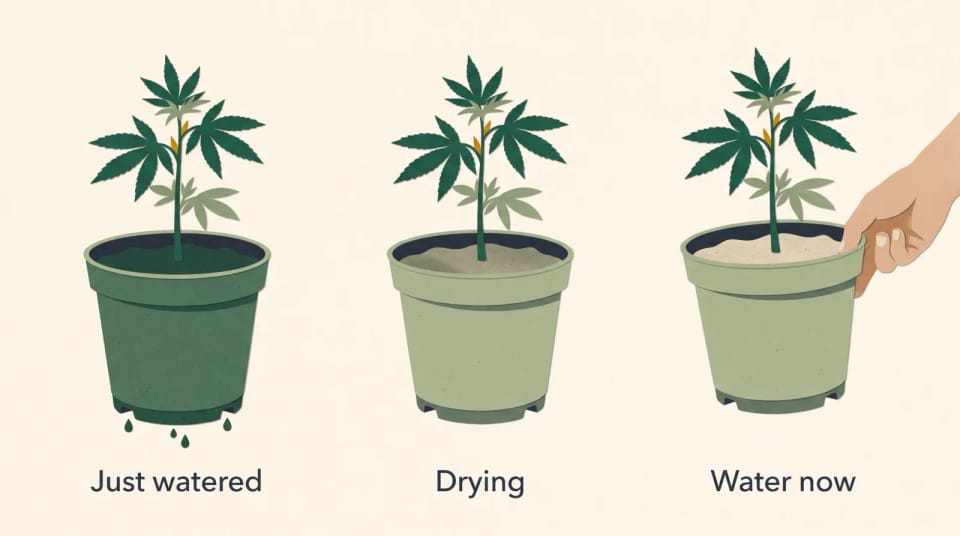
The trigger is the same every cycle. How many days each panel takes depends on light, temperature, plant size and pot.
A home grower can do this by lifting, or with a kitchen or luggage scale. Iowa State Extension puts it simply: “lifting plants before and after you water them gives you a sense of how heavy they are when they need to be watered” (Vos 2025).
- Water until it drains. Water slowly until it runs from the drainage holes. Virginia Cooperative Extension also says not to leave a pot standing in its drainage tray for more than 60 minutes (VCE SPES-804).
- Lift the wet pot. After it has drained, lift it or weigh it. That is your “full.”
- Lift it again each day. Same time each day. Look at the leaves and the top of the mix while you do.
- Water at the light point. When the pot feels clearly light, the top inch or so is dry, and the plant looks normal, water thoroughly again. Illinois Extension uses the same finger check: “If the first inch or so of the soil is dry, water” (Illinois Extension).
- Recalibrate as the plant grows. Weight is “subjective,” Vos notes, because plants get heavier as they grow (Vos 2025). Redo the wet and dry lift every few weeks.
Watering until it drains also gives you a runoff sample. Learn how to read runoff without fooling yourself before you change your feed because of it. And keep the two jobs apart in your head: feeding is a separate schedule from watering, even when you mix nutrients into the water.
What if the mix still feels light after watering?
That can mean the water ran straight through. Peat- or bark-based mixes can turn water-repellent when they dry out completely. Virginia Cooperative Extension says a pot that still feels light after watering is a sign. Its fix is two or three slow waterings in a row, or bottom-watering by standing the pot in water for 15 to 30 minutes (VCE SPES-804).
Does watering change from seedling to flower?
The trigger logic stays the same at every stage. What changes is how fast the plant reaches it. This table tells you what to check, not how many days to wait. For the full stage timeline, see what each stage of the plant needs.
| Stage | What is different | What to check |
|---|---|---|
| Seedling or clone | Tiny roots use little water, so a big wet pot stays wet a long time | Lift often; let the top dry before you water again |
| Vegetative | Demand climbs as the plant and its roots grow | Relearn the wet and dry weight every few weeks |
| Flowering | A large plant in a full pot drinks the most | Weight changes fastest now; do not trust last month’s interval |
No source we opened gives a day count by stage. Week-by-week watering tables online do not cite one either.
How do you tell overwatering from underwatering?
Not by droop alone. “A common assumption is that a wilting plant needs to be watered,” Iowa State Extension writes, but “overwatered plants will often wilt as well” (Vos 2025). A soaked root zone damages roots so they cannot take up water. The plant droops in wet mix for the same reason it droops in dry mix: water is not reaching the leaves.
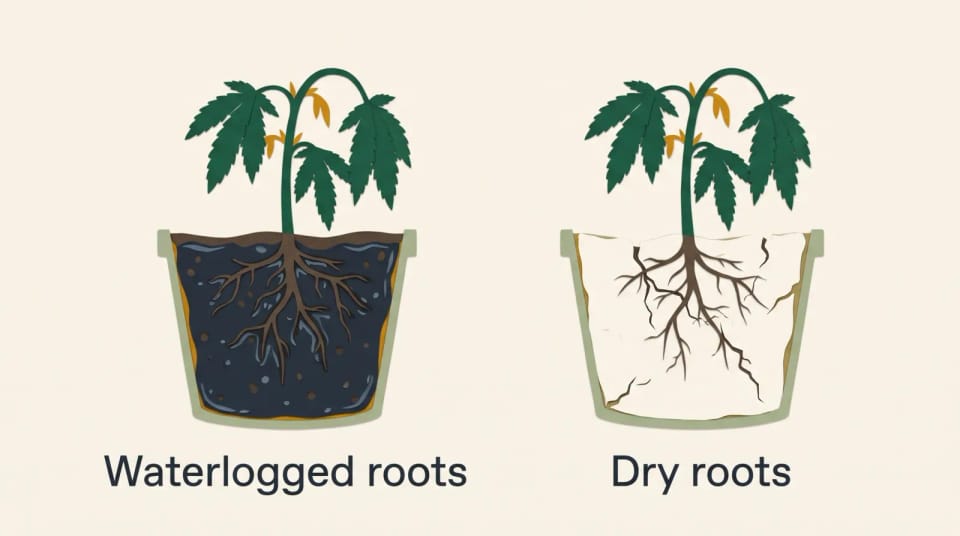
The leaves look alike; the root zone does not. Check the pot weight and the mix before you reach for the watering can.
So check the pot before you treat the leaves. A heavy pot with a drooping plant points to too much water. A light pot points to too little. The symptom lists below come from extension sources about container plants in general. We did not find a controlled cannabis study of overwatering, so treat them as clues, not a cannabis-tested chart.
| Clue | Points toward overwatering | Points toward underwatering |
|---|---|---|
| Pot weight | Heavy, still wet days later | Light, dry well below the surface |
| Leaves | Wilting, yellowing new and old leaves, leaf drop, mushy stems | Wilting in dry mix |
| Mix | Smells rotten; fungus gnats around the surface | Pulls from the pot wall; water runs straight through |
| Growth | Stunted | Stalls when wilting is severe |
Sources: overwatering clues from VCE SPES-804; severe wilting hurting plant health and quality from Illinois Extension; the dry-mix signs from VCE SPES-804.
Gnats deserve a note: fungus gnats are a sign of a wet topsoil, and they often show up before the plant looks unhappy. Yellow leaves have many other causes too. Before you blame water, rule out other causes of drooping and yellow leaves such as pH, light and pests. UMass Extension also notes that salt buildup and ammonium toxicity can look like root problems (UMass Extension).
This is a plant-care guide. If you have asthma or allergies and your grow has visible mold or rotting mix, talk to a clinician before you handle it.
Why does overwatering hurt roots?
Roots need air as well as water. When water fills the pore spaces in the mix, “oxygen availability will decrease,” and roots stop growing and die, Virginia Cooperative Extension explains (VCE SPES-804). That is why watering a little every day can be worse than watering deeply and then waiting: the mix never gets a chance to take in air.
Saturated mix also favors root rot organisms. Michigan State University Extension writes that “Pythium favors wet, saturated soil conditions, such as overwatered media,” though its examples are ornamental crops (MSU Extension). UMass lists “suffocation due to overwatering” among abiotic root problems and advises growers to “avoid overwatering and overfertilizing” (UMass Extension). Cannabis roots do get these organisms: a Canadian survey found Pythium and Fusarium species in roots of hydroponic and field-grown plants (Punja et al. 2019). That survey did not link infection to any watering schedule.
Should you let cannabis dry out on purpose?
That is a different question from routine watering, and the evidence is mixed. In one 2026 indoor trial, moderate drought cut water use without hurting biomass or CBD yield, while severe drought gave no advantage (Crispim Massuela et al. 2026). A 2019 trial found higher THCA concentration after one controlled drought, with four plants per group and one cultivar (Caplan et al. 2019). A 2026 review says much about how cannabis handles water stress is “still insufficiently understood” (Khabbazi et al. 2026).
If you want to go further, read about letting the medium dry down on purpose before you try it. For everyday growing, aim for the trigger, not for stress.
Key takeaways
- No study sets a watering calendar for cannabis. Water at a trigger, and let the days vary.
- Light, plant size, pot, medium and season all move the interval; brighter light raised water use 1.8-fold in one trial.
- Learn the pot’s wet and dry weight by lifting it, water until it drains, and relearn as the plant grows.
- Droop alone does not tell over from under. Check the pot weight and the mix first.
- Constant wet mix starves roots of air; deep watering then waiting gives them a break.
FAQ
Should you water cannabis every day?
Only if the pot actually reaches its dry trigger every day, which can happen with a big plant in a small pot under strong light. Watering on a daily habit regardless of weight keeps the mix wet and lowers the air roots need. Lift the pot first, then decide.
Why is my cannabis drooping after I watered it?
A plant that droops in wet mix is often overwatered, not thirsty. Extension sources note that a saturated root zone damages roots so they cannot take up water, and the plant wilts anyway. Let the pot dry back toward its light weight before you water again, and check for other causes such as pH problems.
Do seedlings need water more or less often than big plants?
Seedlings use far less water, so a pot usually takes longer to dry with a seedling in it. The risk is keeping a big pot of mix wet around a tiny root system. Water less in volume, lift often, and let the top of the mix dry between waterings.
How do you know when a cannabis plant needs water?
The pot feels clearly lighter than it did after a full watering, the top inch or so of mix is dry, and the plant looks normal. Learn that light weight by lifting the pot right after watering and again each day. A wilting plant is a late sign, not the trigger to wait for.
Sources
- Caplan D, Dixon M, Zheng Y. Increasing inflorescence dry weight and cannabinoid content in medical cannabis using controlled drought stress. HortScience, 2019. DOI: 10.21273/HORTSCI13510-18.
- Collado CE, Hwang SJ, Hernandez R. Supplemental greenhouse lighting increased the water use efficiency, crop growth, and cutting production in Cannabis sativa. Frontiers in Plant Science, 2024. DOI: 10.3389/fpls.2024.1371702.
- Collado CE, Hernandez R. Vegetative and reproductive stage lighting interactions on flower yield, water use efficiency, terpenes, and cannabinoids of Cannabis sativa. Scientific Reports, 2025. DOI: 10.1038/s41598-025-27437-4.
- Crispim Massuela D, et al. Less water, same buds: moderate drought as a water-saving strategy for indoor cannabis. Frontiers in Plant Science, 2026. DOI: 10.3389/fpls.2026.1930650.
- Dumroese RK, Montville ME, Pinto JR. Using container weights to determine irrigation needs: a simple method. Native Plants Journal, 2015. DOI: 10.3368/npj.16.1.67.
- Hausbeck M, Harlan B, Linderman S. P is for Pythium root rot on ornamentals. Michigan State University Extension, 2017.
- Khabbazi SD, et al. Drought stress in Cannabis sativa L.: current knowledge, research gaps, and future perspectives. Frontiers in Plant Science, 2026. DOI: 10.3389/fpls.2026.1890092.
- Ortiz-Delvasto N, Garcia-Gomez P, Carvajal M, Barzana G. Aquaporins-mediated water availability in substrates for cannabis cultivation in relation to CBD yield. Plant and Soil, 2024. DOI: 10.1007/s11104-023-06341-8.
- Punja ZK, et al. Pathogens and molds affecting production and quality of Cannabis sativa L. Frontiers in Plant Science, 2019. DOI: 10.3389/fpls.2019.01120.
- University of Illinois Extension. Watering (container gardens).
- UMass Amherst Extension. Root diseases of greenhouse crops.
- Virginia Cooperative Extension. Properly watering container houseplants (SPES-804).
- Vos R. Watering plants in containers and plug trays. Iowa State University Extension, 2025.



