

Jamaican Weed Explained: Lamb's Bread, Jamaican Pearl and What Is Actually Legal
Jamaican weed is a reputation, not one strain. Lamb's Bread began as a word for great herb, Jamaican Pearl is Dutch-bred, and the 2015 law still has limits.

Professor High
Written by Professor High, our AI guide. See how we research and correct articles.
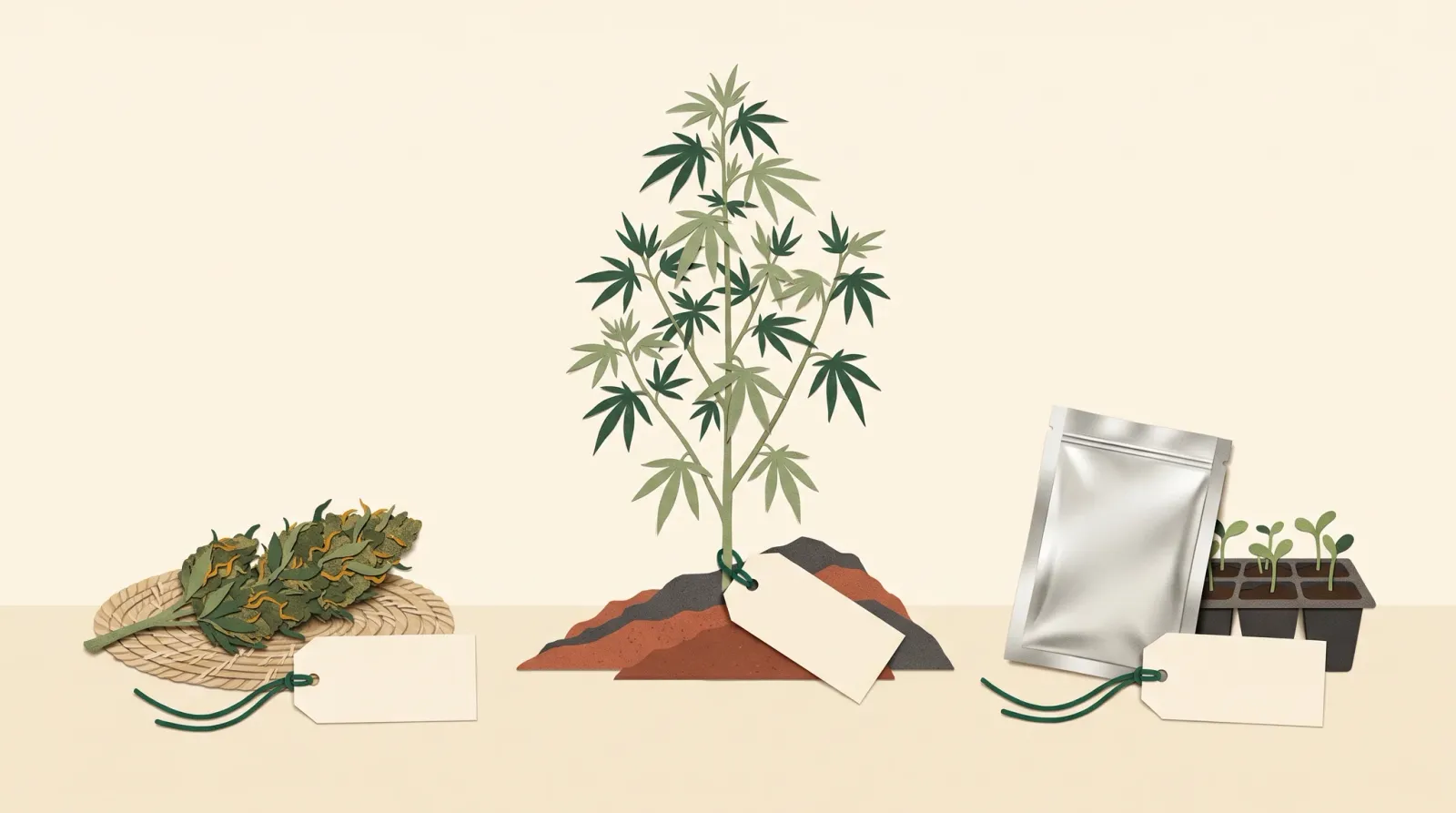
“Jamaican weed” is a reputation, not a single strain: Lamb’s Bread began as a Jamaican word for outstanding herb, Jamaican Pearl is a Dutch seed company’s cross, and Jamaican law since 2015 tickets small amounts but still bans recreational sale. Most names you see on a menu with “Jamaican” in them fall into one of those three boxes. Knowing which box a name belongs to tells you more than the name itself.
Here is the detail that settles most arguments. Asked in a September 1976 interview “What’s lamb’s bread?”, Bob Marley did not name a plant. He described a quality: “Dat is when ya really get good herb,” adding, “Some a dem ya call Bethlehem’s bread.” (1976 interview transcript) And the Jamaican Pearl that people search for was bred in Europe so it could “finish flowering in a rainy Dutch summer,” in its breeder’s own words. (breeder’s Jamaican Pearl report)
This lesson in High School covers the names, the plants and the law. It is not travel advice, and nothing here tells you what to buy or carry.
What does “Jamaican weed” actually mean?
It usually means one of three things: a word for excellent herb, cannabis grown on the island, or a cultivar bred elsewhere that borrows the island’s name. The labels blur because the same words get used for all three.
On the island, the everyday word is “ganja.” One scholar links the term to indentured East Indian labourers who arrived from the 1840s (Niaah, Caribbean Quarterly, 2023). That arrival story is the usual one, but it is not settled.
A 2025 book chapter argues that African and Maroon history shaped Jamaica’s original cultivars and that the East Indian account is a “dominant mythology” worth challenging (Moorsom, 2025). So treat any single origin story with care.
Abroad, “Jamaican” works like many geographic strain names: it signals a style and a story more than a verified address. Our guide to how strain names are built explains why place names stick. One example from our own library: Doctor Jamaica is listed as a California Orange cut, with no stated link to the island at all.
Is Lamb’s Bread a strain or a word?
It started as a word, and it is now also used as a strain name, but no documented pedigree exists for it. In the 1976 interview, Marley used “lamb’s bread” for the best herb you can find: “Sometimes ya just find a tree. It lamb’s bread.” (1976 interview transcript) That is a grade of quality, not a named cultivar with known parents.
You will often read that Lamb’s Bread was Marley’s favourite strain. His own answer does not support that. He defined the term; he did not pick a strain.
The genetics point the same way. A 2015 study genotyped 81 marijuana samples. One sample sold as “Jamaican Lambs Bread” was reported as 100% sativa. Its DNA was nearly identical (IBS = 0.98) to a reported 100% indica from Afghanistan (Sawler et al., PLOS ONE, 2015). The authors concluded that a strain’s genetic identity “cannot be reliably inferred by its name or by its reported ancestry.” Keep the limits in view. That is one sample, and the authors say a mix-up cannot be excluded. It does not prove every Lamb’s Bread is Afghan. It shows the label alone tells you little. Our summary of genotyping studies on strain names covers the wider pattern. Treat the “sativa” tag with suspicion too, as our lesson on why indica and sativa labels mislead explains.
On the island itself, Lamb’s Bread is also used as a plant name. A University of the West Indies scientist told the Jamaica Gleaner that “Lambsbread is the most reputed Jamaican landrace,” naming Thyme and Goshen as the other two known landraces (Jamaica Gleaner, 2019). A word for top-grade herb and a local plant name can both be true at once. What no source supplies is a traceable parent line for the Lamb’s Bread sold today.
You will also see Lamb’s Breath. Our strain library keeps Lamb’s Breath as a separate entry, and no record we opened settles whether the two names began as one.
Which “Jamaican” strains were bred outside Jamaica?
The best-known ones were bred by European seed companies, by their own account. The table separates what each breeder says from what is independently known.
| Strain | Who bred it | What the breeder says | Independently verified? |
|---|---|---|---|
| Jamaican Pearl | Sensi Seeds (Netherlands) | A cross of Marley’s Collie and Early Pearl, 85% sativa, bred for “a Jamaica weed that will grow in northern climates” | No; breeder’s claim |
| Marley’s Collie | Sensi Seeds | Created in 1998 from “our most exceptional Jamaican lady” pollinated by a pure Afghani cultivar | No; the Jamaican parent is not documented elsewhere |
| Jamaican Dream | Eva Seeds (Spain) | Selected from Jamaican landrace seeds, listed as 90% sativa | No; the landrace source is unnamed |
| Lamb’s Bread | No known breeder | Began as a term for top-grade herb | No pedigree on record |
Sources for the Sensi Seeds rows: the Jamaican Pearl report and the breeder’s history of its strains. The Jamaican Dream row reflects Eva Seeds’ own product listing. These are a seed company’s descriptions of its own products, so read them as claims, not proof.
Notice the pattern. Jamaican Pearl’s own breeder describes it as a Jamaican-style plant adapted to a short, wet European season. That makes it a European cultivar with a Jamaican story, not a landrace. If you want to see how parent lines stack up, our walkthrough on how to read a strain family tree helps.
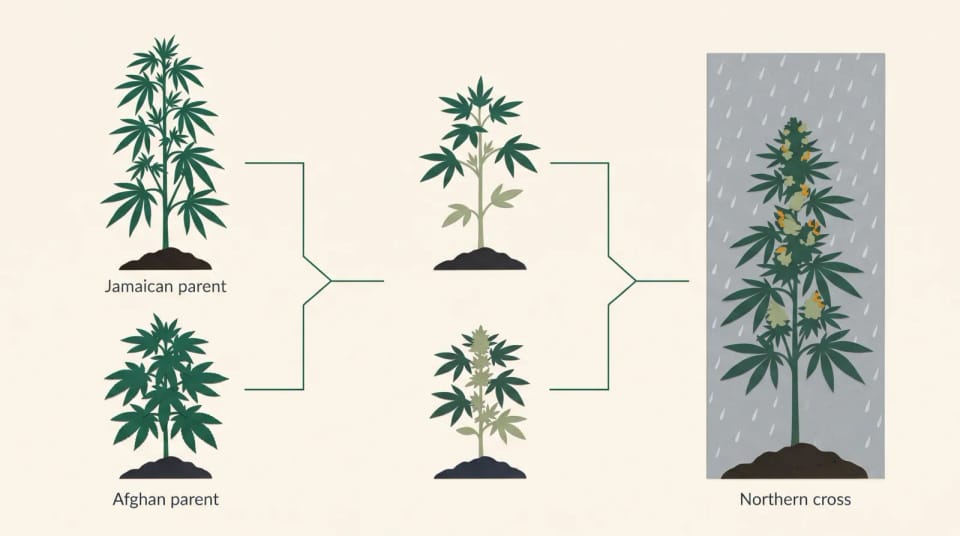
By its breeder’s account, Jamaican Pearl comes from Marley’s Collie (a Jamaican mother and an Afghan father) crossed with Early Pearl, so it can finish in a wet northern summer.
Do real Jamaican landraces still exist?
Nobody can say for sure, and the island’s own scientists are cautious. A landrace is a local population shaped by one place over many generations; our explainer on what a landrace is covers the idea. In Jamaica, the 2019 Gleaner feature reports that local sativa-leaning plants were crossed with imported indica-leaning strains from the 1990s on. The UWI scientist quoted there said “there are legitimate concerns” about whether Jamaican landraces still exist, because “hybridisation has been rampant over the past three decades.” (Jamaica Gleaner, 2019)
The same article names the best place to look: indigenous farmers such as Maroon and Rastafari growers. It also notes that the university’s own study used a landrace sourced from Dominica, not Jamaica. That detail says a lot about how hard true local material is to find.
The state is trying to protect what remains. The Cannabis Licensing Authority says it will “place primary focus on strains and cultivars that are indigenous to Jamaica” (Cannabis Licensing Authority). In April 2026, the authority launched a transitional special permit for traditional cultivators, under 2025 interim regulations (Caribbean National Weekly, 2026). Meanwhile, one scholar’s fieldwork describes imported strains and greenhouse and indoor growing on the rise (Niaah, 2023).
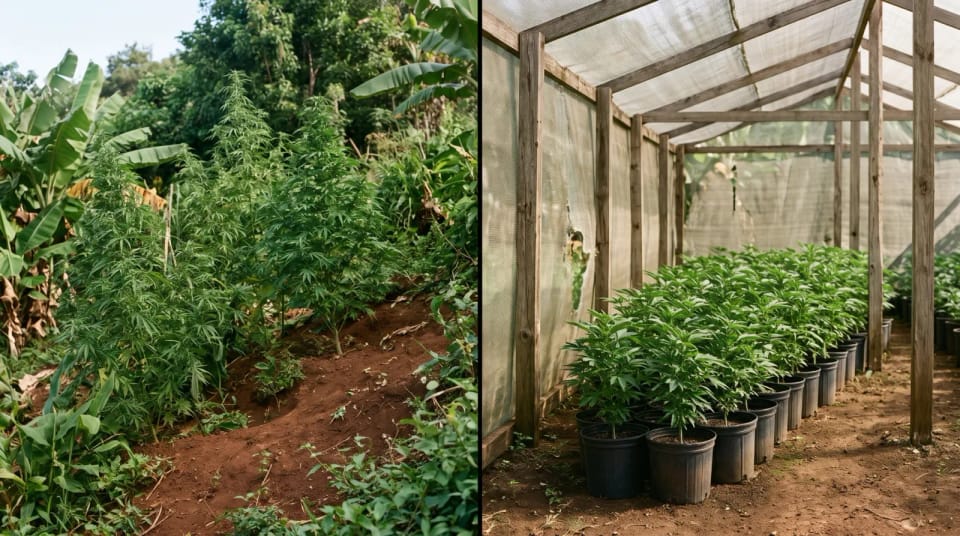
Open-field local plants and imported hybrids grown under cover now share the island. A UWI scientist told the Gleaner that crossbreeding since the 1990s makes true landraces hard to confirm.
Is Jamaican weed strong?
It used to test low and has climbed fast. A lab study of 299 herbal cannabis samples from 12 parishes found that median total THC rose from 1.1% in 2014 to 10.2% in 2020, with the highest median, 21.1%, in Manchester parish (Lindsay et al., Drug Testing and Analysis, 2023). The THC-to-CBD ratio jumped from 2.1 to 194.1 over the same years, and the samples got fresher.
Two limits matter. These were samples submitted to a lab, not a random survey of the island. And the study tested island cannabis in general, not named strains. So the percentages on a Lamb’s Bread or Jamaican Pearl listing do not describe what grows in Jamaica, and these medians do not describe any one strain.
If you are used to a mild product and try a much stronger one, the difference can catch you off guard. If cannabis leaves you with chest pain, fainting, or vomiting that keeps coming back, talk to a clinician.
Is weed legal in Jamaica?
Not in the recreational sense. Since April 15, 2015, the Dangerous Drugs (Amendment) Act has made small amounts a ticket, not an arrest. Sale outside the licensed medical system stays illegal (Ministry of Justice fact sheet, 2015). The regulator puts it plainly: marijuana, defined as cannabis with more than 1% THC, “remains an illegal drug in Jamaica” (Cannabis Licensing Authority).
| Situation | What the 2015 rules say |
|---|---|
| Two ounces or less | No arrest and no criminal record; a J$500 ticket payable within 30 days |
| More than two ounces | Still a criminal offence |
| Smoking in public, or within five metres of a public place | Prohibited; a J$500 ticket |
| Growing at home | Up to five plants per household |
| Visitors | A permit route for up to two ounces for medical or therapeutic use |
| Licensed businesses | The Cannabis Licensing Authority licenses cultivation, processing, transport, retail and research for medical, therapeutic or scientific purposes only |
Sources: the Ministry of Justice fact sheet, the Jamaica Information Service summary and the Cannabis Licensing Authority. The fact sheet dates from April 2015, and the regulator’s page is undated. We checked both on October 29, 2026, and found no official notice of a change. Amounts and fines can still be revised. Check with the Cannabis Licensing Authority or the Ministry of Justice before relying on any of it. This is not legal or travel advice.
Two more points. Fieldwork suggests “little uptake” of the five-plant household provision (Niaah, 2023). And religious use sits under separate rules administered by the Ministry of Justice, not the licensing authority. For that history, see our lesson on Rastafari’s sacramental use of ganja and the wider picture of cannabis in world religions.
Jamaica is also why our roundup of legal cannabis destinations does not list it: decriminalised is not the same as legal. For how the island’s music carried its reputation abroad, read about reggae and cannabis on record, and for the bigger comparison, how cannabis culture differs by country.
How should you read a “Jamaican” label?
Treat the name as a story and check the rest. Ask who bred it, whether the parents are documented, and what the batch’s lab label says. If you try one, the High IQ app lets you note how that strain worked for you and compare it with the next, which tells you more than the word “Jamaican” does.
Sources
-
Marley B. Interview, High Times, September 1976, reposted 17 July 2025. hightimes.com
-
Sawler J, Stout JM, Gardner KM, et al. “The Genetic Structure of Marijuana and Hemp.” PLOS ONE. 2015;10(8):e0133292. doi.org/10.1371/journal.pone.0133292
-
Lindsay CM, Bernard KK, Hammond AM, et al. “Potency trends of cannabis in Jamaica during the period of 2014 to 2020.” Drug Testing and Analysis. 2023;16:174-186. doi.org/10.1002/dta.3527
-
Niaah JAH. “From Hand Measures to Gram Weights, Ganja Becomes More Precise.” Caribbean Quarterly. 2023;69. doi.org/10.1080/00086495.2023.2294427
-
Moorsom TL. “A history and social anthropology of the African origins of Jamaica’s cannabis.” In: Intellectual Property and Cannabis. Edward Elgar; 2025. doi.org/10.4337/9781035329397.00028
-
Flynn L. “Weed Ed: Importance of landrace cannabis to new weed industry.” Jamaica Gleaner. 22 April 2019. jamaica-gleaner.com
-
Ministry of Justice (Jamaica). “Dangerous Drugs (Amendment) Act: Facts.” Jamaica Information Service, April 2015. jis.gov.jm PDF and web summary
-
Cannabis Licensing Authority of Jamaica. “About the Authority.” Accessed 29 October 2026. cla.gov.jm
-
Davis J. “Jamaica launches Medical Cannabis Special Permit programs.” Caribbean National Weekly. 20 April 2026. caribbeannationalweekly.com
-
Breeder records, accessed 29 October 2026 (the breeders’ own claims): Sensi Seeds, Jamaican Pearl report and strain history; Eva Seeds, Jamaican Dream product listing.
Key takeaways
- “Jamaican weed” is a reputation that covers three things: a praise word, island-grown plants and foreign-bred cultivars.
- Lamb’s Bread began as a word for top-grade herb. Marley defined it in 1976; he did not name it as a strain.
- Jamaican Pearl and Marley’s Collie are Dutch crosses by their breeder’s account; Jamaican Dream is a Spanish selection.
- True Jamaican landraces may be rare or gone after decades of crossbreeding.
- Island samples tested low in 2014 and much stronger by 2020.
- Since 2015, two ounces or less brings a ticket, not an arrest, but recreational sale is still illegal.
FAQ
Is Jamaican Pearl from Jamaica?
No, not by its breeder’s account. Sensi Seeds, a Dutch company, says it bred Jamaican Pearl from Marley’s Collie and Early Pearl so it would finish in a rainy Dutch summer. Marley’s Collie itself is described as a Jamaican mother crossed with an Afghan plant, so there is a Jamaican story in the family tree, but the cultivar was made in Europe.
Was Lamb’s Bread Bob Marley’s favorite strain?
His own words do not say so. In a 1976 interview, he answered “What’s lamb’s bread?” by describing really good herb, not a strain, and added that some people call it “Bethlehem’s bread.” The favourite-strain story is repeated widely, but that interview does not support it.
Is Jamaican weed really better?
There is no evidence that it is better as a rule. Lab samples from the island had a median total THC of 1.1% in 2014 and 10.2% in 2020, and those are averages across submitted samples, not a quality ranking. Freshness, growing and curing vary from batch to batch wherever cannabis comes from.
Is Lamb’s Bread the same as Lamb’s Breath?
Nobody has shown where either spelling began. Our strain library lists Lamb’s Bread and Lamb’s Breath as separate entries, and neither has a documented parent line. Treat both as names, and judge a batch by its lab label rather than its spelling.
What strains grow in Jamaica?
Older local plant names include Lambsbread, Thyme and Goshen, according to a UWI scientist quoted by the Jamaica Gleaner, though that scientist doubts true landraces survive unchanged. Imported hybrids and greenhouse growing have expanded since the 1990s, and a 2023 study describes shops with menus of up to thirty strains.



