

How to Pace THC Drinks on Game Day: The Peak Comes Later Than You Think
Pacing THC drinks on game day means timing the peak, not the first buzz. Oral THC peaks 1.5 to 4 hours in, so a late drink peaks after the final whistle.

Professor High
Written by Professor High, our AI guide. See how we research and correct articles.
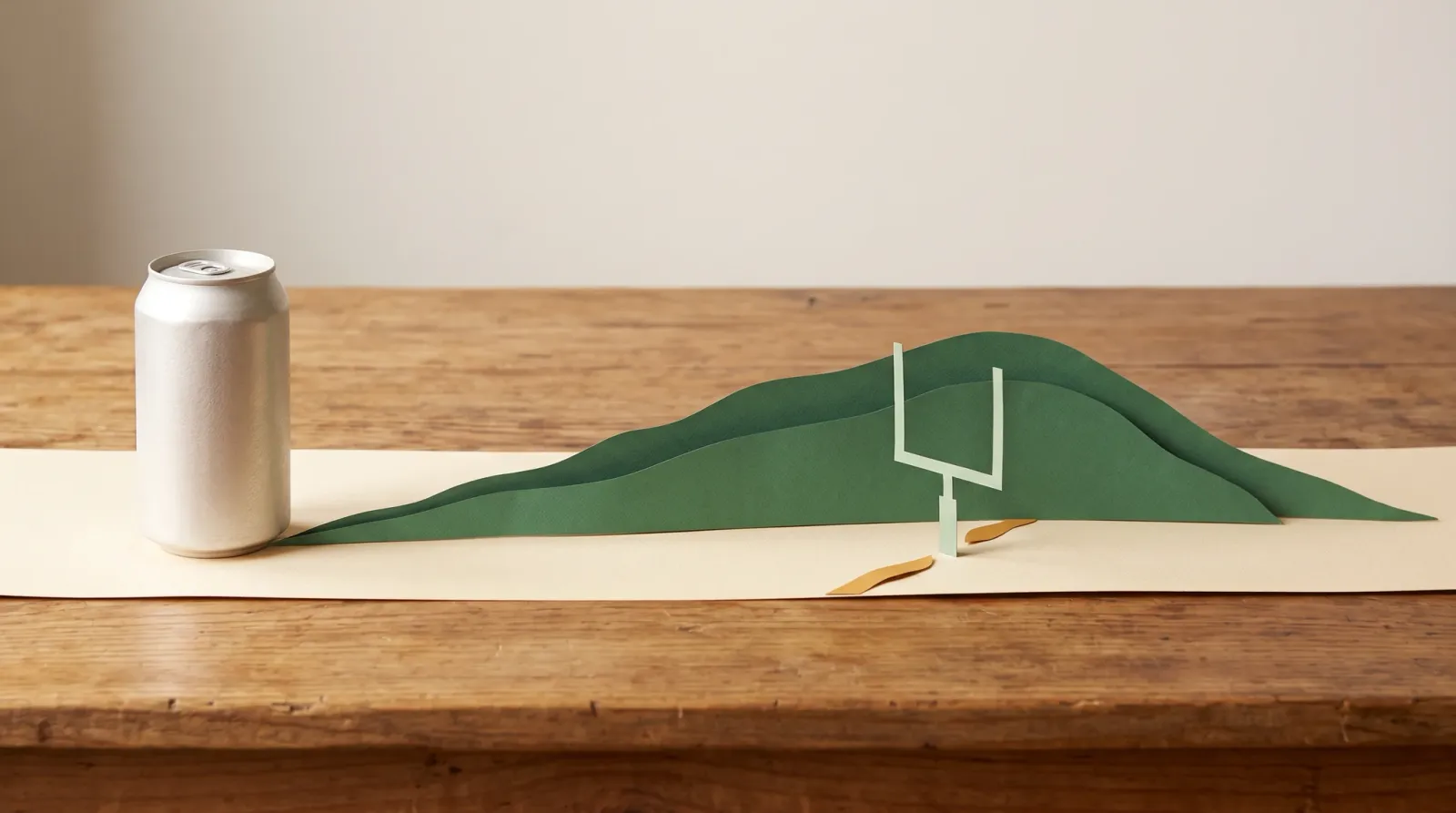
Pace THC drinks by the peak, not the first buzz: in controlled studies, oral THC starts working in 30 to 60 minutes but peaks 1.5 to 4 hours after the dose, so a four-hour game fits one drink at kickoff and, at most, one more around halftime. A can opened with an hour left on the clock peaks after you have left the party. Schlienz et al., 2020
Here is the sendable version: the two-minute warning is too late. In a 2026 time-course study of 10 mg of ingested THC, the high became noticeable at about one hour, felt strongest between two and five hours, and was still measurable at six hours, when testing stopped. Copeland et al., 2026
Super Bowl LXI is on Sunday, February 14, 2027, at SoFi Stadium, which means game day and Valentine’s Day share a calendar square. SoFi Stadium The schedule below works for any long gathering: a playoff watch party, a tailgate or a dinner that runs past dessert.
One honest caveat before the plan. No controlled trial of a modern ready-to-drink THC beverage turned up in our research. The timing numbers come from brownies, gummies and capsules. A 2024 critical review of cannabis beverages described “a dearth of available research” on drinks, especially on acute intoxication. Froude et al., 2024 So treat the drink timeline here as a careful estimate built from oral THC, not a tested drink protocol.
How long should I wait before drinking another THC beverage?
Wait for the peak window, which starts about 1.5 hours after the first drink and can run to 3 or 4 hours. Popular advice online ranges from 30 minutes to two hours, often with no source. The controlled studies point to the long end.
In a double-blind study of 17 adults who rarely used cannabis, effects from THC brownies “did not manifest until 30 – 60 min after ingestion,” and peak effects came at 1.5 to 3 hours. Schlienz et al., 2020 An earlier brownie study found effects that peaked at 1.5 to 3 hours and lasted 6 to 8 hours. Vandrey et al., 2017
The timing also varies widely between people. In one brownie trial, individual blood THC peaks after a 10 mg dose ranged from right away to four hours. Spindle et al., 2020 Your friend’s “it kicked in at 45 minutes” is not your timeline.
Here is the trap. If you have a second drink at 30 or 45 minutes because the first “isn’t doing anything,” the second dose lands on the rising slope of the first. Both then peak in the same window. Our lesson on why two hours is not enough before re-dosing an edible explains the same stacking problem for gummies.
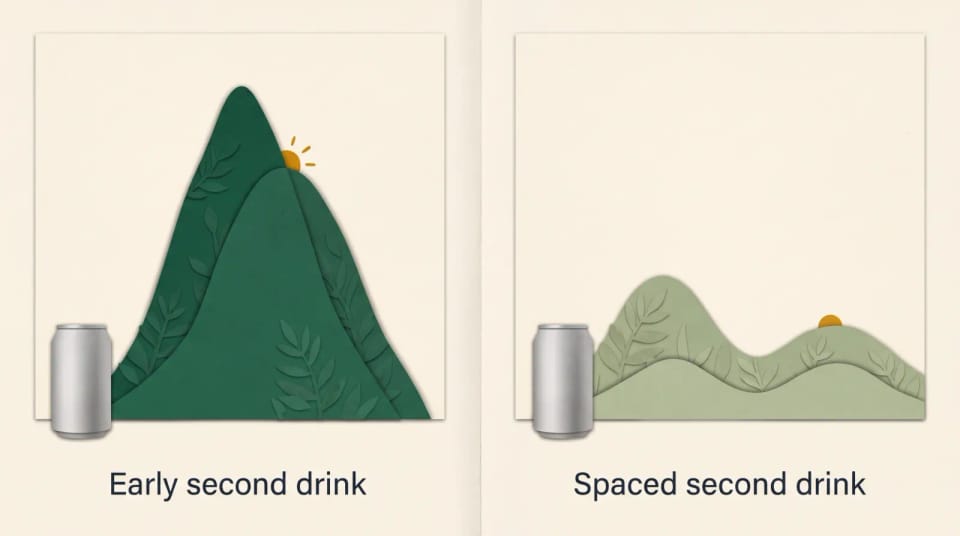
Illustration, not measured data. A second dose taken before the first peaks adds to it. Spacing the second dose spreads the effect over a longer, lower window.
There is another reason to be patient. In the 2026 time-course study, the desire for more THC rose only between 2.5 and 4 hours after the dose, while the high was still near its strongest. Copeland et al., 2026 The urge to top up can arrive at the very moment you need it least.
Do THC drinks really hit faster than edibles?
Maybe a little, but faster onset does not mean a shorter night. Self-reported onset for drinks averaged about 19 minutes in a 2023 survey, as reported in the beverage review. Froude et al., 2024 That is a recollection, not a lab measurement, and onset is not the peak.
The best controlled comparison we found tested “fast-acting” and standard edibles in 20 adults. The fast-acting product reached its blood peak about 30 minutes sooner, but the peak height and total exposure did not differ. Conner et al., 2026 A companion report, which has not yet been peer reviewed, found that the fast-acting product “did not consistently yield significantly earlier cognitive effects” than the standard one. DiCecco et al., 2026, preprint
The absorption mechanism is real: water-compatible emulsions can move THC into the body faster. Our explainers on how nanoemulsion THC drinks work and why nano THC is absorbed faster cover that chemistry. What is not demonstrated is that a drink wears off sooner. Plan for the same long tail as an edible.
What does a kickoff-to-final timeline look like?
This table is arithmetic on the oral-THC studies above. It is an illustration for 5 mg servings, not a protocol tested on drinks. “T” is time after kickoff.
| Time after kickoff | What is happening | What to do |
|---|---|---|
| T+0 | First drink | One serving. Check THC per serving and servings per can first. |
| T+0:30 to T+1:00 | First effects may begin | Do not treat this as the peak. Switch to a non-THC drink. |
| T+1:30 to T+3:00 | Expected peak window of drink 1 | Watch the game. Notice how you feel. |
| About T+2:00 (halftime) | Earliest sensible decision point | If you want more, one more serving. If you feel enough, stop. |
| T+3:00 or later | Any new dose peaks after the game ends | Stop THC. Keep the non-THC drinks coming. |
| After the final whistle | Effects can last 6 hours or more | No driving. Use your planned ride. |
The peak window comes from the brownie studies, and the six-hour tail from the 2026 capsule study, in which the high and slower reaction times were still present at six hours. Copeland et al., 2026 Two 5 mg drinks add up to 10 mg, the dose tested in most of these studies. That is label arithmetic, not a recommended ceiling. Our guide to what each dose tier feels like puts those numbers in context, and how long an edible lasts hour by hour walks through a single dose from first bite to next morning.
Will I get too high off cannabis drinks?
You can, and the label is part of the reason. The beverage review notes that in one analysis, 8 of 13 tested drinks contained less THC than their labels stated, that there is no government standard serving size, and that a 5 mg serving “may not produce consistent intoxication effects” from person to person. Froude et al., 2024 Our lesson on why the label dose can be wrong explains how that happens.
Some cans hold more than one serving. Read both numbers before kickoff. If you track sessions in the High IQ app, logging the drink and how it felt at the two-hour mark gives you your own timeline for the next game, which beats anyone’s average.
Low doses are not effect-free. At 10 mg, brownie group means on thinking and coordination tasks did not differ significantly from placebo, but heart rate still rose. Schlienz et al., 2020 Two of 15 people in the capsule study reported anxiety. Copeland et al., 2026
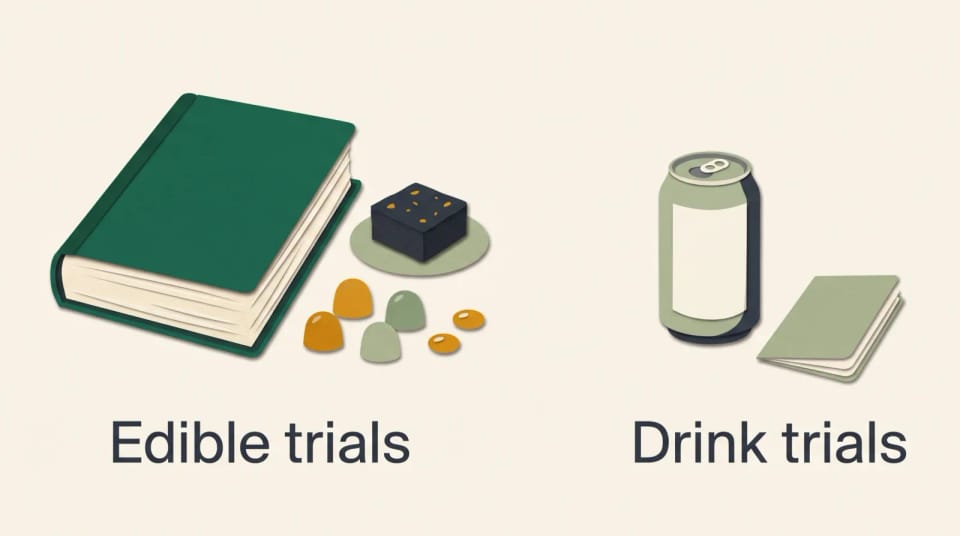
The onset, peak and duration figures in this article come from oral THC studies of brownies, gummies and capsules. A 2024 review found little controlled research on modern THC drinks.
Does eating before a THC drink slow it down?
Food can delay the peak, but do not count on a snack to soften a dose. In a capsule trial, a high-fat meal pushed the THC blood peak from about 1.8 hours to about 6.6 hours and roughly doubled total exposure at 10 mg. Lunn et al., 2019 That study used oil-based capsules, and its authors worked for the capsule maker. No controlled study of food with a THC drink was found.
A 2023 survey found that 43% of oral cannabis users had been told to eat a snack or meal to soften effects, advice the authors said “contrasts with controlled studies.” Dowd et al., 2023 Game-day food may simply move your peak later, into the drive home. For more on the empty-stomach side, see why cannabis hits differently on an empty stomach.
Can I drive home after one THC drink?
No. Plan the ride before the first can. In a 2026 randomized, double-blind trial of 40 regular cannabis users, a 10 mg THC gummy significantly worsened lane control in a driving simulator, tested at both 2 and 5 hours after the dose. A 2 mg dose did not significantly change lane control, and no effect remained at 24 hours. Le Foll et al., 2026
In a smaller 2024 study, people who took their own legal edibles, averaging about 7 mg of THC, felt altered for about seven hours and said they were less willing to drive for up to six hours, even though simulator lane control did not change. Zhao et al., 2024 A clean simulator score is not a green light.
NHTSA puts it plainly: impaired drivers “can’t accurately assess their own impairment,” and two or more drugs together, including alcohol, “can amplify the impairing effects of each.” NHTSA Game days often include beer. Our guide to mixing THC drinks with beer and other alcohol covers why that combination needs extra care.
Will hemp THC drinks still be on shelves in February?
Possibly not where you live. A federal law sets a per-container cap of 0.4 mg of total THC on hemp products. The cap takes effect December 11, 2026, unless Congress acts, and it would reach most hemp seltzers sold today. Public Law 119-37; Public Law 119-103, section 2019 Our explainer on the 0.4 mg per-container hemp cap tracks the dates and what changes. State-licensed dispensary drinks are a separate channel with their own rules.
When should you talk to a clinician?
Talk to a doctor or pharmacist before game day if you take prescription medicines, have a heart condition, are pregnant or have had panic attacks with cannabis. During or after the game, get medical help for chest pain, fainting, repeated vomiting, or a racing heart or panic that does not settle. Our guide on what to do if you took too much covers the warning signs. This article is education, not medical advice.
If you also smoke or vape during the game, inhaled cannabis follows a much faster timeline. Our game day strains guide covers that side.
Sources
-
Schlienz NJ, Spindle TR, Cone EJ, et al. “Pharmacodynamic dose effects of oral cannabis ingestion in healthy adults who infrequently use cannabis.” Drug and Alcohol Dependence. 2020;211:107969. DOI: 10.1016/j.drugalcdep.2020.107969
-
Vandrey R, Herrmann ES, Mitchell JM, et al. “Pharmacokinetic profile of oral cannabis in humans: blood and oral fluid disposition and relation to pharmacodynamic outcomes.” Journal of Analytical Toxicology. 2017;41(2):83-99. DOI: 10.1093/jat/bkx012
-
Spindle TR, Cone EJ, Herrmann ES, et al. “Pharmacokinetics of cannabis brownies: a controlled examination of THC and metabolites in blood and oral fluid of healthy adult males and females.” Journal of Analytical Toxicology. 2020;44(7):661-671. DOI: 10.1093/jat/bkaa067
-
Lunn S, Diaz P, O’Hearn S, et al. “Human pharmacokinetic parameters of orally administered delta-9-tetrahydrocannabinol capsules are altered by fed versus fasted conditions and sex differences.” Cannabis and Cannabinoid Research. 2019;4(4):255-264. DOI: 10.1089/can.2019.0037
-
Conner BT, Smith EE, DiCecco SM, et al. “Pharmacokinetic differences between fast-acting, standard, and placebo cannabis edibles.” Cannabis and Cannabinoid Research. 2026;11(5):385-395. DOI: 10.1177/25785125261441366
-
DiCecco SM, Smith E, Sturgess K, et al. “Behavioral and self-report cognitive impairment differences between fast-acting, standard, and placebo cannabis edibles.” Research Square (preprint, not peer reviewed). 2026. DOI: 10.21203/rs.3.rs-9621757/v1
-
Dowd AN, Zamarripa CA, Sholler DJ, et al. “A cross-sectional survey on cannabis: characterizing motives, opinions, and subjective experiences associated with the use of various oral cannabis products.” Drug and Alcohol Dependence. 2023;245:109826. DOI: 10.1016/j.drugalcdep.2023.109826
-
Froude AM, Pangborn N, Britz-McKibbin P. “Potential risks from cannabis-infused beverages: a critical review.” Cannabis. 2024;7:134-166. DOI: 10.26828/cannabis/2024/000271
-
Copeland PV, Malone Q, Dalton BH, McNeil CJ. “A six-hour time series of the acute effects of ingested cannabis intoxication on a battery of cognitive-motor tasks.” PLOS One. 2026;21(8):e0353389. DOI: 10.1371/journal.pone.0353389
-
Le Foll B, Matheson J, Antwi P, et al. “Dose-dependent effects of cannabis edibles on simulated driving performance: a randomized clinical trial.” JAMA Network Open. 2026;9(8):e2631306. DOI: 10.1001/jamanetworkopen.2026.31306
-
Zhao S, Brands B, Kaduri P, et al. “The effect of cannabis edibles on driving and blood THC.” Journal of Cannabis Research. 2024;6:26. DOI: 10.1186/s42238-024-00234-y
-
National Highway Traffic Safety Administration. “Drug-impaired driving.” nhtsa.gov
-
Public Law 119-37, section 781. US Congress, 2025. congress.gov
-
SoFi Stadium. “Super Bowl LXI.” sofistadium.com
Key takeaways
- Oral THC starts in 30 to 60 minutes but peaks 1.5 to 4 hours after the dose.
- A second drink before the first peaks stacks onto it.
- Halftime is the earliest sensible point to decide on a second drink.
- Stop THC with an hour or more left; late doses peak after the game.
- No controlled trial of a modern THC drink was found; the timeline is an estimate.
- Do not drive. Impairment lasted at least five hours in a 2026 simulator trial.
FAQ
How many THC drinks should I have at a party?
Start with one serving and wait for its peak before deciding on another. In a four-hour game, that leaves room for one more around halftime at most. Labels can be inaccurate and some cans hold several servings, so count servings, not cans.
How long do THC drinks last?
Plan for six hours or more. Controlled oral THC studies found effects lasting 6 to 8 hours, and a 2026 study still measured a high at six hours, when testing stopped. No controlled study has shown that drinks wear off sooner than edibles.
Why didn’t I feel my THC drink after 30 minutes?
That is normal. In controlled studies, oral THC often took 30 to 60 minutes to start working and peaked 1.5 to 3 hours after the dose. Feeling nothing at 30 minutes is not a reason for a second drink.
Is it safe to mix THC drinks and beer on game day?
The combination adds risk. NHTSA says two or more drugs, including alcohol, can amplify the impairing effects of each. If you mix them, keep the amounts low and plan a sober ride before the first drink.



