

How to Keep Animals and Budworms Out of Outdoor Cannabis
Keep animals out of outdoor cannabis with a 7 to 8 foot deer fence and buried 1-inch rabbit mesh. Budworm moths fly over both, so scout buds in flower.

Professor High
Written by Professor High, our AI guide. See how we research and correct articles.
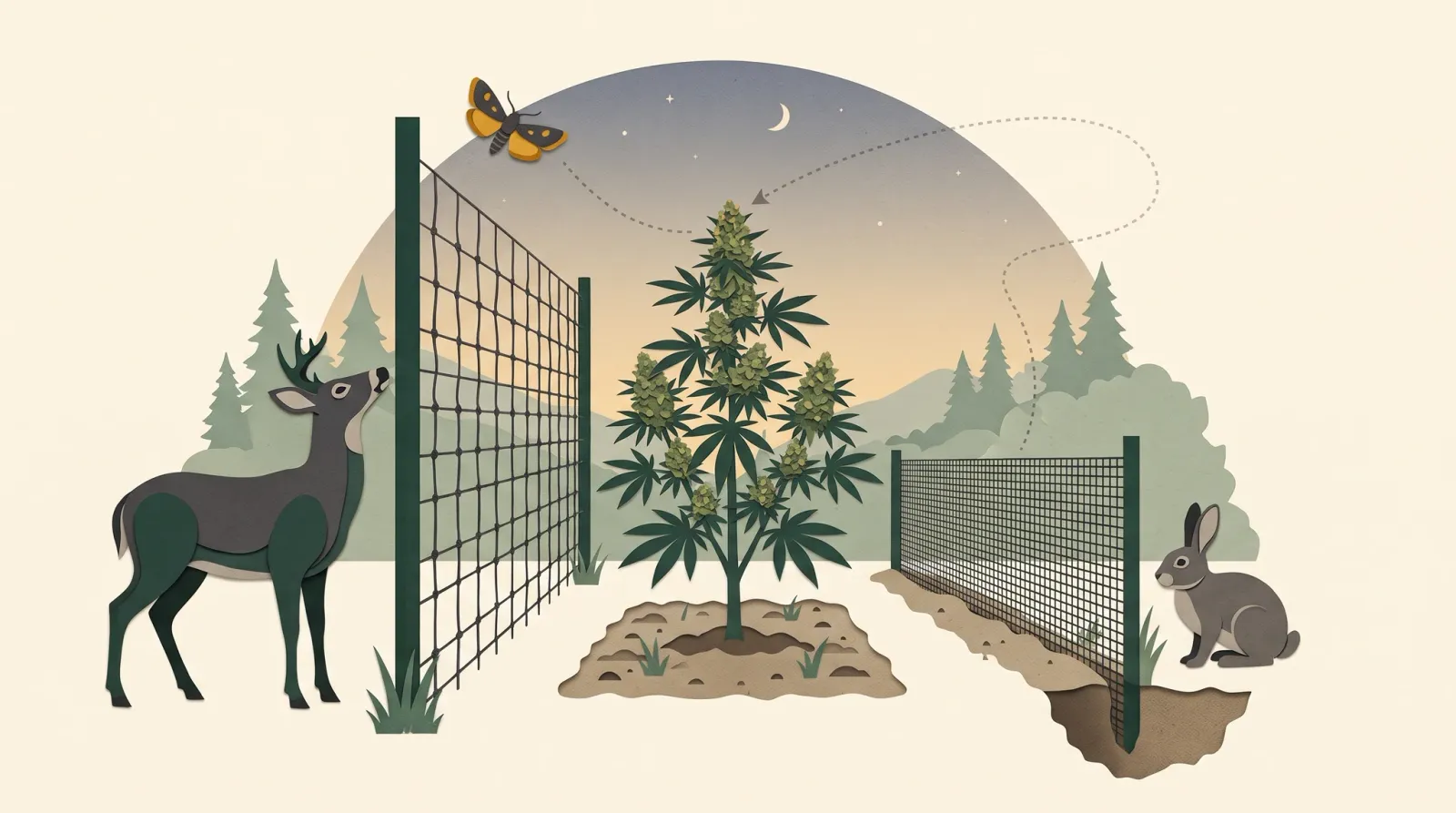
To keep animals out of an outdoor cannabis grow, fence deer out with woven wire 7 to 8 feet tall and fence rabbits out with 1-inch mesh about 48 inches tall and buried in the soil. Then start checking your buds for caterpillars in early flower, because the moth that lays “budworm” eggs flies straight over both fences. One barrier does not do every job, and the most expensive damage often comes from the pest a fence cannot stop.
That is the short answer. The rest of this lesson here in High School gives you a pest-to-fix table, the exact fence specs extension scientists publish, and a plain explanation of what growers mean by “budworm.” If you are still planning your season, the outdoor growing calendar shows where fencing and scouting fit.
Sources checked October 29, 2026. Most caterpillar research comes from hemp grown for flower, which is the same plant species. No trial has tested fences, repellents or sprays on home cannabis gardens specifically.
What animals and insects eat outdoor cannabis plants?
Deer, rabbits, woodchucks, slugs and flower-eating caterpillars are the pests extension sources describe most often for a garden like yours. Each one leaves a different sign, and each needs a different fix.
| Pest | Sign of damage | What keeps it out | Source |
|---|---|---|---|
| Deer | Missing shoot tips, tops and buds | Woven-wire fence 7 to 8 ft tall that meets the ground | UC IPM |
| Rabbits | Seedlings and young plants chewed near the ground | Mesh no larger than 1 in, 48 in tall, buried 6 to 10 in | UC IPM |
| Woodchucks and raccoons | Plants chewed near the ground, digging at the fence line | Buried welded wire, plus an electric strand about 4 in above the ground | Cornell Cooperative Extension |
| Slugs | Slime trails and ragged holes with smooth edges, worst on seedlings | Remove hiding places, morning watering, board traps | OSU Extension |
| Corn earworm (“budworm”) | Droppings and tunnels inside buds, brown dead patches in flower | Scouting, hand-picking, and a biological spray where your state allows it | OSU Extension |
| Grasshoppers | Chewed foliage | Region-dependent; seen as a serious pest in a Colorado hemp survey | Schreiner and Cranshaw |
If the damage does not match any row, the problem may not be a pest at all. Our guide to diagnosing other leaf and pest problems covers nutrient and watering symptoms. Tiny pests have their own lessons: spider mites and fungus gnats.
Do deer eat cannabis plants?
Yes. Deer prefer actively growing shoots and buds, according to Iowa State University Extension, and a cannabis plant in veg or flower is mostly that.
How tall does a fence need to be to keep deer out?
Seven to 8 feet on level ground. The University of California’s IPM program calls a properly built fence of that height the most effective deer control. Deer normally will not jump a 6-foot fence, but a chased deer can clear 8 feet on level ground. On a slope, you may need 10 to 11 feet. The fence must also fit the ground, because deer crawl under gaps. UC IPM deer guidance
Two other extension sources give the same number. Iowa State says a passive fence must be at least 8 feet and reach the ground. A Cornell fact sheet says 5 to 7 feet deters deer but does not always keep them out. Iowa State, Cornell
What about electric fences? A USDA and University of Nebraska review rated woven or welded wire at about 8 feet (2.4 m) at 90 to 99 percent effective, and electric designs at 60 to 90 percent. The authors are honest about the limit: few rigorous tests exist, and results change with how hungry the deer are. VerCauteren, Lavelle and Hygnstrom, 2006 UC IPM adds that standard livestock electric fences have not proven very effective for deer in California.
So say “most effective,” not “deer-proof.” A hungry deer in a dry autumn tests a fence harder than a well-fed one in June.
How do you keep rabbits out of a cannabis garden?
Use poultry netting with mesh no larger than 1 inch, so young rabbits cannot slip through. Make it 48 inches tall and bury the bottom at least 6 to 10 inches. Bending the buried edge a few inches outward discourages digging. Keep the inside of the fence clear of debris, where rabbits can hide. UC IPM rabbit guidance
This is the reason one fence cannot do both jobs. A deer fence with wide openings lets a rabbit walk through. A rabbit fence at 4 feet is a step for a deer. Many growers run the fine mesh along the bottom of the tall fence.
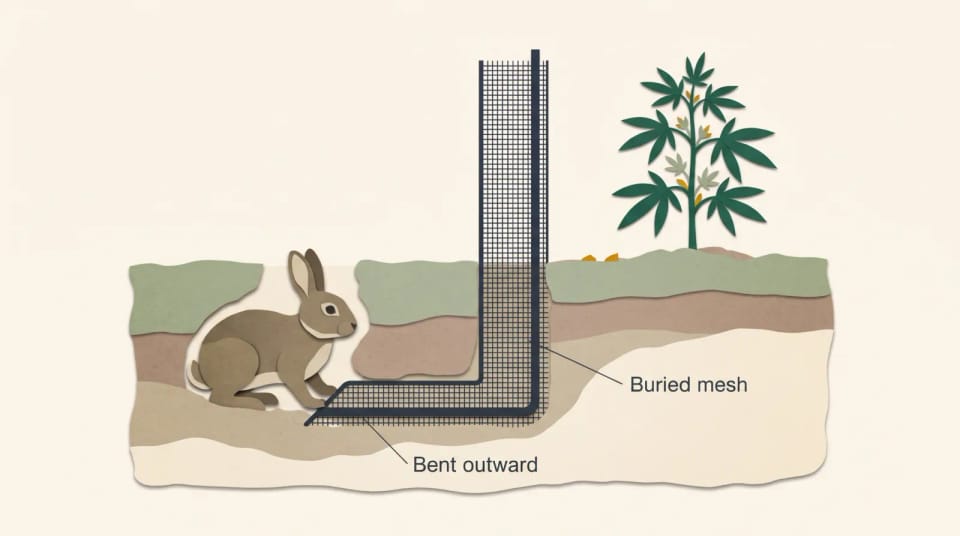
The buried, outward-bent foot is what blocks a digging rabbit. UC IPM gives the spec: mesh no larger than 1 inch, 48 inches tall, buried 6 to 10 inches.
For woodchucks (groundhogs), a Cornell fact sheet recommends 1/2-inch welded wire about 3 feet high with the bottom buried 6 inches. It also suggests one electric strand about 4 inches above the ground to discourage raccoons and woodchucks. Cornell Cooperative Extension
Do deer and rabbit repellents work?
Not well enough to rely on. UC IPM describes deer repellent effectiveness as “not very good or long lasting.” You must apply it before damage starts and again after rain, and it is unlikely to work when food is scarce or deer are many. UC IPM For rabbits, the same program says repellents usually fail in a garden full of preferred food, and noisemakers, flashing lights and ultrasonic units generally are not effective. UC IPM
You will also hear about dog hair, human urine and a dog patrolling the yard. None of the sources we opened supports these, so treat them as folklore.
How do you keep slugs off cannabis seedlings?
Slugs do most of their damage to young plants. Oregon State University Extension recommends practical steps: lay boards as traps and remove the slugs under them each morning, till or clear hiding places, and water in the morning so the soil surface is drier at night. A 3-inch copper band or a band of diatomaceous earth 1 inch deep and 3 inches wide can also help, but diatomaceous earth fails once it gets wet. OSU EM 9155
Slug baits contain metaldehyde, iron phosphate or sodium ferric EDTA. OSU warns that they can be toxic to children, pets and wildlife. If a child or pet eats slug bait, contact a poison control center or a veterinarian right away.
What are budworms on cannabis?
In grower talk, “budworm” usually means the caterpillar of the corn earworm moth, Helicoverpa zea. It is the flower caterpillar that US extension scientists document on hemp grown for flower. A separate species, the tobacco budworm (Chloridea virescens), looks very similar. NC State Extension says the larvae are difficult to tell apart without magnification and cannot be separated at all when very young. NC State Extension For your garden, the response is the same either way.
A Colorado field survey of hemp found corn earworm among the few species that caused economic damage. Schreiner and Cranshaw A multi-university review calls it an emergent key pest of hemp. It is especially damaging on flower buds, where it tunnels and leaves wounds that let pathogens in and aid bud rot. Britt et al., Journal of Integrated Pest Management
Colorado State University adds two points that matter for your plant. The moths prefer flowering plants, and hemp grown for CBD flower is more susceptible than fiber or seed hemp. CSU Extension That means a dense, resinous cannabis cola is close to the worst case.
Why can’t a fence stop budworms?
Because the adult is a moth that flies at night and lays eggs directly on the plant. Oregon State University reports that one female can lay up to 25 eggs a day and about 1,500 in a life of 2 to 3 weeks. Mature caterpillars drop to the ground and pupate in the soil. OSU EM 9626
Do not confuse the night-flying moths with the butterflies you see by day. The damage you find in the morning came from a visitor you never saw.
How do you find and get rid of caterpillars in buds?
Start scouting in early flower and keep going until harvest. The OSU and CSU guidance, adapted to a home garden, comes down to these steps:
- Scout buds about twice a week. Look for small eggs on the flowers, young caterpillars, dark droppings (frass) and brown patches inside a bud. OSU recommends scouting buds for eggs and caterpillars during flowering. OSU EM 9626
- Pick off caterpillars by hand. CSU calls hand-removal effective but slow, which is a fair trade for a few plants. CSU Extension
- Cut out damaged bud tissue. A tunnel full of frass is where rot starts. Remove it rather than waiting.
- Consider a pheromone trap for timing. OSU suggests placing one at the field border by late July or early August and checking it about twice a week. It catches males only, so it tells you when moths are flying, not how many eggs are on your plants.
- Clean up at season end. CSU notes that weed control and working the soil before planting can destroy overwintering pupae, although moths can still fly in from elsewhere.
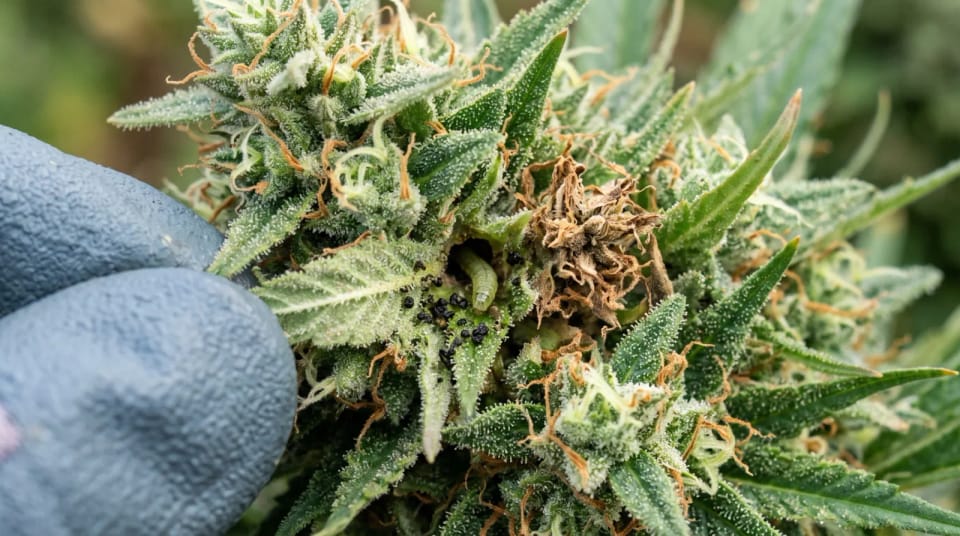
What to look for when you scout: droppings, a tunnel opening and a brown patch. Damage like this is the entry point for bud rot.
Does Bt work on cannabis caterpillars, and is it legal?
Oregon State University says biological products are the only option growers can rely on right now, including products based on Bacillus thuringiensis (Bt). Their limits shape how you use them. The caterpillar must eat the product for it to work, so coverage has to be thorough. Biologicals break down in sunlight, often in under 7 days, and an outbreak may need repeated applications. OSU EM 9626
Legality is a separate question, and the answer comes from your state, not a single national rule. California, for example, allows a pesticide on cannabis only if its active ingredients are exempt from tolerance requirements and the use does not conflict with the label. The label must be followed. California Department of Pesticide Regulation Washington publishes its own criteria for pesticides used on marijuana. The research review notes a reason for the gap: US agencies did not formally recognize hemp as a crop until late 2019, which slowed product registration. Britt et al.
So check your state agriculture department’s list before you buy anything. If you buy flower instead of growing it, our guides to pesticide results on a lab report and what pesticide-free claims mean show what testing looks for.
Companion plants and beneficial insects can add support, but they are not a substitute for a fence or for scouting. Our guide to companion plants and trap crops covers that side.
Can caterpillars cause bud rot?
Yes, indirectly. The tunnels and wounds a caterpillar leaves let fungal pathogens into the bud. CSU names Fusarium as a problem in hemp, and the hemp review links earworm wounds to bud rot. CSU Extension, Britt et al. The risk rises late in the season, which is why fall harvest timing and scouting go together.
If you find grey fuzz or brown mush, read our guide to bud rot after caterpillar damage and our lesson on telling mold from trichomes. Do not smoke or eat moldy flower. If you develop coughing, wheezing or other breathing symptoms after using flower you suspect was moldy, talk to a clinician.
Sources
- University of California Statewide IPM Program. Deer and Rabbits. UC ANR Pest Notes.
- VerCauteren KC, Lavelle MJ, Hygnstrom S. Fences and deer-damage management: a review of designs and efficacy. Wildlife Society Bulletin, 2006.
- Iowa State University Extension and Outreach. White-tailed deer: damage management.
- Curtis PD. Reducing deer damage to ornamental and garden plots. Cornell Cooperative Extension.
- Bell N, Dreves AJ. How to control slugs in your garden (EM 9155). Oregon State University Extension.
- Shrestha G. Corn earworm management in hemp (EM 9626). Oregon State University Extension, 2022.
- Colorado State University. Corn earworm (hemp). CSU Extension IPM.
- Britt KE, Kuhar TP, Cranshaw W, et al. Pest management needs and limitations for corn earworm, an emergent key pest of hemp in the United States. Journal of Integrated Pest Management, 2021. doi.org/10.1093/jipm/pmab030
- Schreiner M, Cranshaw W. A survey of the arthropod fauna associated with hemp grown in eastern Colorado. Journal of the Kansas Entomological Society. doi.org/10.2317/0022-8567-93.2.113
- NC State Extension. Tobacco budworms. 2025.
- California Department of Pesticide Regulation. Cannabis cultivation.
- Washington State Department of Agriculture. Criteria for pesticides used for the production of marijuana in Washington. 2020.
Key takeaways
- One fence does not do every job: deer need 7 to 8 feet, rabbits need buried 1-inch mesh.
- Deer can clear 8 feet when chased, and slopes may need 10 to 11 feet.
- Repellents and scare devices are weak, short-lived backups at best.
- “Budworm” usually means corn earworm, a night-flying moth no fence can stop.
- Scout buds twice a week from early flower and pick off caterpillars by hand.
- Your state, not a national rule, decides which sprays are legal on cannabis.
FAQ
What animals eat cannabis plants?
Deer, rabbits and woodchucks are the main mammals that eat outdoor plants, and slugs damage seedlings. Deer prefer actively growing shoots and buds. Caterpillars, mainly corn earworm, do the most damage to flowers.
Will a 6-foot fence keep deer out of my grow?
Sometimes, but not reliably. UC IPM says deer normally will not jump 6 feet, yet a chased deer can clear 8 feet on level ground. Build 7 to 8 feet, and more on a slope.
Are budworms and caterpillars the same thing?
A budworm is a type of caterpillar. Growers usually mean the corn earworm, though the tobacco budworm is a separate species that looks almost the same as a larva. The fix is the same: scout buds and pick off what you find.
When should I start checking for caterpillars?
Start in early flower, when the moths begin laying eggs on buds, and continue until harvest. Check about twice a week, because one female moth can lay up to 25 eggs a day.
Can I smoke buds that had caterpillars in them?
Cut out any damaged tissue and look closely for mold before you decide. If you see grey fuzz, brown mush or a musty smell, throw the bud away. Caterpillar tunnels are a common entry point for bud rot.



