

Thrips on Cannabis: The Black-Speck Test That Tells Them From Spider Mites
Thrips on cannabis leave silvery scars plus tiny black specks; spider mites do not. Learn the check, and why a leaf spray misses the stage in the soil.

Professor High
Written by Professor High, our AI guide. See how we research and correct articles.
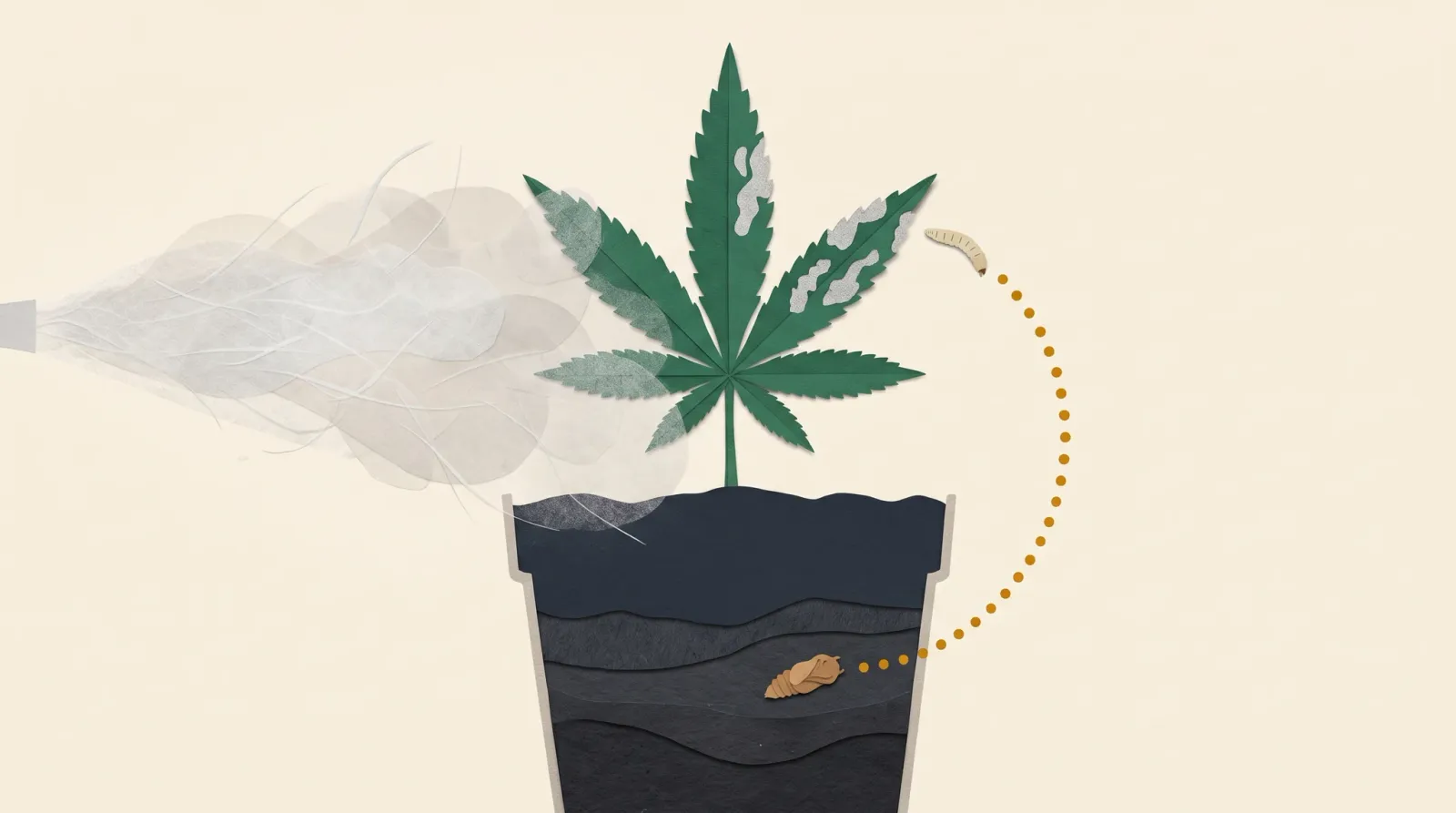
Thrips leave silvery scars on cannabis leaves plus tiny black specks of excrement, and spider mites do not leave those specks. That one detail is the fastest way to tell the two pests apart. The second thing to know is that young thrips drop off the plant to pupate, often in the growing medium, so a leaf spray on its own misses a whole life stage.
Here is the version you can send to a friend: look for black specks, then look in the soil. British Columbia’s government pest manual for commercial cannabis says thrips “leave excrement which appears as little black dots” and that “this allows you to differentiate between thrips and two spotted spider mite damage.” It also warns growers not to reuse potting mix “as many thrips species pupate in the soil.” BC Integrated Pest Management for Commercial Cannabis
This lesson in High School is for home and small-room growers. It explains how to confirm thrips, why they come back, and what the government and extension sources recommend. It does not rank sprays as safe for flower, because nobody has tested that.
Sources checked October 29, 2026.
What do thrips look like on cannabis?
Adult thrips are slender insects about 1 to 1.5 mm long. You need magnification to see them well. Colorado State University notes that onion thrips and western flower thrips look nearly identical, so naming the species takes a microscope or an expert. Colorado State University: Thrips A Florida hemp review recommends a 10x to 20x hand lens for scouting and a taxonomist for species-level ID. Ahmed et al., Journal of Integrated Pest Management, 2023
The damage is easier to see than the insect. Thrips puncture leaf cells and suck out the contents, which leaves pale or silvery marks. Extension guides describe “stippling and silvering” and black spots of feces left behind. University of Minnesota Extension, Krischik 2022 Heavy feeding gives leaves a “silvery or scratched appearance.” Virginia Cooperative Extension: Thrips On young growth, the BC manual adds, feeding can leave leaves scarred or distorted.
If you already own a loupe for reading trichomes at harvest, you own the right tool for this job.
Thrips vs spider mites: how do you tell the damage apart?
Early on, the two look alike. The BC manual says thrips damage “may resemble two spotted spider mite damage” at first. The differences show up when you look closer.
| What you check | Thrips | Two-spotted spider mites |
|---|---|---|
| Leaf marks | Pale flecks that merge into silvery streaks or patches | Fine pale stippling |
| Black specks beside the marks | Yes, tiny dots of excrement | No |
| Webbing | No | Fine silk on leaf undersides and tips in heavier infestations |
| The animal itself | Slender insect, about 1 to 1.5 mm, adults winged | Tiny eight-legged mite, often on leaf undersides |
| Where part of the life cycle happens | Off the plant, often in the medium | On the plant |
| What to read next | This lesson | Our spider mites on cannabis guide |
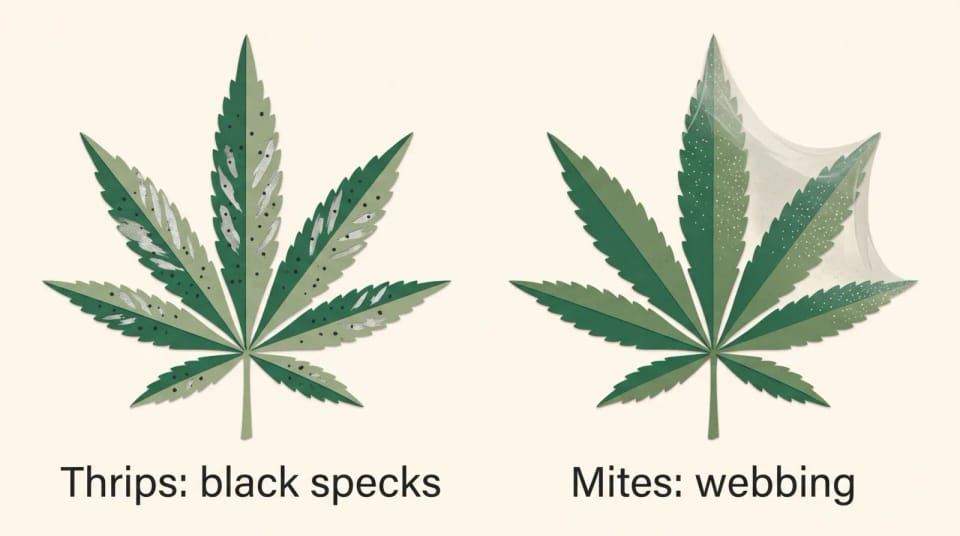
Two matched leaves, two pests. Black specks point to thrips; webbing points to mites. An illustration, not a photo of a real infestation.
Silver marks alone do not prove anything. Light stress, nutrient problems and other pests can also discolor leaves, so rule those out with our guide to other leaf symptoms that look like pests. The black specks and a live insect are the confirming steps.
How do you check for thrips without guessing?
Use two checks the BC manual describes, plus a loupe.
- Look for the specks. Turn a damaged leaf toward the light. Tiny black dots beside the silvery patches point to thrips.
- Tap a branch over white paper. Hold a white sheet under a branch and tap it. Thrips larvae and adults fall and move across the paper, where they are easy to see. The BC manual uses this tap to count larvae and adults.
- Confirm with magnification. A 10x loupe shows the slender body. Adults have wings; larvae do not.
- Hang sticky cards. The BC manual recommends yellow or blue sticky traps for monitoring. Minnesota Extension notes that blue cards catch adult thrips and yellow cards catch more kinds of flying pests. Cards show trends; they do not catch larvae on leaves.
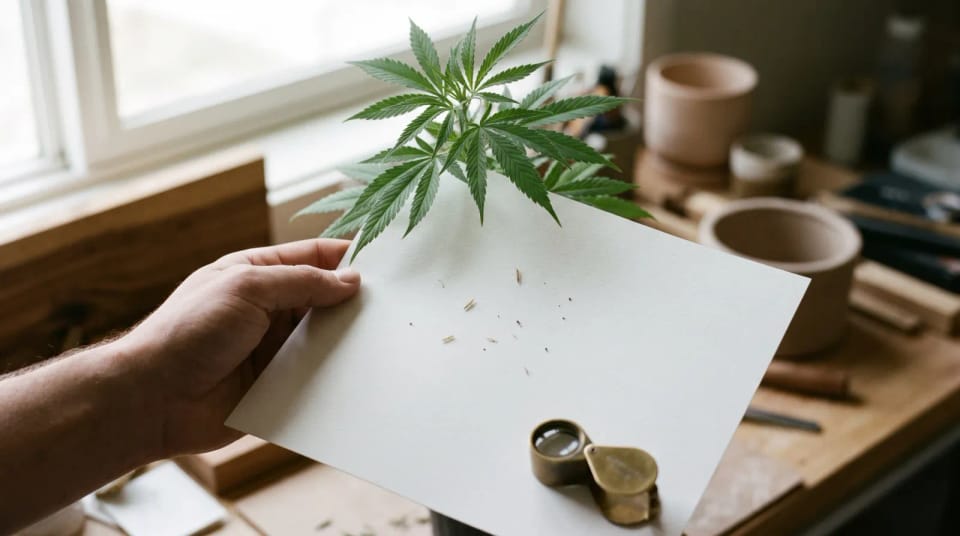
The white-paper tap: anything that falls shows against the white. A staged image; real thrips are smaller. Confirm with a loupe before you act.
No official thrips threshold exists for cannabis. The BC manual says plainly that “no official thresholds have been established for cannabis pests in B.C.” Numbers from ornamental greenhouses do not transfer, so watch the trend on your cards instead of chasing a magic number.
Why do thrips keep coming back after you treat them?
Because the leaf is only part of their life. Virginia Tech describes the stages as egg, nymph, prepupa, pupa and adult. “Nymphs feed for four to five days and then drop from the plant to pupate in the soil.” Virginia Cooperative Extension Colorado State adds that the third and fourth larval stages do not feed and mature in the soil, which makes them “hard to reach.”
Three more facts explain the rebound:
- Eggs hide inside the leaf. The BC manual notes that thrips lay eggs inside plant tissue. Colorado State says few products kill eggs.
- The cycle is fast when it is warm. Virginia Tech gives about 10 days from egg to adult for western flower thrips at 80°F (27°C). Minnesota Extension reports up to eight generations a year in a greenhouse. A warm room speeds things up, so keep an eye on grow room temperature and humidity.
- They resist pesticides. Virginia Tech says “total eradication is usually not possible, especially since thrips populations do develop pesticide resistance.” Colorado State agrees: “Thrips resist many insecticides.”
So a single spray that kills the adults on the leaves leaves eggs in the tissue and pupae in the medium. Later, a new wave appears. Small flies around the soil are possibly fungus gnats in the soil instead; the two share the soil stage and the sticky-card logic, but the fixes differ.
How much damage can thrips do to cannabis?
Less is known than you would hope. A 2019 review of US hemp pests says “thrips are regularly found on hemp but remain largely uncharacterized.” The same review reports that onion thrips can cause serious foliage damage on indoor plants but did not reach damaging levels outdoors, where plants grow fast. Cranshaw et al., Journal of Integrated Pest Management, 2019
The only yield measurement in drug-type cannabis that we found is a small Canadian experiment. Researchers caged 60 clones of one cultivar at a commercial facility in Ontario and started them with zero, one or five onion thrips. In the preprint, plants started with five thrips averaged 90.22 g of fresh flower, against 130.15 g for plants with none. McCune et al., bioRxiv preprint, 2020
The peer-reviewed version later appeared in Phytoprotection in 2021. McCune, Morphy, Eaves and Fournier, Phytoprotection
Read that result with its limits. It covers one facility, one cultivar and one thrips species, and it measured fresh weight, not dried flower. Thrips also reached the control plants. The preprint mentioned a possible THC drop from pooled samples with no statistics, and the published title drops THC. So treat yield loss as real but unmeasured for your room, and treat a THC effect as not established.
Do thrips spread viruses to cannabis?
Not confirmed. Thrips carry plant viruses in other crops, and that is why the claim gets repeated. For cannabis, the BC manual states that “to date, no viruses have been confirmed” in the crop. A 2023 review of cannabis viruses says tomato spotted wilt virus infected cannabis only when researchers inoculated it by hand, and that thrips as a vector “have yet to be verified” in cannabis growing. Miotti et al., Viruses, 2023 One hemp review does link onion thrips to “hemp streak virus,” but the virology review calls that infection “never formally demonstrated.”
How do you get rid of thrips on cannabis?
Work in the order the government and extension sources use: block, monitor, bring in biological control early, and spray only within the rules.
Block new arrivals
The BC manual lists screens on vents, inspection of all new plant material, and fresh potting mix for each crop. Virginia Tech adds that loose soil on floors gives thrips a place to pupate, and that fine mesh on vents works but reduces airflow. Cuttings and clones are a common way pests enter a room, so quarantine and inspect them first.
Use biological control early, for both stages
The BC manual says to “use biological controls preventively” and matches predators to life stages:
- Leaf stage (young larvae): predatory mites such as Amblyseius cucumeris and A. swirskii.
- Adults: the minute pirate bug Orius insidiosus.
- Soil stage (pupae): the soil mite Stratiolaelaps scimitus, the rove beetle Dalotia coriaria, or a drench of Steinernema feltiae nematodes.
Be realistic about results. Minnesota Extension says biocontrol “can only work when thrips populations are low.” Virginia Tech says releases “may not adequately reduce high densities,” and that Stratiolaelaps is not a primary thrips control. A 2024 lab study found that the main predators did eat onion thrips. Its authors also note that onion thrips outbreaks in Ontario greenhouses broke through programs built for western flower thrips. Summerfield et al., Insects, 2024 We found no field trial of any of these agents on cannabis. The BC manual also notes that biologicals need repeated releases in cannabis because the crop cycle is short.
Check the rules before any spray
This is where most online guides go wrong. They list neem, soap and spinosad as if every grower can use them. Pesticide rules for cannabis depend on where you live.
- United States: California’s regulator says “there are no pesticides registered specifically for use directly on cannabis” and that their use on cannabis “has not been reviewed for safety or human health effects.” Under California law, only certain tolerance-exempt or minimum-risk products are not illegal, and “the label is the law.” California Department of Pesticide Regulation Some states publish their own lists, such as Oregon’s cannabis pesticide guide list, which the state says is not an endorsement.
- Canada: growers need products registered for cannabis. Alberta’s list shows registered Beauveria bassiana products that name thrips on the label. Government of Alberta: Registered cannabis pesticides Virginia Tech notes that Beauveria needs frequent applications and works best at high humidity.
Check your own regulator’s current list and read the label before you buy anything. Rotate between products with different modes of action when the label allows it, since resistance is the rule with thrips.
Aim to finish before flower
The BC manual’s rule of thumb is to “achieve pest control prior to flower.” Pests and biological agents stick in trichomes. Foliar sprays can leave residues or change flavor, and wet sprays can raise humidity around buds, which favors mold. If an infestation meets harvest anyway, see our guides to mold or trichomes and drying and curing.
Can you still smoke buds from a plant that had thrips?
No study answers this directly. We found no research on whether thrips damage itself makes flower harmful, and no residue study of thrips-control products on cannabis flower. The one smoke-transfer study we found tested four other pesticides on spiked flower. Up to 69.5% of one compound reached the smoke from a glass pipe in a lab machine. Sullivan et al., Journal of Toxicology, 2013 That tells you residues can travel into smoke. It does not tell you anything about neem, spinosad, soap or Beauveria.
If you buy flower and worry about sprays, learn how to read pesticide results on a COA and what a pesticide-free label does and does not mean. If you feel unwell after using any cannabis product, such as trouble breathing, a rash or persistent nausea, talk to a clinician or your local poison control center.
Sources
- Province of British Columbia. Integrated Pest Management for Commercial Cannabis in BC. 2019.
- Cranshaw W, et al. Developing insect pest management systems for hemp in the United States. Journal of Integrated Pest Management. 2019.
- McCune F, Morphy C, Eaves J, Fournier V. Onion thrips reduces yields in indoor-grown cannabis. Phytoprotection. 2021. Preprint: bioRxiv.
- Day E, Dellinger TA, Cote KW. Thrips. Virginia Cooperative Extension 444-281. Reviewed 2025.
- Krischik V. Thrips management in greenhouse, hoop house and nursery. University of Minnesota Extension. 2022.
- Colorado State University. Thrips. Agricultural Biology IPM pages.
- Ahmed MZ, McKenzie CL, Osborne LS. Arthropod and mollusk pests of hemp and their indoor management plan in Florida. Journal of Integrated Pest Management. 2023.
- Summerfield A, et al. Laboratory investigations on biological control agents for onion thrips and western flower thrips. Insects. 2024.
- Miotti N, et al. A guide to cannabis virology. Viruses. 2023.
- Sullivan N, Elzinga S, Raber JC. Determination of pesticide residues in cannabis smoke. Journal of Toxicology. 2013.
- California Department of Pesticide Regulation. Pesticide use on cannabis.
- Oregon Department of Agriculture. Cannabis and pesticides.
- Government of Alberta. Registered cannabis pesticides.
Key takeaways
- Silvery scars plus tiny black specks point to thrips. Spider mites leave stippling and webbing, not specks.
- Confirm with a white-paper tap and a 10x loupe before you treat.
- Young thrips pupate off the plant, often in the medium, so leaf sprays alone miss a stage.
- Block arrivals, monitor with cards, and start biological control while numbers are low.
- Use only products your own regulator allows on cannabis, and aim to finish before flower.
FAQ
What do thrips look like on cannabis?
Adults are slender insects about 1 to 1.5 mm long, and you need magnification to see them well. You usually notice the damage first: pale flecks that merge into silvery streaks, with tiny black specks of excrement beside them. A 10x loupe confirms the insect.
Can thrips kill a cannabis plant?
The sources we found do not report thrips killing cannabis plants. They do report leaf damage, and one small indoor study measured lower fresh yield on clones started with five onion thrips. The BC manual notes that feeding on young growth can leave leaves scarred or distorted.
Can you treat thrips during flowering?
The BC government manual advises getting pests under control before flower. Sprays can leave residues or change flavor, wet buds favor mold, and insects and biological agents stick in trichomes. Any product you use must be allowed on cannabis where you live, and the label sets the rules.
Why do I still have thrips after spraying?
Most sprays reach only the insects on the leaves. Eggs sit inside the leaf tissue and pupae rest in the growing medium, so a new wave appears after the spray. Thrips also develop resistance, which is why sources stress monitoring, soil-stage control and rotating products.
What are the white or silver marks on my cannabis leaves?
Silvery patches with black specks usually mean thrips. Fine pale dots with webbing point to spider mites. Marks with no insects, specks or webbing may come from light or nutrient stress, so check for the pest before you treat.



