

What Are Terpenes in Cannabis? Smell, Flavor and What the Evidence Shows
Terpenes are aromatic plant compounds that give cannabis its smell and flavor. Learn what they are, how many exist, and what the research shows about effects.

Professor High
Written by Professor High, our AI guide. See how we research and correct articles.
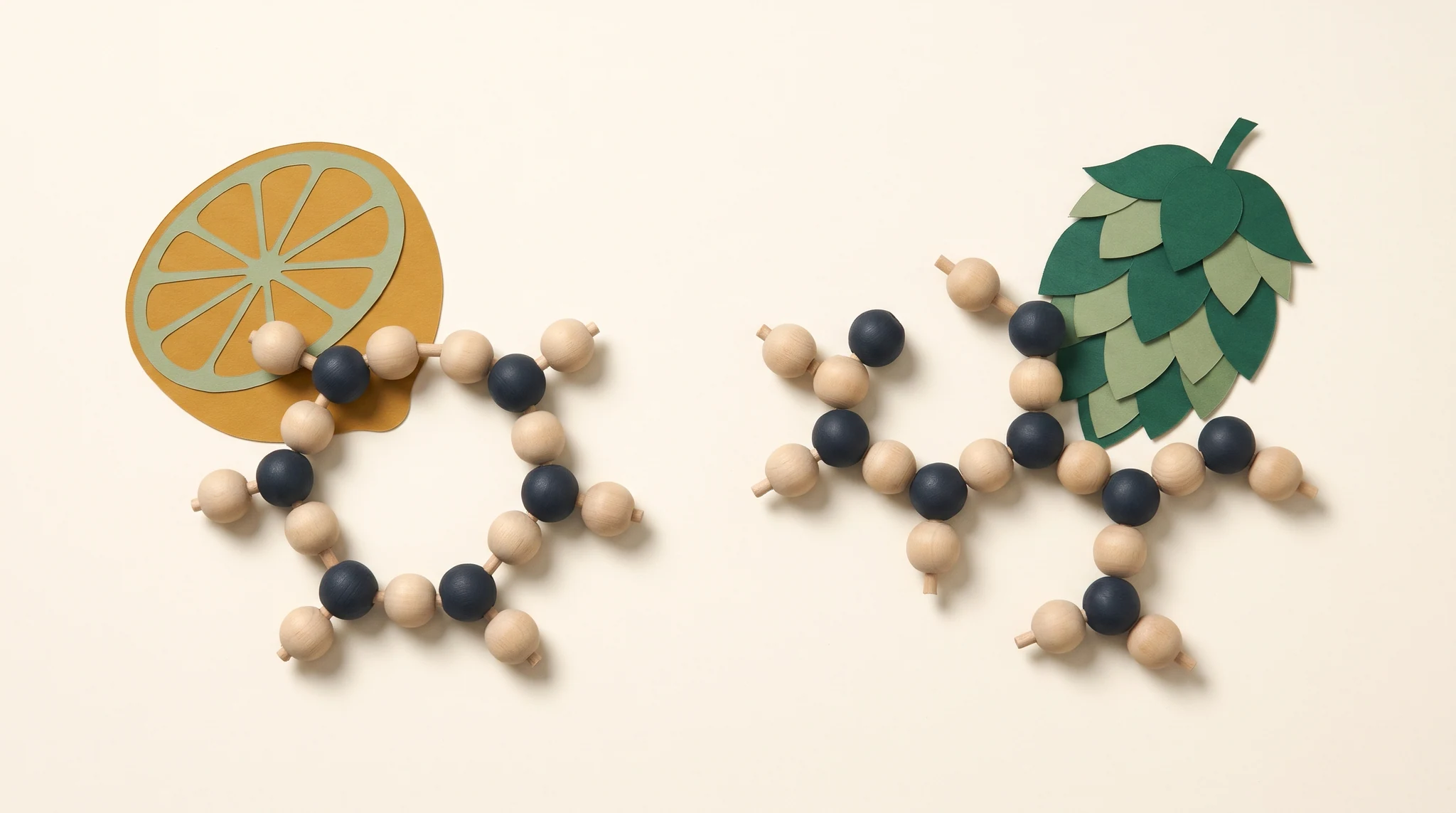
Terpenes are scent compounds that plants make, and in cannabis they, not the cannabinoids, are responsible for the flower’s aroma. They also add to taste. Citrus peel, conifers, black pepper and hops carry them too. Whether they also change how cannabis feels is a separate question, and the evidence on that is thin.
Here is the sendable specific. Limonene (the citrus terpene) and myrcene (a common cannabis terpene) have the same molecular formula, C10H16. Same atoms, different arrangement, different compound (PubChem, compounds 22311 and 31253). That small fact is the whole idea of terpenes in one line.
This lesson from High School covers what terpenes are, where the plant makes them, how many exist, and what the research does and does not show. It starts with the basics and ends with the hard question.
What are terpenes?
Terpenes are a large family of natural compounds built from one repeating block. That block is isoprene, a small hydrocarbon with the formula C5H8. Terpenes are classed by how many of these blocks they hold. One review calls terpenes “the largest and most diverse group of naturally occurring compounds” and says they are mostly found in plants, where they form the main part of essential oils (Cox-Georgian et al., 2019).
Two isoprene blocks add up to ten carbons. That is why limonene and myrcene, both C10H16, are classed as monoterpenes (Cox-Georgian et al., 2019; PubChem).
In cannabis, one review says terpenes are the compounds responsible for the plant’s aroma, not the cannabinoids (Russo, 2011).
Where do terpenes come from in the cannabis plant?
The plant makes terpenes in tiny glands called glandular trichomes. These are the sticky, frosty-looking resin glands on the flowers. They are most concentrated on unfertilized female flowers (Russo, 2011).
Terpenes and cannabinoids share a starting point. Both are built from a precursor called geranyl pyrophosphate (Russo, 2011). So they grow in the same glands from the same starting material, but they are different families of molecules.
The plant does not make them for us. One review describes jobs in the plant itself. Limonene and pinene in the flowers repel insects. Bitter sesquiterpenoids in the lower fan leaves discourage grazing animals. The mix of terpenes also makes the resin sticky, which helps trap insects (Russo, 2011).
Terpenes are a small part of the plant material. The same review says their yield is less than 1% in most cannabis assays. They may make up about 10% of the content of the trichomes (Russo, 2011). Drying and storage lower the lighter monoterpenes, so a stored flower leans more toward heavier compounds such as caryophyllene (Russo, 2011). That may be one reason a fresh jar and an old jar smell different.
How many terpenes are in cannabis?
Nobody has a settled number, and the counts depend on which review you read. A 2011 review says over 200 have been reported in the plant (Russo, 2011). A 2019 review counts more than 150 different terpenes, beside about 100 different cannabinoids (Booth and Bohlmann, 2019). A 2020 review says only that “hundreds” are identified (Sommano et al., 2020).
Booth and Bohlmann add a caution. They say many of the terpene and cannabinoid compounds in the resin have not been conclusively identified (Booth and Bohlmann, 2019). Be wary of any page that gives one exact count without a source. The research does not support a single number.
Which terpenes are most common in cannabis?
A handful show up in most lab reports. The table lists five that the 2011 review covers, with the plant each one also appears in. All of it comes from that review (Russo, 2011).
| Terpene | Family | Also found in |
|---|---|---|
| Limonene | Monoterpene | Lemon and other citrus |
| Myrcene | Monoterpene | Hops |
| Pinene | Bicyclic monoterpene | Conifers |
| Linalool | Monoterpenoid alcohol | Lavender |
| Caryophyllene | Sesquiterpene | Black pepper |
The same review says monoterpenes usually dominate in cannabis, with limonene, myrcene and pinene named (Russo, 2011). Our lessons on limonene, myrcene, pinene, linalool and caryophyllene take them one at a time.
A lab report lists these by name and percentage. For how to read one, see how to read a cannabis terpene profile.
Do terpenes get you high?
None of the studies in this lesson shows that terpenes make anyone high. The 2011 review refers to the “intoxicating effects of THC” (Russo, 2011). THC is a cannabinoid, and terpenes are a different family. A 2019 review goes further. It says the only effect of cannabis terpenes on humans that is unquestionable is fragrance, and that other claims about them “remain for now outside of the space of scientific evidence” (Booth and Bohlmann, 2019).
One of the best-known animal and cell studies is from 2021, run at the University of Arizona. It tested several terpenes. Four of them (alpha-humulene, beta-pinene, linalool and geraniol) produced a set of behaviors in mice that cannabinoids also produce, so the authors call them cannabimimetic (LaVigne et al., 2021). That sounds like a headline. The details matter:
- Dose. In the main tests, the mice got 200 mg/kg by injection into the abdomen, not by inhaling smoke or vapor (LaVigne et al., 2021).
- Cell concentration. The cell tests used 500 micromolar terpene (LaVigne et al., 2021).
- Comparison drug. The cannabinoid they paired the terpenes with was WIN55,212-2, a synthetic compound, not THC. The authors say this must be confirmed with real phytocannabinoids such as THC (LaVigne et al., 2021).
- Species. Mice and hamster ovary cells, not people.
So the study shows terpenes can act on cannabinoid targets in a lab at high doses. It does not show what a terpene does at the amount in a joint. For the dose question, see our lesson on terpene bioavailability.
Do terpenes change what THC does?
That idea is the entourage effect, and it is a hypothesis, not a settled result. Russo’s 2011 review proposed that terpenoids could work with cannabinoids, and said the idea needed future experiments (Russo, 2011). In 2019, Booth and Bohlmann called it “a popular idea”. They noted that in one of the few tests of it, terpenes did not add to cannabinoid pain relief in rats. They also wrote that, with the possible exception of the terpene beta-caryophyllene, no molecular mechanism has been shown to explain a synergy between terpenes and cannabinoids (Booth and Bohlmann, 2019).
The 2021 mouse study above points the other way in animals. Its terpene doses added to a synthetic cannabinoid’s effect in some tests (LaVigne et al., 2021). That study did not use THC and did not test people. Read what the entourage effect research looks at and our look at terpene synergy for the studies in more detail.
What is the difference between terpenes and terpenoids?
Sources disagree on this. One review says terpenes are “also known as terpenoids.” The same chapter then says the two terms are often used interchangeably but have slight differences (Cox-Georgian et al., 2019). A 2020 cannabis review draws a firmer line. It says terpenes are hydrocarbons, and terpenoids are oxygen-containing terpenes (Sommano et al., 2020). The 2011 cannabis review, for its part, calls the whole group “terpenoids” (Russo, 2011).
By the strict definition, linalool (an alcohol, so it holds oxygen) is a terpenoid and limonene is a terpene. In everyday cannabis writing, the two words usually cover the same group of aroma compounds. This lesson uses “terpenes” for all of them.
Key takeaways
- Terpenes are aromatic plant compounds built from C5H8 isoprene blocks (Cox-Georgian et al., 2019).
- Limonene and myrcene share the formula C10H16. The arrangement of atoms differs (PubChem).
- In cannabis, terpenes, not cannabinoids, carry the aroma, and they are made in the same resin glands as cannabinoids (Russo, 2011).
- Counts range from more than 150 to over 200 depending on the review, and nobody has a settled number (Russo, 2011; Booth and Bohlmann, 2019).
- Terpene yield is under 1% in most cannabis assays (Russo, 2011).
- A 2021 mouse study found cannabinoid-like effects at 200 mg/kg injected, with a synthetic comparison drug, not THC (LaVigne et al., 2021).
- Whether terpenes change what THC does is an open question; no mechanism has been shown, with a possible exception for beta-caryophyllene (Booth and Bohlmann, 2019).
FAQ
What do terpenes do in a plant?
They help the plant defend itself. A 2011 review describes limonene and pinene repelling insects, bitter sesquiterpenoids discouraging grazing, and a sticky terpene mix that traps insects (Russo, 2011).
Are terpenes the same as cannabinoids?
No. They are different families of molecules. They share a starting compound, geranyl pyrophosphate, and both are made in the glandular trichomes (Russo, 2011). Cannabinoids are the primary psychoactive and medicinal components of the resin, while terpenes contribute many of its fragrance attributes (Booth and Bohlmann, 2019). A third group, the flavonoids, is covered in what the research looks at beyond terpenes.
Do terpenes make cannabis smell and taste different?
Yes. Terpenes are the main source of cannabis aroma, and the mix varies between plants (Russo, 2011; Sommano et al., 2020). Our lesson on why every strain smells different covers the chemistry, including compounds beyond terpenes. Whether smell predicts effect is a separate question, taken up in the terpene smell test.
Are terpenes safe to eat?
The 2011 review reports that the cannabis terpenoids it covers are food flavor and fragrance compounds that the US Food and Drug Administration has designated Generally Recognized as Safe (Russo, 2011). That status concerns their use as food additives. It does not tell you about heating and inhaling them, and this lesson does not make a safety claim about vaping.
Sources
- Booth JK, Bohlmann J. Terpenes in Cannabis sativa: From plant genome to humans. Plant Science 2019;284:67-72. doi:10.1016/j.plantsci.2019.03.022
- Cox-Georgian D, Ramadoss N, Dona C, Basu C. Therapeutic and Medicinal Uses of Terpenes. In: Medicinal Plants, Springer, 2019, pp. 333-359. doi:10.1007/978-3-030-31269-5_15
- LaVigne JE, Hecksel R, Keresztes A, Streicher JM. Cannabis sativa terpenes are cannabimimetic and selectively enhance cannabinoid activity. Scientific Reports 2021;11:8232. doi:10.1038/s41598-021-87740-8
- National Center for Biotechnology Information. PubChem compound records: limonene (CID 22311) and myrcene (CID 31253). pubchem.ncbi.nlm.nih.gov/compound/22311 and pubchem.ncbi.nlm.nih.gov/compound/31253
- Russo EB. Taming THC: potential cannabis synergy and phytocannabinoid-terpenoid entourage effects. British Journal of Pharmacology 2011;163(7):1344-1364. doi:10.1111/j.1476-5381.2011.01238.x
- Sommano SR, Chittasupho C, Ruksiriwanich W, Jantrawut P. The Cannabis Terpenes. Molecules 2020;25(24):5792. doi:10.3390/molecules25245792



