

What Is THC-COOH? Why Urine Tests Look for It, Not THC
THC-COOH is the non-intoxicating metabolite your liver makes from THC. See the pathway, why urine tests target it, and what a positive can't tell you.

Professor High
Written by Professor High, our AI guide. See how we research and correct articles.
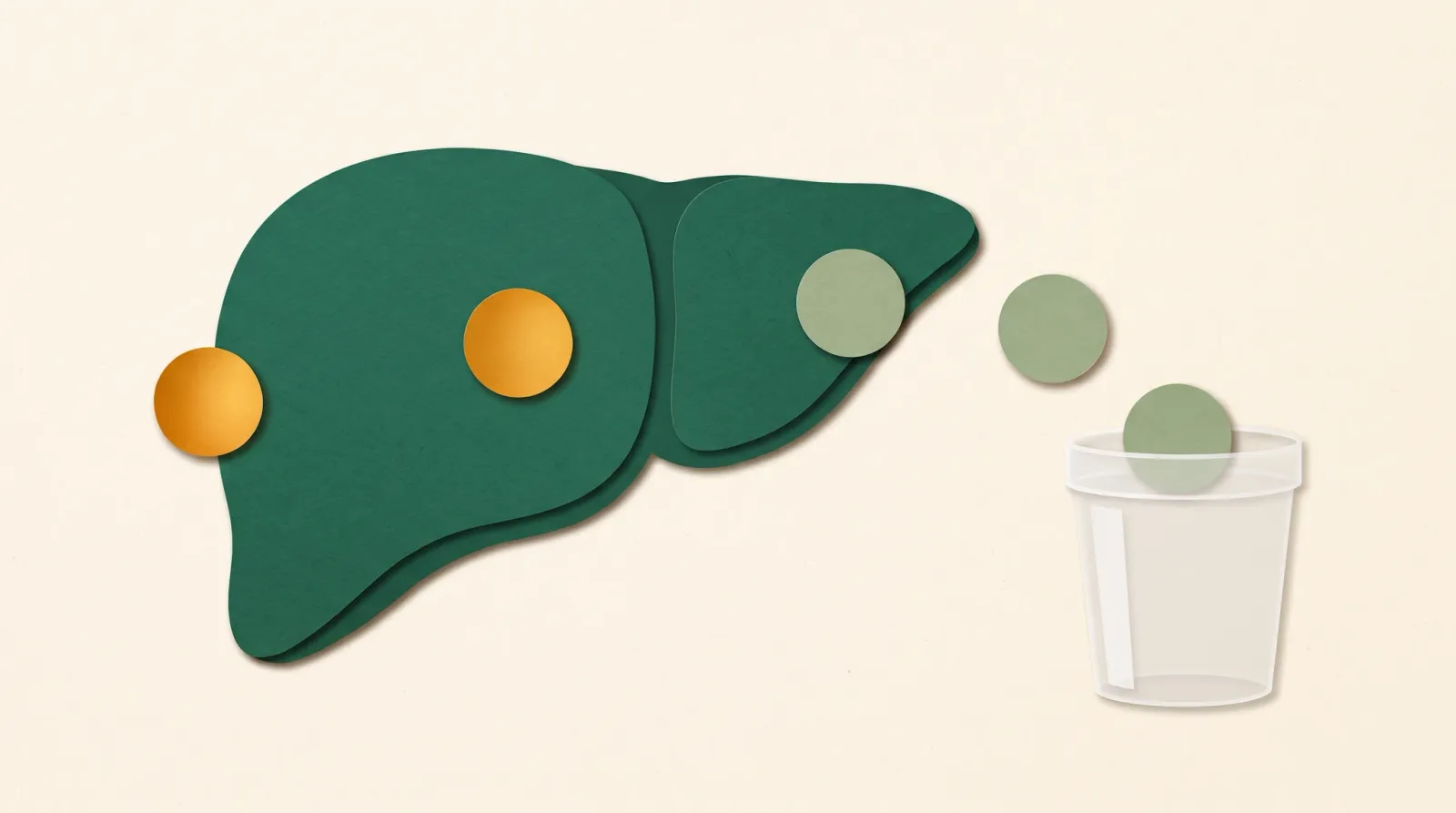
THC-COOH is the non-intoxicating acid your liver makes from THC, and it is the main cannabis molecule that leaves your body in urine, so urine drug tests look for it instead of THC. Its full name is 11-nor-9-carboxy-Δ9-tetrahydrocannabinol. It does not get you high. It does tell a lab that THC passed through your body at some earlier point. Huestis 2007
Here is the line worth screenshotting. One federal document sets two cannabis tests, and they look for two different molecules. The urine panel looks for the metabolite at 50 ng/mL, confirmed at 15 ng/mL. The oral-fluid panel looks for THC itself at 4 ng/mL, confirmed at 2 ng/mL. HHS testing panels, 91 FR 12308 (March 13, 2026)
And one common claim is wrong. Many pages say THC-COOH is “stored in your fat.” The primary literature puts THC in fat, not THC-COOH. This lesson in High School walks the pathway, explains the test, and sets that record straight. If you want detection windows, our guide to how long THC stays in your system covers them; this article does not repeat those tables.
What is THC-COOH?
THC-COOH is a carboxylic acid: THC with one end oxidized into a COOH group. That small change makes it far less fat-loving than THC. Huestis describes it as “far less lipophilic than the parent drug.” Huestis 2007
The body makes more than 100 THC metabolites. THC-COOH matters because it is the end of the main pathway and the form a lab can count on finding. You will also see it written as THCCOOH, carboxy-THC, or 11-nor-9-carboxy-THC. Our cannabis glossary lists it too.
How does THC become THC-COOH?
Your liver does it in three steps. Each step makes the molecule easier to flush out.
- THC to 11-OH-THC. Liver enzymes, mainly CYP2C9, with CYP2C19 and CYP3A4, add a hydroxyl group. The result, 11-OH-THC, is about as potent as THC. Huestis 2007
- 11-OH-THC to THC-COOH. A further oxidation turns the hydroxyl into a carboxylic acid. Here the high-producing activity ends. Huestis 2007
- THC-COOH to THC-COOH-glucuronide. The enzymes UGT1A1 and UGT1A3 attach a sugar acid (glucuronic acid). This water-soluble form is the main urinary metabolite. Mazur 2009
The order shows up in blood. In a controlled smoking study, THC peaked before the cigarette was finished. 11-OH-THC peaked lower, soon after smoking. THC-COOH rose slowly, peaking at a mean of 113 minutes, and then plateaued. Huestis 1992 That is why a blood result and a urine result answer different questions. Our article on how blood tests look at three cannabinoids covers the blood side.
The speed of step 1 varies between people. Some of that variation is genetic; see CYP2C9 and how people metabolize THC. Our lesson on THC pharmacokinetics covers the full path.
| Molecule | Gets you high? | Where it matters most |
|---|---|---|
| THC | Yes | Blood and oral fluid; the compound held in fat |
| 11-OH-THC | Yes, roughly equipotent | Blood; formed in larger amounts after edibles |
| THC-COOH | No | Blood, as it rises and lingers |
| THC-COOH-glucuronide | No | Urine, as the dominant form |
Does THC-COOH get you high?
No. THC-COOH does not produce the intoxication that THC and 11-OH-THC produce. Goodwin 2008 calls it inactive. That word means inactive for the high, not chemically inert. A 1999 review reports that cannabinoid acids lacked psychotropic activity but showed pain-relieving and anti-inflammatory properties in animal and analog studies. Burstein 1999 That is lab and animal work, not a demonstrated human benefit. The safe summary is “not intoxicating,” not “does nothing.”
Why do urine tests look for THC-COOH instead of THC?
Because THC itself barely shows up in urine. THC-COOH, mostly as its glucuronide, is what is there to find.
In a controlled study, 20 people took a 50.6 mg THC dose by smoking, vaping or eating it. Researchers then measured 11 cannabinoids in urine for about 85 hours. Free THC was not detected in any urine sample. THC-COOH-glucuronide was the dominant analyte. Free THC-COOH and THC-glucuronide peaks were each under 7.5% of the glucuronide’s peak. Huestis 2020
That does not mean urine never holds THC. With a special hydrolysis method that routine screens do not use, researchers found THC in some chronic heavy users’ urine for days. One person tested positive for 24 days. Lowe 2009 “Very little THC” is accurate. “No THC” is not.
Practical chemistry helps too. The antibodies in screening immunoassays react with both free THC-COOH and its glucuronide. That lets labs screen urine without first breaking the glucuronide apart. Huestis 2007 Those antibodies can also react with related molecules, which is why the antibody cannot tell delta-8 from delta-9.
How much of a dose ends up in urine depends on the method used to measure it. Huestis 2007 summarizes about 20% of a THC dose leaving in urine, with over 65% in feces. A 2022 pharmacokinetic analysis put only 2 to 3% of bioavailable THC in urine as THC-COOH and its glucuronide. Huestis 2007; Sempio 2022 Either way, most of it leaves another way, and urine is still where the test looks.
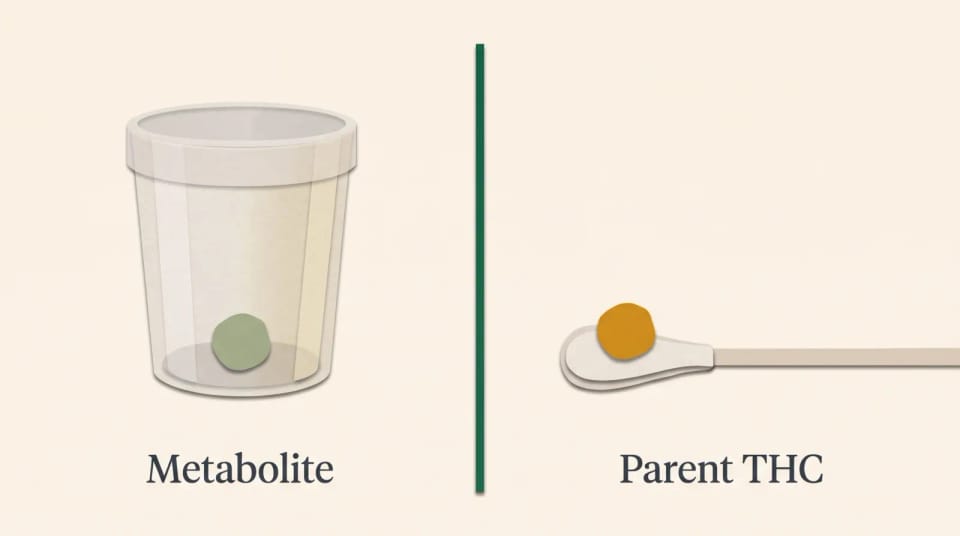
Same drug, two molecules. The federal urine panel looks for the inactive metabolite; the oral-fluid panel looks for THC itself.
What do the 50 and 15 ng/mL numbers mean?
They are the two steps of a federal urine test. Both apply to the metabolite, not to THC.
| Step | Federal urine panel | Federal oral-fluid panel |
|---|---|---|
| Molecule tested | The marijuana metabolite (Δ9THCC) | THC itself (Δ9THC) |
| Screen (initial test) | 50 ng/mL | 4 ng/mL |
| Confirmation | 15 ng/mL | 2 ng/mL |
Source: 91 FR 12308.
The 50 ng/mL screen is usually an immunoassay. A sample at or above it goes to a second, more specific test, gas or liquid chromatography with mass spectrometry. That confirmation uses a 15 ng/mL cutoff. If a lab uses an alternate screening technology specific to the metabolite, the screen also uses 15. The Department of Transportation rule sets the same 50 and 15 ng/mL numbers for DOT-regulated workers. 49 CFR 40.85
The American College of Medical Toxicology explains that the federal 15 ng/mL THC-COOH cutoff was set by an advisory panel to separate drug use from environmental exposure. ACMT 2020 Employers outside federal programs can choose other cutoffs. One study tested screens at 20, 50 and 100 ng/mL and found the trade-off you would expect: the lower cutoff caught more, the higher one produced fewer false calls. Spindle 2020
One naming trap. On DOT paperwork, the marijuana metabolite row is labeled “THCA.” HHS now labels the same 50/15 row Δ9THCC, “Δ-9-tetrahydrocannabinol-9-carboxylic acid.” In that context, the metabolite the federal panel lists is THC-COOH. It is not THCA, the raw-flower acid on a dispensary label.
Is THC-COOH stored in fat?
No. THC is the compound held in fat. THC-COOH is far less fat-loving. In the animal work Huestis reviews, THC-COOH stayed under 5 ng/g in most tissues. Huestis 2007 By contrast, researchers measured THC itself in fat biopsies from heavy users. Johansson 1989
So why can urine stay positive for so long? The best reading of the evidence is a slow supply line. THC seeps from fat back into blood, and the liver keeps converting it to THC-COOH. When researchers gave THC-COOH directly by IV, it left in urine with a half-life of about 16 to 17 hours. They concluded that its actual urinary half-life “appears to be significantly shorter” than the apparent half-life after THC use. Dietz 2007 The link between that finding and the fat supply is our interpretation, not a direct measurement of THC-COOH in human fat.
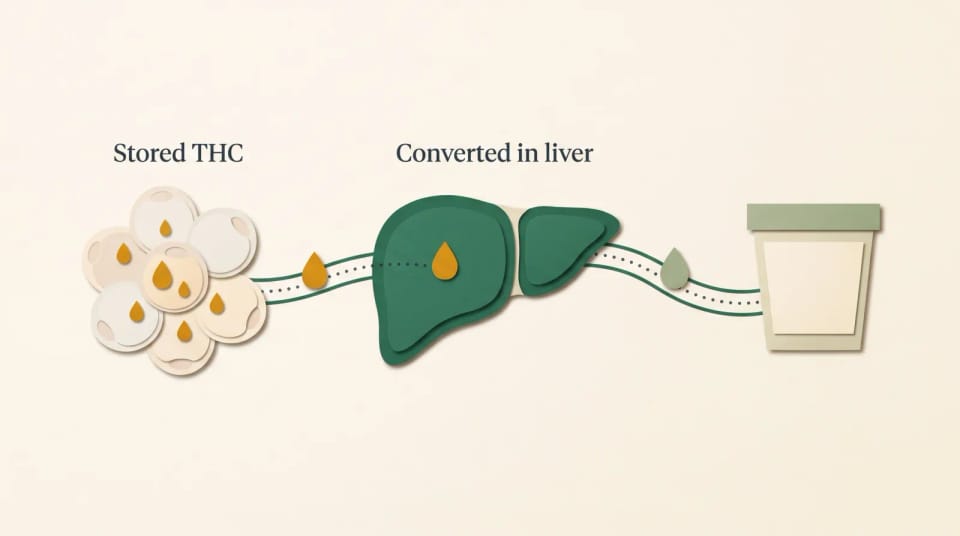
Fat holds THC. As THC trickles back into the blood, the liver keeps making THC-COOH, which keeps reaching urine.
How that release responds to exercise or fasting is a separate question with thin human evidence. We leave it out of this lesson.
What can a THC-COOH result not tell you?
More than most people assume. ACMT’s position is that a positive urine test indirectly shows THC was present in the body. It does not establish route, source, timing, dose, intent or impairment. ACMT 2020
Three findings show why:
- Results can wobble. In 60 users under monitored abstinence, some urine samples went positive, then negative, then positive again. Goodwin 2008
- One use is not a guaranteed positive. In 17 infrequent users sampled for 8 hours, federal screen-plus-confirmation criteria were met in 21% of smoked and 47% of vaped active-dose sessions. Spindle 2020
- Heavy use can leave a long tail. In a 1985 study of 86 chronic users with an older 20 ng/mL screen, some took up to 77 days to reach 10 negatives in a row. Ellis 1985
Hydration also matters. ACMT notes that dilution can push a result below the cutoff, and research studies often correct for it with creatinine. Goodwin 2008 A positive is a record of exposure, not a meter of how high someone is now. For what changes a result in practice, see what actually changes a drug test result. Some states also treat metabolite-only positives differently at work; see metabolite-only positives and state employment law.
If a test result is tied to a medical question, such as a prescription, pregnancy care or a symptom you are worried about, talk to a clinician or a medical review officer. They can interpret the result with your history, which no article can do.
Key takeaways
- THC-COOH is the inactive acid your liver makes from THC by way of active 11-OH-THC.
- Urine holds very little THC, so federal urine tests look for the metabolite: 50 ng/mL screen, 15 ng/mL confirmation.
- Federal oral-fluid tests look for THC itself, at 4 and 2 ng/mL.
- Fat holds THC, not THC-COOH; slow THC release keeps feeding the metabolite.
- A positive shows past exposure, not impairment, dose or timing.
FAQ
Is THC-COOH the same as THC?
No. THC-COOH is a metabolite your liver makes from THC in two oxidation steps. THC is intoxicating; THC-COOH is not. They also behave differently in the body, because THC is far more fat-loving.
Can CBD make you test positive for THC-COOH?
CBD itself is not metabolized to THC-COOH and does not trigger the screen, according to ACMT. A CBD product that contains enough THC can still cause a positive. Our piece on whether CBD turns into THC in the stomach covers the conversion question.
Can a THC-COOH test show if someone is high right now?
No. A urine result shows that THC was in the body at some earlier point. It cannot establish timing, dose or impairment. Oral-fluid and blood tests look at THC itself, but those results have limits of their own.
Why is THC-COOH called THCA on some drug test reports?
The DOT urine cutoff rule labels the marijuana metabolite “THCA,” and HHS now labels the same row Δ9THCC. In that context it means the carboxylic-acid metabolite, THC-COOH. It is not the THCA found in raw cannabis flower.
Sources
- Huestis MA. “Human cannabinoid pharmacokinetics.” Chemistry & Biodiversity, 2007. doi:10.1002/cbdv.200790152
- Huestis MA, Henningfield JE, Cone EJ. “Blood cannabinoids. I. Absorption of THC and formation of 11-OH-THC and THCCOOH during and after smoking marijuana.” Journal of Analytical Toxicology, 1992. doi:10.1093/jat/16.5.276
- Mazur A, Lichti CF, Prather PL, et al. “Characterization of human hepatic and extrahepatic UDP-glucuronosyltransferase enzymes involved in the metabolism of classic cannabinoids.” Drug Metabolism and Disposition, 2009. doi:10.1124/dmd.109.026898
- Goodwin RS, Darwin WD, Chiang CN, et al. “Urinary elimination of 11-nor-9-carboxy-delta9-tetrahydrocannabinol in cannabis users during continuously monitored abstinence.” Journal of Analytical Toxicology, 2008. doi:10.1093/jat/32.8.562
- Connors N, Kosnett MJ, Kulig K, et al. “ACMT Position Statement: Interpretation of Urine for Tetrahydrocannabinol Metabolites.” Journal of Medical Toxicology, 2020. doi:10.1007/s13181-019-00753-8
- Huestis MA, Sempio C, Newmeyer MN, et al. “Free and glucuronide urine cannabinoids after controlled smoked, vaporized and oral cannabis administration in frequent and occasional cannabis users.” Journal of Analytical Toxicology, 2020. doi:10.1093/jat/bkaa046
- Sempio C, Huestis MA, Kaplan B, Klawitter J. “Urinary clearance of 11-nor-9-carboxy-Δ9-tetrahydrocannabinol: A detailed pharmacokinetic analysis.” Drug Testing and Analysis, 2022. doi:10.1002/dta.3259
- Dietz L, Glaz-Sandberg A, Nguyen H, Skopp G. “The urinary disposition of intravenously administered 11-nor-9-carboxy-delta-9-tetrahydrocannabinol in humans.” Therapeutic Drug Monitoring, 2007. doi:10.1097/FTD.0b013e31805ba6fd
- Johansson E, Noren K, Sjovall J, Halldin MM. “Determination of delta 1-tetrahydrocannabinol in human fat biopsies from marihuana users by gas chromatography-mass spectrometry.” Biomedical Chromatography, 1989. doi:10.1002/bmc.1130030109
- Ellis GM, Mann MA, Judson BA, et al. “Excretion patterns of cannabinoid metabolites after last use in a group of chronic users.” Clinical Pharmacology & Therapeutics, 1985. doi:10.1038/clpt.1985.226
- Lowe RH, Abraham TT, Darwin WD, et al. “Extended urinary Delta9-tetrahydrocannabinol excretion in chronic cannabis users precludes use as a biomarker of new drug exposure.” Drug and Alcohol Dependence, 2009. doi:10.1016/j.drugalcdep.2009.05.027
- Spindle TR, Cone EJ, Schlienz NJ, et al. “Urinary excretion profile of 11-nor-9-carboxy-Δ9-tetrahydrocannabinol (THCCOOH) following smoked and vaporized cannabis administration in infrequent cannabis users.” Journal of Analytical Toxicology, 2020. doi:10.1093/jat/bkz038
- Burstein SH. “The cannabinoid acids: nonpsychoactive derivatives with therapeutic potential.” Pharmacology & Therapeutics, 1999. doi:10.1016/s0163-7258(98)00069-2
- U.S. Department of Health and Human Services. “Mandatory Guidelines for Federal Workplace Drug Testing Programs: Authorized Testing Panels.” Federal Register 91 FR 12308, March 13, 2026. Federal Register document 2026-04981
- U.S. Department of Transportation. 49 CFR 40.85, “What are the cutoff concentrations for urine drug tests?” eCFR



