

What Is Twaxing? How Much Stronger a Waxed Joint Gets
Twaxing adds wax or other concentrate to a joint. The math shows how much THC it adds, and lab data show why it is still not the same as a dab.

Professor High
Written by Professor High, our AI guide. See how we research and correct articles.
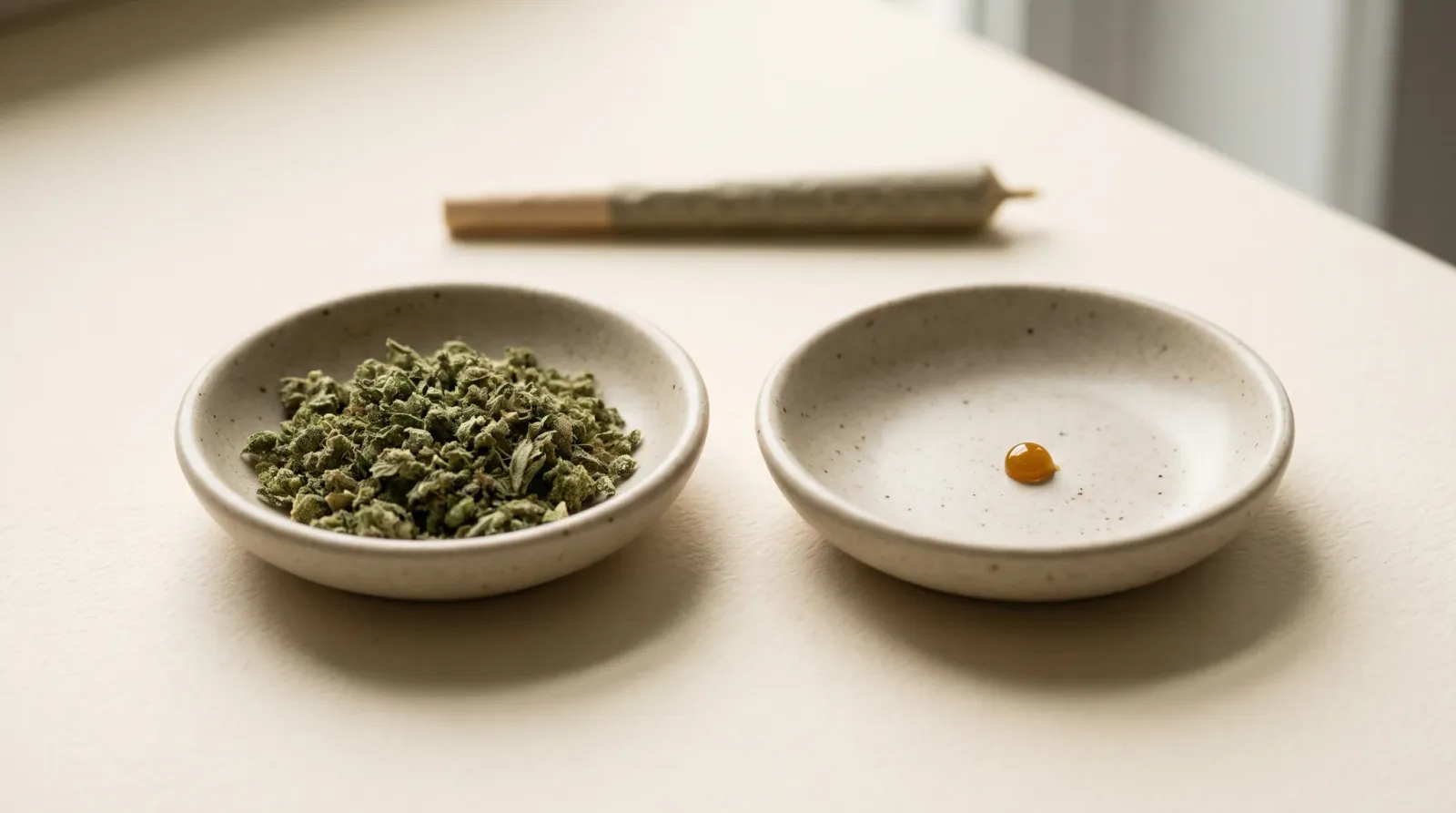
Twaxing means adding cannabis concentrate, such as wax, shatter, hash or kief, to a joint, and a little goes a long way. At average lab-measured Colorado potencies, 0.1 g of concentrate adds about 71 mg of potential THC to a half-gram joint that already holds about 104 mg. That small addition carries about two-thirds of the THC of the whole joint. (Giordano et al., 2025)
That is the number to remember. Below, we show the arithmetic, explain why a twaxed joint still does not hit like a dab, and give a pacing rule built on two smoke and blood studies. The word “twax” is slang with no standard definition, so here is the one this lesson uses: flower in a rolled joint, plus any added concentrate, inside or outside the paper.
What is twaxing?
Twaxing is the practice of putting a concentrate on or in a joint. A seed-bank blog post from July 2018 already described it as a trend and listed the common placements. We cannot say who coined the word, and we found no measurement of how popular it is today.
People twax in four common ways:
| Placement | What it looks like | What we know about it |
|---|---|---|
| Inside | A thin layer or rope of wax laid along the flower before rolling | Common in commercial infused pre-rolls; no study measures its burn |
| Outside coil | A thread of concentrate wrapped around the outside of the paper | Forum debate centers on waste and uneven burning; unmeasured |
| Tip | A small amount pressed onto the lit end | No data |
| Kief dust | Kief rolled onto a sticky coat of oil on the paper | Related to kief and its uses; no data |
If you have seen moon rocks, the idea is the same, applied to a nug instead of a joint. The concentrates differ in texture, which decides what is easy to lay along a joint; our wax, shatter and hash guide covers those differences.
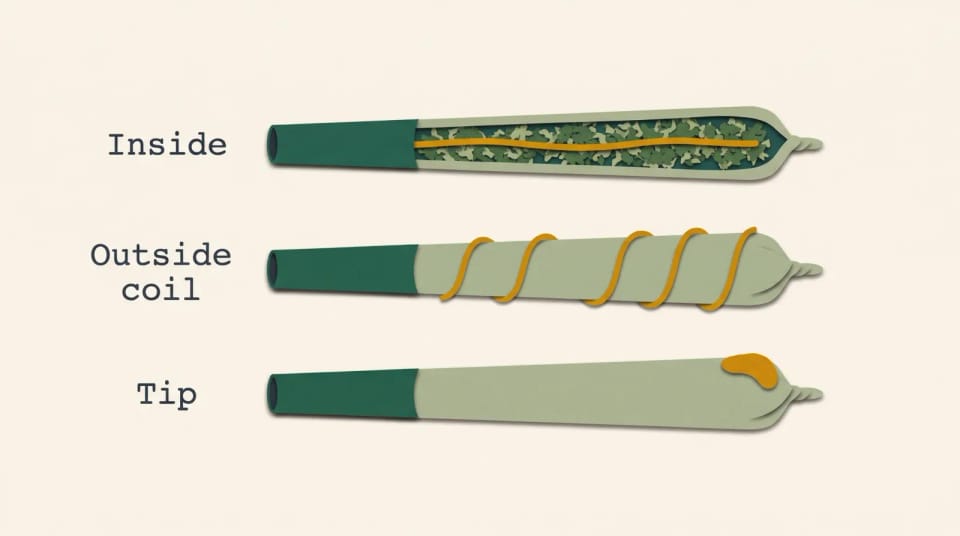
The three common twax placements. No study has measured whether one burns slower or wastes less than another.
How much stronger does a twaxed joint get?
Quite a bit on paper. Use the same label math as for the THC in a plain flower joint: grams times total THC percentage times 10 gives milligrams of potential THC.
For the inputs, we used the averages from a 2025 study that bought 277 products from 52 Colorado dispensaries and tested them in a lab. Flower averaged 20.8% total THC and concentrates averaged 70.7%. Per gram, the concentrate carried 3.4 times the THC of the flower. (Giordano et al., 2025, full text)
| Build | Flower | Concentrate | Total weight | Potential THC | Blend THC | Change vs plain joint |
|---|---|---|---|---|---|---|
| Plain joint | 0.5 g (104 mg) | none | 0.50 g | 104 mg | 20.8% | baseline |
| Add a pinch | 0.5 g | 0.05 g (35 mg) | 0.55 g | 139 mg | 25.3% | +34% |
| Add a pea-size piece | 0.5 g | 0.1 g (71 mg) | 0.60 g | 175 mg | 29.1% | +68% |
| Swap, same weight | 0.4 g (83 mg) | 0.1 g (71 mg) | 0.50 g | 154 mg | 30.8% | +48% |
| Heavy twax | 0.5 g | 0.2 g (141 mg) | 0.70 g | 245 mg | 35.1% | +136% |
Read the table with three limits in mind.
- These are illustrative amounts. We found no source for a typical amount of wax in a twaxed joint. If you want to see what 0.1 g looks like, our visual guide to cannabis quantities helps.
- These are Colorado averages. Your flower and concentrate can be well above or below them. In the same study, 96.0% of concentrates tested within 15% of their label, against 56.7% of flower. That is why concentrate labels are more reliable than flower labels.
- Potential THC is not the dose you absorb. A review of smoking studies puts the average bioavailability of smoked THC at about 30%, with wide variation between people. (McGilveray, 2005) Do not divide the total by a number of puffs either; delivery is not even along the joint, as we explain below.
If you buy rather than build, store-bought infused pre-rolls are the commercial version of the same idea, and that lesson covers price and burn.
Is a twaxed joint as strong as a dab?
No study has tested it directly, but the evidence points to no. Some retail pages claim a twaxed joint is “on par with dabbing”. None that we opened cites any data.
Two lines of evidence explain why the claim is weak.
- The heat is different. A dab flash-vaporizes concentrate on a hot surface. A joint burns, and some smoke escapes from the lit end between puffs. In a preliminary machine study, simulated dabbing recovered about 75.5% of the total THC, while flower smoke delivered roughly 19% to 27%. The authors note that a joint loses more to sidestream smoke. That study did not test concentrate burned inside a joint. (Hädener et al., 2019)
- People who dab reach higher blood THC. In 252 adults using their own legal products, dabbing went with higher plasma THC and stronger reported effects than joint-like or bong-like use. There was no twaxed-joint group. (Chen et al., 2025)
So a twaxed joint carries more THC than a plain joint, but the concentrate inside it still goes through combustion. The fair summary is “a stronger joint”, not “a dab you can roll”. For how dabbing itself works, see our dabbing basics lesson.
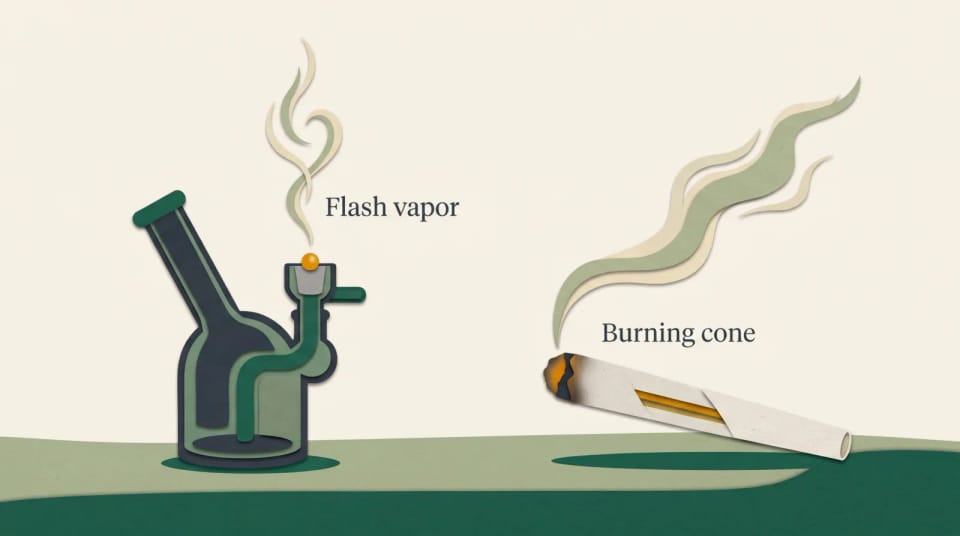
A dab vaporizes concentrate. A twaxed joint burns it, and some smoke drifts off between puffs. No study has measured a twaxed joint directly.
Does adding wax change how much you end up using?
Sometimes, but not reliably. People do adjust for strength, a habit researchers call self-titration. The adjustment is partial.
- In 80 users who brought their own products, concentrate users self-titrated and reached intoxication and impairment comparable to flower users. (Cuttler et al., 2021)
- In a lab-van study of 121 people, concentrate users still had higher blood THC than flower users, and memory and balance were impaired after use with both product types. (Bidwell et al., 2020)
- A review of studies from 1973 to 2020 found mixed results. Some experiments showed people smoking less of stronger cannabis; others showed higher doses and stronger effects. (Leung et al., 2021)
- In a large survey of mostly daily US consumers, people who used higher-THC versions of the same product type reported using larger amounts, not smaller ones. (Borodovsky et al., 2025)
Eyeballing does not help much. In a UK study of 247 users, people used slightly less cannabis in joints as THC rose, but recreational users were poor at judging potency compared with daily users. (Freeman et al., 2014) A scale beats a guess.
More THC is also not a better session for everyone. In a survey of 574 people who used both, the same users rated flower as giving more overall positive effects than concentrates, and 77.5% preferred flower. (Okey and Meier, 2020) Most of them rarely used concentrates, so read that as one group’s preference, not a rule.
How do you pace a twaxed joint?
Here is a practical rule, not a clinical guideline: stop at the halfway mark and wait at least 10 minutes before you decide on the rest.
It rests on two findings. First, in smoking-machine tests of a flower joint, the cannabinoid content of each puff rose as the joint burned down toward the mouth end. The second half delivers more than the first. (Eyal et al., 2024) Second, plasma THC after a smoked cigarette peaked about 10 minutes after inhalation in an older study. (McGilveray, 2005) Neither study tested concentrate, so treat the rule as a starting point.
Two more points help:
- Weigh both parts and do the math first. Then you know what you rolled.
- Share it, or roll it smaller. The swap row in the table shows that trading flower for wax at the same weight still raises potential THC by about half.
If you use the High IQ app, log how a twaxed joint felt against a plain one with the same flower. Your own notes beat a general rule.
Twaxing also stacks two things that lower-risk cannabis guidelines advise against: high-potency products and combusted inhalation. Those guidelines suggest choosing lower-potency products and non-smoking methods, and avoiding deep inhalation or breath-holding. (Fischer et al., 2017) Frequent high-THC use also builds tolerance faster.
When to talk to a clinician
Too much THC can bring on anxiety, nausea, a racing heart and dizziness; our lesson on greening out explains why. Get medical help right away for chest pain, fainting, trouble breathing, or vomiting that does not stop. Talk to a clinician if you have a heart or lung condition, take medications, are pregnant, or notice that you need more and more to feel the same effect.
Key takeaways
- Twaxing means adding concentrate to a joint, inside, outside, on the tip or as a kief coat.
- At Colorado average potencies, 0.1 g of concentrate adds about 71 mg of potential THC to a half-gram joint that holds about 104 mg.
- Potential THC is not an absorbed dose; smoked THC bioavailability averages about 30%.
- No study shows a twaxed joint matches a dab, and the available evidence points the other way.
- Stop at halfway and wait 10 minutes: later puffs carry more, and blood THC peaks about 10 minutes after inhalation.
FAQ
Are twax joints worth it?
That depends on what you want. A twaxed joint carries much more THC than a plain one, but it burns the concentrate instead of vaporizing it, so it does not deliver like a dab. In one survey, most people who used both flower and concentrates preferred flower.
How much wax goes in a joint?
There is no standard amount, and we found no source for a typical one. Our table shows 0.05 g, 0.1 g and 0.2 g only as examples. Weigh what you add and use the label math to see the potential THC.
Does twaxing make a joint burn unevenly?
Possibly, but nobody has measured it. Claims that concentrate makes a joint burn slower or more evenly come from retailers and forums. If your joint runs down one side, our guide on why a joint canoes explains the usual causes.
Is twaxing the same as an infused pre-roll?
Close. An infused pre-roll is a commercially made joint with concentrate added, sold with a label. A twaxed joint is usually one you build yourself, so you control the amounts and need to do the math. Learning how to roll a joint well comes first either way.
Does a twaxed joint get you higher than a plain joint?
It carries more THC, and higher-THC products went with higher blood THC in studies of flower and concentrate users. How high you feel also depends on how you smoke, your tolerance, and whether you adjust your intake. Start with less than you think you need.
Sources
- Giordano G, et al. Accuracy of labeled THC potency across flower and concentrate cannabis products. Scientific Reports, 2025.
- Hädener M, et al. A preliminary investigation of lung availability of cannabinoids by smoking marijuana or dabbing BHO. Forensic Science International, 2019.
- Chen MY, et al. Mode matters: how modes of cannabis administration affect THC plasma concentrations and subjective effects. Journal of Cannabis Research, 2025.
- Bidwell LC, et al. Association of naturalistic administration of cannabis flower and concentrates with intoxication and impairment. JAMA Psychiatry, 2020.
- Cuttler C, et al. Acute effects of high-potency cannabis flower and cannabis concentrates on everyday life memory and decision making. Scientific Reports, 2021.
- Leung J, et al. Do cannabis users reduce their THC dosages when using more potent cannabis products? A review. Frontiers in Psychiatry, 2021.
- Freeman TP, et al. Just say “know”: how do cannabinoid concentrations influence users’ estimates of cannabis potency and the amount they roll in joints? Addiction, 2014.
- Borodovsky JT, et al. Self-titration of cannabis consumption: an epidemiological perspective. Journal of Psychiatric Research, 2025.
- McGilveray IJ. Pharmacokinetics of cannabinoids. Pain Research and Management, 2005.
- Eyal AM, et al. Inconsistency in the composition of the smoke of a cannabis cigarette as smoking progresses. Cannabis and Cannabinoid Research, 2024.
- Fischer B, et al. Lower-risk cannabis use guidelines: a comprehensive update of evidence and recommendations. American Journal of Public Health, 2017.
- Okey SA, Meier MH. A within-person comparison of the subjective effects of higher vs. lower-potency cannabis. Drug and Alcohol Dependence, 2020.



