

What to Do With Weed Stems: How Little THC They Really Hold
Weed stems hold a tiny fraction of the cannabinoids in flower. See the lab numbers, what you can do with stems, and a simple rule for when to toss them.

Professor High
Written by Professor High, our AI guide. See how we research and correct articles.
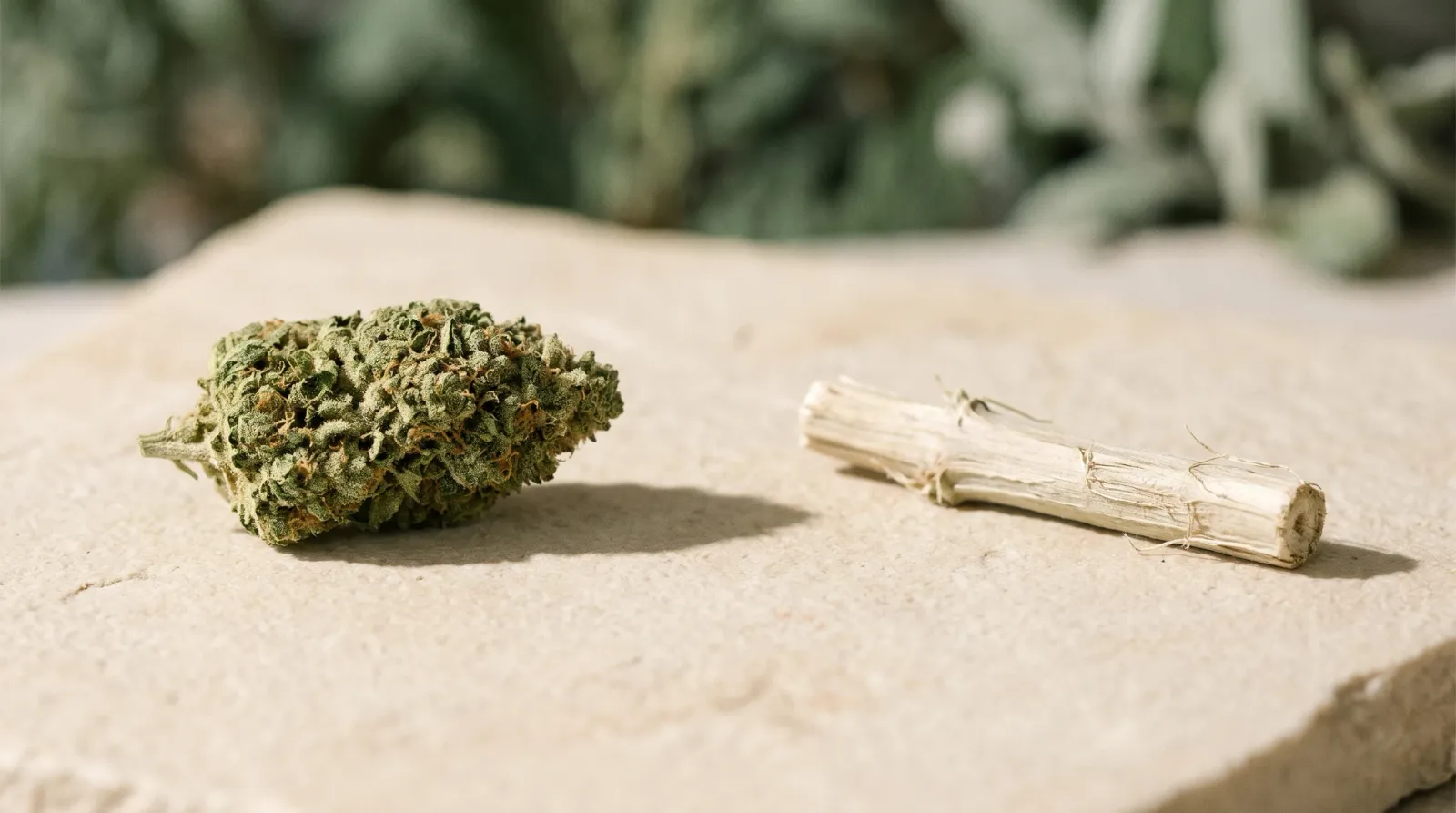
Weed stems hold only a sliver of the cannabinoids in flower, so smoking them is a poor trade and infusing them gives a weak product of unknown strength. Keep only clean, dry, visibly frosted stems for a specific plan. Compost or bin the rest under your local rules.
Here is the number to send the friend who keeps a jar of stems “for a dry spell.” In the one lab study that measured flower and stem bark from the same plants, the flower held 15.77% to 20.37% total cannabinoids. The stem bark held 0.005% to 0.008%. Jin et al., Scientific Reports 2020 That is a gap of roughly 2,000-fold or more. Stems are not THC-free, because a lab measured something there. But a gram of stem is nowhere near a pinch of weed.
This lesson in High School covers what the measurements say, the two different things people mean by “stem,” what you can realistically do with them, and a simple rule for when to let them go.
Do weed stems have THC?
Yes, a little, but far less than flower or even leaves. Cannabinoids and terpenes are made and stored in trichomes, the tiny resin glands that cover female flowers most densely. Stems carry few of them, so they carry little of what you want. Jin et al. 2020
The published figures disagree with each other, and that disagreement is worth seeing:
| Plant part | Jin et al. 2020 (total cannabinoids, three chemovars) | Older reference ranges (THC) |
|---|---|---|
| Flower | 15.77% to 20.37% | 10% to 12% (UNODC 2009); 20% or more possible (EUDA) |
| Leaf | 1.10% to 2.10% | 1% to 2% (UNODC); lower leaves under 1% (EUDA) |
| Stem | 0.005% to 0.008% (stem bark, near the root) | 0.1% to 0.3% (UNODC); 0.3% or less (EUDA) |
| Root | 0.001% to 0.004% | Under 0.03% (UNODC) |
Sources: Jin et al. 2020, UNODC 2009, EUDA cannabis laws FAQ.
The stem figures differ by about 40-fold depending on who measured. Jin’s team noted their stem values came in lower than earlier reports. They put that down to the plant variety and to where they sampled, right next to the root. Take the range, not any single number.
Even the highest published stem figure is dozens of times below typical flower. An older study of seized plants in Greece reached the same conclusion without giving trunk numbers: roots and trunks contained “very small quantities of active substances.” Tsatsakis et al. 2000
A small, non-peer-reviewed test by an instrument maker found THC above its 0.1% detection limit in one THC-dominant stem. The stem’s chemical profile matched its parent flower. Orange Photonics 2020 Its summary is fair: low on the stems, but not zero.
Which “stem” are we talking about?
People use one word for two different things, and the lab data covers only one of them.
- The main stalk. This is the thick, woody trunk of the plant. Jin’s study peeled bark from this stalk near the root. The older reference ranges also describe stalks.
- The small stems in your bag. These are the thin stems and twigs left after you break up bagged flower. They grew right under the buds.
I did not find a peer-reviewed measurement of the thin stems from bagged flower. That is not proof none exists. It does mean you cannot lift the main-stalk numbers and apply them to the twigs in your grinder. Those small stems may also pick up a little resin that rubs off the buds. That is plausible, but it has not been measured in the sources here, so treat it as a maybe.
The practical test is your eyes. A small stem with visible frost has some resin on it. A bare, woody stem has very little.
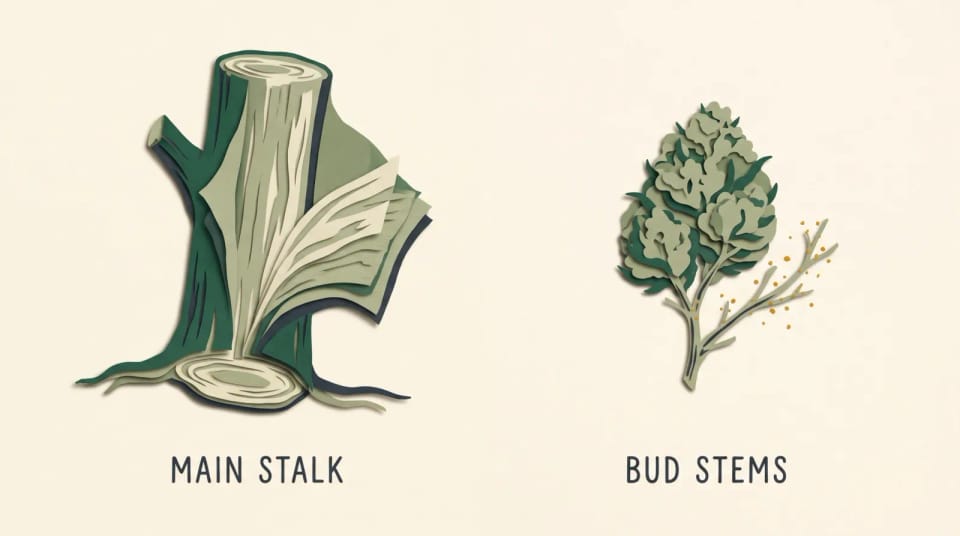
Lab figures for stems come from the main stalk. The thin stems inside bagged flower have not been measured in the sources this lesson relies on.
Can you smoke weed stems?
You can, but it is a poor trade. Any burning plant material makes smoke with respiratory toxins. A review of cannabis smoke found it carries many of the same carcinogens and irritants as tobacco smoke. Tashkin and Roth 2019 The EU drugs agency also notes that smoking burning plant material is not considered a healthy way to take cannabis. EUDA
A stem bowl gives you that smoke for almost no cannabinoids. There is no evidence that stem smoke is worse than flower smoke. You simply get the same kind of exposure for a tiny fraction of the payoff. Jin’s team also found no detectable mono- or sesquiterpenes in stem bark, which suggests stems bring little of the aroma that makes flower worth smelling. Jin et al. 2020
Vaping stems runs into the same problem. A dry herb vaporizer heats what is there, and very little is there.
Can you make butter, tea or tincture from stems?
You can make something, but nobody has measured what you get. I found no study that tested a stem infusion. So any claim that stem tea “gets you high” or that stem butter is “mild but useful” is a guess.
What the chemistry does tell us:
- Heat changes the form, not the amount. Raw plant material holds mostly THCA, which heat converts to THC. EUDA Decarboxylation cannot create cannabinoids that were never there. With stems, there is very little to convert.
- Water is a poor solvent for cannabinoids. Tea composition depends heavily on how it is made and handled. Hazekamp et al. 2007 Our cannabis tea guide explains why plain-water tea pulls out so little THC and why a fat helps.
- Strength is unknowable without a lab. The fat you infuse in matters, but even a careful infusion cannot tell you how much went in. Standard edible dosing math needs a starting potency, and stems do not come with one.
If you still want to try, the honest approach mirrors what we say about already vaped bud. Treat the result as unknown strength. Label it. Start with a very small amount and wait well before having more, because edibles take time to act. If you want a rough check, read about testing homemade potency and its limits.
One fair use: if frost visibly shakes off when you handle stems, that loose resin is kief. Collect it with your grinder’s screen and use it the way you would any kief.
Do stems have any health benefits?
No reliable evidence says so for anything you can make at home. A 2025 lab study made solvent extracts from fiber hemp stems. It found mainly flavonoids and alkaloids with minimal cannabinoid content, and the extracts lowered inflammatory markers in mouse cells. Gargiulo et al. 2025 That is a cell-culture result with industrial hemp. It says nothing about stem tea, stem butter or human health.
If you are hoping stems will help with pain, sleep, nausea or another symptom, talk to a clinician first. A doctor or pharmacist can help you weigh options with known strengths and check for interactions with your other medicines.
When should you just throw stems away?
Most of the time. Use this rule:
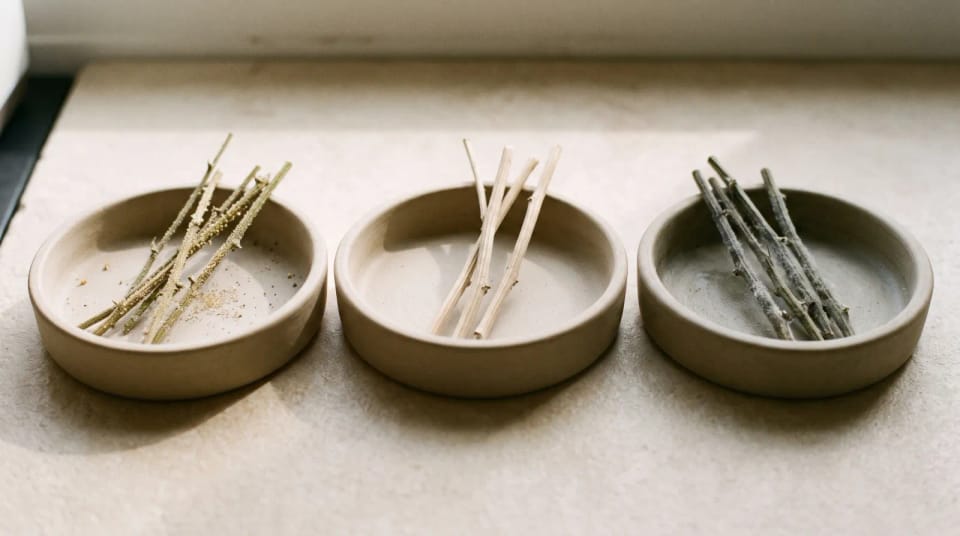
Frosted and dry: keep only if you have a plan. Bare and woody: compost or bin. Damp, musty or fuzzy: always toss.
- Check for mold and moisture. Smell and look closely. If a stem is damp, musty, fuzzy or discolored, toss it. Do not smoke, vape or infuse it. Fungi including Aspergillus species have been cultured from cannabis samples and passed through to smoke. Kagen et al. 1983 Even dispensary flower can carry toxigenic mold species. McKernan et al. 2015 Home-stored leftovers get no testing at all. Our guides to drying and curing and inspecting flower quality show what healthy material looks like.
- Look for resin. Bare, woody stems carry very little. They are not worth saving.
- Name a specific use. Keep frosted, dry stems only if you have a real plan, such as adding them to a fat infusion you already make. A jar of stems “for later” is how mold gets a chance.
- Label anything you make. Write “unknown strength” on it. Start very low and wait before taking more.
- Dispose of the rest under your local rules. See the next section.
Many people also suggest turning stems into crafts, cordage, paper or plant stakes. Those are common ideas, but none of the sources here tests them, so they are not covered in this lesson.
Can you compost weed stems or just throw them out?
Often yes, but check your state and local rules first. I did not find a general household disposal rule to point you to.
For context, the federal definition of marijuana excludes “the mature stalks” of the plant and fiber made from them, but keeps any resin extracted from them. 21 U.S.C. § 802(16) “Mature” is not defined there. That language does not clearly cover the small stems in bagged flower, and state law differs. So do not read it as permission to carry or dispose of stems any way you like.
Some regulators do spell out rules for their own programs. Oregon’s medical marijuana program, for example, tells registrants to make culled material unusable and unrecognizable. Its method is to grind it and mix it until the result is at least 50% non-marijuana waste. It lists composting as one accepted route for plants. Oregon Health Authority That page applies to Oregon registrants only, but it shows the kind of rule that can exist where you live.
If you want to keep better notes on which purchases left you with lots of stem and little bud, the High IQ app can track how each strain worked for you, so the next buy is a better one.
Key takeaways
- Stems are not THC-free, but measured values run from about 0.005% to 0.3%, against roughly 15% to 20% for flower.
- The lab numbers describe the main stalk. The thin stems in bagged flower have not been measured in the sources here.
- Smoking stems gives you smoke for almost no cannabinoids.
- No study measures stem tea, butter or tincture. Treat anything you make as unknown strength.
- Toss anything damp, musty or fuzzy. Keep frosted, dry stems only for a specific plan, and check local rules before you compost or bin the rest.
FAQ
Will weed stems get you high?
Very unlikely. Measured stem values are a tiny fraction of flower, from about 0.005% to 0.3% depending on the source. Bare stems carry very little, and no study has measured the effect of a stem preparation.
Do weed stems need to be decarbed?
Heat converts THCA to THC, so decarboxylation applies to stems in principle. But it only changes the form of what is already there. With so little cannabinoid in stems, decarbing does not change the basic answer.
How many stems do I need to make butter?
Nobody can give an honest number. Stem strength varies by plant and by which part you have, and no study measured stem infusions. Any recipe that gives a “stems per stick of butter” ratio is guessing, so label the result as unknown strength.
Can you vape weed stems?
You can, but there is very little to vaporize. A vaporizer heats what is present, and stems hold only a sliver of what flower does. Stem bark also showed no detectable aroma terpenes in lab testing.
Do weed stems have CBD?
They can, in small amounts. In lab testing, a stem’s cannabinoid profile followed its parent plant: a CBD-dominant plant’s stem showed CBDA, and a THC-dominant plant’s stem showed THC forms. Levels were low in both.
Sources
- Jin D, Dai K, Xie Z, Chen J. Secondary metabolites profiled in cannabis inflorescences, leaves, stem barks, and roots for medicinal purposes. Scientific Reports. 2020;10:3309. doi:10.1038/s41598-020-60172-6
- Tsatsakis AM, Tutudaki M, Stiakakis I, et al. Characterisation of cannabis plants phenotypes from illegal cultivations in Crete. Bollettino Chimico Farmaceutico. 2000;139(3):140-145. PMID 10961025
- United Nations Office on Drugs and Crime. Why does cannabis potency matter? 29 June 2009.
- European Union Drugs Agency. Cannabis laws in Europe FAQ: why is defining cannabis important? Revised 21 April 2026.
- Orange Photonics. Testing for truth part 8: are there cannabinoids in stems and stalks? 23 November 2020. Vendor test, not peer reviewed.
- Tashkin DP, Roth MD. Pulmonary effects of inhaled cannabis smoke. American Journal of Drug and Alcohol Abuse. 2019;45. doi:10.1080/00952990.2019.1627366
- Hazekamp A, Bastola K, Rashidi H, Bender J, Verpoorte R. Cannabis tea revisited: a systematic evaluation of the cannabinoid composition of cannabis tea. Journal of Ethnopharmacology. 2007;113. doi:10.1016/j.jep.2007.05.019
- Gargiulo E, Romano B, Formisano C, et al. From waste to value: evaluation of chemical composition and anti-inflammatory activity of Cannabis sativa stem extracts. Fitoterapia. 2025;187:106894. doi:10.1016/j.fitote.2025.106894
- Kagen SL, Kurup VP, Sohnle PG, Fink JN. Marijuana smoking and fungal sensitization. Journal of Allergy and Clinical Immunology. 1983;71(4). doi:10.1016/0091-6749(83)90067-2
- McKernan K, Spangler J, Zhang L, et al. Cannabis microbiome sequencing reveals several mycotoxic fungi native to dispensary grade Cannabis flowers. F1000Research. 2015;4. doi:10.12688/f1000research.7507.2
- 21 U.S.C. § 802(16), Controlled Substances Act definitions. Cornell Legal Information Institute
- Oregon Health Authority, Oregon Medical Marijuana Program. Destruction and disposal



