Cannabis Tea: Why Most Recipes Fail and How to Make One That Works
Steeping flower in hot water extracts almost no THC. Here is the chemistry, the two steps that fix it, and four tested recipes with dosing maths.

Professor High
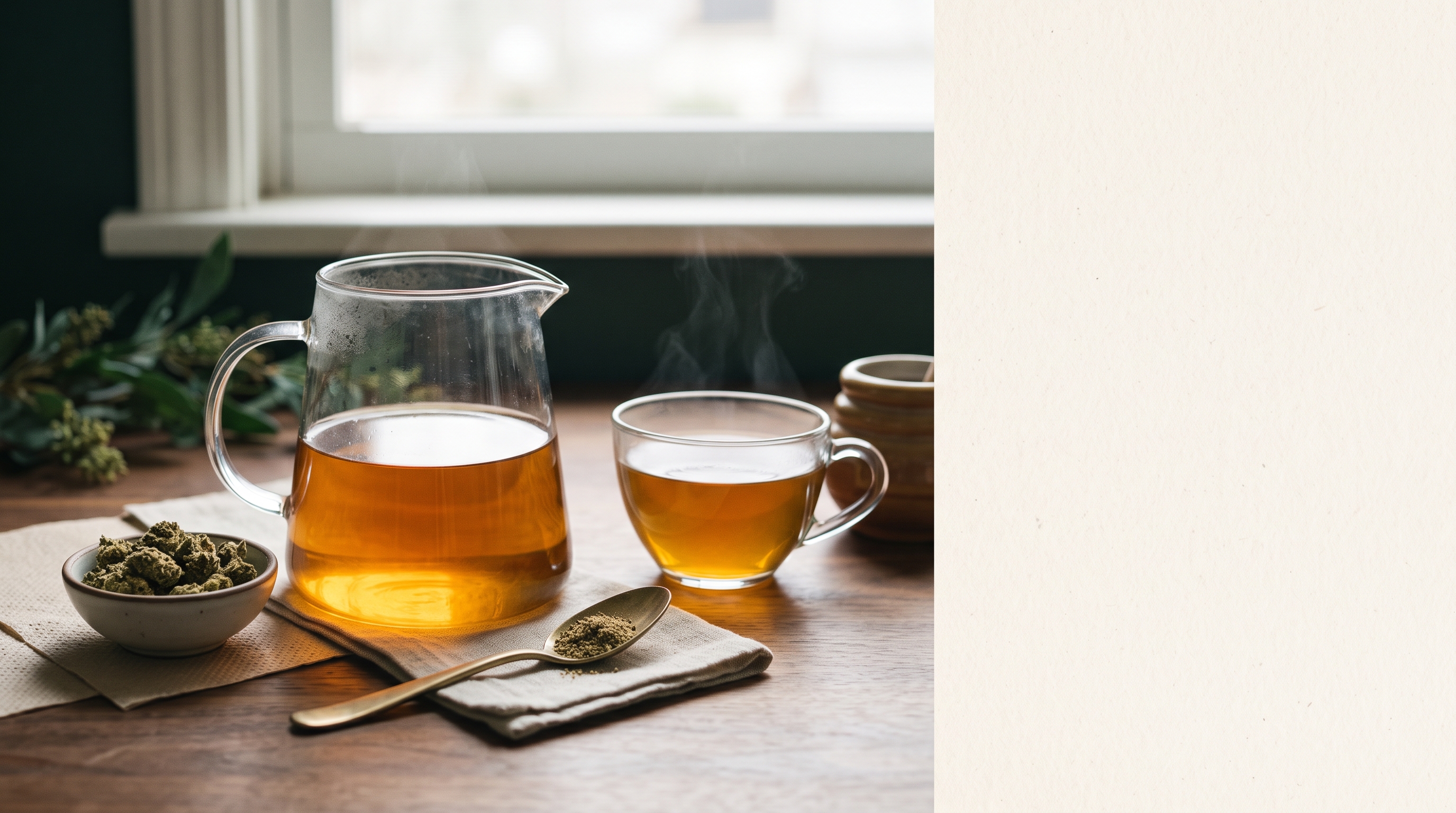
You crumbled a gram of good flower into a mug, poured boiling water over it, waited fifteen minutes, and drank something that tasted like lawn clippings and did absolutely nothing. Then you found a comment thread where forty people swore it worked, and concluded you must have done it wrong.
You didn’t. You did exactly what the recipe said. The recipe was wrong.
Cannabis tea is the one preparation where the folk method and the chemistry are in open conflict. Almost every version online skips one or both of the steps that matter, and the result is terpene water — aromatic, pleasant, and almost entirely non-intoxicating. The fix is well documented and takes about forty minutes.
The problem in one number
In 2024, a team at the University of Chemistry and Technology in Prague ran the experiment properly: 1 gram of cannabis in a tea bag, 250 mL of boiling water, 10 minutes.
Transfer of Δ9-THC into the water was 0.4% to 1.9% of what was in the plant.
They then added 20 grams of 10%-fat cream to the steeping water and repeated it. Transfer jumped to 53% to 64% — roughly fiftyfold (Maly et al., 2024).
That comparison is the whole article. The rest is explanation and consequences.
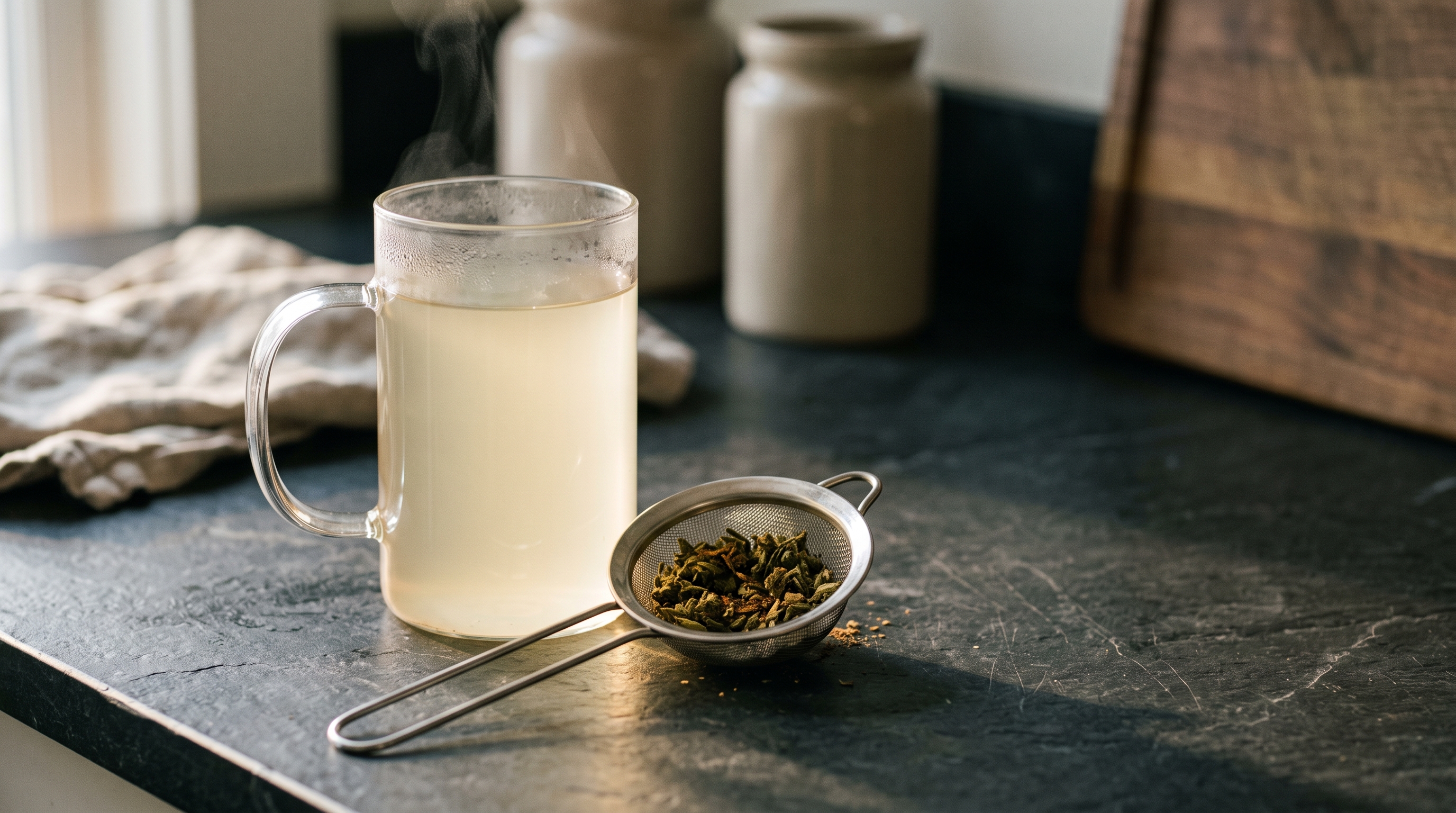
Why water is the wrong solvent
THC is lipophilic. It dissolves readily in fats and oils and very poorly in water — a property established in the pharmaceutical literature more than fifty years ago (Garrett and Hunt, 1974).
You can see the ceiling in real data. A 2007 Leiden University study followed the official Dutch pharmacy protocol for medicinal cannabis tea: 1.0 g of flower in 1.0 L of boiling water, simmered 15 minutes. The finished tea averaged 0.010 mg/mL of THC — about 10 mg in the entire litre, from plant material holding roughly 174 mg (Hazekamp et al., 2007).
More telling: using 1.5 g of flower instead of 1.0 g did not significantly increase the water concentration. The solution was already saturated. Adding more flower to the pot just leaves more THC in the flower.
They confirmed it directly by dropping pure THC into boiling water. Only about 17% was recovered after 15 minutes, and a visible film of precipitate formed on the glass. The rest came out of solution and stuck to the pot.
The acid form muddies the picture
Raw cannabis contains little THC. It contains THCA — tetrahydrocannabinolic acid — which is not meaningfully intoxicating. The Leiden flower measured 191 mg/g THCA against 6 mg/g THC.
THCA’s carboxyl group makes it noticeably more water-soluble than THC, so steeping raw flower does extract something: mostly THCA, which came out at 0.043 mg/mL — four times the THC level. Prague saw the same pattern.
This is why cannabis tea has a reputation as “the gentle version.” It isn’t gentle. It’s mostly the wrong molecule.
Step one: decarboxylation is not optional
To turn THCA into THC you have to knock off that carboxyl group with heat. Boiling water cannot do it. Prague noted plainly that 100 °C is insufficient for meaningful conversion, and Leiden measured just 6.6% conversion of pure THCA over a 15-minute boil.
The kinetics are characterised. Wang and colleagues heated acidic cannabinoids in a vacuum oven and tracked conversion:
| Oven temperature | Time for THCA to approach zero |
|---|---|
| 110 °C (230 °F) | ~30 minutes |
| 130 °C (266 °F) | ~9 minutes |
| 145 °C (293 °F) | ~6 minutes |
At 110 °C they saw complete conversion with only about 8% relative loss in total cannabinoid content (Wang et al., 2016).
One finding worth internalising: heating in the dark under vacuum produced no detectable CBN. The stale breakdown product everyone blames on “overheating” is an oxidation product — heat alone, without oxygen and light, didn’t make it. So keeping your flower covered during decarb matters as much as the temperature.
The home-oven translation
Your oven is not a vacuum oven. It cycles 10–15 °C around its setpoint, it is full of air, and most ovens are miscalibrated. Treat the lab numbers as a floor.
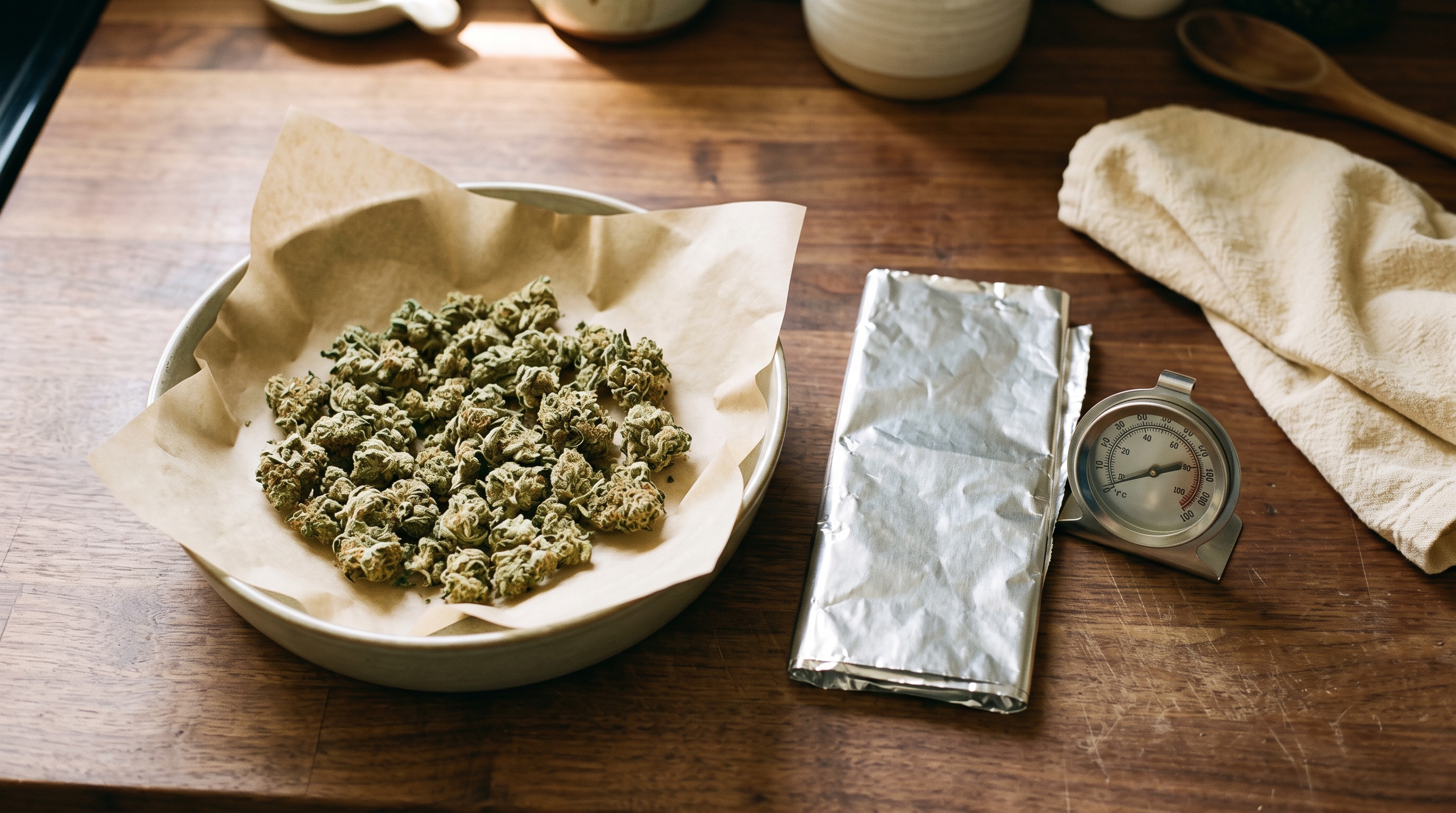
- Break flower into coarse pieces by hand. Don’t grind to powder — it scorches and slips through strainers later.
- Spread on parchment in a small dish and cover with foil, trapping terpene vapour and limiting oxygen.
- Bake at 115 °C / 240 °F for 30–35 minutes.
- Use a separate oven thermometer. Don’t trust the dial.
- Cool covered before opening. It should be dry and a shade darker — toasted-oregano brown, not coffee brown.
Full detail in how to decarb cannabis perfectly every time and decarboxylation explained.
Step two: add fat, and add enough of it
Decarbed flower in plain water still gives you a near-empty cup. THC needs somewhere to go.
Prague’s cream condition was 20 g of 10%-fat cream in 250 mL — about 2 grams of actual fat per cup. That was enough to lift transfer from under 2% to over 50%. You don’t need much fat. You need some, and it has to be in the pot while the extraction is happening, not stirred in at the end.
| Fat source | Fat per serving | Notes |
|---|---|---|
| Whole milk (240 mL) | ~8 g | The traditional choice. Forgiving, mild, works well. |
| Half-and-half or single cream (30 mL) | ~3–4 g | Closest to the tested condition. Very reliable. |
| Full-fat coconut milk (60 mL) | ~12 g | Best vegan option. High saturated fat, mixes cleanly. |
| Coconut oil or butter (1 tsp) | ~4.5 g | Works, but tends to separate into a slick without agitation. |
| Oat or almond milk (240 mL) | ~1–3 g | Marginal. Usually too little fat unless it’s a barista formulation. |
| Skim milk | ~0 g | Functionally the same as water. Don’t. |
Skim milk deserves the emphasis. If the fat isn’t there, the mechanism isn’t there. More on which fats extract best in choosing the right fat for cannabis infusions.
What about lecithin?
Lecithin is genuinely useful as an emulsifier: a quarter-teaspoon keeps your infusion suspended instead of separating into a slick on the surface of the mug — and that slick is where a chunk of your dose ends up if you leave it behind.
The claim that lecithin increases potency is a different claim, and it rests on user reports rather than controlled human data. The proposed mechanism — better micelle formation and lymphatic uptake — is plausible but has not been demonstrated in people drinking cannabis tea. Use lecithin for texture; don’t count on it for milligrams.
Commercial drinks solve this with engineered nanoemulsions that suspend cannabinoid droplets in water directly — see nano-emulsified THC and fast-acting edibles. Your kitchen can’t replicate it and doesn’t need to.
Why tea feels different from smoking — and from a gummy
Anything swallowed passes through the liver before reaching general circulation. That first pass destroys most of the dose and chemically transforms part of what survives.
On destruction: oral THC in a chocolate cookie reached a bioavailability of 6% ± 3%, versus 18% ± 6% for the same drug smoked, with oral absorption described as “slow and erratic” (Ohlsson et al., 1980). Erratic is the operative word — the same dose in the same person on two different days does not reliably produce the same effect.
On transformation: the liver converts THC into 11-hydroxy-THC. Given intravenously to humans, that metabolite produced psychological and pharmacological effects lasting several hours, and the authors concluded conversion to it accounts for THC’s effects in people (Lemberger et al., 1972). More in why edibles hit harder.
So tea behaves like an edible, with one wrinkle: it arrives as a warm liquid on a frequently empty stomach, which tends to move faster than a dense brownie.
| Smoked / vaporised | Cannabis tea | Baked edible | |
|---|---|---|---|
| Onset | 1–5 min | ~30–75 min | 45–120 min |
| Peak | 10–30 min | 1.5–3 hours | 2–4 hours |
| Total duration | 2–4 hours | 4–8 hours | 4–8+ hours |
| Dose control | High — titrate live | Low — committed once swallowed | Low |
| Main metabolite | THC | 11-hydroxy-THC | 11-hydroxy-THC |
Those onset ranges are rules of thumb, not measurements. Individual variation in gut transit, liver enzyme activity and body composition is enormous, which is exactly why the two-hour rule exists — see the 2-hour rule that saves sessions and sublingual vs edible onset speed.
The long tail is what people underestimate. A cup at 9 p.m. is still doing something at 2 a.m.
The traditional version got it right
None of this is new. Cannabis has a long documented history of religious and medicinal use in India (Touw, 1981), and the canonical preparation — bhang — is not a water steep. It is a paste of cannabis ground with milk, ghee, spices and nuts, then thinned into a drink. Bhang lassi adds yoghurt on top.
Fat, fat, and more fat. Whoever worked that out did it without a chromatograph, presumably by noticing that the water version didn’t do anything.
Four recipes that actually work
Read the potency maths section before you make any of these. All four assume you have already decarbed your flower.
1. Bhang-style masala chai (the canonical version)
Makes 2 cups.
- 0.25 g decarbed flower, coarsely broken
- 480 mL whole milk
- 2 green cardamom pods, cracked
- 1 small cinnamon stick
- 4 black peppercorns
- 1 tsp loose black tea (assam works)
- Honey or sugar to taste
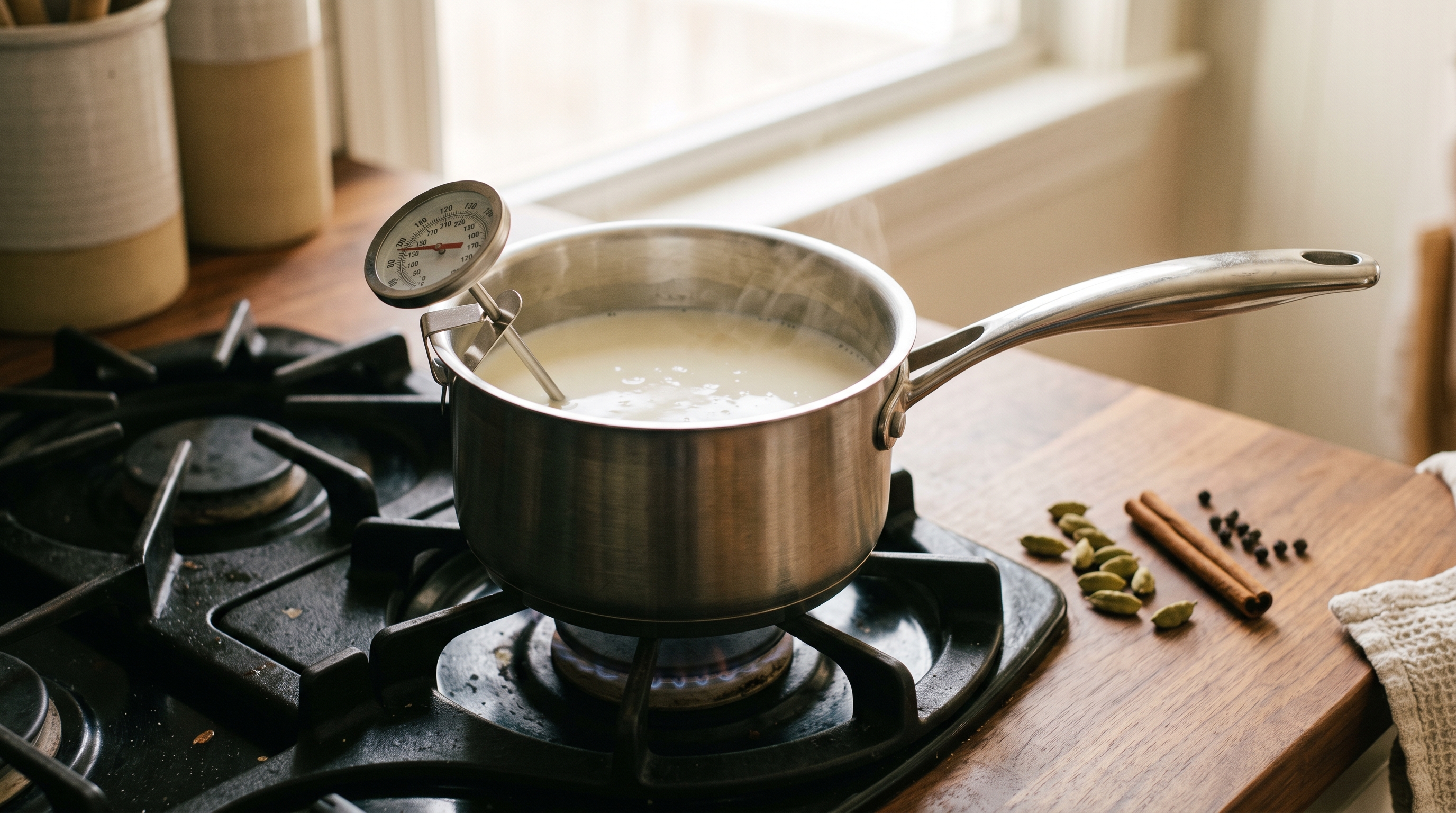
Combine milk, decarbed flower and whole spices in a small saucepan. Bring to 85–90 °C (185–195 °F) — steaming, with small bubbles at the edge, but not a rolling boil — and hold it there for 40 minutes, stirring every five minutes and scraping the bottom so the milk doesn’t catch. Add the black tea for the final 4 minutes. Strain twice through a fine-mesh sieve, pressing the solids firmly to recover the fat clinging to them. Sweeten.
Milk scorches easily and terpenes are volatile, so resist the urge to crank the heat. A longer hold at a lower temperature beats a short boil.
2. Coconut green tea (vegan)
Makes 2 cups.
- 0.25 g decarbed flower
- 400 mL water
- 120 mL full-fat canned coconut milk (the thick stuff, not the carton drink)
- 1/4 tsp sunflower lecithin
- 2 tsp loose sencha or gunpowder green tea
- Pinch of salt
Whisk coconut milk and lecithin into the water in a saucepan until uniform. Add the decarbed flower. Hold at 85 °C for 35 minutes, whisking occasionally. Remove from heat, let it drop to about 75 °C — green tea turns bitter above that — then steep the leaves for 3 minutes. Strain, press, salt.
Coconut milk carries more saturated fat per millilitre than dairy cream and holds an emulsion well, which makes this the most consistent of the four.
3. The five-minute cup (most reliable)
Makes 1 cup.
- 1 tsp finished cannabis-infused coconut oil or butter, of known potency
- 240 mL hot water or hot milk
- 1 tea bag of anything you like
- 1/4 tsp lecithin, or a small immersion blender
Brew the tea normally. Whisk or blend the infused fat in while the liquid is hot. Drink promptly, before it separates.
Use this one if you care about knowing your dose. Because the infusion happened in a controlled batch — see cannabutter or infused coconut oil — every cup draws from the same known pool instead of being its own uncontrolled extraction. It also skips the vegetal flavour, a problem tackled in edibles without the weedy taste.
4. Low-dose evening tisane
Makes 2 cups.
- 0.1 g decarbed flower from a CBD-forward or balanced cultivar
- 480 mL whole milk, or oat milk plus 1 tsp coconut oil
- 1 tsp dried chamomile
- 1/2 tsp dried lavender
- Small piece of fresh ginger
Same method as the chai: 85 °C, 35 minutes, strain and press. Add the chamomile and lavender in the last 5 minutes so their volatile oils survive.
At 0.1 g of flower split across two cups this lands in genuine microdose territory. If sleep is the goal, the honest evidence on cannabis and rest is more mixed than the marketing suggests — cannabis and sleep and CBN: facts vs fiction both cover where the data actually sits.
Potency maths, honestly
Here is the arithmetic — and the size of the error bar, because anyone giving you the first without the second is selling something.
Step 1 — Find your ceiling. Multiply your flower’s labelled total THC percentage by 10 for milligrams per gram. A 20% flower holds 200 mg/g, almost all as THCA.
Step 2 — Apply the decarb conversion. Removing the carboxyl group costs about 12% of the mass, so multiply by 0.877.
200 mg × 0.877 = 175 mg THC per gram, theoretical maximum
Step 3 — Apply a recovery factor. Between imperfect decarb, incomplete transfer into fat, and what stays in the strained solids, assume 60% for a milk-based tea. Prague hit 53–64% under lab conditions, so 60% is a fair kitchen figure.
175 mg × 0.60 = ~105 mg THC per gram of flower
Step 4 — Divide by servings. Recipe 1 uses 0.25 g across 2 cups:
0.25 g × 105 mg/g = 26 mg total ÷ 2 cups = ~13 mg per cup
Thirteen milligrams is a real dose. Without established tolerance, a first cup should be half that — drop to 0.1 g for a two-cup batch and land near 5 mg.
The error bar. Treat that 13 mg as ±40%. Labels drift, ovens miscalibrate, simmer temperatures wander, and you pressed the solids harder or softer than I did. It is good enough to keep you out of trouble and not good enough to call a dose.
More arithmetic in edible dosing math for home cooks; to measure rather than estimate, see how to test homemade edible potency at home. Beginners start with the cannabis beginner’s dosing chart.
A note on hemp and “CBD tea”
Prague made a point that gets overlooked: even using hemp with under 1% THC by dry weight, a 250 mL cup prepared with cream could exceed the acute reference dose of 1 μg/kg body weight several times over for a 70 kg adult. Low-THC is not no-THC once you add the fat that makes extraction work. Drinking hemp tea expecting zero psychoactive load? Add the cream at the end, not during the steep.
The seven mistakes
- Skipping decarb. You extracted THCA. It is not the same molecule.
- Using water alone. Under 2% transfer. This is the single biggest failure mode.
- Using skim or low-fat milk. The fat is the mechanism, not a flavour choice.
- Adding the fat after straining. It has to be present during extraction, not stirred into the finished cup.
- Boiling hard. Saturation means extra heat buys you nothing, while scorching the milk and driving off terpenes.
- Not pressing the solids. A meaningful share of your dose is in the fat clinging to spent plant matter. Press the sieve.
- Redosing at the 60-minute mark. Onset can run past an hour. This is how a pleasant evening becomes an unpleasant one.
An eighth, quieter mistake: storing it too long. Leiden found that after a single day of refrigeration, THC and THCA in stored tea had fallen to 60% and 71% of starting levels; after twelve days, to 6% and 8%. The cannabinoids come out of solution and stick to the container. A solubiliser — they tested coffee creamer and a cyclodextrin — held levels roughly steady for five days. Fat-based tea stores far better than water-based, but drink it within a few days and shake before pouring. See cannabis edibles shelf life and how to store cannabis.
Does the cultivar matter?
Somewhat — and less than the label implies. The extraction chemistry is identical regardless of what the jar says. What changes is the cannabinoid ratio you start from and which terpenes survive. Terpenes are volatile and a lot leave with the steam, which is another reason a long low simmer beats a hard boil; how much of the rest reaches you is covered in terpene bioavailability.
For a heavy evening cup, people reach for myrcene-dominant flower — Granddaddy Purple, Northern Lights, Bubba Kush — the Relax High end, aiming at sleepy and relaxed. Read the myrcene 0.5% rule before treating that as law. For daytime, limonene- and pinene-forward cultivars like Jack Herer, Sour Diesel or Green Crack sit in Uplift High territory. Balanced or CBD-forward options — Harlequin, ACDC, Cannatonic — suit the low-dose tisane, nearer Balance High and calm. Linalool and caryophyllene are worth knowing in an evening context; Blue Dream remains the middle-of-the-road first attempt.
But the honest position — the one this site is built on — is that the name on the jar is a marketing artefact. Two jars of the same cultivar from different growers can carry materially different cannabinoid and terpene profiles, and the effect you get from a given chemistry is not the effect your friend gets.
So the only dataset that will ever answer “what should I brew?” is your own. Log the flower, the batch, the dose you estimated, and what actually happened over the following six hours. That is what the High IQ app is for — after a dozen entries, patterns show up that no strain description ever will.
FAQ
Does a plain water steep give me anything at all? Terpenes, flavonoids, chlorophyll, a fair amount of non-intoxicating THCA, and roughly 0.4–1.9% of the THC. If you enjoy the taste and the ritual, that’s a legitimate reason to do it. Just don’t expect effects.
Do I have to decarb if I’m simmering in milk for 40 minutes? Yes. Milk simmers around 85–95 °C, well below what efficient conversion needs — Wang’s data shows THCA still requires roughly 30 minutes at 110 °C. You’d get partial conversion at best.
Can I use the leftover strained flower? After a fat-based extraction, not for much. After a water-only steep the opposite holds — nearly everything is still in there — so dry the solids and use them in a proper fat infusion instead.
Why did tea hit harder than the same flower smoked? The liver converts THC to 11-hydroxy-THC, a metabolite active in its own right (Lemberger et al., 1972). And when you smoke you titrate; once you’ve swallowed a cup you’re committed to the whole dose. See high-dose vs microdose edibles.
Can I batch it and refrigerate? Fat-based tea holds a few days, and Leiden showed a creamer-type solubiliser kept levels roughly stable over five. Water-based degrades fast — down to 60% of starting THC after one day. Shake before pouring either way; separation means uneven dosing.
Is tea better for beginners than an edible? Not inherently. Onset is slightly faster and dividing a batch across cups makes small doses easier to hit, but pharmacokinetically it’s still an edible — same erratic absorption, same long tail. Start at 2–5 mg and read the first-time users guide.
Sources
- Maly, M., Benes, F., Binova, Z., Hajslova, J. (2024). Tea Prepared from Dried Cannabis: What Do We Drink? Journal of Agricultural and Food Chemistry, 72(38), 21254–21265. doi:10.1021/acs.jafc.4c05940 · PubMed 39264724
- Hazekamp, A., Bastola, K., Rashidi, H., Bender, J., Verpoorte, R. (2007). Cannabis tea revisited: a systematic evaluation of the cannabinoid composition of cannabis tea. Journal of Ethnopharmacology, 113(1), 85–90. doi:10.1016/j.jep.2007.05.019 · PubMed 17604926
- Wang, M., Wang, Y.-H., Avula, B., Radwan, M. M., Wanas, A. S., van Antwerp, J., Parcher, J. F., ElSohly, M. A., Khan, I. A. (2016). Decarboxylation Study of Acidic Cannabinoids: A Novel Approach Using Ultra-High-Performance Supercritical Fluid Chromatography/Photodiode Array-Mass Spectrometry. Cannabis and Cannabinoid Research, 1(1). doi:10.1089/can.2016.0020
- Ohlsson, A., Lindgren, J.-E., Wahlen, A., Agurell, S., Hollister, L. E., Gillespie, H. K. (1980). Plasma delta-9-tetrahydrocannabinol concentrations and clinical effects after oral and intravenous administration and smoking. Clinical Pharmacology and Therapeutics, 28(3), 409–416. doi:10.1038/clpt.1980.181 · PubMed 6250760
- Lemberger, L., Crabtree, R. E., Rowe, H. M. (1972). 11-hydroxy-Δ9-tetrahydrocannabinol: pharmacology, disposition, and metabolism of a major metabolite of marihuana in man. Science, 177(4043), 62–64. doi:10.1126/science.177.4043.62 · PubMed 5041775
- Garrett, E. R., Hunt, C. A. (1974). Physicochemical Properties, Solubility, and Protein Binding of Δ9-Tetrahydrocannabinol. Journal of Pharmaceutical Sciences, 63(7). doi:10.1002/jps.2600630705
- Touw, M. (1981). The Religious and Medicinal Uses of Cannabis in China, India and Tibet. Journal of Psychoactive Drugs, 13(1). doi:10.1080/02791072.1981.10471447
Cannabis affects everyone differently. Nothing here is medical advice. Know your local laws, start low, and give it two hours.
