

Why Cannabis Turns Black: Healthy Pigment vs. Mold and Rot
Black cannabis is often very dark purple pigment, but black that wipes off is surface mold and soft grey-brown tissue inside is rot. How to tell them apart.

Professor High
Written by Professor High, our AI guide. See how we research and correct articles.
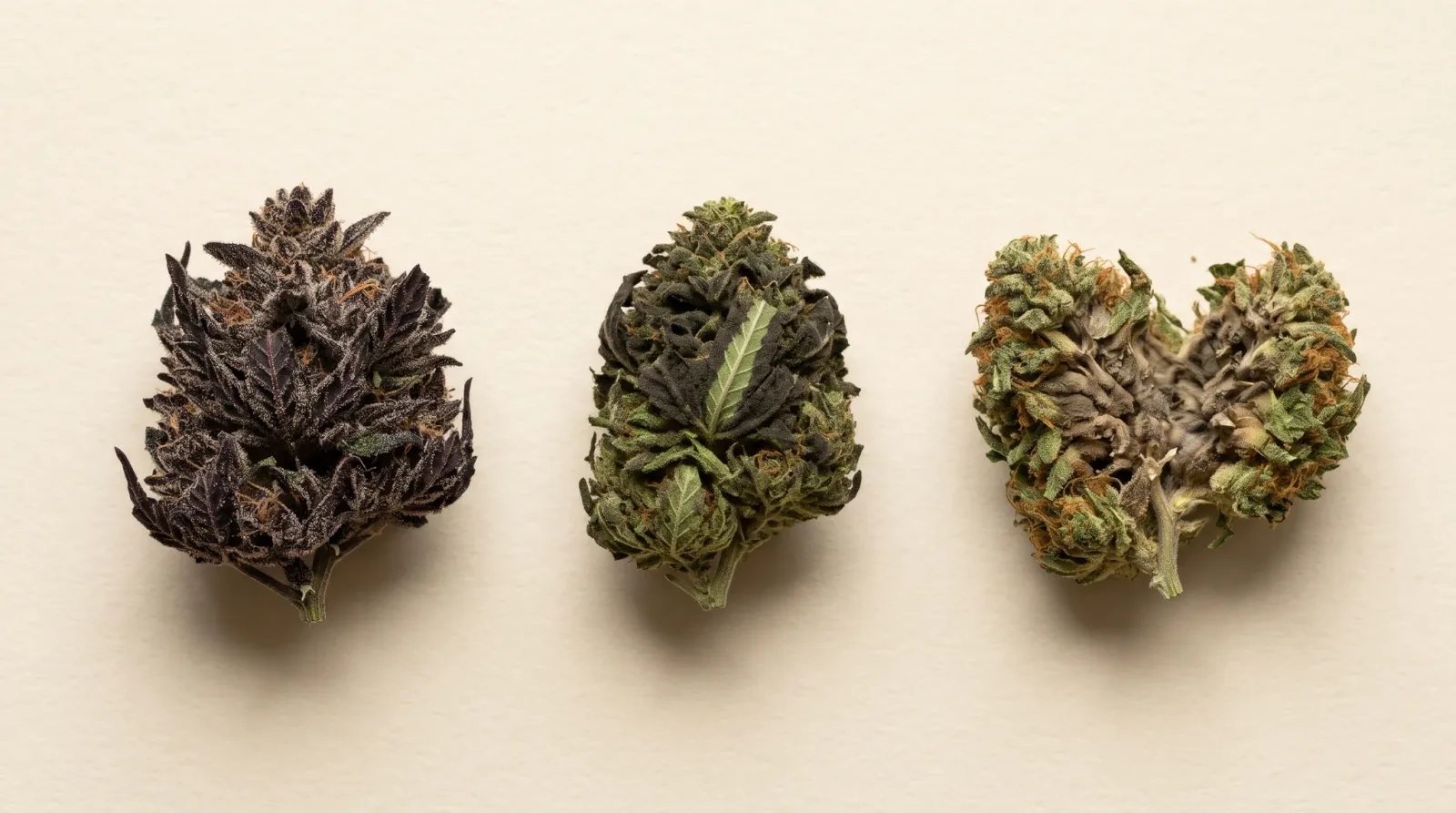
Black cannabis can be healthy, very dark purple pigment, but black that wipes off is surface mold, black fuzz on dried flower can be Aspergillus, and soft grey-brown tissue inside a bud is rot. So color alone never clears a bud. The useful question is not “how dark is it?” but “where does the dark sit, and does it move?”
Here is the short version to send a friend: three black things, three tests. Pigment stays put and the bud stays firm. Sooty mold sits on top and wipes off. Rot lives inside, so the outside can look fine. This lesson in High School walks through each one, what the evidence says, and where a home check is no longer enough.
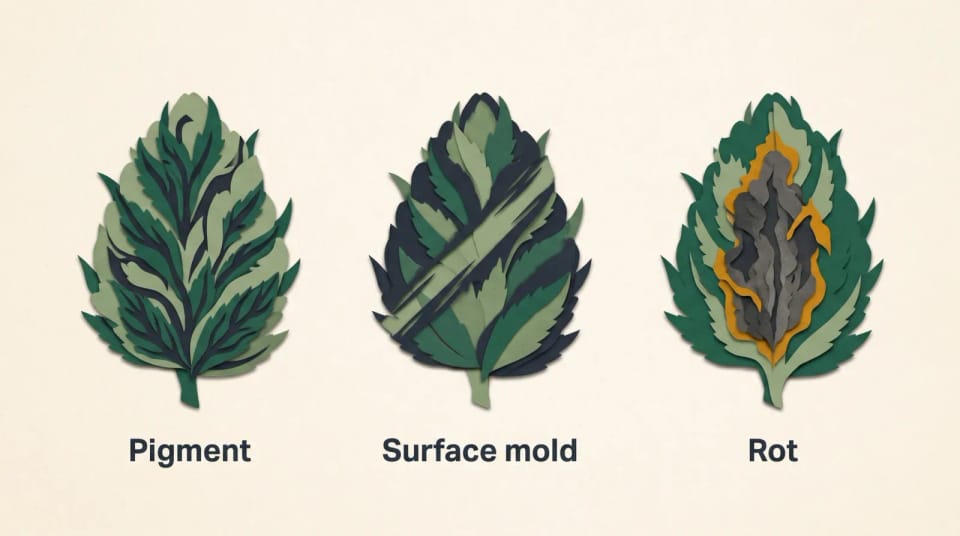
Where the black sits is the first clue. Pigment is part of the tissue, a coating sits on top, and rot starts inside. None of these looks can certify a bud as clean.
Is black weed natural?
Yes, it can be. Plant scientists who study “black” flowers, leaves and fruits say most of them are not black at all. A 2023 review put it plainly: “While some plant organs appear black, they are, in fact, dark purple.” The pigment is a heavy load of anthocyanins, with cyanidin playing an important role in black-looking tissue (Wang et al., 2023). That review covers many plant species, not cannabis specifically.
Cannabis makes the same family of pigments. A 2023 study measured anthocyanins in different cannabis tissues and found cyanidin-3-rutinoside was the main one in both vegetative and floral tissue (Bassolino et al., 2023). So a near-black bud is usually the purple story taken to its extreme. For the full chemistry, including why the same pigment can look red, purple or blue, see the anthocyanin chemistry behind purple and dark buds.
Two signs point to pigment rather than a problem:
- The color follows the plant’s own structure: bract tips, sugar leaf edges, sometimes calyxes, with trichomes still sitting on top.
- The bud is firm and dry, and the dark color does not move when you touch it.
Can any strain turn black?
Not reliably. Pigment starts with genetics. A 2024 study comparing four differently colored cannabis varieties linked leaf anthocyanin to how strongly eight pathway genes were expressed, and found anthocyanins were largely responsible for the red and purple looks (Gagalova et al., 2024). That study looked at leaves, not flowers, and only four varieties.
Temperature can push the pigment further in a line that already makes it. In a 2025 controlled study of one uniformly purple cannabis population, anthocyanin in the main flower cluster peaked at constant 8 °C and 15 °C and dropped at both 0.5 °C and 22 °C (Kim et al., 2025). That does not show cold nights will darken a random green strain. Genetics set the ceiling; conditions move a plant within it.
The same caution applies to names. A strain sold as Black Domina may or may not look dark in your jar. Read why “black” in a strain name is not a color guarantee before you shop by name.
Does black weed hit harder?
No study we found links bud color to strength. In the Kim study, CBD content and flower dry weight followed plant maturity, while anthocyanin followed temperature (Kim et al., 2025). The pigment and the cannabinoids are controlled separately, at least in that one population. The pigment research measured pigment and gene activity, not potency or effects (Bassolino et al., 2023).
The absence of a study is not proof that color never matters. But it means “darker equals stronger” is a guess, not a finding. If you want to know how a dark strain actually works for you, the High IQ app lets you track how each strain worked, so your notes can do what the color cannot.
Can black weed be moldy?
Yes. Two different mold problems can look black or near-black, and a third common rot looks grey-brown.
Sooty mold sits on the surface. University of California pest specialists describe sooty mold as a dark, threadlike growth, like soot, on plants coated in honeydew from sap-sucking insects such as aphids and whiteflies. It does not infect the plant. It grows on top and washes off (UC IPM Pest Notes: Sooty Mold). If you see it, a sucking-insect population is or was nearby. That guidance covers garden plants in general, not smoked flower, so the “wash it and use it” advice for fruit does not carry over. For pest scouting habits, see spotting sap-sucking pests early.
Black mold can grow on dried buds. Researchers swabbing indoor-grown dried cannabis buds grew Aspergillus niger, which forms black colonies on a lab plate, along with other molds. Air plates in grow rooms also grew Cladosporium, with brown to black colonies (Punja et al., 2019). Note the limit: “black” there describes a culture in a dish, not what a bud looks like to your eye. Mold on dried flower is driven by moisture. A three-year study of more than 2,000 samples found mold counts rose with warm, humid bud conditions and poor drying, and fell with airflow, hang-drying and drying to about 12 to 14 percent moisture (Punja et al., 2023). Our guides to drying and curing without mold and storing flower at a safe humidity cover prevention.
Bud rot is usually grey-brown, not black. In the same 2019 study, buds with rot showed brown discoloration, blighted bracts and leaves, and decaying tissue. Incubated samples grew grayish-brown mycelium, identified as Botrytis cinerea (Punja et al., 2019). Rot works from inside the bud outward, so a bud can look normal on the surface. Learn how bud rot (Botrytis) develops and spreads for the grower’s side of it.
White fuzz is a different problem again: see powdery mildew, the white surface mold.
How do you tell pigment from mold or rot?
Use location and movement first. This table puts the three side by side.
| What you see | Pigment | Surface (sooty) mold | Rot |
|---|---|---|---|
| Where the black sits | In the tissue itself | On top of leaves and bracts | Inside the bud |
| Color up close | Deep purple to near-black | Flat black, soot-like film | Grey-brown, sometimes with grey fuzz |
| Does it wipe off? | No | Yes, it transfers | No; the surface may look normal |
| Bud texture | Firm and dry | Normal under the film | Soft, spongy or collapsed |
| Usual cause | Anthocyanin genetics, plus conditions | Honeydew from sap-sucking insects | Fungal infection, often in damp, dense buds |
| What to do | Judge it like any other bud | Stop; do not use it | Stop; bag it and discard it |
Then run these checks, in order:
- Look at where the black sits. Pigment follows the shape of the bracts and sugar leaves. A coating looks like a separate layer.
- See whether it moves. Touch the dark area gently with a clean, damp white tissue. If dark residue transfers, it is on the surface and is not pigment. Stop there and do not use that flower.
- Check the inside. If the bud feels soft, damp or spongy, part it gently, away from your face. Breaking suspect flower can release spores. Soft grey-brown tissue or fuzz inside is rot.
- Rely on the lab result. Passing steps 1 to 3 does not make a bud clean.
That last step matters because the wipe check is a rule of thumb built from general plant-pathology facts. No study we found has tested it on cannabis flower. And even a lab plate cannot tell harmful fungi from harmless ones by count alone (Punja et al., 2023), so your eyes certainly cannot. For a fuller inspection routine, use a quick quality inspection checklist.
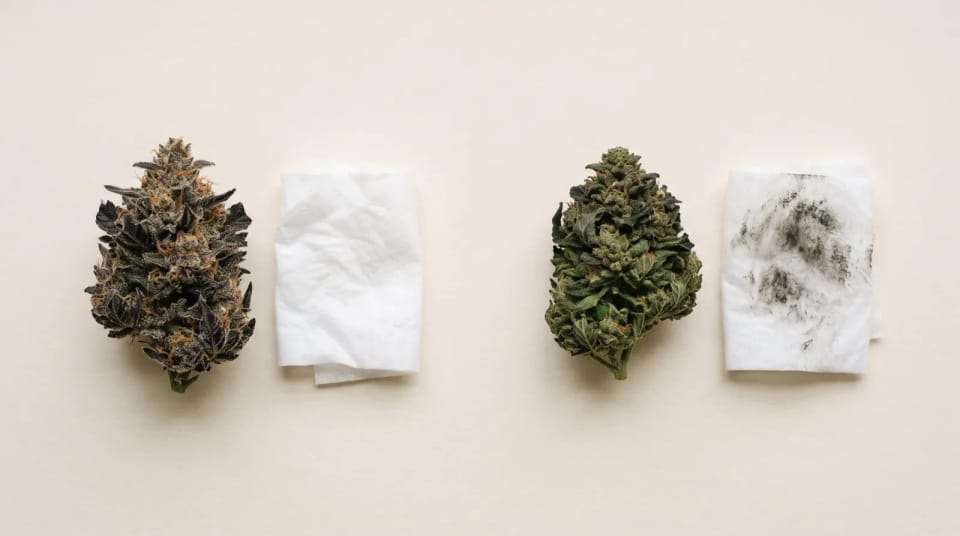
The damp-tissue check separates a surface coating from pigment. It cannot prove a bud is free of mold; only a lab test can do that.
Is black weed safe to smoke?
Dark pigment on its own is not known to be a hazard, but nothing about a look can clear a bud. Black that wipes off, black fuzz, or soft grey-brown tissue means stop.
Regulators treat black mold on flower as a safety matter, not a cosmetic one. California requires inhalable cannabis to test negative for four pathogenic Aspergillus species, including A. niger, in a one-gram sample, and a failed batch may not be released for retail sale (DCC regulations, 4 CCR §15720). In 2025, California issued a mandatory recall of one flower product over A. flavus and A. niger contamination and told consumers to dispose of or return it (DCC recall notice). Other states set their own rules; we checked only California.
So for licensed flower, the certificate of analysis is the real clearance. If you shop with the High IQ app, scanning the label keeps the product details handy when you look up that certificate. For homegrown or untested flower, there is no lab result, and any of the warning signs above is a reason to discard it.
For what to do with flower you already suspect, read what to do with flower you think is moldy. When to talk to a clinician: if you feel unwell after using flower you now think was moldy, or you have a lung or immune condition and are unsure about flower you used, contact a doctor and tell them what you used. This article cannot assess symptoms or risk for you.
Why are my leaves turning black?
That is a different question. Black leaf tips, edges or spots usually point to growing problems rather than pigment in the buds, and this lesson does not cover how to correct them. Start with other reasons cannabis leaves turn dark.
Key takeaways
- Most “black” plant tissue is very dark purple anthocyanin, and cannabis makes the same kind of pigment.
- Genetics set how dark a strain can get; cool temperatures raised pigment in one already-purple line.
- No study links bud color to potency.
- Black that wipes off is a surface coating such as sooty mold. Soft grey-brown tissue inside a bud is rot.
- A home check can rule a bud out, never in. California tests inhalable flower for A. niger; the certificate of analysis is the clearance.
FAQ
What makes weed look black?
Usually a heavy load of anthocyanin pigment that reads as near-black purple. Researchers who study black plant tissue say it is, in fact, dark purple. In cannabis, the main anthocyanin measured is cyanidin-3-rutinoside.
Is black weed stronger than green weed?
No study we found ties bud color to strength. In one controlled study, pigment followed temperature while CBD content followed plant maturity. Judge strength by the lab label, not the color.
Can black spots on buds be bud rot?
They can be a warning sign, but Botrytis bud rot is usually described as brown and grayish-brown, with tissue decay that starts inside the bud. Black specks or fuzz on dried flower can also be other molds, such as Aspergillus niger. Either way, stop and do not use the bud.
How do I tell purple buds from rot?
Pigmented buds are firm and dry, and the color follows the bracts and leaves. Rotting buds feel soft or spongy and show grey-brown tissue when gently parted. If you are unsure, discard it; a home check cannot clear a bud.
Can you wash sooty mold off cannabis and smoke it?
Do not. Extension guidance says sooty mold washes off garden plants and fruit, but that advice is about eating washed fruit, not inhaling plant material. Treat any black coating on flower as a reason to stop using it.
Sources
- Wang F, Chen J, Tang R, et al. Research Progress on Anthocyanin-Mediated Regulation of ‘Black’ Phenotypes of Plant Organs. Current Issues in Molecular Biology, 2023. DOI: 10.3390/cimb45090458.
- Bassolino L, Fulvio F, Pastore C, et al. When Cannabis sativa L. Turns Purple: Biosynthesis and Accumulation of Anthocyanins. Antioxidants, 2023. DOI: 10.3390/antiox12071393.
- Gagalova KK, Yan Y, Wang S, et al. Leaf pigmentation in Cannabis sativa: Characterization of anthocyanin biosynthesis in colorful Cannabis varieties. Plant Direct, 2024. DOI: 10.1002/pld3.70016.
- Kim SR, Basnet P, Kovaleski AP, Ellison SL. Anthocyanin accumulation, inflorescence dry weight and total cannabidiol content have different temperature optima in Cannabis sativa. Journal of Cannabis Research, 2025. DOI: 10.1186/s42238-025-00311-w.
- Punja ZK, Collyer D, Scott C, et al. Pathogens and Molds Affecting Production and Quality of Cannabis sativa L. Frontiers in Plant Science, 2019. DOI: 10.3389/fpls.2019.01120.
- Punja ZK, Ni L, Lung S, Buirs L. Total yeast and mold levels in high THC-containing cannabis inflorescences are influenced by genotype, environment, and pre-and post-harvest handling practices. Frontiers in Microbiology, 2023. DOI: 10.3389/fmicb.2023.1192035.
- Windbiel-Rojas K, Messenger-Sikes B. Sooty Mold, Pest Notes publication 74108. UC Statewide Integrated Pest Management Program.
- California Department of Cannabis Control. Medicinal and Adult Use Cannabis Regulations, 4 CCR §15720, Microbial Impurities Testing. Revised January 1, 2026.
- California Department of Cannabis Control. Mandatory recall notice for a flower product, Aspergillus flavus and Aspergillus niger. July 17, 2025.



