

Apple Strains Explained: Which Ones Actually Come From Sour Apple?
Apple strains share a flavor claim more than parents. Apple Fritter and Apple Strudel trace to Sour Apple; others borrow the name. Six records compared.

Professor High
Written by Professor High, our AI guide. See how we research and correct articles.
Apple-named strains share a name and a sweet-fruit claim more reliably than they share parents. Apple Fritter and Apple Strudel both trace back to Sour Apple. Apples and Bananas and Apples and Oranges borrow the word for flavor, and their records conflict. Meanwhile, the compounds that make real apple peel smell like apple also turn up in cannabis flower from strains with no apple in the name at all.
Here is the fact that settles most arguments. Apples and Bananas has two different documented parentages, and neither one contains Sour Apple. One breeder record lists a cross of Platinum Cookies, Granddaddy Purple, Blue Power and Gelatti (Cookie Fam Genetics record). Another, from the breeder of its offspring, says it combines “Now N Later and Jet Fuel Gelato” (Compound Genetics record). The apple in that name is a flavor, not a family.
This lesson in High School takes six apple strains one at a time, sorts them by why the name says “apple”, and then looks at the chemistry behind apple notes. For how breeders pick names in general, start with what strain names tell you.
Do apple strains share genetics?
Some do, but most do not. Of the six strains below, two descend from Sour Apple. Two borrow “apple” for flavor and have records that disagree with each other. Two have records too thin to trust. We built this table from breeder and seed-bank records we opened on October 29, 2026.
| Strain | Why “apple”? | What the record lists | How strong is the record? |
|---|---|---|---|
| Apple Fritter | Sour Apple parent | Sour Apple x Animal Cookies (seed-bank record; database entry) | Strong for the cross; weak for who bred it and when |
| Apple Strudel | Sour Apple grandparent | Sunset Strudel x Sour Apple Killer (Raw Genetics record); Sour Apple Killer is NBK x Sunset Sherbet x Sour Apple (Jungle Boys record) | Strong for the stated cross |
| Sour Apple | The root of the apple line | Original Diesel x C99 (Top Shelf Seeds record); a second “Sour Apple” entry also exists | Medium: more than one plant uses the name |
| Apples and Bananas | Flavor | Two different parentages, neither with Sour Apple (records linked above) | Conflicting |
| Apples and Oranges | Flavor, sometimes a parent | Three different parent pairs in three sources | Conflicting: one name, several plants |
| Apple Lobster | Unclear | A Blue Lobster cross with the second parent not published | Weak: no breeder record found |
Two notes on the table. First, “the record lists” means a breeder or seed bank made that claim. It is not a genetic test. Genotyping studies have found that one strain name can cover different plants. Second, this is a count of six strains, not a rule for every apple name on a menu.
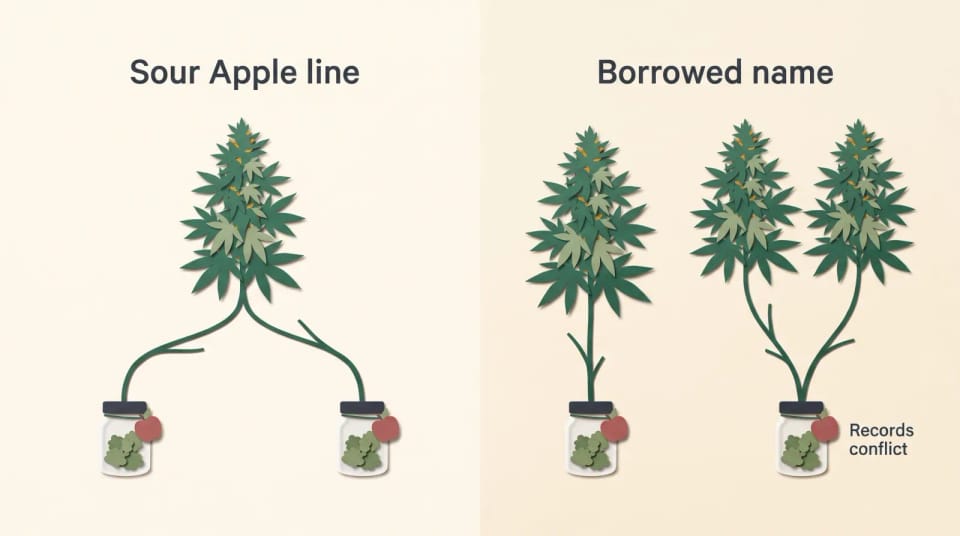
Apple Fritter and Apple Strudel share a Sour Apple ancestor. Apples and Bananas and Apples and Oranges share only the word, and each has more than one recorded parentage. The diagram is simplified and shows the pattern, not any one strain’s full tree.
Is Apple Strudel related to Apple Fritter?
Yes, distantly. Both trace back to the Sour Apple name, but through different routes. Apple Fritter is a direct cross: Sour Apple x Animal Cookies, according to both a seed-bank listing and a database entry (seed-bank record). Apple Strudel is one step further away. Its breeder record reads “Lineage: Sunset Strudel x Sour Apple Killer” (Raw Genetics record), and Sour Apple Killer lists Sour Apple as one of three parents (Jungle Boys record).
So the two are cousins, not siblings. Each also has a dessert-line partner: Animal Cookies on the Fritter side, Sunset Sherbet and Sunset Strudel on the Strudel side. That dessert half may explain why both get described in bakery terms, but no study has tested that. If you like tracing these lines yourself, our guide on how to trace a strain’s family tree shows the method.
Who made Apple Fritter is less settled than what it is. One database entry credits a Northern California grower and says it was created in 2013 (database entry), but the same entry lists the breeder as unknown. We found no second record that confirms the credit.
Where does Sour Apple come from?
The best-documented Sour Apple is a cross of Original Diesel and C99. The breeder record reads “Original Diesel clone only hit with a selected C99 male” (Top Shelf Seeds record). That puts the root of the apple line in the Diesel family, which sits closer to the gas side of the palate than to candy.
Here is the surprise. That breeder’s own description never mentions apple. It promises “a sour citrus hit mixed in with a tropical pineapple taste.” The same database also links a separate “Sour Apple (IBL)” entry, marked only as “probably” the parent in some family trees (Raw Genetics record). So even the root of the apple line is more than one plant, and the best-documented one is described as citrus and pineapple.
What is the difference between Apples and Bananas and Apples and Oranges?
They share a naming pattern, not a family. Both names come from fruit flavor, and both have conflicting records.
Apples and Bananas has the two parentages described above. The Compound Genetics record also describes its aroma in plain terms: “bold notes of, you guessed, apples and bananas” (Compound Genetics record). That is the clearest case of a name chosen for smell.
Apples and Oranges is messier. We found three different parent pairs:
- A seed bank selling one breeder’s version lists “Apple Fritters x Tangerine Cookies” (seed-bank listing). That version would sit in the Sour Apple line through Apple Fritter.
- A second breeder lists “rainbow pavé from compound genetics x Orange daiquiri” (Jamie Cee’s record). The database’s family tree for that record traces Rainbow Pavé to Apples and Bananas, so this version’s apple comes from the borrowed-name side instead. Its breeder describes a “smell of oranges and spice with a back note of gas”, with no apple mentioned.
- A strain aggregator lists a third pair. We could not find a breeder record for it, so we leave it out.
Two plants with the same name and different parents are different cultivars. When a menu says “Apples and Oranges”, ask whose version it is.
Are Lobster strains related to Apples and Bananas?
Through Blue Lobster, probably yes, but Apple Lobster itself has no record we could confirm. One retailer explainer says Blue Lobster is a selected cut of an “Apples and Bananas x Eye Candy” cross released under another name, and lists Apple Lobster as a Blue Lobster cross with the “second parent not published” (retailer explainer). That is a secondary source, not a breeder page. Treat the Lobster branch as likely but unverified, and Apple Lobster’s other parent as unknown.
Which apple strain names have no record?
Three popular names had no breeder record we could find:
- Apple Burst. The listings we found disagree on its parents, and none names a breeder.
- Apple Cookies. A grow listing gives a cross, but we found no seed-bank or breeder record to confirm it.
- Apple Zlushie. Several searches turned up no parentage at all.
Not finding a record is not proof that none exists. It does mean any lineage you read for these three is unconfirmed.
What makes weed smell like apple?
No study has tested an apple-named strain, so nobody can say which compound makes Apple Fritter smell the way it does. What we can say is what real apples smell of, and whether those compounds show up in cannabis.
Start with the apple. A study of peel from 40 apple cultivars found 78 aroma compounds, and 47 of them were esters, the fruity-smelling compounds formed from an acid and an alcohol. The most abundant were hexyl butyrate, hexyl 2-methylbutyrate and hexyl hexanoate, along with a sesquiterpene called alpha-farnesene (Yang and colleagues, Foods, 2021).
A separate aroma study of Honeycrisp apples also named hexyl 2-methylbutanoate and alpha-farnesene among its most potent odorants (Yan and colleagues, Food Chemistry, 2020).
Now the cannabis. A 2024 study measured the aroma compounds rising from 19 dried flower cultivars. It tentatively identified n-hexyl butanoate, the same compound as hexyl butyrate, in 9 of the 19. The highest level was in Skunk Haze, at 2.18% of the measured aroma. Hexyl hexanoate appeared in six, and a form of alpha-farnesene appeared in 18 of 19 (Janta and Vimolmangkang, Journal of Cannabis Research, 2024). None of the 19 cultivars had “apple” in its name.
The cannabis plant makes farnesene itself. Genetic work on hemp found farnesene among its most abundant sesquiterpenes, alongside beta-caryophyllene and humulene (Booth and colleagues, PLOS ONE, 2017).
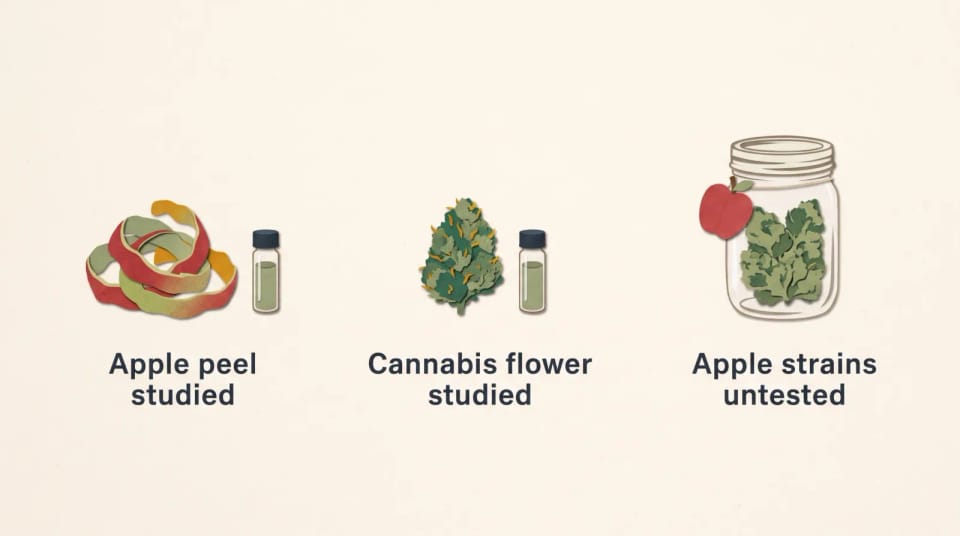
Apple esters have been measured in apple peel and in some cannabis flower. No study has measured them in a strain named for apple.
Do apple strains actually smell like apples?
Sometimes, by their breeders’ accounts, but the records are uneven. Sour Apple Killer’s description promises “a super sour candy apple flavor” (Jungle Boys record). Sour Apple’s own breeder describes citrus and pineapple, and one Apples and Oranges breeder describes oranges, spice and gas. Those are seller descriptions, not sensory tests.
Here is where the evidence gets honest. Finding an apple ester in a flower is not the same as proving it makes that flower smell like apple. The 19-cultivar study identified its compounds by library match without reference standards, reported share of aroma rather than concentration, and could not guarantee that each sample was the strain on its label (Janta and Vimolmangkang, 2024).
Two more studies add caution. In one, fruity and tropical aromas tracked small amounts of non-terpene compounds, such as sulfur-containing esters, more than the dominant terpenes. That study covered five plants from one cross, and its authors had commercial ties to the work (Paryani and colleagues, ACS Omega, 2024). In the other, a trained panel built a 25-term vocabulary for cannabis aroma from 91 samples, and none of the terms was apple. Its “fruity” term was defined as “fruit cocktail (pear, peach, grape)” (Isaacson and colleagues, PLOS ONE, 2025).
So be wary of any page that names “the apple terpene”. We found no source for one. The broader story of how hundreds of compounds combine into a smell is in the chemistry behind cannabis aroma, and how to read a terpene profile covers what a lab label can and cannot tell you.
Does an apple name tell you how a strain will feel?
No. A name tells you what a seller chose to call a plant, and the records above show how far that can drift. Aroma chemistry describes the flower, not a demonstrated effect in your body. Our lesson on whether your nose predicts your high covers what the smell-to-effect research does and does not show.
Even the same strain can vary from batch to batch, for reasons we cover in why the same strain hits differently. If you want a guide that goes beyond the name, High Families group strains by terpene profile. That is a product classification, not a medical prediction.
If any strain leaves you with a racing heart, chest pain, or anxiety or confusion that does not settle, stop and talk to a clinician. A name or a flavor cannot tell you how your body will respond.
How do you check what apple means on a label?
Treat the word as a question for the seller. These five steps take a few minutes.
- Ask who bred it and what it is a cross of. A named breeder gives you a record to check.
- Find the breeder or seed-bank record. If two records give different parents, as with Apples and Bananas, treat the lineage as unsettled.
- Look for Sour Apple in the family tree. If Sour Apple, Apple Fritter or Sour Apple Killer appears, the name points to a family line. If not, the apple is a flavor claim or a borrowed name.
- Read the lab label, then smell the jar. The terpene results describe the batch in your hand. Your nose is the only apple test anyone has run on it.
- Note how it worked for you. The High IQ app lets you log how a strain worked and compare two strains side by side, which gives the next apple-named jar something real to measure against.
Sources
-
Yang S, Hao N, Meng Z, Li Y, Zhao Z. “Identification, Comparison and Classification of Volatile Compounds in Peels of 40 Apple Cultivars by HS-SPME with GC-MS.” Foods. 2021;10(5):1051. doi.org/10.3390/foods10051051
-
Yan D, Shi J, Ren X, Tao Y, Ma F, Li R. “Insights into the aroma profiles and characteristic aroma of ‘Honeycrisp’ apple (Malus × domestica).” Food Chemistry. 2020. doi.org/10.1016/j.foodchem.2020.127074
-
Janta P, Vimolmangkang S. “Chemical profiling and clustering of various dried cannabis flowers revealed by volatilomics and chemometric processing.” Journal of Cannabis Research. 2024;6:41. doi.org/10.1186/s42238-024-00252-w
-
Booth JK, Page JE, Bohlmann J. “Terpene synthases from Cannabis sativa.” PLOS ONE. 2017;12(3):e0173911. doi.org/10.1371/journal.pone.0173911
-
Paryani TR, Sosa ME, Page MFZ, et al. “Nonterpenoid Chemical Diversity of Cannabis Phenotypes Predicts Differentiated Aroma Characteristics.” ACS Omega. 2024;9(26):28806-28815. doi.org/10.1021/acsomega.4c03225
-
Isaacson SE, Wilson-Poe AR, Ye T, Qian YL, Shellhammer TH. “Beyond potency: A proposed lexicon for sensory differentiation of Cannabis sativa L. aroma.” PLOS ONE. 2025;20(10):e0335125. doi.org/10.1371/journal.pone.0335125
-
Breeder and seed-bank records on SeedFinder, accessed 29 October 2026: Apple Strudel (Raw Genetics); Sour Apple Killer (Jungle Boys); Sour Apple (Top Shelf Seeds); Apples and Bananas (Cookie Fam Genetics); Gastro Pop (Compound Genetics); Apple Fritter (Homegrown Cannabis Co.); Apple Fritter (unknown breeder); Apples and Oranges (Jamie Cee’s).
-
Seed-bank listing for Elev8 Seeds Apples n Oranges, accessed 29 October 2026. linda-seeds.com
-
Retailer explainer on Lobster strains, accessed 29 October 2026. originscannabis.com
Key takeaways
- Apple Fritter and Apple Strudel trace to Sour Apple; Fritter directly, Strudel through Sour Apple Killer.
- Apples and Bananas has two recorded parentages, and neither contains Sour Apple.
- Apples and Oranges has three different parent pairs, so the name covers more than one plant.
- Apple Lobster, Apple Burst, Apple Cookies and Apple Zlushie have no breeder record we could confirm.
- Apple-peel esters and alpha-farnesene appear in some cannabis flower, but no study has tested an apple-named strain, and no single “apple terpene” is supported.
FAQ
What is Apple Fritter’s lineage?
Seed-bank and database records list Apple Fritter as Sour Apple x Animal Cookies. One database entry credits a Northern California grower and a 2013 release, but the same entry lists the breeder as unknown. Treat the cross as well documented and the origin story as unconfirmed.
Are apple strains indica or sativa?
The name does not tell you. The apple strains above have parents from Diesel, Cookies, Sherbet and Gelato lines, so they do not fit one box. Read why indica and sativa labels do not predict effects, and check the terpene profile on the label instead.
What terpene makes weed smell like apple?
No source we found names one. In real apples, the main aroma compounds are esters such as hexyl butyrate, plus a sesquiterpene called alpha-farnesene. Some of those compounds appear in cannabis flower, but no study has shown that they cause an apple smell in any named strain.
Is Apples and Oranges a cross of Apples and Bananas?
One version may be. A breeder’s Apples and Oranges uses Rainbow Pavé as a parent, and the database family tree traces Rainbow Pavé to Apples and Bananas. Another seed bank lists Apple Fritter x Tangerine Cookies instead, so the answer depends on whose version you have.



