Does Canada's THC Tolerance Allow an Underweight Flower Bag?
Canadian cannabis tolerances govern different things: flower grams, cannabinoid label content and expiry stability. Here is which rule applies.

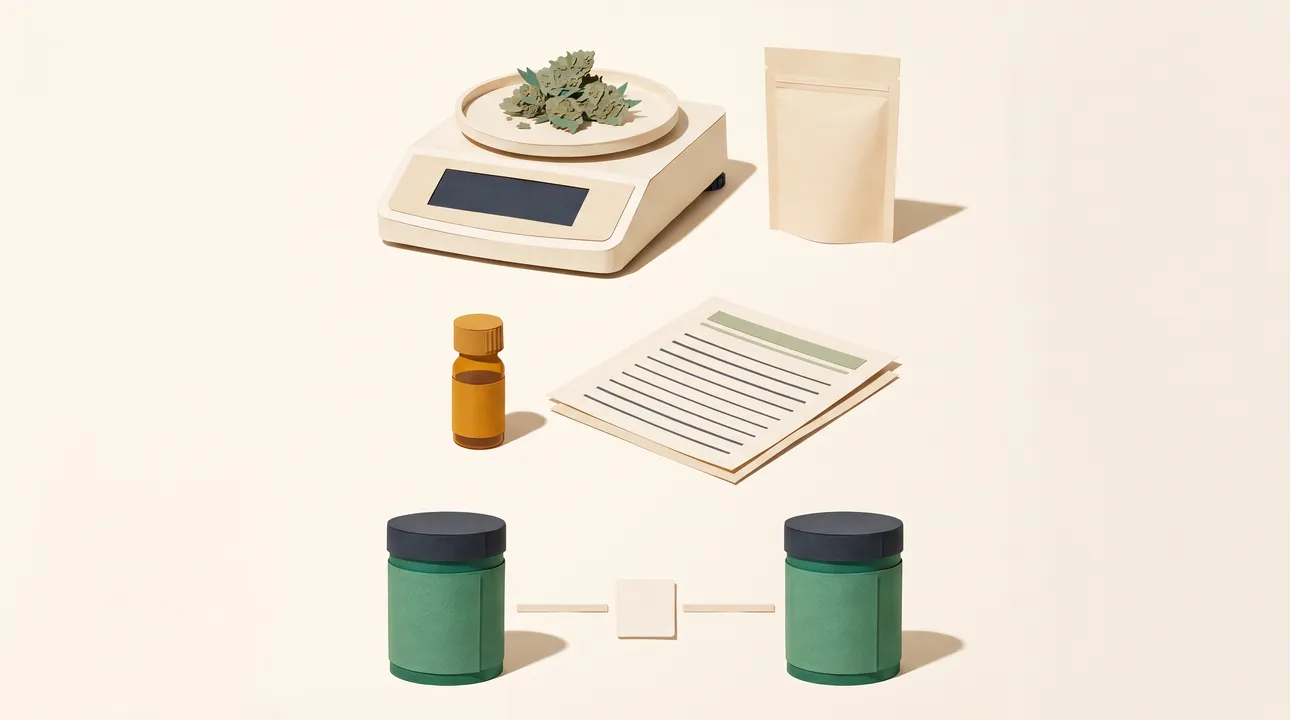
No: Canada’s THC-content tolerance does not give a flower package the same allowance for missing weight. Package grams, cannabinoid label content and evidence for an expiry date answer three different questions.
Professor High’s rule: read each percentage with what it measures and which product class it covers. A flower bag’s grams do not become THC milligrams because both appear on the same label.
The federal text used here is marked current to September 21, 2026. Its last amendment was June 4. September 28 is the website update date, not the stated currency of the law. Justice Canada’s current regulations.
Which Canadian cannabis tolerance am I looking at?
| Question | Rule to read |
|---|---|
| How much product is in the package? | Net weight or volume: §133 and Health Canada’s product-class tables. |
| How does THC or CBD content compare with the label? | §97: separate limits for extracts, topicals and edibles. |
| What supports a stated expiry date? | §123.02: stability data after packaging under recommended storage conditions. |
These are separate rules, even when two happen to use the same percentage. The relevant texts are §133, §97 and §123.02.
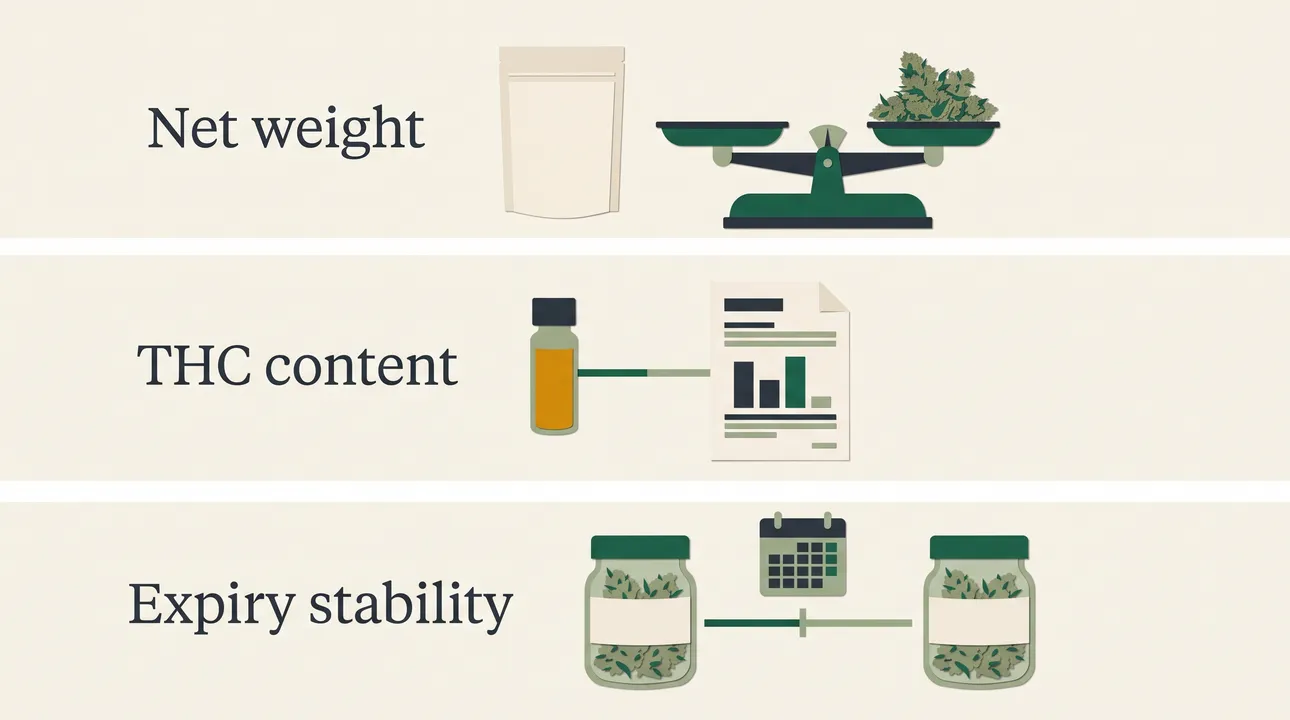
Three measurements, three questions. This schematic does not show a package passing any regulatory test.
How much weight variation is allowed for dried flower?
Section 133 points to Health Canada’s net-weight and volume tables. For dried or fresh cannabis, the current mass table says:
| Declared net weight: dried or fresh cannabis | Tolerance |
|---|---|
| More than 0 g, up to and including 2 g | 10% |
| More than 2 g | 5% |
Exactly 2 g belongs to the first band. Extracts, edibles and topicals have their own mass or volume bands; do not carry this flower table over to them. Health Canada’s net-weight and volume limits.
Imagine a plain dried-flower package labelled 3.5 g. The Act defines dried cannabis as dried plant material, excluding seeds. This example has no added extract. It falls above 2 g. The table’s percentage corresponds to 3.5 × 0.05 = 0.175 g. That calculation explains the band. It does not validate a home scale or decide whether a particular package complies. Cannabis Act definition.
Net weight concerns the product, rather than product plus packaging. Our grams and tare glossary explains those basic units. A measurement question still needs its own evidence; a cannabinoid tolerance cannot settle it.
Does the 15% THC rule apply to dried flower?
Section 97’s extract/topical rule is about THC or CBD content, not flower grams. Those products must contain 85–115% of the quantity or concentration shown on the label. The 15% is a share of the declared value. It is not 15 percentage points added to a potency percentage.
Edible cannabis has separate tiers under the same section:
| Labelled THC or CBD: edible cannabis | Content as a share of that claim |
|---|---|
| More than 5 mg | 85–115% |
| More than 2 mg, up to and including 5 mg | 80–120% |
| 2 mg or less | 75–125% |
These limits concern cannabinoid quantity. They are not the edible’s total food weight. Cannabis Regulations §97.
Section 97 gives no such tier for dried or fresh cannabis. Flower labels still have rules. Health Canada’s 2021 letter says the THC and CBD shown on a dried-product label should reflect the tested lot. The Act also prohibits false or misleading labels. Health Canada’s lot-based clarification, Cannabis Act §26(e).
Keep the report tied to the product using our COA batch and lot matching lesson. A legal limit is a different thing from a lab’s estimated range. Read measurement uncertainty on cannabis reports. The edible label-accuracy lesson also separates a label claim from a lab’s sample result. Its examples do not replace Canadian rules.
Why does the expiry rule mention 80–120% for flower?
That range is part of an expiry-stability requirement. Under §123.02, the processor needs data to support a stability period. That period is after packaging that meets the rules, with storage under the recommended conditions.
For dried or fresh cannabis, the product must maintain 80–120% of its THC and CBD content. Its microbial and chemical contaminants must also stay within the referenced limits. Extracts and topicals instead use §97(1)’s content limits plus their applicable contaminant limits. Both content and contaminants matter. Cannabis Regulations §123.02.
That provision does not supply a blanket 20% flower potency-label allowance. It asks what data support stability over a stated period. A single batch result answers a different question, as our test-date versus package-date lesson explains.
The guide lists expiry dates as optional for dried/fresh cannabis, extracts and topicals. A stated date needs an established stability period. Edible cannabis cannot carry an expiry date under §123.02. Edible “best before” information belongs to a separate durable-life rule. Neither point establishes a fixed shelf life for every cannabis product. Health Canada’s packaging and labelling guide.
FAQ
Can a flower bag be 15% light because THC can vary?
That reasoning uses the wrong rule. Flower mass has its own size bands; the extract/topical cannabinoid rule cannot authorize a missing-weight amount. An actual package needs its own evidence and the correct mass rule.
Does a package labelled exactly 2 g use the 5% band?
No. The official dried/fresh mass table includes 2 g in the 10% band. The 5% band starts above 2 g.
Is the edible cannabinoid allowance always 15%?
No. Section 97 assigns edible tiers according to the labelled THC or CBD quantity. Do not use one tier for every edible or confuse it with the weight of the food.
Does a missing flower expiry date mean unlimited shelf life?
No. An optional expiry label is not evidence of stability forever. A stated expiry needs data under the specified conditions. A missing date does not create a universal duration.
Key takeaways
- Identify the product class and the measured quantity before using a tolerance.
- Flower grams, cannabinoid label content and expiry stability are separate questions.
- A worked percentage explains a rule; it does not decide a refund or an individual package’s compliance.
Sources
- Justice Canada: Cannabis Regulations §133, net weight and volume.
- Health Canada: Net-weight and volume tolerance tables.
- Justice Canada: Cannabis Regulations §97, cannabinoid variability.
- Justice Canada: Cannabis Regulations §123.02, expiry evidence.
- Health Canada Compliance Directorate: Dried-product label clarification, August 10, 2021.
- Justice Canada: Cannabis Act §26, prohibited labels, and §2, definitions.
- Health Canada: Packaging and labelling guide.




