Cannabis and the Vagus Nerve: The Gut-Brain Axis Explained
How cannabinoids talk to your vagus nerve and gut-brain axis — the science of CB1 on vagal afferents, nausea, appetite, motility, and mood.

Your Gut Has a Direct Line to Your Brain — And Cannabis Is on the Call
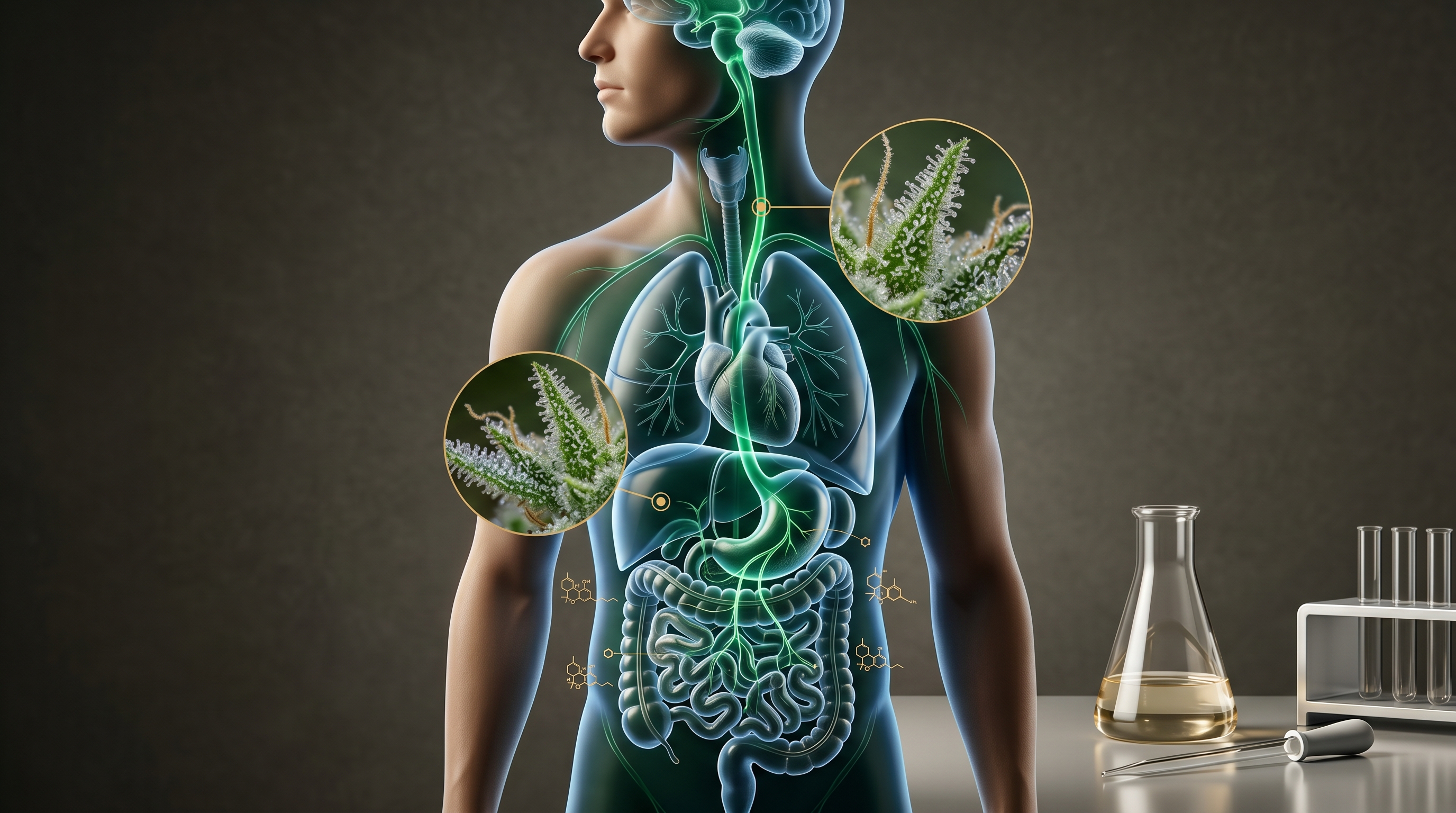
There is a nerve that runs from your brainstem all the way down into your gut, weaving through your heart and lungs along the way. It is called the vagus nerve, and it is the busiest communication cable in your body. Most of the traffic on that cable does not flow the way you would expect. Roughly 80 to 90 percent of vagal fibers carry signals up, from your gut to your brain. Your belly, it turns out, has a lot more to say to your head than your head has to say back.
Scientists call this two-way conversation the gut-brain axis. It helps run everything from hunger and nausea to mood and stress. Here is the part that should make any cannabis fan lean in. Cannabinoid receptors are stationed right along that line. The same receptors that THC binds to are sitting on the vagus nerve. They line the nervous system of your gut, too. Your own body makes “endocannabinoids” that bind there as well.
That overlap is not a coincidence. It may help explain a lot. Cannabis can quiet nausea, switch on the munchies, ease an angry gut, and shift your mood — sometimes all in one session. In this deep-dive, we will trace how the endocannabinoid system (ECS) plugs into the vagus nerve. We will look at what the research shows. And we will be honest about where the science is still a work in progress. No medical claims here. Just the evolving biology of cannabinoids meeting your body’s most important nerve.
If you are new to the ECS itself, our endocannabinoid system guide is a good primer before you dive in.
The Gut-Brain Axis and the Vagus Nerve, Briefly
Before we add cannabis to the picture, let’s establish the wiring.
Your gut contains its own nervous system. It is called the enteric nervous system (ENS), or the “second brain.” It holds hundreds of millions of neurons arranged in two layers of nerve clusters. It can run basic digestion on autopilot, with no input from the brain at all. But it does not work in isolation. It stays in constant contact with the central nervous system, and the vagus nerve is the primary cable carrying that conversation.
The vagus has two kinds of fibers. Afferent fibers are the sensory ones. They send information up to the brainstem. They report on stretch, chemistry, hormones, and even the activity of your gut bacteria. Efferent fibers carry commands back down to control gut muscle and secretion. Because the gut-to-brain traffic dominates, much of your mood, appetite, and sense of calm is whispered upward from your gut.
The gut-brain axis is not purely electrical, either. It also runs on hormones, immune signals, and metabolites produced by your microbiome — the trillions of bacteria in your intestines. We cover that bacterial side of the story in depth in cannabis and gut health. For now, the key idea is simple: this is a busy, bidirectional system, and the endocannabinoid system is woven right into it.
Where the Endocannabinoid System Sits in the Gut
The ECS has three core parts. First, cannabinoid receptors, mainly CB1 and CB2. Second, the endocannabinoids your body makes on demand, anandamide and 2-AG. Third, the enzymes that build and break them down. Your body’s anandamide is so close to THC in how it behaves that we call it your body’s natural THC.
In the gut, these components are not scattered randomly. According to a major review in Gastroenterology [Sharkey, 2016], CB1 sits on nearly every class of gut nerve cell. That includes the sensory neurons, the relay neurons, and the “go” motor neurons. The one exception is the “stop” motor neurons. CB1 also shows up on some hormone-releasing cells of the gut lining, and in the gut wall itself.
Crucially for our story, CB1 is also expressed on the vagal afferent neurons that connect the gut to the brain. CB2, the other main cannabinoid receptor, sits mostly on immune cells and ramps up during inflammation. (If the CB1-versus-CB2 split is fuzzy for you, our explainer on why receptor location matters breaks it down.)
This layout explains a lot. CB1 sits on the “go” side of gut circuits. It also sits on the vagal fibers that report back to the brain. So cannabinoids are well placed to dial down gut activity and to filter what the brain hears from the gut. In short, the gut ECS works like a brake. It nudges things back toward balance when motility, inflammation, or sensation drift too far.
Nausea, Appetite, and Motility: Three Vagal Conversations
The clearest place to watch cannabinoids work the gut-brain axis is in three everyday experiences: feeling queasy, feeling hungry, and the speed at which food moves through you.
Nausea and Vomiting
Anti-nausea is one of the oldest documented uses of cannabis, and the brainstem mechanics are reasonably well mapped. The same review describes the key brainstem hub where vagal nausea signals arrive [Sharkey, 2016]. There, CB1 activation reduces the release of “go” transmitters and calms the vomit reflex. The feeling of nausea is a bit different. For that, the endocannabinoid 2-AG seems to play the lead role, not anandamide. This is why drugs that raise 2-AG can blunt nausea in animal models.
There is a famous paradox here, though. A subset of heavy, long-term users develop cannabinoid hyperemesis syndrome (CHS) — cyclic vomiting that, bizarrely, is relieved by hot showers. The same plant that calms nausea can, in some chronic users, appear to cause it. The cause is still debated. It may involve worn-out receptors, or something in the whole plant. Notably, CHS has not been reported with pure, scheduled THC pills. We unpack this fully in our guide to cannabinoid hyperemesis syndrome. It is a sharp reminder that “cannabis modulates nausea” is not the same as “more cannabis is better.”
Appetite — the Munchies, Decoded
The munchies are not just a punchline; they are a vagal signaling story. One study showed that fasting raises anandamide in the small intestine, and that the appetite-boosting effect of cannabinoids depends on an intact vagus nerve [Gomez, 2002]. A second team, writing in the Journal of Neuroscience, found something neat [Burdyga, 2004]. CB1 on vagal nerves rises during fasting and drops fast after eating. The switch is the satiety hormone cholecystokinin (CCK). In other words, when you are hungry, the gut turns up the cannabinoid volume on the very nerve that tells your brain “keep eating.”
There are two routes here. The first is indirect: cannabinoids tune gut hormones like CCK and ghrelin, which act on the vagal fibers. The second is direct: endocannabinoids act on CB1 right on the vagal neurons. A review in Nutrients has detailed both pathways [DiPatrizio, 2021]. For the full appetite picture, see the science behind the munchies and our look at why cannabis hits differently on an empty stomach. It is also why THCV, which behaves differently at the receptor, is studied as an appetite suppressant.
Gut Motility
CB1 also governs how fast things move. CB1 on gut nerves blocks the release of acetylcholine, a “go” signal. So turning CB1 on generally slows transit. That is why cannabinoids can ease cramping and loose stools. The cleanest evidence comes from a mouse study in the Journal of Neuroscience [Vianna, 2012]. Mice were bred to lack CB1 only in their vagus nerve. They developed faster gut transit. That pins normal motility control on vagal CB1. Block CB1 with a drug, and people report diarrhea as a side effect — the same pattern, in reverse.
This homeostatic control is part of why the ECS is being explored for functional gut disorders. Our guides on cannabis for IBS and cannabis for Crohn’s and IBD dig into the clinical side.
Inflammation and the Microbiome-ECS Loop
Step past the nerves and you find a second layer: the immune system and your gut bacteria, both of which talk to the ECS.
On the immune side, CB2 receptors ramp up during inflammation. Turning them on tends to calm the immune response in the gut wall. Working through both CB1 and CB2, the ECS helps keep gut inflammation in check. That is one reason it draws interest as a drug target. For the broader molecular story, see cannabis and inflammation and cannabis and the immune system.
The microbiome layer is newer and genuinely surprising. A review in Frontiers in Cellular Neuroscience lays out a true two-way street [Srivastava, 2022]. Your bacteria shape your endocannabinoid tone. The bacterium Akkermansia muciniphila helps set gut endocannabinoid levels, barrier strength, and hormone output. And Lactobacillus acidophilus raises CB2 levels in gut cells. It runs the other way too. Changing your endocannabinoid levels reshapes which bacteria thrive.
The ECS also helps guard the gut barrier itself. It shapes the proteins that seal the gut wall, like ZO-1 and occludin. Those seals decide how much bacterial waste (LPS) leaks into the blood and stokes low-grade inflammation. We go deeper on this feedback loop in cannabis and gut health. The upshot: cannabinoids are not acting on an isolated nerve — they are nudging a whole ecosystem.
Mood and Anxiety: The Long Way Round
Here is where the gut-brain axis gets personal. The vagus carries gut signals up to brain regions that govern emotion. Cannabinoids shape those signals. So there is a plausible route from your gut to your mood — though it is still emerging science.
Several threads are worth pulling. First, the ECS dampens the body’s main stress circuit, the HPA axis. One review notes that endocannabinoid signaling “suppresses the activity of the HPA pathway” [Sharkey, 2016]. It does this through several brain regions, including the amygdala and hypothalamus. (Our piece on cannabis and cortisol covers that stress-hormone angle.)
Second, chronic stress appears to rewire the gut ECS through epigenetics. In animal models, chronic stress switched off part of the Cnr1 gene. That lowered CB1 in the sensory neurons of the gut. The result was a more touchy, pain-prone gut — a direct link between stress and belly pain. That dovetails with the idea of endocannabinoid tone running high or low, and the still-controversial notion of clinical endocannabinoid deficiency.
Third, the microbiome-vagus connection touches mood directly. In the Frontiers review, a probiotic Lactobacillus rhamnosus strain calmed anxiety and stress hormones in mice [Srivastava, 2022]. But there was a catch. The effect only worked when the vagus nerve was intact. Cutting it erased the benefit. Gut bacteria also help make serotonin. That connects to the mood story beyond THC and to how the ECS shapes dopamine-driven decisions. If you use cannabis to manage stress, our cannabis and anxiety guide is worth a read.

Practical Implications (Hedged, As Always)
So what does a cannabis enthusiast do with all this? Carefully, and without overclaiming. Here is how the science might translate to lived experience.
- Your gut state shapes your high. Whether you are fasted or fed changes CB1 activity on your vagus, which may be part of why the same product hits differently on an empty stomach versus a full one.
- “Calming” is not one thing. A product that quiets your gut and dampens HPA stress signaling could feel calming through an entirely different route than one that mainly acts on the brain. Effect labels rarely capture that nuance.
- Heavier is not safer. The CHS paradox is the loudest evidence that more cannabinoid input can flip a system from “balanced” to “dysregulated.” Tolerance and downregulation are real.
- The whole ecosystem matters. Diet, fiber, and microbiome health plausibly tune your endocannabinoid tone, which means your gut habits may quietly shape how cannabis feels.
None of this is a treatment recommendation. The honest move is to observe your own patterns rather than trust a strain name. If you want to choose by likely effect instead of marketing labels, start with High Families. Then track what you consume against how you actually feel afterward. Your own data beats anyone else’s average.
Limitations and What We Still Don’t Know
Time for the asterisks, because this field has many.
Most of the mechanism work is preclinical. The elegant vagal-CB1 studies [Gomez, 2002; Burdyga, 2004; Vianna, 2012] are rodent experiments. Mouse and rat gut-brain wiring resembles ours, but it is not identical, and findings do not always translate.
Human evidence is thinner and messier. We have gene links between CNR1, FAAH, and IBS types. We have side-effect data from CB1-blocking drugs. And we have clinical interest in gut disorders. But we have few large, well-run human trials that isolate the vagal pathway on its own.
Direction and dose are tricky. Endocannabinoids and phytocannabinoids can have opposing effects on the gut barrier in different contexts. Acute and chronic use diverge (cortisol responses are a good example). And the CHS paradox shows the same receptor system can produce opposite outcomes depending on exposure.
Causation is hard to prove. A correlation between your gut bacteria, your endocannabinoid tone, and your mood does not establish which is driving which. The microbiome-ECS-vagus loop is genuinely bidirectional, which makes clean causal claims rare.
Treat the gut-brain axis as a powerful framework for understanding cannabis — not as a settled instruction manual. The science is moving fast, and we will keep updating as it does.
Key Takeaways
- The vagus nerve is the main cable of the gut-brain axis, and most of its traffic flows from gut to brain.
- CB1 receptors sit on enteric neurons and on vagal afferent fibers, so cannabinoids can tune the signals your gut sends upward.
- This wiring helps explain cannabis effects on nausea, appetite, and gut motility — each a distinct vagal conversation.
- Your microbiome and immune system add more layers, shaping endocannabinoid tone in both directions.
- Most mechanism data is preclinical. Treat the gut-brain axis as a lens for understanding cannabis, not a treatment plan, and track your own patterns.
Frequently Asked Questions
Does cannabis directly stimulate the vagus nerve? Not exactly “stimulate.” Cannabinoids bind CB1 receptors on vagal afferent neurons and on the gut nerves that feed into the vagus. This tunes the signals that nerve sends to the brain. Think of it as adjusting the volume, not flipping a switch. And much of the detailed evidence is from animal studies.
Why does cannabis help nausea but sometimes cause vomiting? CB1 activation in the brainstem can reduce the emetic reflex, which is the basis of cannabis’s anti-nausea reputation. But in some heavy chronic users, the system appears to flip, producing cannabinoid hyperemesis syndrome. The mechanism is still debated and likely involves receptor changes from sustained heavy use.
Can my gut bacteria really affect how high I feel? Possibly, indirectly. Research suggests gut bacteria influence your endocannabinoid tone and gut barrier, and the vagus relays gut signals to the brain. Whether that meaningfully changes a given high in humans has not been proven — consider it an intriguing hypothesis, not a fact.
Is the gut-brain axis why edibles feel different from smoking? The big difference is metabolism — edibles convert THC into the stronger 11-hydroxy-THC in the liver. But because edibles pass through the gut, where CB1 is dense, the gut-brain axis may add another layer to that already different experience.
Should I take cannabis for a gut condition based on this? No. This article explains mechanisms, not medical guidance. Functional gut disorders are complex, cannabinoid effects depend on dose and context, and you should talk to a qualified clinician before using cannabis for any health condition.
Sources
- Sharkey KA, Wiley JW. “The role of the endocannabinoid system in the brain-gut axis.” Gastroenterology. 2016;151(2):252-266. doi:10.1053/j.gastro.2016.04.015
- Burdyga G, Lal S, Varro A, et al. “Expression of cannabinoid CB1 receptors by vagal afferent neurons is inhibited by cholecystokinin.” Journal of Neuroscience. 2004;24(11):2708-2715. doi:10.1523/JNEUROSCI.5404-03.2004
- Vianna CR, Donato J, Rossi J, et al. “Cannabinoid receptor 1 in the vagus nerve is dispensable for body weight homeostasis but required for normal gastrointestinal motility.” Journal of Neuroscience. 2012;32(30):10331-10337. doi:10.1523/JNEUROSCI.4507-11.2012
- DiPatrizio NV. “Endocannabinoids and the gut-brain control of food intake and obesity.” Nutrients. 2021;13(4):1214. doi:10.3390/nu13041214
- Srivastava RK, Lutz B, Ruiz de Azua I. “The microbiome and gut endocannabinoid system in the regulation of stress responses and metabolism.” Frontiers in Cellular Neuroscience. 2022;16:867267. doi:10.3389/fncel.2022.867267
- Gómez R, Navarro M, Ferrer B, et al. “A peripheral mechanism for CB1 cannabinoid receptor-dependent modulation of feeding.” Journal of Neuroscience. 2002;22(21):9612-9617. doi:10.1523/JNEUROSCI.22-21-09612.2002


