Cannabis Biohacking: CBG, CBD, and THCV Stacking Protocols
How biohackers combine CBG, CBD, and THCV for focus, recovery, and metabolism — the science, sample protocols, ratios, and honest caveats.

If you have ever opened a tab full of cannabinoid acronyms and felt your brain start to fog over, welcome. You are exactly the person this article is for. “Cannabinoid stacking” is the buzzy biohacker name for something pretty simple: combining two or three minor cannabinoids on purpose, in chosen ratios, to nudge your body toward a specific goal like focus, recovery, or metabolic support.
The three stars of the show are CBG (cannabigerol), CBD (cannabidiol), and THCV (tetrahydrocannabivarin). None of them will get you high at typical wellness doses. All three are showing up in tinctures, capsules, and “morning focus” gummies with confident marketing claims attached.
Here is the honest framing first: stacking is a wellness practice, not a medical treatment. Some of the science is promising. A lot of it is early, built on rodent studies or small pilot trials. I will walk you through what we know, what people do, and where the hype runs past the evidence. The goal is to help you experiment with care and talk to your doctor.
The Building Blocks
Before you stack anything, you should understand what each block may do on its own. These three cannabinoids behave very differently in the body, which is the entire reason people combine them.
CBG — the clarity block
CBG is often called the “mother cannabinoid” because the plant builds the others from its acidic form. For a deeper origin story, see our guide on CBG, the mother cannabinoid with clinical breakthroughs.
What makes CBG interesting for biohackers is its receptor profile. It touches CB1 and CB2 receptors. It also hits 5-HT1A serotonin receptors and α2-adrenoceptors — a wider footprint than CBD. Users tend to describe it as calm alertness. Think a clean cup of green tea, not a jolt of coffee.
The most credible human data so far is a 2024 double-blind, placebo-controlled crossover trial in 34 healthy adults [Cuttler, 2024]. A single 20 mg dose of hemp-derived CBG significantly reduced anxiety and stress and enhanced verbal memory compared to placebo — with no intoxication and no measurable impairment. CBG also has a meaningful body of preclinical work in inflammation and gut health, including animal colitis models where high-CBG hemp extract reduced disease severity and reshaped the gut microbiome. That ties into what we cover in cannabis and gut health: the endocannabinoid-microbiome connection.
The caveat: that anxiety trial was a single dose in 34 people, and the lead researcher openly called for replication. A separate randomized sleep trial in veterans found no statistically significant benefit over placebo. CBG is promising, not proven.
CBD — the buffer block
CBD is the one you already know. It is non-intoxicating and the best-studied minor cannabinoid by a wide margin. People reach for it around anxiety, recovery, and general “take the edge off” support. For the basics, our THC vs CBD differences explainer is a good primer, and CBD is stimulating, not sedating, at low doses explains why dose flips its character.
In a stack, CBD does two jobs. First, it has its own potential anti-inflammatory and calming effects. Second — and this is the clever part — it inhibits FAAH, the enzyme that breaks down your body’s natural “bliss molecule” anandamide. By slowing that breakdown, CBD may extend the activity of your own endocannabinoids. It is the buffer that smooths the experience of bolder partners.
One important nuance researchers have flagged: isolated CBD tends to follow a bell-shaped dose-response curve, meaning it works in a fairly narrow window, while whole-plant extracts seem to keep delivering as the dose rises. That observation is part of why people stack rather than mega-dose a single isolate.
THCV — the metabolic block
THCV is the strange one, and the most fun to explain. It is a structural cousin of THC with a dose-dependent personality. At low doses it acts as a CB1 antagonist — basically the opposite of THC. That is why it earned the nickname “diet weed” for appetite suppression. At high doses (roughly 100 mg and up) it flips into a CB1 agonist. It can then produce mild, short-lived THC-like effects. So anyone marketing THCV as flatly non-psychoactive is skipping the asterisk. Our deep dive on THCV, the energizing cannabinoid that suppresses appetite covers this biphasic behavior, and THCV metabolic health human studies digs into the clinical record.
The metabolic data is the headline. A randomized controlled trial in 62 people with type 2 diabetes (13 weeks) found THCV improved fasting glucose and adiponectin levels versus placebo. A separate 90-day placebo-controlled study using THCV plus a small amount of CBD in oral strips (8–16 mg THCV daily) reported statistically significant weight loss, smaller waist circumference, and lower blood pressure and LDL cholesterol [Smith, 2025].
Two honest caveats here, both load-bearing. In that diabetes trial, THCV alone helped — the CBD-plus-THCV combination did not produce favorable effects for either compound. And in the weight study, 16 mg of daily THCV triggered a false-positive THC urine drug test. File both of those away.
Sample Protocols By Goal
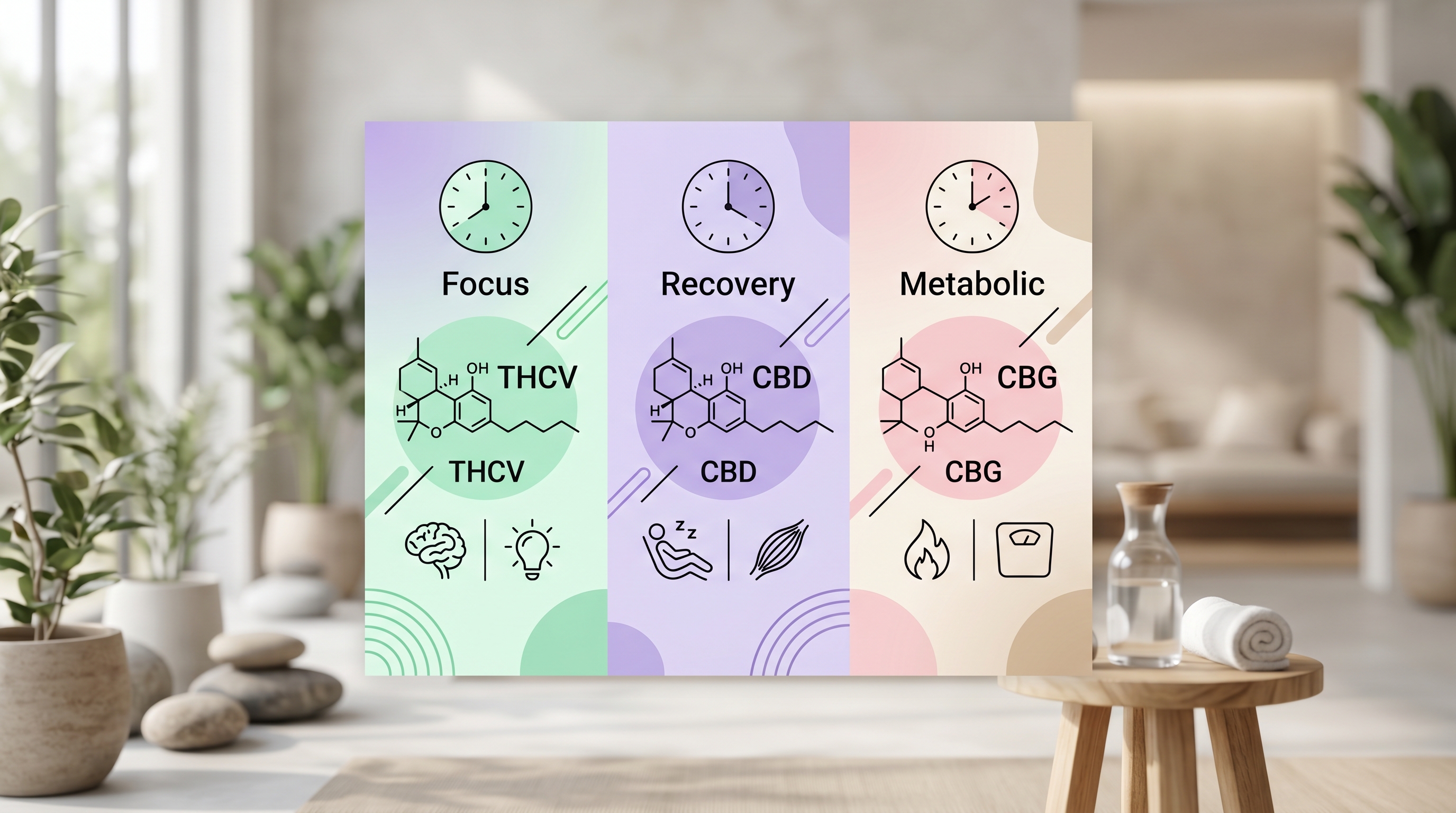
Here is where biohackers turn building blocks into routines. The table below reflects what people commonly do based on consumer practice and the receptor logic above. Treat these as starting points to discuss with a clinician, not prescriptions. I have kept doses conservative on purpose.
| Goal | Stack | Typical Ratio | Timing | What the science actually supports |
|---|---|---|---|---|
| Morning Focus | CBG + CBD | 2:1 CBG-forward (e.g. 10–20 mg CBG, 5–10 mg CBD) | A.M., with or without food | Single-dose CBG trial for stress/memory; CBD as buffer. Preliminary. |
| Recovery | CBD + CBG | 1:1 (e.g. 15–25 mg each) | After training or in the evening | Anti-inflammatory mechanisms are mostly preclinical/animal; human recovery data is thin. |
| Metabolic Support | THCV (+ small CBD) | THCV-led (e.g. 5–15 mg THCV) | A.M., often before food | Strongest human signal of the three, but small trials; combo data is mixed. |
For focus stacks, people often anchor with daytime, clear-headed strains — the kind we profile in best cannabis strains for focus and productivity and morning cannabis: the chemistry of energy and focus. If your real goal is sustained attention rather than a buzz, the principles in microdosing cannabis for productivity and focus apply directly.
Recovery stackers frequently pair these cannabinoids with the body-comfort terpene story we tell in cannabis for athletic recovery and caryophyllene, the terpene that acts like a cannabinoid. And anyone exploring metabolic support should read cannabis and weight: does marijuana affect your metabolism alongside cannabis and diabetes: what endocannabinoid research reveals.
Dosing, Ratios, and Timing
The golden rule of stacking is the same as everywhere else in cannabis: start low, go slow. Because minor cannabinoids interact with your endocannabinoid system differently than THC, the dose that feels like nothing at 5 mg can feel perfect at 10 mg.
A sensible CBG-plus-CBD on-ramp many users follow looks like this:
- Days 1–7: 5 mg CBG with 10 mg CBD in the morning. Just observe.
- Days 8–14: 10 mg CBG with 15 mg CBD. Note focus, calm, and any dry mouth or mild drowsiness.
- Day 15 and on: Adjust up or down based on how you respond, not a label.
A few practical notes on ratios and format:
- Ratios shift the character. CBG-forward (2:1) leans alert; CBD-forward (2:1 or 3:1) leans calm. There is no universal “right” ratio — it is a dial, not a switch.
- Separate bottles beat blends if you want to experiment. A combined product locks the ratio; two tinctures let you tune it.
- Format changes onset. Tinctures kick in around 15–45 minutes; gummies and capsules take 60–90 minutes because they go through digestion. Match the format to whether you want a quick lift or all-day coverage.
- Give it weeks, not minutes. Many of these effects, especially anti-inflammatory and metabolic ones, build over 3–4 weeks of consistent use. One dose is rarely a fair test.
This is the same personalization logic we apply to THC and CBD in how to find your ideal THC to CBD ratio and finding your THC-CBD sweet spot. Your endocannabinoid system is yours alone — see the endocannabinoid tone theory and our endocannabinoid system guide for why two people can react so differently to the same stack.
The Entourage Rationale
So why combine these at all instead of taking one? The argument rests on the entourage effect — the theory, first proposed in 1998, that cannabis compounds work better together than in isolation. Each cannabinoid knocks on a different receptor “door”: CBG modulates 5-HT1A and α2; CBD inhibits FAAH and touches TRPV1; THCV antagonizes CB1. Stack them and, in theory, you engage several pathways at once. We unpack the full idea in the entourage effect explained and the entourage effect in cannabis science, and the terpene side of the story in the science of terpene synergy.
This connects to the broader full-spectrum conversation. If the entourage effect is real, whole-plant or “broad-spectrum” preparations should outperform isolates — a question we tackle in full-spectrum vs broad-spectrum vs isolate CBD.

Here is the part the marketing leaves out: a 2025 scientific review concluded the synergistic enhancement of cannabinoids by terpenes “remains unproven,” noting there are no clinical trials specifically designed to validate the entourage effect in people [André et al., 2024]. Much of the supporting evidence comes from cell and animal models. The concept is plausible and biologically reasonable. It is not settled science. And remember that THCV diabetes trial where the combo underperformed the single compound — proof that “more cannabinoids” does not automatically mean “better.”
Evidence Honesty and Cautions
Let me be very direct, because you deserve it. The human evidence for cannabinoid stacking is early and thin. We have a handful of small trials, a lot of rodent data, and an ocean of confident product claims. That does not mean these compounds do nothing — it means we should hold our conclusions loosely and watch our own bodies closely.
Real cautions worth taking seriously:
- CBD interacts with prescription medications. It is metabolized by the same liver enzymes (CYP3A4, CYP2C19, CYP2C9) that process most prescription drugs. Clinically meaningful interactions generally appear above roughly 300 mg/day of CBD, but people on narrow-therapeutic-index drugs — blood thinners, certain anti-seizure medications, immunosuppressants — should be especially careful. The “grapefruit warning” rule of thumb applies: if your medication warns against grapefruit, talk to a pharmacist before adding CBD.
- CBD plus valproate can raise liver enzymes and, in one pediatric series, was linked to thrombocytopenia (low platelets). Liver monitoring matters when stacking with certain drugs.
- THCV is not reliably “non-psychoactive.” At high doses it can produce THC-like effects, and at 16 mg/day it caused a false-positive THC drug test in one study. If you are subject to drug testing, this is not theoretical.
- Product quality is wildly inconsistent. These are largely unregulated. Buy from brands that publish a current certificate of analysis (COA) confirming what is actually in the bottle.
- Side effects, while usually mild, are real: dry mouth, dry eyes, mild drowsiness, and occasionally mild drops in blood pressure.
Talk to your doctor first. This is genuinely important, not boilerplate. If you take prescription medication, are pregnant or nursing, have liver concerns, or manage a chronic condition, review any cannabinoid stack with a healthcare professional — ideally one who knows the drug-interaction landscape. Cannabinoid stacking is a wellness experiment you run with your care team, not around them.
The most useful biohacker habit is not the perfect ratio — it is tracking. Log your dose, timing, and how you actually felt. Patterns beat hype every time, and they give your doctor real data to work with.
Frequently Asked Questions
Will a CBG, CBD, or THCV stack get me high? At typical wellness doses, no. CBG and CBD are non-intoxicating. THCV is non-intoxicating at low doses but can produce mild THC-like effects above roughly 100 mg, so dose matters.
What is the best stack for focus? Most people use a CBG-forward stack (around 2:1 CBG to CBD) in the morning. The evidence is preliminary — a single-dose CBG trial showed reduced stress and improved memory — so treat it as an experiment, not a guarantee.
Can THCV really help with weight or metabolism? THCV has the strongest human metabolic signal of the three, with small trials showing improved fasting glucose and modest weight loss. But the trials are small, and it is not a weight-loss drug. See cannabis and weight.
Is the entourage effect proven? No. It is a plausible, popular theory, but a 2025 review concluded the synergy “remains unproven” in humans. Some combinations may help; assume nothing automatically.
Can I take these with my prescription medication? Maybe not safely. CBD especially can interfere with how your body processes other drugs. Always check with your doctor or pharmacist first.
How long until I notice anything? Acute effects (calm, focus) may appear in 15–90 minutes depending on format. Anti-inflammatory and metabolic effects build over 3–4 weeks of consistent use.
Key Takeaways
Cannabinoid stacking is a genuinely interesting frontier. You take three non-intoxicating compounds, each pulling a different lever, and combine them toward a goal. The receptor science is real. The early trials are encouraging. But “encouraging” is not “proven,” and the entourage idea behind the whole practice is still unproven in humans.
So experiment like a scientist, not a salesperson:
- Start low and go slow. Add one variable at a time.
- Track everything. Log your dose, timing, and how you felt.
- Buy tested products. Look for a current COA.
- Mind your medications. Check with your doctor before you stack.
The strain matters less than how you respond. The only way to learn that is to pay attention — and that is exactly what we built High IQ to help you do.
Sources
- Cuttler, C., et al. (2024). Acute effects of cannabigerol on anxiety, stress, and mood. Scientific Reports. DOI: 10.1038/s41598-024-66879-0
- Effect of Cannabigerol on Sleep and Quality of Life in Veterans: A Randomized, Placebo-Controlled Trial. PubMed: 41574318 (ClinicalTrials.gov NCT05088018)
- High Cannabigerol Hemp Extract Moderates Colitis and Modulates the Microbiome. PMC: PMC11338277
- Smith, G. L. (2025). Weight Loss and Therapeutic Metabolic Effects of THCV-Infused Mucoadhesive Strips. Cannabis, 8(1). PubMed: 39968488
- The role of tetrahydrocannabivarin (THCV) in metabolic disorders (2025 review). PMC: PMC12011981
- The Entourage Effect in Cannabis Medicinal Products (review). PMC: PMC11870048
- Systematic review of drug-drug interactions of THC, CBD, and Cannabis. Frontiers in Pharmacology (2024). DOI: 10.3389/fphar.2024.1282831
- Drug Interactions of THC and CBD: Recommendations for Clinical Practice. PMC: PMC10824494
Professor High writes for educational purposes only. This is wellness content, not medical advice. Always consult a qualified healthcare provider before starting or combining any cannabinoid regimen, especially if you take prescription medication.


