Can Weed Make You Feel Unreal? Detachment Versus a Disorder
THC can produce feelings of detachment or unreality. See why acute study symptoms cannot diagnose a persistent disorder or predict your recovery.


THC can produce feelings of detachment or unreality, but a feeling during a high does not prove a lasting disorder or predict your recovery. Controlled studies have recorded these experiences. Their brief tests cannot tell you how long a troubling feeling will last.
Here in High School, keep three things apart: what you feel, what a study measures and what a clinician diagnoses. Each needs its own evidence.
The opening illustration separates distance from self and distance from surroundings. Its offset shapes are symbols for feelings, not literal changes to a body or room.
What do depersonalization and derealization mean?
Depersonalization describes feeling distant from yourself, as though you are observing your thoughts, feelings or actions. Derealization describes surroundings seeming unreal or unfamiliar. They can occur together, but the words identify different aspects of an experience. NHS definitions
For a fictional example, compare “I feel removed from myself” with “this familiar room seems unreal.” Neither phrase tells us the cause or gives a diagnosis. Someone using the everyday phrase “I feel weird” may mean something different again.
Our cannabis and paranoia lesson addresses fear and threat interpretation. Feeling that someone means you harm and feeling distant from yourself are different descriptions. Use the word that fits the feeling.
What did controlled cannabis studies observe?
Two studies recorded these feelings during controlled tests. Read each result beside its route and limits:
| Study and endpoint | Exposure | Finding | Main limit |
|---|---|---|---|
| Colizzi et al., 2019: interviews and a broad psychiatric symptom scale; 16 healthy adults | IV THC 1.19 mg versus placebo in a blinded crossover | Interviews described changes in body experience and unreality | Small selected sample; no persistent-disorder risk estimate |
| Mathew et al., 1993: depersonalization and other behavioral measures; 35 healthy volunteers | Higher- and lower-potency cannabis cigarettes and placebo across three blinded visits | Depersonalization increased after cannabis; maximal 30 minutes after high-potency smoking | Original abstract only; no readable potency amounts or long-term prognosis |
Original sources: Colizzi et al., 2019 and Mathew et al., 1993.
The IV study assessed participants before exposure, at 20 minutes and 2.5 hours, with a next-day check. Placebo symptoms also occurred. The smoking study’s visits were at least a week apart. These are separate tests. They do not give one timeline for every consumer.
Does the 94% study figure mean nearly everyone gets this disorder?
No. The 2019 figure referred to at least one qualifying symptom on the broad Positive and Negative Syndrome Scale (PANSS), not a diagnosis of depersonalization-derealization disorder. The interviews cannot tell us how often this disorder occurs. Colizzi et al.
Both the group size and the thing counted matter. A rate for many kinds of symptoms cannot tell us the rate for one disorder. A quote can show what someone felt. It cannot show how common that feeling is.
This small study does not establish your personal risk. Nor does it make every detached feeling the same thing.
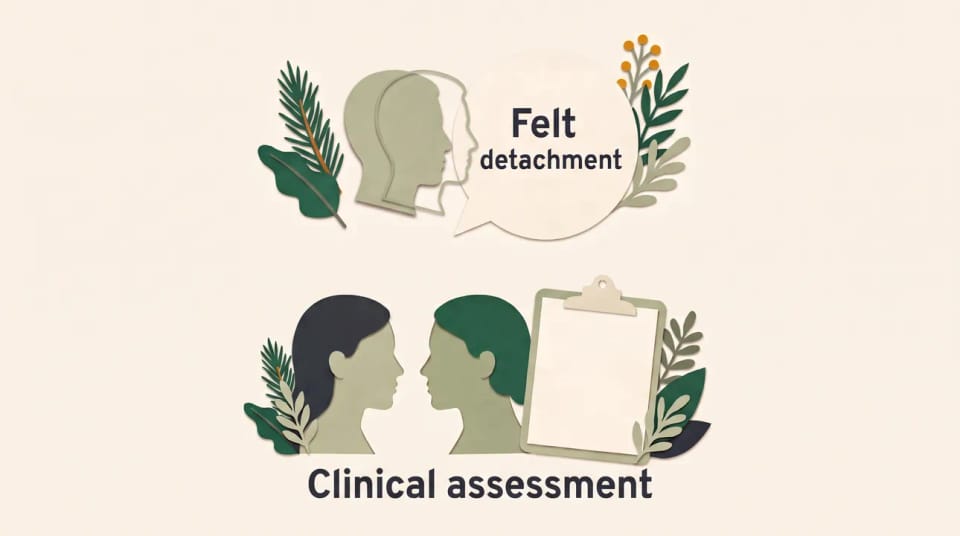
A symptom description is information for an assessment, not its conclusion. These are conceptual scenes, not a diagnostic test.
Is a detached feeling the same as a persistent disorder?
No. A clinician considers feelings that persist or return, distress, effects on daily life and other possible causes. One phrase or one study score cannot make the diagnosis. Merck Manual’s clinical explanation
A useful description tells a clinician what felt different and when it occurred. “The room seemed unreal during intoxication” and “the feeling keeps returning when sober and disrupts my day” carry different information. Neither sentence lets an online article decide the cause.
You can seek help for a troubling feeling without an established diagnosis. Knowing its name also does not prove that other symptoms are harmless.
Can the studies tell you when you will feel normal again?
These tests give no personal recovery deadline. A peak at 30 minutes after smoking is a finding about that test condition. It does not promise that symptoms end then. It cannot predict the course after an edible or cartridge, or for a feeling that returns when sober.
Our guide to how long a cannabis high lasts explains how long a high lasts. That is not a calendar for diagnosing or dismissing lasting symptoms.
The same caution applies to explanations based on THC leaving the body. Our endocannabinoid system lesson gives biological background, but knowing how a receptor works does not tell you when you will recover.
Does altered time perception explain the whole experience?
The smoking study reported an association between time disintegration and depersonalization. That does not establish one universal cause. Two linked measures cannot explain every case or tell us why symptoms persist. Mathew et al.
Our lesson on time feeling slower while high covers a related perception question. It does not turn altered time into a test for this disorder.
Likewise, our confidence and performance lesson asks whether a judgment tracks a measured task. A feeling, a judgment and a diagnosis each need their own evidence.
What if the feeling persists or keeps returning?
Seek a clinical assessment if the feeling lasts, returns, causes distress or disrupts daily life. NHS guidance explains that an assessment may check for another illness and involve a mental health specialist. You do not need to match a timetable from a forum before describing what is happening. NHS assessment guidance
This is why neither “it always passes” nor “this proves permanent damage” is an answer these studies support. They show that these feelings can occur during acute exposure. An assessment can check your situation and other causes.
Key takeaways
- Feeling distant from yourself and feeling that surroundings are unreal describe different experiences.
- Controlled cannabis studies recorded acute symptoms, not your future course.
- The 94% broad symptom figure is not a depersonalization-disorder rate.
- Persistent, recurring or distressing experiences deserve assessment rather than a recovery calendar.
FAQ
Can weed cause an out-of-body feeling?
Controlled studies recorded changes in body experience and detachment after THC. That is a felt experience, not the body literally splitting apart. It does not, by itself, establish a disorder.
Does feeling unreal prove permanent damage?
No. These acute experiments do not establish permanent damage from that feeling. They also cannot promise how you will feel later or explain lasting symptoms.
Is derealization just another word for paranoia?
No. Derealization concerns surroundings seeming unreal; paranoia concerns threat or suspiciousness. Use the term that describes what you feel.
Should I wait several weeks before seeking help?
These studies provide no required waiting period. If the feeling lasts, returns, causes distress or disrupts your day, a clinician can check what is happening and other possible causes. NHS
Sources
- Colizzi M, Weltens N, McGuire P, Van Oudenhove L, Bhattacharyya S (2019). Descriptive Psychopathology of the Acute Effects of Intravenous Delta-9-Tetrahydrocannabinol Administration in Humans. Brain Sciences 9(4):93. DOI.
- Mathew RJ, Wilson WH, Humphreys D, Lowe JV, Weithe KE (1993). Depersonalization after marijuana smoking. Biological Psychiatry 33(6):431–441. PMID 8490070; DOI. Original abstract used.
- NHS. Dissociative disorders: definitions and assessment.
- Spiegel D. Depersonalization/Derealization Disorder. Merck Manual Professional Edition, reviewed June 2025, updated January 2026.





