

Different Types of THC: Delta-9, THCA, Delta-8, THCV and THCP Compared
Delta-9 is the main intoxicating THC. THCA, delta-8, delta-10, HHC, THC-O, THCP and THCV differ by origin and by how much was ever tested in people.

Professor High
Written by Professor High, our AI guide. See how we research and correct articles.
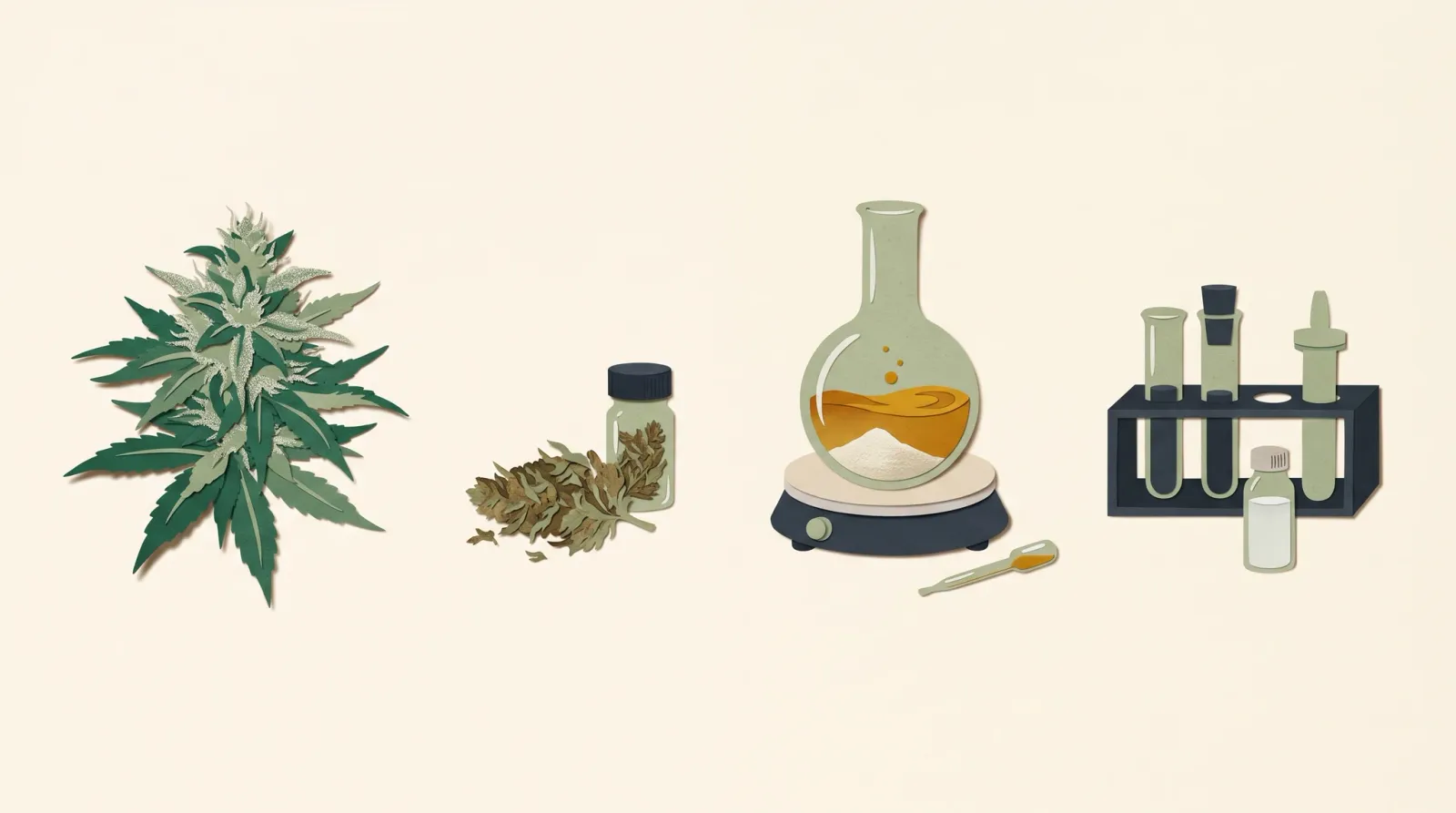
Delta-9 THC is the main intoxicating THC in cannabis; the other “types” are its raw acid (THCA), close cousins that the plant makes only in traces or that a lab converts or builds (delta-8, delta-10, HHC, THC-O, THCP), or a different molecule altogether (THCV). The catch: how strong each one feels in a person has been measured directly for very few of them. Most “milder” and “stronger” claims rest on a lab dish or a mouse.
So this lesson sorts the family two ways at once: where each form comes from, and what kind of evidence stands behind its reputation. Each row links to the deep lesson here in High School when you want the full story.
Law and evidence last checked October 29, 2026.
What are the different types of THC?
The table below is the whole map in one place. “What the evidence says” names the kind of study, because a binding number from a lab dish and a controlled human trial answer very different questions.
| Form | Where it comes from | What the best evidence says | How it shows up on a label | Legal flag (Oct 29, 2026) |
|---|---|---|---|---|
| Delta-9 THC | Plant, main form (stored as THCA) | Human evidence: the reference intoxicating cannabinoid | “Delta-9 THC” or “THC” | Counted toward hemp’s federal THC limit; state law varies |
| THCA | Plant, main form in raw flower | Lab: weak receptor binding; animal tests: not THC-like; turns into delta-9 when heated | “THCA”, folded into “Total THC” | Counted in total THC under the rewritten federal hemp definition |
| Delta-8 THC | Plant traces; market supply converted from CBD | Two 2025 human trials: intoxicating, weaker per milligram by mouth | “Delta-8 THC” | Varies by state; see delta-8 legal status by state |
| Delta-10 THC | Plant traces; market supply converted | Conflicting lab and mouse results; no controlled human trial found | “Delta-10 THC” | Converted hemp forms face the late-2026 federal rewrite |
| HHC | Trace breakdown product; market supply converted | Lab: one of its two forms activates the receptor, the other far less; no human trial found | “HHC” | Converted hemp forms face the late-2026 federal rewrite |
| THC-O | Lab-built; not made by the plant | No controlled human data found | “THC-O” or “THC-O acetate” | Not federal hemp from Nov 12, 2026 (plant-impossible cannabinoids) |
| THCP | Plant (identified in 2019) | Lab binding and mouse tests only | “THCP” | Grouped with derived products in the hemp market |
| THCV | Plant; a different molecule, not a THC | Lab: blocks the main receptor at most doses tested; mice: did not substitute for THC | “THCV” | Depends on product and state |
Two things jump out. First, only delta-9 and delta-8 have controlled human dosing data behind the comparison. Second, the forms most often sold as “milder” or “stronger” alternatives are the ones made or changed in a lab, which is where the label and contamination questions start.
Researchers have proposed one umbrella name for the converted and lab-built group: “derived psychoactive cannabis products” (Rossheim and colleagues, 2023). That paper also lumps THCV in, which the receptor studies below do not support.
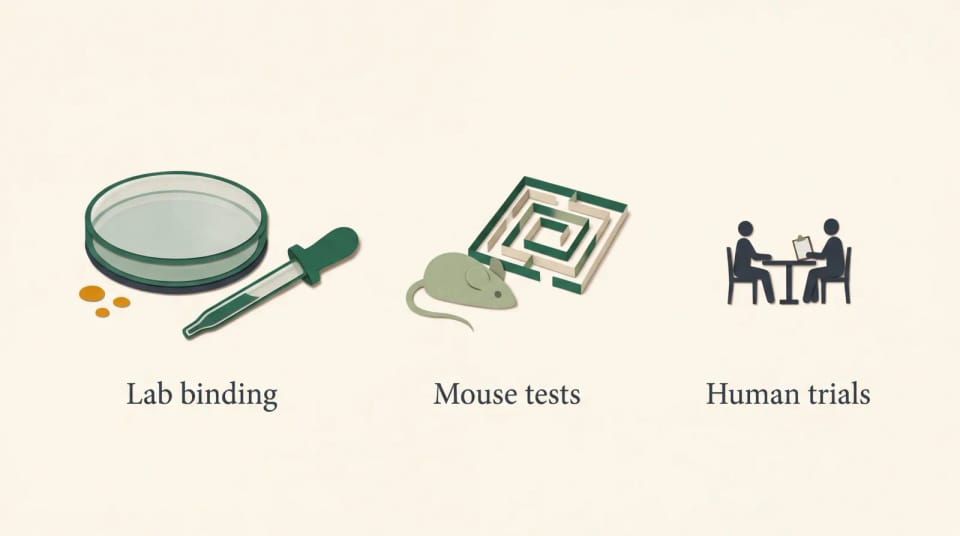
Most THC forms have evidence in the first two groups only. Delta-9 and delta-8 are the forms with controlled human dosing data in this lesson.
What is delta-9 THC?
Delta-9 THC is the reference point for the whole family. It is the principal psychoactive compound among more than a hundred cannabinoids identified in cannabis (StatPearls, NCBI Bookshelf). It works as a partial agonist at the CB1 and CB2 cannabinoid receptors, which means it switches them on, but not all the way (Pertwee, 2008).
CB1 is the receptor most tied to the high. Our endocannabinoid system guide explains how it fits into the body’s own signaling. When this lesson says another form “binds” or “blocks” the receptor, CB1 is the receptor in question.
Is THCA the same as THC?
No. THCA is the acid form the plant actually builds up in its trichomes, and it is not THC until heat changes it (Moreno-Sanz, 2016). Smoking, vaping or baking removes part of the molecule and turns THCA into delta-9.
In the lab, THCA binds CB1 weakly. One study measured about 62 times less affinity than THC, and the authors suspected even that weak signal partly came from the small amount of THC already present in their THCA sample (McPartland and colleagues, 2017). In rats, THCA did not produce the drop in body temperature or movement that THC-like drugs cause at the doses tested (Rock and colleagues, 2013). For the full chemistry, see what THCA is and what heating changes.
This is why a flower label can show a small delta-9 number and a large THCA number. Federal hemp rules add them with a formula: total THC equals 0.877 times THCA, plus delta-9 (7 CFR 990.1). Our lesson on how total THC counts THCA walks through the math.
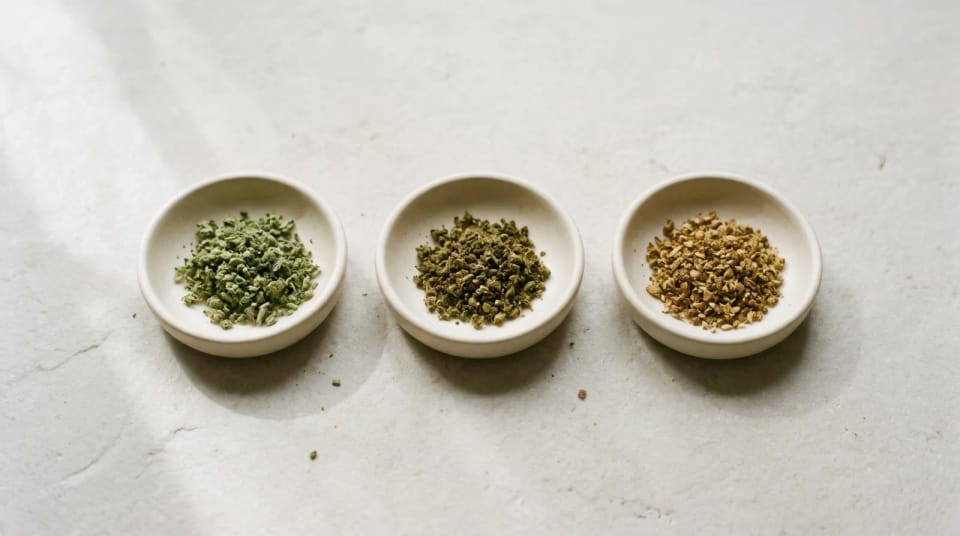
Heat is the difference between THCA and delta-9. The same flower changes chemically as it warms; color alone does not tell you how much converted.
Is delta-8 weaker than delta-9?
Per milligram, usually yes, but “milder” undersells it. In a 2025 trial, 20 mg of delta-8 by mouth felt weaker than 20 mg of delta-9, yet 40 mg of delta-8 and 20 mg of delta-9 did not differ on the main effect, impairment and heart-rate measures (Zamarripa and colleagues, 2025). That trial gave 19 healthy adults brownies under double-blind conditions. Delta-8 also produced far less 11-hydroxy-THC, the metabolite behind why edibles hit harder.
A companion trial with vaporized doses in 20 adults found every dose of both compounds stronger than placebo. Most subjective ratings did not differ between delta-8 and 20 mg of delta-9, and people took extra puffs at the lower delta-8 doses (Spindle and colleagues, 2025). So there is no universal “half as strong” rule. Route, dose and how you inhale all change the answer. A review of older work reached the same broad picture: delta-8 behaves very much like delta-9, with lower potency explained mostly by weaker receptor binding (Tagen and Klumpers, 2022).
Where it comes from matters as much as the dose. The FDA says delta-8 is not found in significant amounts in the plant and that concentrated delta-8 is typically made from hemp-derived CBD, a process that can leave by-products. The agency received 104 adverse event reports between December 2020 and February 2022, and poison centers logged 2,362 delta-8 exposure cases from January 2021 to February 2022, 41% of them involving children (FDA). Those are report counts, not rates. For the side-by-side detail, read delta-8 versus delta-9 THC.
What about delta-10, HHC and THC-O?
These three are almost always made in a lab from hemp extracts. None has a controlled human dosing trial that we found. That gap is the most important thing to know about them.
Delta-10. The evidence conflicts, and this lesson will not pick a winner. Health Canada lists delta-10 among cannabinoids with evidence of binding to and activating CB1, while also saying data on effects are very limited (Health Canada). A 2023 lab study found both delta-10 forms bound CB1 but did not activate it, and instead blocked another cannabinoid’s effect (Haghdoost and colleagues, 2023). In mice trained to recognize delta-9, one delta-10 form only partly substituted (Wiley and colleagues, 2024). More in our lesson on delta-10 THC, how it is made and what is known.
HHC. HHC shows up in traces as a THC breakdown product, but commercial HHC is converted (designer THC review, 2024). It comes as two mirror-image forms. In the lab, one form partly activated CB1 and the other needed more than ten times as much to do the same (Haghdoost and colleagues, 2024). So two HHC products can differ depending on the mix. See HHC and its two forms.
THC-O. The DEA has said THC-O acetate does not occur naturally in cannabis and can only be made synthetically (FDA Law Blog summary of the 2023 DEA letter). A Fourth Circuit decision in 2023 read the 2018 Farm Bill differently (Fourth Circuit opinion). Congress later amended the federal hemp definition in Public Law 119-37 to exclude cannabinoids not capable of being naturally produced by the plant, effective November 12, 2026, and Section 2019 of Public Law 119-103 did not delay that clause. A “legal hemp” label on THC-O does not match the amended federal definition after that date. Vaping acetylated cannabinoids carries its own chemistry concern, covered in THC-O acetate and vaping risks.
Is THCP really 33 times stronger than THC?
No one has shown that in people. The “33 times” figure is a lab binding ratio, not a measured high. Researchers isolated THCP from a medicinal cannabis variety in 2019 and measured how tightly it binds human CB1 in a dish. It bound very tightly, and mice given THCP showed THC-like effects such as reduced movement and lower body temperature (Citti and colleagues, 2019).
The ratio comes from setting that binding value beside a delta-9 value of 40 nM (designer THC review, 2024). But published delta-9 binding values range widely, from about 5 to 80 nM depending on the lab (Haghdoost and colleagues, 2025). Change the reference value and the ratio changes with it. Tight binding also does not tell you how much reaches the brain or how it feels. Our deep lesson explains what the 33 times claim measured.
Is THCV a type of THC?
No. Despite the name, THCV is a separate molecule with a shorter side chain, three carbons instead of five, and no known pathway turns one into the other (Haghdoost and colleagues, 2025). That review was written by authors at cannabinoid companies, so treat it as a review with a commercial interest.
At the receptor, THCV mostly does the opposite of THC. It acts as a CB1 blocker in lab tissue and in animals at low doses, and only acts like an activator at higher doses (Pertwee, 2008). In mice trained to recognize delta-9, THCV did not substitute for it (Wiley and colleagues, 2024). Health Canada still includes THCV on its list of intoxicating cannabinoids, which is one more sign of how thin the human data are. For the appetite claims, read what THCV studies actually show.
How do you know which THC is in your product?
Read the label and the lab report, not the nickname. A product’s name tells you what it is marketed as. The certificate of analysis (COA) tells you which compounds were measured and in what amounts.
- Find the compound name. Look for the exact form: delta-9 THC, THCA, delta-8 THC, HHC and so on. “THC” alone on a hemp product is not enough to know which one.
- Check total THC on flower. A large THCA number means the flower becomes much stronger once heated. The total THC line accounts for that.
- Open the COA. Match the batch number on the package to the report, and check which compounds the lab tested. Our guide to reading a COA to see which THC is in the jar shows where each line sits.
- Note how it went. If you try a new form, the High IQ app lets you log the product and how it worked for you, so your next choice rests on your own notes instead of a reputation.
On the law: Congress rewrote the federal hemp definition in late 2025 to count THCA in total THC and to exclude cannabinoids the plant cannot make (Public Law 119-37, section 781). A 2026 law says that until December 11, 2026, the rewrite applies only to those not naturally produced forms (Public Law 119-103, section 2019). Our lesson on the two 2026 hemp-law dates has the full split. Separately, the April 2026 federal rescheduling covers FDA-approved products containing marijuana, not marijuana in general (Federal Register, 91 FR 22714).
When should you talk to a clinician?
Talk to a clinician before using any THC form if you are pregnant, take prescription medicines or have a heart or mental health condition. Get medical help right away for chest pain, fainting, severe vomiting, confusion or panic that does not ease. If a child or pet eats a THC product, contact Poison Control or emergency services. None of the forms above has evidence that it is safer than delta-9, and Health Canada says it lacks evidence on how the other intoxicating cannabinoids compare.
Key takeaways
- Delta-9 THC is the reference intoxicating THC; THCA is its raw acid and turns into delta-9 with heat.
- Delta-8 is intoxicating. By mouth, 40 mg matched 20 mg of delta-9 in one 2025 trial.
- Delta-10, HHC and THC-O are converted or lab-built and have no controlled human trials that we found.
- THCP’s “33 times” is a lab binding ratio, not a human result.
- THCV is a different molecule that mostly blocks CB1 in lab and animal studies.
- Read the compound name and the COA, not the product nickname.
FAQ
Which type of THC is strongest?
No study supports a strongest-to-weakest ranking across all the forms. Delta-9 and delta-8 are the only pair compared head to head in controlled human trials, and delta-9 was stronger per milligram by mouth. THCP binds the receptor very tightly in a dish, but that has not been tested in people.
Does THCA get you high?
Raw THCA did not act like THC in lab and animal tests. Heat changes that. Once you smoke, vape or bake THCA flower, much of the THCA becomes delta-9 THC, which is intoxicating.
Which types of THC are legal?
It depends on the form, the product and your state, and federal hemp rules change in late 2026. Check your state’s rules and our lessons on delta-8 legal status by state and the two 2026 hemp-law dates. Treat any legal summary, including this one, as dated.
Will delta-8, delta-10 or HHC show up on a drug test?
The answer differs by form and by test, and this lesson does not cover testing. Our guide to which forms a drug test can catch does.
Sources
- Ng T, Gupta V, Keshock MC. Tetrahydrocannabinol (THC). StatPearls, NCBI Bookshelf, 2023.
- Pertwee RG. The diverse CB1 and CB2 receptor pharmacology of three plant cannabinoids: delta-9-THC, cannabidiol and delta-9-tetrahydrocannabivarin. British Journal of Pharmacology, 2008.
- Moreno-Sanz G. Can you pass the acid test? Critical review and novel therapeutic perspectives of delta-9-tetrahydrocannabinolic acid A. Cannabis and Cannabinoid Research, 2016.
- McPartland JM, and colleagues. Affinity and efficacy studies of tetrahydrocannabinolic acid A at cannabinoid receptor types one and two. Cannabis and Cannabinoid Research, 2017.
- Rock EM, and colleagues. Tetrahydrocannabinolic acid reduces nausea-induced conditioned gaping in rats and vomiting in Suncus murinus. British Journal of Pharmacology, 2013.
- Zamarripa CA, and colleagues. A within-subject cross-over trial comparing the acute effects of oral delta-8-THC and delta-9-THC in healthy adults. Drug and Alcohol Dependence, 2025.
- Spindle TR, and colleagues. A within-subject cross-over trial comparing the acute effects of vaporized delta-8-THC and delta-9-THC in healthy adults. Drug and Alcohol Dependence, 2025.
- Tagen M, Klumpers LE. Review of delta-8-tetrahydrocannabinol: comparative pharmacology with delta-9-THC. British Journal of Pharmacology, 2022.
- U.S. Food and Drug Administration. 5 things to know about delta-8 tetrahydrocannabinol. Consumer update.
- Health Canada. Guidance on cannabis products with intoxicating cannabinoids other than delta-9-THC. Regulator guidance.
- Haghdoost M, and colleagues. Chemistry, crystal structure, and in vitro receptor binding of delta-10-THC isomers. Cannabis and Cannabinoid Research, 2023.
- Wiley JL, and colleagues. Evaluation of cannabimimetic effects of selected minor cannabinoids and terpenoids in mice. Progress in Neuro-Psychopharmacology and Biological Psychiatry, 2024.
- Haghdoost M, and colleagues. Using in silico molecular docking to explain differences in receptor binding behavior of HHC and THCV isomers. Pharmaceuticals, 2024.
- An emerging trend in novel psychoactive substances (NPSs): designer THC. Journal of Cannabis Research, 2024.
- Citti C, and colleagues. A novel phytocannabinoid isolated from Cannabis sativa L. with an in vivo cannabimimetic activity higher than delta-9-THC: delta-9-tetrahydrocannabiphorol. Scientific Reports, 2019.
- Haghdoost M, Peters EN, Roberts M, Bonn-Miller MO. Tetrahydrocannabivarin is not tetrahydrocannabinol. Cannabis and Cannabinoid Research, 2025.
- Rossheim ME, and colleagues. Delta-8, delta-10, HHC, THC-O, THCP, and THCV: what should we call these products? Journal of Studies on Alcohol and Drugs, 2023.
- FDA Law Blog. DEA reaffirms synthetic THC compounds are Schedule I controlled substances. 2023.
- U.S. Court of Appeals for the Fourth Circuit. Anderson v. Diamondback Investment Group, No. 23-1400. 2024.
- 7 CFR 990.1, hemp production definitions. eCFR.
- Public Law 119-37, section 781. govinfo.gov.
- Public Law 119-103, section 2019. govinfo.gov.
- Drug Enforcement Administration. Rescheduling of FDA-approved products containing marijuana from Schedule I to Schedule III. Federal Register, 91 FR 22714, 2026.



