What Is Delta-10 THC? How It's Made, How Strong It Is and Its Legal Status
Commercial delta 10 thc is made from hemp CBD. A title search of 17 PubMed papers found no human dosing trial. Outside the hemp definition, it is Schedule I.

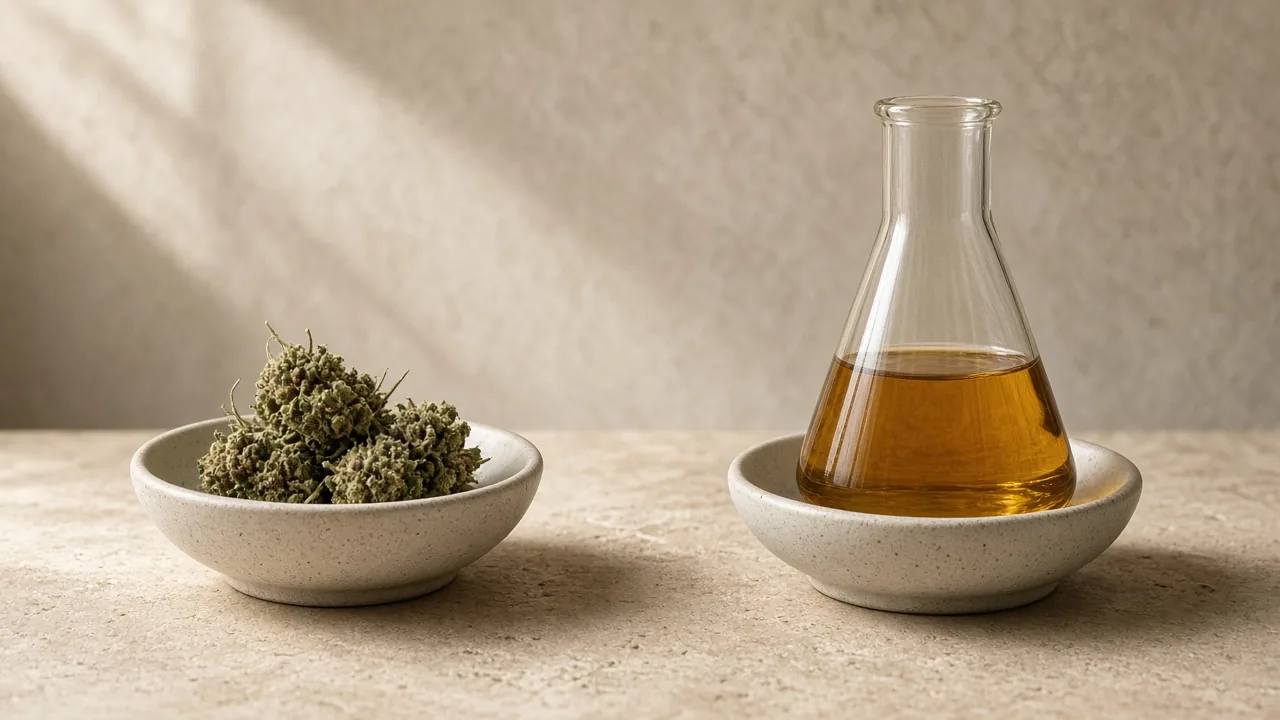
Delta-10 THC is a lab-converted THC isomer, and an FDA lab series found it inside commercial vapes and edibles submitted from 2019 to 2024 as synthetic delta-8 or delta-9 THC.
Ciolino and Ranieri tested those products with HPLC. The samples held mixtures of seven THC isomers. Delta-10 was one of them. Some products also contained THCP or HHC [Ciolino, 2026].
A PubMed search on October 13, 2026 for delta-10 THC returned 17 papers. None of those 17 titles named a controlled human dosing trial. That is a title search. It is not proof that no such trial exists.
This page will not give you a dose. It will not call delta-10 safe. It will not say it is “half as strong” as delta-9. No primary source opened here measured a percent strength in people.
What is delta-10 THC?
Delta-10 THC is a THC isomer. The difference is where one double bond sits.
Delta-9 THC is the main THC the plant makes. Its double bond sits between carbon 9 and carbon 10. Carbon 9 is part of that bond. It is not a separate left-or-right center.
Delta-8 moves that bond one step, between carbon 8 and carbon 9. The delta-8 versus delta-9 explainer covers that shift. It does not cover delta-10.
Delta-10 moves the bond the other way. Chemists write one common form as (6aR,9R)-delta-10-THC. In that form, carbon 9 can point two ways. Labs therefore report a trans isomer and a cis isomer [Haghdoost, 2023]. The mouse study below used the (6aR,9R) form [Wiley, 2024].
A different molecule, delta-6a,10a-THC, is not delta-10. FDA chemists listed the two as separate peaks [Ciolino, 2021] [Ciolino, 2026].
The bond position changes how the molecule meets the CB1 receptor. A binding number from a dish is not a human strength score. Shop pages often say the plant makes delta-10 in trace amounts, or that it feels energizing. The papers opened for this page do not measure a trace level in living flower. They treat delta-10 as an isomer that shows up after chemical or heat treatment [Ciolino, 2021].
How is delta-10 THC made?
Commercial delta-10 starts with hemp CBD. Acid closes the CBD ring and makes a mix of THC isomers. That first step does not place the delta-10 double bond.
In one chemistry study, the main products were delta-9 THC and delta-8 THC. Two further side products were delta-8-iso-THC and delta-4(8)-iso-THC. Delta-10 was not a main product in that paper [Marzullo, 2020].
A second step moves the double bond. Under base-catalyzed conditions, delta-9 THC or delta-8 THC can form two delta-10 isomers. One is (6aR,9R)-delta-10-THC. The other is (6aR,9S)-delta-10-THC. The (6aR,9R) form is the one reported as thermodynamically favored [Ciolino, 2021].
Household acids can push a similar reaction. A forensic lab used battery acid, muriatic acid, and vinegar. The route left marker impurities, including 10-methoxy-THC. That was a route study. It was not a survey of jars sold as delta-10 [Kiselak, 2020].
Finished products are often mixtures. A lab tested 27 delta-8 vape products from 10 brands. None matched the delta-8 amount on the label. Eleven contained unlabeled cutting agents. Every product contained reaction side products, including delta-9 THC, heavy metals, olivetol, and other cannabinoid byproducts [Meehan-Atrash, 2022]. Those were delta-8 vapes, not a delta-10 product line. The lesson still applies. A converted-cannabinoid label can be wrong.
FDA chemists also found delta-10 in vape liquids from the 2019 lung-injury investigation. Delta-9 was the plant isomer in most of them. Delta-8, delta-6a,10a-THC, delta-10, and exo-THC showed up as well. Significant or major amounts of these unnatural isomers were in more than 10 percent of the THC vape liquids. Lesser amounts were in another 60 percent. The authors tied that pattern to chemical or heat treatment. They did not tie the lung injuries to delta-10 [Ciolino, 2021].
The 2026 series is the clearest shop finding. Products submitted as synthetic delta-8 or delta-9 held seven THC isomers, including delta-10. Vape and dab oils ran from 25 to 96 percent total THC isomers by weight. Gummies ran from 57 to 321 milligrams per piece. One combination gummy held 649 milligrams of delta-8 THC and 791 milligrams of THC plus HHC isomers together. That paper did not test every jar sold as delta-10 [Ciolino, 2026].
If a certificate of analysis lists solvents, use the guide to residual solvents on a COA. A clean solvent line does not prove the isomer mix matches the front label.
Does delta-10 THC get you high?
The human evidence is thin. None of the 17 titles in the October 13, 2026 PubMed set named a controlled dosing trial in people.
What exists is receptor work, one mouse study, and a user survey.
In a binding test, trans-delta-10-THC needed 29.1 nanomolar to do the job that delta-9 THC did at 2.1 nanomolar. The cis isomer needed 294.2 nanomolar. A higher number means more compound was required to displace the test drug. It is not a percent of delta-9 strength. All five authors were affiliated with Canopy Growth Corporation [Haghdoost, 2023].
In the same paper, neither isomer acted like an agonist up to 10 micromolar. Both blocked a CB1 agonist. The blocking values were 460 nanomolar for the trans isomer and 1040 nanomolar for the cis isomer. The authors read that as a lack of THC-like agonist activity. Crystal structures confirmed both isomers [Haghdoost, 2023].
A mouse study does not match that reading. (6aR,9R)-delta-10-THC partly substituted for delta-9 THC in a drug-discrimination test. Only delta-8 THC fully substituted. Delta-9, delta-8, that delta-10 form, and CBN each produced some delta-9-like stimulus effects. The animals were mice, not people [Wiley, 2024].
So the cell paper and the mouse paper disagree. Neither one is a controlled human trial. Do not turn either result into “X percent as strong as delta-9.”
An online survey of 229 U.S. adults who had used cannabis in the past year asked about semi-synthetic cannabinoids. In that sample, 44.5 percent had used at least one. In that sample, 14.0 percent reported past-year delta-10 use. That is self-report in a convenience sample. It is not a measured dose, and the abstract does not give delta-10-specific side-effect rates [Pabon, 2026].
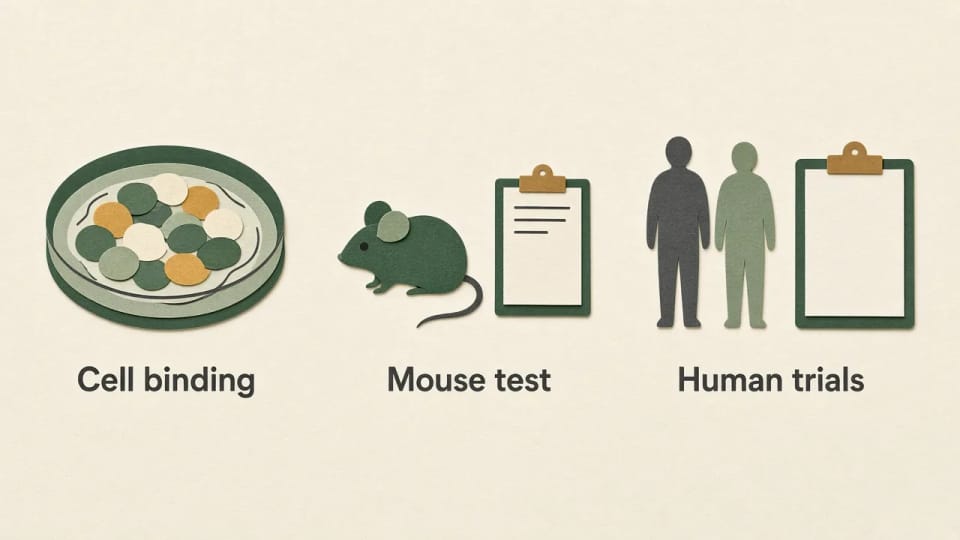
Cell binding and a mouse test answer different questions. The blank page marks that title search. It is not proof that no human trial exists. Arrows between those groups would overclaim.
If you use a converted product, write down what you used, when, and how much. A simple cannabis journal keeps that record in one place.
How does delta-10 compare with delta-8 and delta-9?
Delta-8, delta-9, and delta-10 are isomers. They are not the same product, and they do not have the same evidence.
HHC and THCP are different molecules again. The HHC explainer, the HHC versus THCP comparison, and the THCP potency piece cover those. This page stays on delta-10.
| Question | Delta-9 THC | Delta-8 THC | Delta-10 THC |
|---|---|---|---|
| Natural amount in the plant | The main THC the plant makes [Ciolino, 2021]. | FDA says it is not found in significant amounts. Shop stock is usually converted from CBD. | Papers opened here list it with processing isomers, not as a measured plant trace [Ciolino, 2021]. |
| How shop products are made | Usually extracted from cannabis. | Acid conversion of CBD. One vape audit found mislabeled mixtures that included delta-9 [Meehan-Atrash, 2022]. | Also from chemical conversion. An FDA series found it inside products submitted as synthetic delta-8 or delta-9 [Ciolino, 2026]. |
| Human evidence | Many controlled human studies exist. This page does not review them. | FDA reports, poison-center cases, and product tests. Not a new human trial in this piece. | A title search of 17 PubMed papers on October 13, 2026 found no human dosing trial. That is not proof none exist. The cell-paper authors were affiliated with Canopy Growth. Those cell data and the mouse test disagree [Haghdoost, 2023] [Wiley, 2024]. |
| Federal status by date | Above the hemp limits, marijuana law applies. See the total-THC page. | Disputed: November 12 or December 11, 2026. The November 12 guide states both readings. | Schedule I as a tetrahydrocannabinol outside the hemp definition. The April 28, 2026 rule moved only FDA-approved products and state-licensed medical marijuana to Schedule III. Hemp dates are November 12 and December 11, 2026. |
| Drug-test result | Standard urine screens target THC metabolites. | Can flag a screen. Kit detail is on the drug-test post. | Evidence is limited for a pure product. A positive is a precaution, not a proven result. Liver cells made a different metabolite mix [Kronstrand, 2026]. |
Is delta-10 THC safe?
No source opened here shows a clean safety record for delta-10. This page does not call it safe, and it does not suggest a dose.
FDA’s consumer update “5 Things to Know about Delta-8 THC” is a delta-8 page. The manufacturing warning is the part that travels. Concentrated delta-8 is typically made from hemp CBD. The process can use harsh chemicals and leave byproducts. That worry applies to converted cannabinoids as a class. The counts on that page are delta-8 counts, not a delta-10 tally.
From December 1, 2020 to February 28, 2022, FDA received 104 adverse-event reports about delta-8. From January 1, 2021 to February 28, 2022, national poison centers logged 2,362 delta-8 exposure cases. Of those cases, 41 percent involved children under 18. FDA notes that poison-center exposures are not a full count of harm, and an exposure is not always a poisoning.
CDC Health Advisory 00451, issued September 14, 2021, is also delta-8 surveillance. It describes 661 delta-8 exposures in the window it used. Of those, 119 (18 percent) were hospitalized, and 258 (39 percent) were under 18. The advisory said other products made in a similar way also warrant monitoring. It did not publish a delta-10 case series. The live CDC page no longer serves the advisory. The archived HAN does.
A 2024 poison-center paper grouped delta-8, delta-10, and THC-O acetate. From January 1, 2021 to December 31, 2022, there were 5,022 cases in which one of those three was the primary substance. Delta-8 accounted for 98.1 percent. The abstract does not split the other 1.9 percent into delta-10 versus THC-O. Do not read 5,022 as a delta-10 total. In the grouped set, children under 6 were 30.1 percent of cases, and a serious outcome was coded in 38.4 percent. Most cases were ingestions at home [Burgess, 2024].
Pediatric harm from hemp-derived THC products is covered in what parents need to know about ICU cases. That page is not a delta-10 identity study.
I also checked FDA warning letters that cite delta-8 products in 2022 and 2023. The letters I opened did not name delta-10 as the cited product. That is only the set I opened. It is not proof that no letter anywhere names delta-10.
Nearby Research Hub pages are not delta-10 dosing trials. One reports delta-8 awareness in U.S. surveys. One looks at airway cells and vaped delta-8. One covers pediatric hemp-cannabinoid poison exposures.
Will delta-10 show up on a drug test?
A positive workplace screen is not established for a pure delta-10 product. The evidence is limited. Treat a positive as a precaution, not a proven result of delta-10 use.
In human liver cells, not in people, delta-10 was mostly turned into a glucuronide and a single-hydroxy metabolite. Only a minor carboxy metabolite showed up. Delta-8 in the same model looked more like delta-9 [Kronstrand, 2026]. A different metabolite pattern can confuse a confirmation lab. It does not prove a screen will turn positive. It also does not prove a screen will miss delta-10.
Shop products can contain delta-9. A screen built for THC metabolites can catch that. Immunoassay cross-reactivity, kit by kit, lives on the delta-8, delta-10, and HHC drug-test page. Those kit tests spiked compounds into urine. They did not dose people. This page does not repeat the kit list.
Is delta-10 legal?
Delta-10 that sits outside the hemp definition is a Schedule I tetrahydrocannabinol.
The hemp statute does not print the name delta-10. The schedule does. 21 CFR 1308.11(d)(31) lists tetrahydrocannabinols in Schedule I. That listing covers synthetic equivalents and isomers with a similar structure. It does not include a material that meets the hemp definition in 7 U.S.C. 1639o.
On April 28, 2026, DEA published a final rule at 91 FR 22714. The rule moves only a narrow set to Schedule III. The set is marijuana in an FDA-approved product, or marijuana under a state license to make, distribute, or dispense it for medical use. The same limit covers marijuana extract and naturally derived delta-9 THC in those products. The rule does not apply to synthetically derived THC. It names delta-10-tetrahydrocannabinol as a tetrahydrocannabinol that can be made only by artificial synthesis. Synthetic THC stays in Schedule I. The rule also says it does not change the status of hemp.
The hemp definition still has two dates. Public Law 119-37, section 781, rewrote that definition. One prong covers cannabinoids the plant is not capable of producing. Public Law 119-103, section 2019, keeps that prong on November 12, 2026. A second prong covers a cannabinoid the plant can make, when that cannabinoid was synthesized or manufactured outside the plant. Section 2019 does not move that prong up. It waits until December 11, 2026. Those dates decide whether a product still meets the hemp definition. They do not move a tetrahydrocannabinol that sits outside that definition out of Schedule I.
Lab papers treat delta-10 as a processing isomer, not as a major plant cannabinoid [Ciolino, 2021]. Read the November 12 hemp-law guide for the prongs, and the total THC versus delta-9 page for the hemp math. The wider map is in hemp versus cannabis rules in 2026. State rules for the related isomer are in is delta-8 legal in your state. This is not legal advice for a shop or a state case.
Key takeaways
- Shop delta-10 is a conversion isomer. An FDA lab series found it inside mixtures sold as synthetic delta-8 or delta-9 [Ciolino, 2026].
- A title search of 17 PubMed papers on October 13, 2026 found no controlled human dosing trial. That is not proof none exist.
- Cell binding and a mouse test disagree. The cell-paper authors were affiliated with Canopy Growth. Neither result is a percent of delta-9 strength.
- Converted vapes in one audit were mislabeled and contained delta-9 plus side products [Meehan-Atrash, 2022].
- Poison-center totals that mention delta-10 are mostly delta-8 cases [Burgess, 2024].
- Outside the hemp definition, delta-10 is a Schedule I tetrahydrocannabinol. The April 28, 2026 rule did not move it to Schedule III. Hemp-definition dates are November 12 and December 11, 2026.
- A positive drug screen is not established for pure delta-10. Evidence is limited. Kit detail stays on the drug-test page.
FAQ
Does delta-10 THC get you high?
Cell tests found no THC-like agonist activity up to 10 micromolar. Mice partly generalized a delta-10 form to delta-9. A title search of the 17-paper PubMed set from October 13, 2026 found no controlled human dosing trial. That is not proof none exist. A survey counted past-year use. It did not measure a dose. People may feel an effect. That search did not measure one in a controlled trial.
Is delta-10 stronger than delta-8?
No paper opened here measured a percent. In mice, delta-8 fully substituted for delta-9, and delta-10 only partly substituted [Wiley, 2024]. Binding numbers from a dish are not a human ranking. The authors of that cell paper were affiliated with Canopy Growth [Haghdoost, 2023].
Is delta-10 THC safe?
The sources do not show a clean safety record. Converted products in lab studies were mixtures, sometimes with undeclared delta-9. Poison-center papers that name delta-10 are mostly delta-8 cases. This page has no dose and does not call delta-10 safe.
Is delta-10 legal?
Outside the hemp definition, delta-10 is a Schedule I tetrahydrocannabinol under 21 CFR 1308.11. The April 28, 2026 rule, 91 FR 22714, moved only FDA-approved marijuana products and state-licensed medical marijuana to Schedule III. It leaves synthetic THC in Schedule I, and it names delta-10. Public Law 119-103 sets November 12, 2026 for cannabinoids the plant cannot make, and December 11, 2026 for cannabinoids made outside the plant. This is not legal advice.
Will delta-10 fail a drug test?
A positive urine screen is not established for a pure delta-10 product. The evidence is limited. Liver-cell work found a different metabolite mix than delta-9, which can confuse a confirmation test. That does not prove a screen will turn positive or miss delta-10. Shop products can contain delta-9. Cross-reactivity by kit is on the drug-test page.
Sources
Scholarly entries were checked against Crossref on October 13, 2026. Agency pages and statutes were opened the same day. The April 28, 2026 schedule rule and 21 CFR 1308.11 were opened on October 15, 2026. A clean citation check means the author and year match the record. It does not by itself prove every sentence is fairly framed.
- Marzullo P, Foschi F, Coppini DA, Fanchini F, Magnani L, Rusconi S, Luzzani M, Passarella D. (2020). Cannabidiol as the Substrate in Acid-Catalyzed Intramolecular Cyclization. Journal of Natural Products. https://doi.org/10.1021/acs.jnatprod.0c00436
- Meehan-Atrash J, Rahman I. (2022). Novel Δ8-Tetrahydrocannabinol Vaporizers Contain Unlabeled Adulterants, Unintended Byproducts of Chemical Synthesis, and Heavy Metals. Chemical Research in Toxicology. Print year 2022; online 2021. https://doi.org/10.1021/acs.chemrestox.1c00388
- Kiselak TD, Koerber R, Verbeck GF. (2020). Synthetic route sourcing of illicit at home cannabidiol (CBD) isomerization to psychoactive cannabinoids using ion mobility-coupled-LC-MS/MS. Forensic Science International. https://doi.org/10.1016/j.forsciint.2020.110173
- Ciolino LA, Ranieri TL, Brueggemeyer JL, Taylor AM, Mohrhaus AS. (2021). EVALI Vaping Liquids Part 1: GC-MS Cannabinoids Profiles and Identification of Unnatural THC Isomers. Frontiers in Chemistry. https://doi.org/10.3389/fchem.2021.746479
- Ciolino LA, Ranieri TL. (2026). HPLC-UV quantitation of synthetically derived THC, THCP, and HHC isomers in commercial vaping liquids and edibles (2019-2024). Journal of Forensic Sciences. https://doi.org/10.1111/1556-4029.70408
- Haghdoost M, Brumar D, Geiling B, Brunstetter M, Bonn-Miller MO. (2023). Chemistry, Crystal Structure, and In Vitro Receptor Binding of Δ10-THC Isomers. Cannabis and Cannabinoid Research. All five authors were affiliated with Canopy Growth Corporation. https://doi.org/10.1089/can.2023.0045
- Lead author Wiley JL, with Marusich JA, Blough BE, Namjoshi O, Brackeen M, Akinfiresoye LR, Walker TD, Prioleau C, Barrus DG, and Gamage TF. (2024). Evaluation of cannabimimetic effects of selected minor cannabinoids and Terpenoids in mice. Progress in Neuro-Psychopharmacology and Biological Psychiatry. https://doi.org/10.1016/j.pnpbp.2024.110984
- Burgess A, Hays HL, Badeti J, Spiller HA, Rine NI, Gaw CE, Ding K, Smith GA. (2024). Delta-8 tetrahydrocannabinol, delta-10 tetrahydrocannabinol, and tetrahydrocannabinol-O acetate exposures reported to America’s Poison Centers. Clinical Toxicology. https://doi.org/10.1080/15563650.2024.2340115
- Pabon E, Lake S, Murray CH, Cooper ZD. (2026). Emerging Hemp-Derived Semi-Synthetic Cannabinoids, Absent Regulations: Patterns of Use and Adverse Effects Among a Sample of U.S. Cannabis Consumers. Cannabis and Cannabinoid Research. Print year 2026; issued 2025. https://doi.org/10.1177/25785125251391987
- Kronstrand R, Green H, Loh M, Rüttimann F, Monti MC. (2026). In Vitro Metabolism of Δ8-, Δ9-, and Δ10-THC in Human Hepatocytes: Distinct Δ10-THC Biotransformation and Implications for Drug Testing. Drug Testing and Analysis. https://doi.org/10.1002/dta.70101
- U.S. Food and Drug Administration. 5 Things to Know about Delta-8 Tetrahydrocannabinol – Delta-8 THC. Consumer update. Counts on that page are delta-8 counts. https://www.fda.gov/consumers/consumer-updates/5-things-know-about-delta-8-tetrahydrocannabinol-delta-8-thc
- Centers for Disease Control and Prevention. Health Advisory 00451, September 14, 2021. Delta-8 surveillance. Archived copy used because the live HAN URL no longer serves the advisory. https://archive.cdc.gov/emergency_cdc_gov/han/2021/han00451.asp
- Drug Enforcement Administration. Schedules of Controlled Substances: Rescheduling of Food and Drug Administration-Approved Products Containing Marijuana. Final rule, 91 FR 22714, April 28, 2026, document 2026-08176. Schedule III only for FDA-approved products and state-licensed medical marijuana. Synthetic THC, including delta-10, stays in Schedule I. https://www.govinfo.gov/content/pkg/FR-2026-04-28/pdf/2026-08176.pdf
- 21 CFR 1308.11. Schedule I tetrahydrocannabinols, paragraph (d)(31), including the hemp exclusion in paragraph (d)(31)(ii). https://www.ecfr.gov/current/title-21/chapter-II/part-1308/section-1308.11
- Public Law 119-37, section 781, enacted November 12, 2025. Hemp definition amendments. https://www.govinfo.gov/content/pkg/PLAW-119publ37/html/PLAW-119publ37.htm
- Public Law 119-103, section 2019, approved September 2, 2026. Until December 11, 2026, section 781 applies only to the clauses that section names. The not-capable-of-being-naturally-produced prong is November 12, 2026. https://www.govinfo.gov/content/pkg/PLAW-119publ103/html/PLAW-119publ103.htm
- PubMed search, October 13, 2026. Query covered delta-10-tetrahydrocannabinol, Δ10-THC, and “delta-10 THC”. Count: 17. None of the 17 titles was a controlled human dosing trial. https://pubmed.ncbi.nlm.nih.gov/


