Does Weed Improve Hearing? What the Tests Actually Measured
Does weed improve hearing? Small trials did not find better sound detection. See how hearing tests differ from music detail and brain timing.

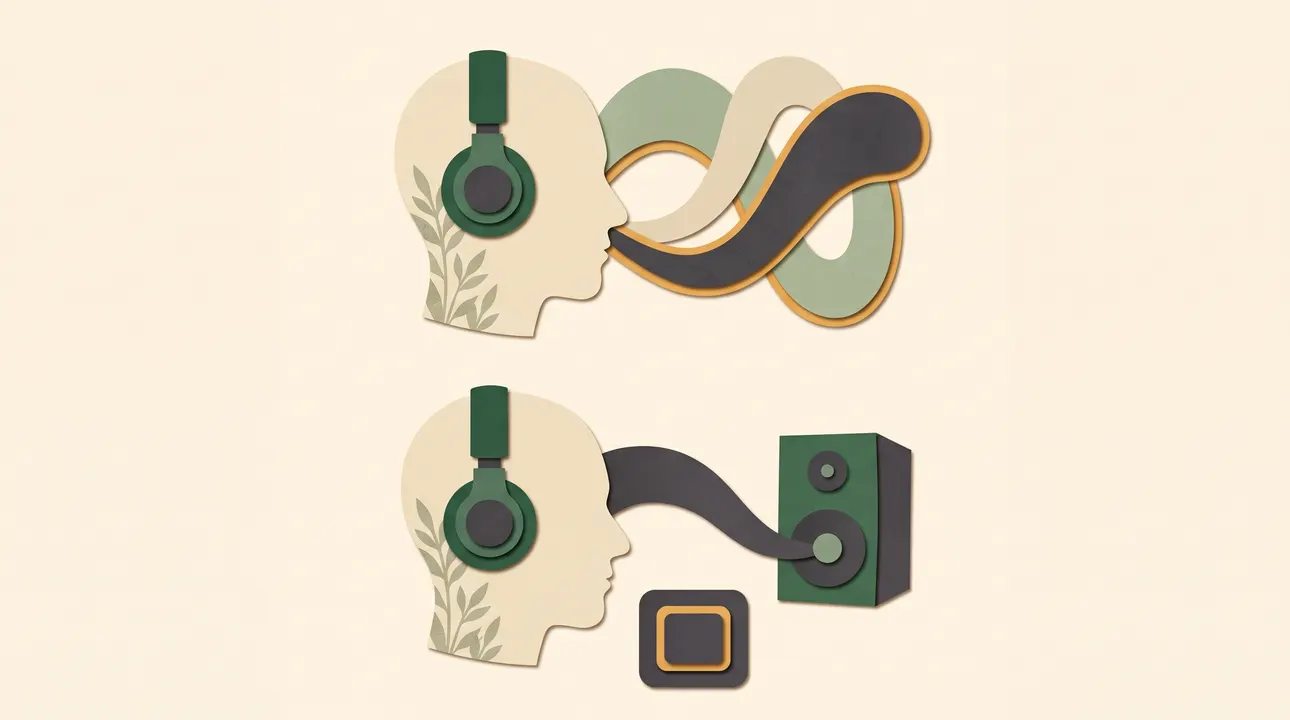
The small hearing trials reviewed here did not establish that weed improves sound detection, despite reports of richer sound. Music seeming clearer is a different claim from hearing a quieter tone. Neither claim can stand in for the other.
A familiar recording can feel newly detailed. That experience deserves a clear description, rather than an automatic conclusion about improved ears. Here in High School, “better hearing” needs a follow-up question: better at which task?
The opening diagram contrasts a listening experience with a detection task. Its ribbons are symbols, not sound measurements or an ear cutaway.
What does better hearing actually mean?
Hearing includes several steps. Sound reaches the ear, becomes an electrical signal and travels to the brain, where it is recognized. A change in the experience does not identify which step changed. NIDCD’s explanation of hearing
Three questions often get folded together:
- Felt experience: Does a song seem richer or more absorbing?
- Sound detection: Can you detect a quieter tone under controlled conditions?
- Neural timing: How consistently does the brain respond to repeated sounds?
Imagine a guitar part that suddenly draws your attention. You might describe it as easier to hear. That observation alone does not tell us whether you could detect a quieter test tone. The song and the hearing test ask different questions.
Our music experience lesson covers musical enjoyment. This lesson focuses on the measurements behind a claim of sharper hearing.
What did the human studies test?
Read the result together with the task, exposure and limit:
| Study and endpoint | Route or exposure | Finding | Main limit |
|---|---|---|---|
| 2025 recalled listening experience; 104 questionnaire participants | Usual recreational use; no assigned dose | Greater reported sensitivity and immersion | Retrospective self-report, not audiometry |
| 2002 sound detection; eight men | Oral THC 7.5 or 15 mg versus placebo; tested at 2 hours | No significant threshold change | Small sample with normal hearing |
| 1976 hearing and speech tests; 30 participants | Cannabis or placebo cigarettes; 15 per group | No significant change | High starting scores limited room for improvement |
| 2015 brain response to clicks; 20 retained EEG participants | IV THC 0.015 or 0.03 mg/kg versus placebo | Less consistent 40 Hz responses at higher dose | Neural response, not hearing threshold or music quality |
Original sources:
- Darakjian et al., 2025.
- Mulheran et al., 2002.
- Liedgren et al., 1976 abstract.
- Cortes-Briones et al., 2015.
These are separate experiments, not a single before-and-after story. Their doses and routes also cannot be combined into a recommended listening dose.
Does feeling more sensitive prove a better hearing threshold?
No. In the 2025 study, people answered while sober and recalled their experiences while high. Fifteen also took part in selected interviews. The study captured what listening felt like; it did not administer THC or measure a change in their hearing thresholds. Recall, expectations and selection affect that interpretation. Darakjian et al.
Name the experience accurately. “I noticed the guitar” describes a listening experience. “My measured threshold improved” requires a controlled measurement. One sentence does not demonstrate the other.
The same distinction matters in our THC and smell lesson: a broad sensory claim needs an endpoint. A rating of intensity and a detection task are different evidence.
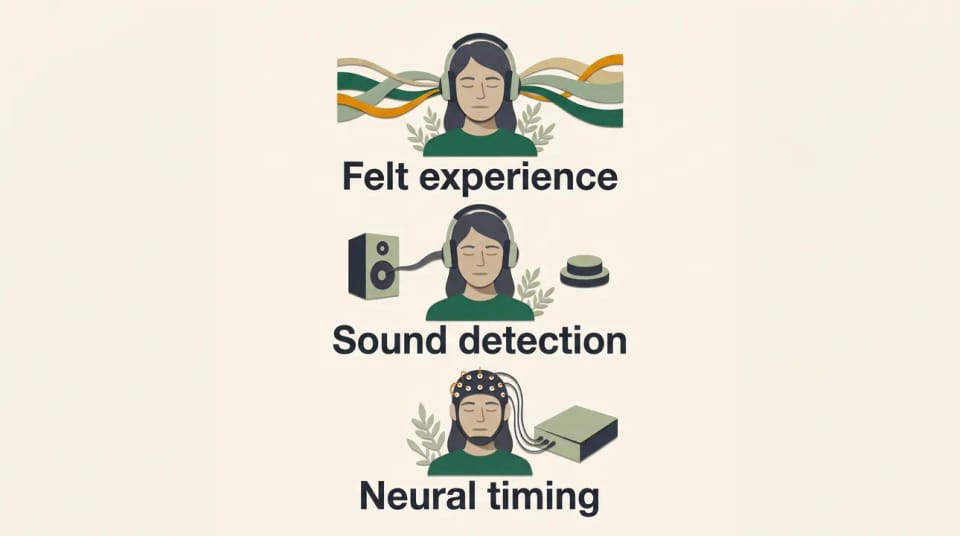
Felt experience, sound detection and neural timing are different questions. These symbols show tasks, not measured results.
Did THC improve the hearing tests?
The 2002 crossover study found no significant change in tone thresholds. Only five men completed its additional tone-in-noise task, which also showed no significant change. The design targeted threshold shifts of 10 dB or more; it cannot rule out every smaller change. Mulheran et al.
An older randomized smoking study likewise reported no significant auditory change. Its authors stressed that normal hearing and maximum starting speech scores limited its ability to test improvement. Only the original abstract was available for this comparison. Liedgren et al.
A ceiling effect means the test leaves little room to improve. If someone already scores at the maximum, an unchanged score cannot answer whether another task would change. It also does not establish a benefit for someone with hearing loss.
“Not significant” means the analysis did not establish a difference. It is not a certificate that all doses, people and listening situations are equivalent.
Does a changed brain response prove sharper hearing?
No. The 2015 IV-THC study measured EEG responses while people heard repeated clicks. The higher dose reduced consistency across trials at 40 Hz. Effects at 20 and 30 Hz were not significant. Response-power changes were also not significant after correction for multiple comparisons. Cortes-Briones et al.
That finding concerns timing across repeated brain responses. It does not mean participants heard quieter sounds, enjoyed music more or suffered permanent hearing damage. Twenty people contributed the retained EEG data after exclusions; that was not the initial enrollment count.
Our CB1 and CB2 lesson introduces receptor targets. A receptor mechanism helps frame a research question; it does not establish an improvement on a particular task.
Likewise, time feeling slower while high is a perception question. It does not prove that the ear gained finer resolution.
Can these results predict your own listening session?
They cannot provide a personal guarantee. The studies used different populations, tasks and exposures. An oral capsule, smoked cannabis and IV THC are not interchangeable experiments. The self-report study used no controlled dose at all.
Cannabis experience adds another question rather than settling the first one. Our lesson on tolerance across different effects explains why feeling familiar with a high is not a general performance test.
When reading an enhancement claim, check what changed: a rating, a test score or a brain signal. Then check who was tested and what they received. If the explanation jumps between those measures, the conclusion has outrun the evidence.
Does more vivid sound make loud listening safer?
No. Loud or prolonged sound can damage hearing even when the listener does not notice damage occurring. NIDCD recommends lowering volume, limiting exposure and using hearing protection around loud sound. A vivid music experience does not establish protection from noise. NIDCD
These experiments also do not establish cannabis as treatment for hearing loss. If hearing seems to have changed, a hearing assessment asks a more useful question than whether the music still feels good.
Key takeaways
- Feeling more absorbed in music does not establish a better hearing threshold.
- Small hearing trials reported null findings with important limits.
- An altered EEG response is not a hearing improvement score.
- Musical enjoyment does not replace noise protection or a hearing assessment.
FAQ
Can weed make you notice sounds you usually miss?
People report that experience, but noticing a detail is not proof of better tone detection. The 2025 study measured recalled experience rather than an audiogram. Original study
Did the hearing studies prove THC has no effect?
No. Small samples and limited tasks leave questions open. A nonsignificant comparison cannot establish universal equivalence.
Does a changed EEG mean your hearing got worse?
Not by itself. EEG timing and a hearing threshold are different endpoints. The 2015 experiment did not establish lasting hearing loss. Original study
Can cannabis replace a hearing aid?
The studies reviewed here do not establish that benefit. Feeling clearer sound is not the same evidence as improved hearing function in people who need hearing care.
Sources
- Mulheran M, Middleton P, Henry JA (2002). Auditory threshold and frequency resolution after THC. Human & Experimental Toxicology 21(6):289–292. DOI.
- Liedgren SR, Odkvist LM, Davis ER, Fredrickson JM (1976). Effect of marihuana on hearing. Journal of Otolaryngology 5(3):233–237. PMID 933252.
- Cortes-Briones J et al. (2015). THC and gamma-band neural oscillations. Neuropsychopharmacology 40(9):2124–2134. DOI.
- Darakjian L, Glassman H, Lo CY, Russo FA (2025). Exploring the interaction between cannabis and music. Annals of the New York Academy of Sciences 1551(1):140–158. DOI.
- NIDCD. How Do We Hear?, updated March 16, 2022; Noise-Induced Hearing Loss.





