

How to Compare Two Cannabis Strains: Start With the Lab Report, Not the Name
Compare two cannabis strains by the lab report for the batch you can buy: total THC, total terpenes, top terpenes. Lineage and effect tags are only claims.

Professor High
Written by Professor High, our AI guide. See how we research and correct articles.
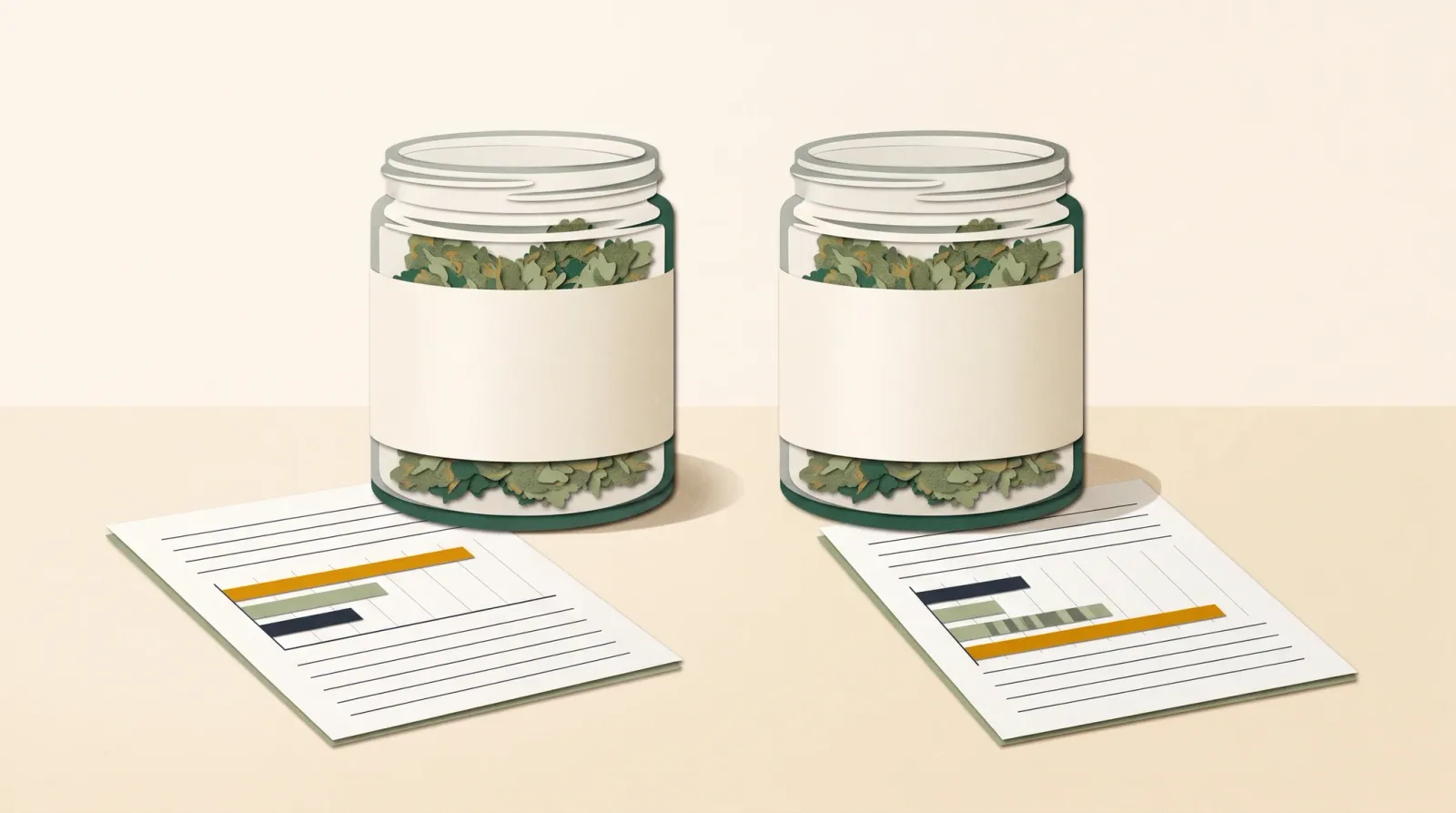
Compare two strains by the lab report for the exact batch you can buy, not by the name: line up total THC, total terpenes and the top three terpenes, treat lineage and effect tags as unverified claims, and let your own notes break the tie. The name on the jar tells you something. The batch tells you more.
Here is the example worth screenshotting. Two famous names, six public lab reports from Connecticut. Blue Dream flower from one grower tested 0.89 to 0.94 percent myrcene and no detectable terpinolene. Jack Herer flower from another grower tested 0.10 to 0.18 percent myrcene and 0.51 to 1.34 percent terpinolene. Then one “Jack Herer” mini pre-roll pack from that same Jack Herer grower tested just 0.06 percent terpinolene and 0.53 percent total terpenes. Same name, very different chemistry. (Blue Dream 3.5 g report, Jack Herer 3.5 g report, Jack Herer mini pre-roll report)
That handful of batches comes from one state and is not a rule about either strain. It is a demonstration of the method. This lesson in High School walks through that method step by step, then shows what each row of a comparison can and cannot tell you.
Lab reports and registry checked October 29, 2026.
Why doesn’t a strain name tell you enough?
A strain name carries some chemical information, but how much depends on the name. In a study of lab data for 89,923 commercial flower samples from six US states, most THC-dominant products fell into three broad terpene groups: caryophyllene-limonene, myrcene-pinene, and terpinolene-myrcene. Some names were consistent and some were not. About 96 percent of “Purple Punch” products sat in one group, while only 62.5 percent of “Tangie” products did. (Smith and colleagues, PLoS ONE, 2022)
Blue Dream was one of the steadier names in that dataset: 88.5 percent of its products landed in the myrcene-pinene group. The Connecticut reports above fit that pattern. That does not make every Blue Dream identical, and Jack Herer was not one of the names the study scored.
Other work points the same way:
- In 2,662 Nevada flower samples, three chemical types carried 396 different breeder-reported names, and the genetic groups did not line up with the chemical ones. (Reimann-Philipp and colleagues, Cannabis and Cannabinoid Research, 2020)
- Dispensary samples of 30 strains from three states showed that most strains had at least one genetic outlier sold under the same name. (Schwabe and McGlaughlin, Journal of Cannabis Research, 2019)
- A genome study of 81 marijuana samples concluded that strain names often do not reflect a meaningful genetic identity. (Sawler and colleagues, PLoS ONE, 2015)
For the plant, sampling and lab reasons behind this, see why the same strain tests differently from batch to batch.
How do you compare two strains step by step?
Work from what is measured toward what is claimed. Each step adds less certainty than the one before it.
- Pin down the exact batch. For each strain, find the product you can actually buy and its certificate of analysis (COA) for that batch. A database profile or a strain page describes the name, not your jar. If you are new to reports, start with how to read a cannabis lab report.
- Line up the measured chemistry. Copy three things from each report: total THC, total terpenes, and the top three terpenes by amount. Note which lab produced each number. Labs can report systematically different cannabinoid levels for similar products, so two reports from different labs are not a perfect head-to-head. (Jikomes and Zoorob, Scientific Reports, 2018) Our guide on how to read a terpene panel covers units, “ND” and detection limits.
- Mark lineage as a claim. Write down the parents the seller lists, then put “claimed” beside them. No baseline genotype exists for any strain, so a shopper cannot check a family tree. (Schwabe and McGlaughlin, 2019) Read what a family tree can and cannot tell you and what DNA tests found for named strains.
- Treat effect tags as reports. “Energizing” or “sleepy” on a menu is someone’s self-report, usually about a different batch. Note it, but do not score it like a lab value.
- Let your own notes break the tie. Try one at a time, on different days, with the same amount and format. Record how each batch worked for you. Your notes on the same batch are the most relevant effect data you will ever have, because your own response varies with dose, setting and tolerance.

The five steps in order. The lab sheet and your own notebook are the sharpest evidence; lineage and effect tags are fainter because they are claims you cannot check.
What does a real side-by-side look like?
Here are six flower reports and one pre-roll report for Blue Dream and Jack Herer, all registered with the Connecticut Department of Consumer Protection. Every value is percent by weight, read from the lab report itself. “ND” means not detected.
| Batch (each links to its lab report) | Lab | Total terpenes | Top three terpenes | Myrcene | Terpinolene | Total THC as printed |
|---|---|---|---|---|---|---|
| Blue Dream, 3.5 g flower | Analytics Labs CT | 2.14 | myrcene, alpha-pinene, beta-pinene | 0.89 | ND | 24.5 |
| Blue Dream, 7 g flower | Analytics Labs CT | 2.66 | myrcene, alpha-pinene, beta-pinene | 0.94 | ND | 24.4 |
| Jack Herer, 3.5 g flower | Northeast Laboratories | 1.80 | terpinolene, caryophyllene, myrcene | 0.10 | 1.16 | 20.72 |
| Jack Herer, 14 g flower | Northeast Laboratories | 2.13 | terpinolene, ocimene, caryophyllene | 0.13 | 0.83 | 21.97 |
| Jack Herer, 14 g mixed buds | Northeast Laboratories | 2.00 | terpinolene, caryophyllene, ocimene | 0.10 | 0.51 | 18.25 |
| Jack Herer, 14 g flower (2026) | Analytics Labs CT | 2.91 | terpinolene, caryophyllene, trans-ocimene | 0.18 | 1.34 | 20.1 |
| Jack Herer, mini pre-roll 5 pack | Northeast Laboratories | 0.53 | caryophyllene, humulene, terpinolene | 0.01 | 0.06 | 21.37 |
The Blue Dream rows come from one grower and the Jack Herer rows from a different grower.
What the table tells you
- The two names really did differ in these batches. Every Blue Dream flower report led with myrcene and showed no terpinolene. Every Jack Herer flower report led with terpinolene and showed little myrcene.
- The same name moved around. Jack Herer terpinolene ranged from 0.51 to 1.34 percent across four flower reports. In the mixed-buds batch, caryophyllene (0.41) and ocimene (0.38) sat close behind terpinolene (0.51), so that jar was less clearly terpinolene-led than the others.
- Format matters. The Jack Herer mini pre-roll carried roughly a fifth to a quarter of the terpenes of the flower from the same grower, and a different terpene topped its list. Pre-rolls use different material and handling, so compare flower with flower.
What the table does not tell you
- It does not rank the strains. Nothing here says one is stronger, better, more relaxing or more energizing.
- It does not compare THC fairly across the two labs. The Blue Dream numbers came from one lab and most Jack Herer numbers from another, and the two labs print their totals in different formats.
- It does not describe Blue Dream or Jack Herer everywhere. These are a few registered batches from one state.
One more lesson hides in the source. The state registry lists terpene values in its own columns, but for the mixed-buds Jack Herer batch those columns leave out terpinolene entirely, while the lab report lists it at 0.51 percent. (Connecticut Cannabis Product Registry, lab report) Always read the report, not a field copied from it.
Want to see how the site’s own strain profiles line up for this pair? Try Blue Dream vs Jack Herer in our strain comparison tool. Those profiles are general strain data, not the batch reports above, so keep the two sources apart.
Which rows are measured and which are claims?
This is the table most comparison checklists skip. It sorts each row by where its information comes from.
| Row | Where it comes from | What it lets you conclude | What it cannot tell you |
|---|---|---|---|
| Total THC | Lab report for the batch | Rough potency of this batch, best compared within one lab | How intense or pleasant it will feel for you |
| Total terpenes | Lab report for the batch | How much aroma chemistry this batch carries | Quality or effect |
| Top three terpenes | Lab report for the batch | Which chemical group the batch resembles | How the batch will feel |
| Lineage | Breeder or seller claim | A story about where the cultivar came from | Genetic identity of your jar |
| Indica, sativa, hybrid | Label or menu | Very little | Chemistry or effect |
| Effect tags and reviews | Other people’s self-reports | What some people said about some batch | What this batch will do for you |
| Your notes | You, on this batch | How this batch worked for you, once | How the next batch will work |
The indica and sativa row is weak for a reason. Samples sold as sativa and indica were genetically indistinct across the genome, and the labels tracked only a few terpenes. (Watts and colleagues, Nature Plants, 2021) A German study of 140 medicinal flowers found no statistical link between terpene profiles and the sativa, indica or hybrid label. (Herwig and colleagues, Cannabis and Cannabinoid Research, 2025) More on that in why indica and sativa labels do not predict your high.
The effect-tag row is weak for a different reason: those tags are self-reports. When researchers joined user-submitted tags for more than 800 cultivars to chemical data, terpene profiles matched how people described flavor. The effect tags formed clusters, but the design cannot show that chemistry causes an effect. (de la Fuente and colleagues, Journal of Cannabis Research, 2020) See also why crowd-sourced strain reviews are weak evidence.
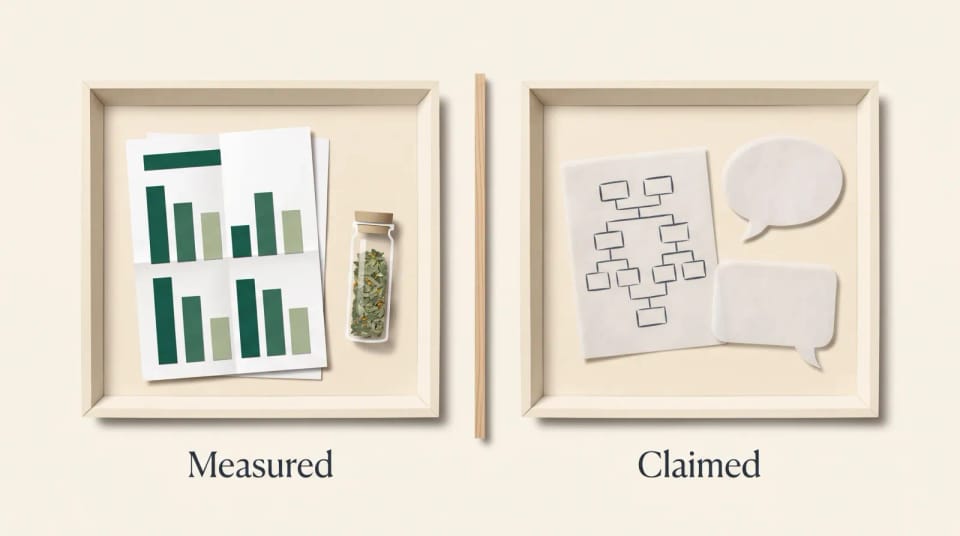
Lab values describe the batch in front of you. Lineage, labels and effect tags are claims: sometimes right, never checked for your jar.
Do terpenes decide how a strain will feel?
Not as far as the evidence can show. Terpene profile is a measured property you can compare from one report to another. Its link to how a strain feels is unproven. Keep three questions separate: what is in the flower, what reaches your body, and what you feel.
- Field data show weak, preliminary links. In a two-week study of 101 regular users, cultivars coded as indica-dominant went with slightly more low-arousal effects, and some primary terpenes went with small differences in reported effects. The terpenes and types came from database labels, not from tests of what people smoked, and the authors call the work preliminary. (Okey and colleagues, Cannabis and Cannabinoid Research, 2023)
- A controlled test found no effect. In a double-blind trial with 19 healthy adults, vaporized alpha-pinene alone did nothing compared with placebo, and it did not reduce the memory impairment caused by THC. (Kumar and colleagues, Medical Cannabis and Cannabinoids, 2025) That is one terpene at a few doses, so it does not settle the question for others.
- Receptor tests did not support the simplest entourage idea. In cell assays, five common terpenes did not act directly at CB1 or CB2 receptors or change how THC acted there, apart from a weak caryophyllene effect at CB2. (Finlay and colleagues, Frontiers in Pharmacology, 2020) Other mechanisms remain open; see what the entourage research looks at.
- Chemistry groups may track outcomes better than names. In a proof-of-concept study, 204 app users logged 6,309 sessions, and self-reported outcomes differed across chemical groups. There was no control group, and the authors frame it as a first look. (Vigil and colleagues, Journal of Cannabis Research, 2023)
So compare terpenes because they are real, measured differences between two batches, not because they predict your evening. That is also how our High Families work: a terpinolene-led batch sorts toward Energy High and a myrcene-led batch toward Relax High. That is a chemistry grouping for browsing, not a forecast of your experience. Read High Families as a way to group chemistry for the full system.
What if the shop shows no terpene numbers?
Ask the store for the COA for that batch. Some states also publish lab reports in public registries, as Connecticut does. If the report has no terpene panel, compare what you have: total THC from the same lab where possible, format and freshness.
Smell is a rough, free cue. The study of 800 cultivars found that terpene profiles matched how people described flavor. (de la Fuente and colleagues, 2020) That supports using your nose to notice a difference between two jars. It does not turn aroma into an effect prediction.
What if two strains look the same on paper?
Then the name difference matters less than it seems. Two batches with similar totals and the same top terpenes are chemically close, whatever the labels say. Choose between them on the product details: batch date, format, dose per serving and price. Our guide to comparing products beyond THC percentage covers those checks, plus recalls.
After that, your notes decide. If you use the High IQ app, its notebook is one place to log how each batch worked, so the next comparison starts from your own record instead of a stranger’s review.
When to talk to a clinician: if any strain leaves you with chest pain, a racing heart that does not settle, fainting, panic you cannot ride out, or repeated vomiting, stop using it and get medical help. Talk to a clinician before use if you are pregnant, take prescription medicines, or have a heart or mental health condition. A strain comparison is a shopping tool, not medical guidance.
Sources
- Smith CJ, Vergara D, Keegan B, Jikomes N. The phytochemical diversity of commercial Cannabis in the United States. PLoS ONE. 2022;17(5):e0267498.
- Reimann-Philipp U, et al. Cannabis chemovar nomenclature misrepresents chemical and genetic diversity. Cannabis and Cannabinoid Research. 2020;5(3):215-230.
- Schwabe AL, McGlaughlin ME. Genetic tools weed out misconceptions of strain reliability in Cannabis sativa. Journal of Cannabis Research. 2019;1(1):3.
- Sawler J, et al. The genetic structure of marijuana and hemp. PLoS ONE. 2015;10(8):e0133292.
- Watts S, et al. Cannabis labelling is associated with genetic variation in terpene synthase genes. Nature Plants. 2021;7(10):1330-1334.
- Herwig N, et al. Classification of cannabis strains based on their chemical fingerprint. Cannabis and Cannabinoid Research. 2025;10(3):409-419.
- de la Fuente A, et al. Relationship among subjective responses, flavor, and chemical composition across more than 800 commercial cannabis varieties. Journal of Cannabis Research. 2020;2(1):21.
- Okey SA, et al. An ecological examination of indica versus sativa and primary terpenes on the subjective effects of smoked cannabis. Cannabis and Cannabinoid Research. 2023;8(5):857-866.
- Kumar L, et al. The individual and interactive effects of alpha-pinene and delta-9-tetrahydrocannabinol in healthy adults. Medical Cannabis and Cannabinoids. 2025;8(1):144-157.
- Finlay DB, et al. Terpenoids from cannabis do not mediate an entourage effect by acting at cannabinoid receptors. Frontiers in Pharmacology. 2020;11:359.
- Vigil JM, et al. Systematic combinations of major cannabinoid and terpene contents in Cannabis flower and patient outcomes. Journal of Cannabis Research. 2023;5(1):4.
- Jikomes N, Zoorob M. The cannabinoid content of legal cannabis in Washington State varies systematically across testing facilities and popular consumer products. Scientific Reports. 2018;8(1):4519.
- Connecticut Department of Consumer Protection. Cannabis Product Registry. Accessed October 29, 2026. Batch lab reports are linked in the comparison table above.
Key takeaways
- Compare the lab report for the batch you can buy, not the strain name.
- Line up total THC, total terpenes and the top three terpenes, and note which lab tested each.
- Lineage, indica or sativa labels, and effect tags are claims, not measurements.
- In six Connecticut flower reports, Blue Dream led with myrcene and Jack Herer led with terpinolene, but Jack Herer’s terpinolene still ranged from 0.51 to 1.34 percent.
- Terpenes are real, comparable chemistry; their effect on how you feel is unproven.
- Your own notes on a batch break the tie.
FAQ
Should I pick the strain with the higher THC?
Not by THC alone. Total THC tells you rough potency for one batch, and numbers from different labs are not directly comparable because labs report systematically different levels. Treat THC as one row among several, and start low with any new batch.
Can two products with the same strain name be different?
Yes. In the Connecticut reports above, four Jack Herer flower batches from one grower ranged from 0.51 to 1.34 percent terpinolene, and a Jack Herer pre-roll had far fewer terpenes. Large datasets show the same thing: some names are consistent and others are not.
Is indica or sativa a useful way to compare strains?
Not really. Genetic studies found that samples labeled indica and sativa were indistinct across the genome, and a study of 140 medicinal flowers found no link between terpene profiles and those labels. The terpene panel on the lab report is the more informative row.
Does lineage tell me how a strain will feel?
No. Lineage is a breeder or seller claim, and genetic testing has found that samples sold under one name can differ. Even a verified family tree would not predict your response, which depends on the batch, the dose and you.



