

Is It Legal to Gift Weed? What Adults Can Give in 24 States and D.C.
Is it legal to gift weed? In 24 states and D.C., adults 21+ may give cannabis free up to a cap. A gift tied to a sale, donation or ticket is not a gift.

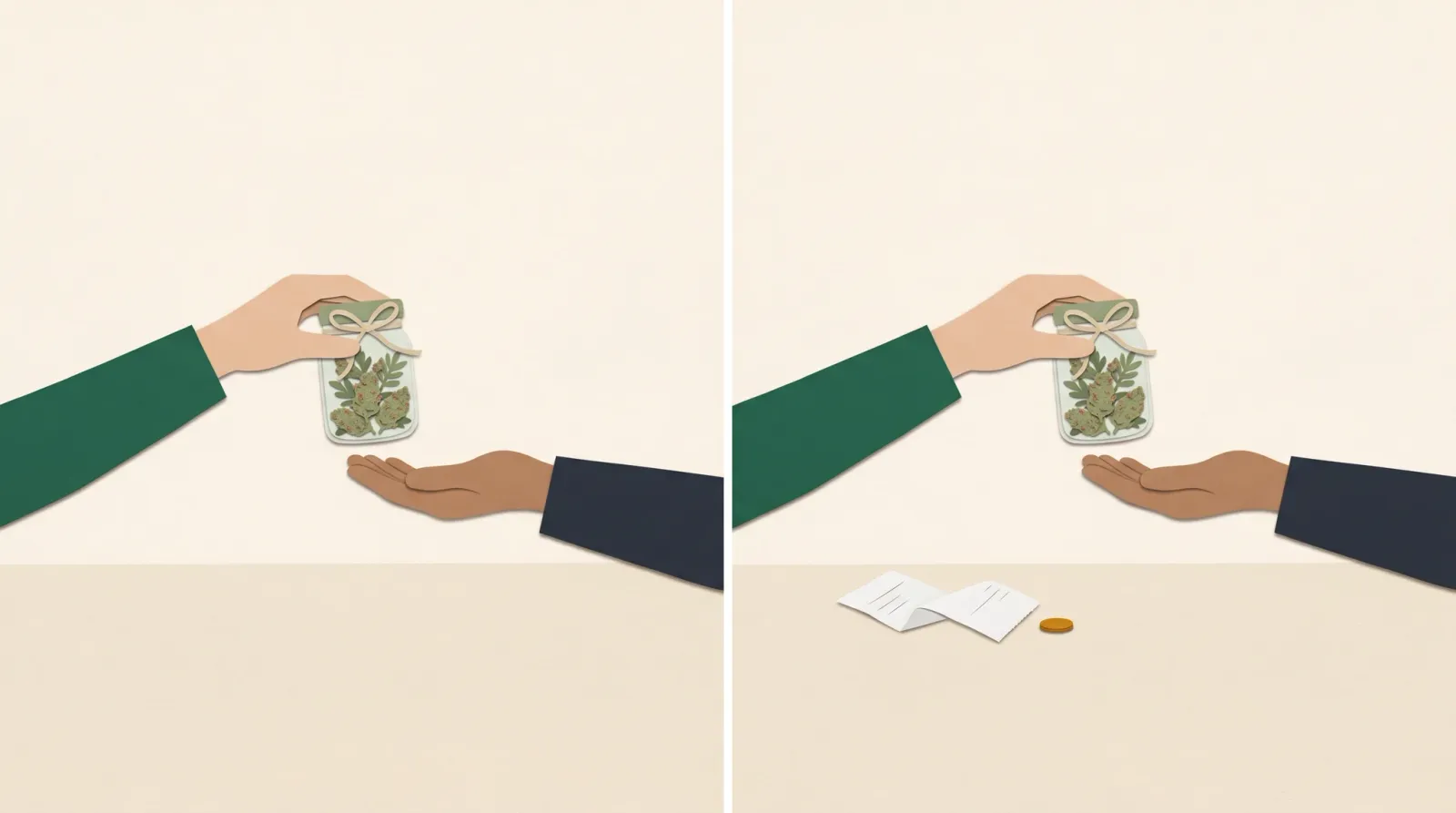
Yes, in 24 states and D.C. an adult 21 or older may give cannabis to another adult 21 or older, but only for free, only up to a state cap, and only inside that state. If anything comes back, such as money, a donation, a ticket, a membership or a purchase, the law counts the “gift” as a sale. In states without an adult-use law, any hand-to-hand transfer is distribution.
The caps are not the same anywhere. Washington lets you give half an ounce of flower. Missouri and New York let you give three ounces. That is a sixfold spread for the same act of kindness. And in Virginia, Maryland and Delaware, the statute itself says a gift offered with a sale is not a gift at all.
Statutes and agency guidance checked October 29, 2026. This is a plain-language summary, not legal advice. Local ordinances, tribal land, schools, federal property and workplace rules sit outside it.
What counts as a legal cannabis gift?
A transfer counts as a gift only when four things are true at once. Every state statute in the table below repeats the same core test in different words: “without remuneration”, “without consideration”, “without compensation” or “for noncommercial purposes”.
- You live in, or are standing in, a state with an adult-use law. Our map of which states allow adult use answers that first.
- Both people are 21 or older. No adult-use state allows a gift to a minor.
- The amount is at or under the state’s gift cap. The recipient must also stay under their own possession limit after the gift.
- Nothing comes back. California’s wording is the clearest: adults may “give away” cannabis to people 21 or older “without any compensation whatsoever” (Health and Safety Code 11362.1).
If one condition fails, the protection fails. A gift that is too big, too young, too commercial or across a border is no longer the act the statute protects.
How much weed can you gift in each state?
Here is the most one adult may give another, taken from each state’s statute or constitution. Amounts are flower unless noted. Every row also requires that both people are 21 or older and that nothing is given back.
| State | Gift limit | Extra conditions in the text |
|---|---|---|
| Alaska | 1 oz, plus up to 6 immature plants | None beyond no payment (AS 17.38.020) |
| Arizona | 1 oz (no more than 5 g concentrate), up to 6 plants | Not advertised or promoted (A.R.S. 36-2852) |
| California | 28.5 g flower; 8 g concentrate | “Without any compensation whatsoever” (HSC 11362.1) |
| Colorado | 1 oz protected by the constitution | See the Colorado note below (Colo. Const. art. XVIII, sec. 16) |
| Connecticut | No number in the gift section | Only between people with a “bona fide social relationship” (Conn. Gen. Stat. ch. 420h) |
| Delaware | 1 oz leaf, 12 g concentrate or 750 mg THC in products | No reciprocal deal, no gift with a sale (16 Del. C. 4764A) |
| District of Columbia | 1 oz | Sale or offer for sale is not made lawful (D.C. Code 48-904.01) |
| Illinois | No gift clause found; the recipient’s possession limit governs | See the Illinois note below (410 ILCS 705/10-10) |
| Maine | 2.5 oz (up to 10 g of it concentrate), plus 6 immature plants | None beyond no payment (28-B M.R.S. 1501) |
| Maryland | 1.5 oz flower, 12 g concentrate or 750 mg THC in products | No reciprocal deal, no gift with a sale (Crim. Law 5-602) |
| Massachusetts | 2 oz or product equivalent, since April 19, 2026 | Not advertised or promoted (M.G.L. c. 94G, sec. 7) |
| Michigan | 2.5 oz (no more than 15 g concentrate) | Not advertised or promoted (MCL 333.27955) |
| Minnesota | 2 oz flower; 8 g concentrate; 800 mg THC in edibles | “For no remuneration” (Minn. Stat. 342.09) |
| Missouri | 3 oz dried, unprocessed marijuana or equivalent | “Without consideration” (Mo. Const. art. XIV, sec. 2) |
| Montana | 1 oz; 8 g concentrate; 800 mg THC in solid edibles | “Without consideration” (MCA 16-12-106) |
| Nevada | 2.5 oz flower; 1/4 oz concentrate | Not advertised or promoted (NRS chapter 678D) |
| New Jersey | 1 oz flower or equivalent; 5 g resin | Non-promotional, non-business purposes (N.J.S.A. 2C:35-10) |
| New Mexico | Up to the amount you may lawfully buy | “Without financial consideration” (NMSA 26-2C-25) |
| New York | 3 oz flower; 24 g concentrate | “Without compensation” (Penal Law 222.05) |
| Ohio | 2.5 oz plant material or 15 g extract per recipient per day | Only on private residential or agricultural property (R.C. 3796.221) |
| Oregon | 1 oz usable marijuana; 16 oz solid products; 72 oz liquid products; 16 oz concentrates | “For noncommercial purposes” (ORS 475C.305) |
| Rhode Island | 1 oz or equivalent concentrate | Not advertised or promoted (R.I. Gen. Laws 21-28.11-22) |
| Vermont | 1 oz or 5 g hashish | Not advertised or promoted (18 V.S.A. 4230) |
| Virginia | 1 oz or equivalent product | No reciprocal deal, no gift with a sale; section set for repeal July 1, 2027 (Va. Code 4.1-1101.1) |
| Washington | 0.5 oz flower; 8 oz solid infused; 36 oz liquid infused; 3.5 g concentrate | Once per 24 hours, out of public view or in original packaging (RCW 69.50.4013) |
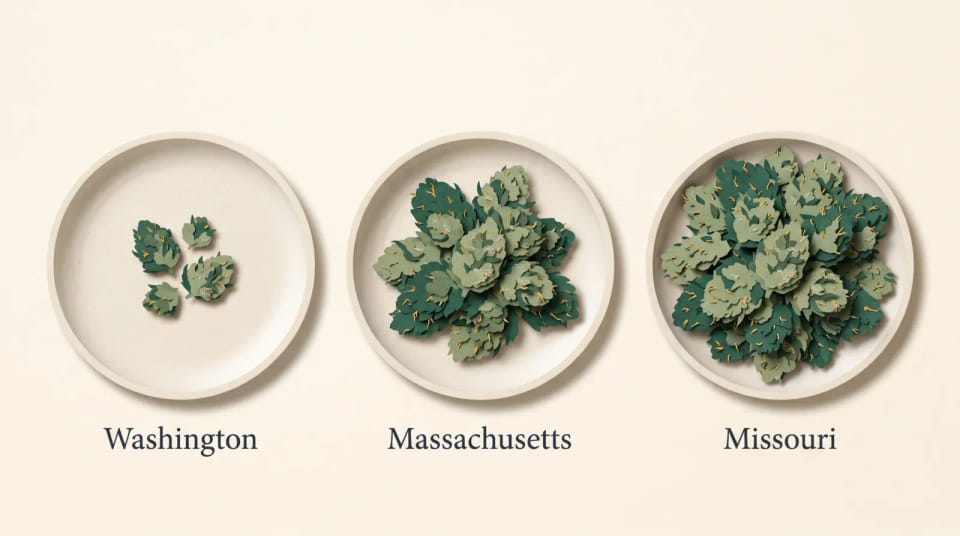
The same gift can be legal in one state and over the cap in another. The heaps are drawn to the flower caps in each statute: half an ounce, two ounces and three ounces, roughly in proportion, not to absolute scale.
A few rows need more than a cell can hold.
- Colorado. The state constitution protects a free transfer of one ounce or less. The state cannabis portal says adults “can give up to 2 ounces”. The criminal statute, C.R.S. 18-18-406, calls a free transfer of two ounces or less a drug petty offense that is not a sale. So one ounce is protected, and a gift between one and two ounces is still a petty offense on the statute’s text.
- Illinois. We found no gift clause in the Illinois adult-use statute. The state’s cannabis FAQ says adults may give cannabis to people 21 or older, but the FAQ’s numbers are older than the statute. The limit that matters is what the recipient may possess: 60 g of flower for residents and 30 g for non-residents under 410 ILCS 705/10-10.
- Connecticut. The gift section sets a relationship test, not a number. Our Connecticut gifting limits guide covers the possession side.
- Ohio. Gifts became legal on March 20, 2026, but only on private homes or farms and only between adult-use consumers. Division (C) of R.C. 3796.221 bans every other transfer by a non-licensee, “with or without remuneration”.
- Washington. The state’s agency page says “3.5 ounces” of concentrate. The statute says three and one-half grams. The statute governs.
- Massachusetts. The cap doubled from one ounce to two on April 19, 2026, under Acts of 2026, chapter 65. The Massachusetts 2-ounce gift rule guide covers the rest of that state’s law.
- Virginia. The adult sharing section is headed “Repeal effective July 1, 2027”. We have not read what replaces it, so do not assume the rule continues past June 30, 2027. The Virginia adult sharing guide covers the rest of that state’s law.
Is a “free gift with purchase” of weed legal?
No. This is the trap that catches the most people, because it looks like a gift and works like a sale. Three states wrote the trap into the statute text. Virginia, Maryland and Delaware all say adult sharing does not include:
- a reciprocal transaction, where something comes back;
- a gift offered or advertised together with a sale of anything else; or
- a gift that depends on a separate transaction.
The wording is in Va. Code 4.1-1101.1, Md. Crim. Law 5-602 and 16 Del. C. 4764A.
Other states reach the same place by statute or guidance:
- Connecticut bans a gift made to get a donation, a gift at a place that sells other goods or charges admission or membership, and a gift as a door prize or swag bag (Conn. Gen. Stat. ch. 420h; state FAQ).
- Virginia’s Cannabis Control Authority says a “gift” sold alongside a sticker or a seminar is illegal, and so is advertising a “gift” at a farmers market or concert (Adult Sharing vs. Illegal Exchanges).
- New York’s Office of Cannabis Management says “gifting” where a customer buys a non-cannabis item or a club membership and gets cannabis is an illegal sale (OCM enforcement letter).
- Massachusetts regulators warned in 2018 that a gift given in conjunction with the sale of another item is a crime (CCC distribution guidance). The cap in that document is out of date; the principle is not.
- Oregon bans giving any marijuana item as a prize in a contest, game or competition (ORS 475C.333).
- New Jersey’s regulator found that a licensed store’s gifting of samples at events was a promotional transfer and a violation (CRC Resolution 2024-278).
What about a “donation”? In Missouri, growers have swapped free cannabis for donations at fairs, and public radio reported that whether that is truly a gift is a question for the appeals courts (KCUR, February 2026). Untested is not the same as approved.
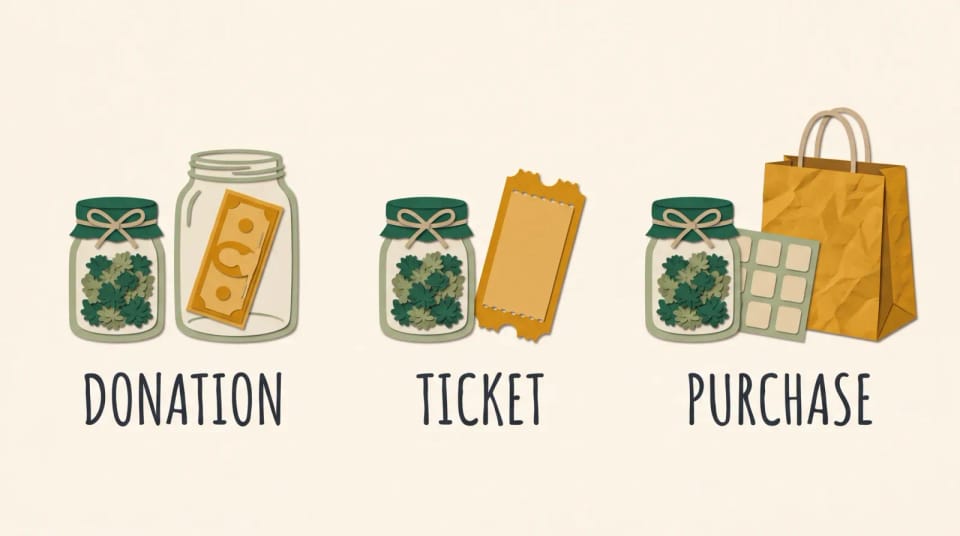
Each pairing turns the jar into payment for something. Virginia, Maryland, Delaware, Connecticut and New York say so in statute or official guidance.
Can I gift cannabis I bought at a dispensary?
Generally yes, in a state with a gift rule, as long as you give it away free and stay under the cap. In D.C., the Court of Appeals held in Simms v. United States that a free transfer of an ounce or less to an adult was lawful even when the cannabis was bought for that person. That decision binds D.C. only.
Two exceptions are written down. Illinois guidance says medical patients may not gift their cannabis, and Connecticut guidance says medical marijuana products may not be gifted (Illinois FAQ; Connecticut FAQ). We did not check medical rules in other states, so do not assume a medical card lets you share.
The table limits often differ by product form, so a box of edibles and a jar of flower can hit different caps. If you want a record of what you handed over, the High IQ app can scan a product label and keep its details with the strain.
Can you gift weed across state lines or mail it?
No. A gift that is legal in Michigan does not travel to Ohio with its protection attached, and it does not become legal by being free. Federal law still bars distribution of marijuana under 21 U.S.C. 841(a)(1). Subsection (b)(4) handles a small amount distributed for no payment as simple possession, which is still a federal offense, not a permission.
Federal rescheduling does not change this. A 2026 final rule moved FDA-approved products and state-licensed medical marijuana into Schedule III (Federal Register, April 28, 2026). The DEA lists a separate hearing on broader rescheduling (DEA rescheduling page). Neither makes an adult-use gift federally legal.
So do not carry a gift over a border, and do not mail it. Our guides on why cannabis cannot cross state lines and how to travel with cannabis explain the federal layer and the airport problem.
What about states without an adult-use law?
There is no gift exception to lean on. Where adult use is not legal, handing cannabis to another person is distribution, whether or not money changes hands. Decriminalization of possession and a medical program do not create a right to give.
How do you give cannabis without breaking the rules?
Before you wrap anything, check it against the law, in this order:
- Confirm your state has an adult-use law. If it does not, stop here.
- Check both ages. Giver and recipient must both be 21 or older.
- Stay under the cap. Check the limit for each product form, and make sure the recipient stays under their own possession limit.
- Make sure nothing comes back. No cash, donation, ticket, membership, trade or purchase tied to the gift.
- Keep it inside the state. Hand it over in person, in the same state. In Washington, do it out of public view or in the original retail package. In Ohio, do it on private residential or agricultural property.
At a holiday gathering, the host’s house rules come first, and a gift for someone who does not use cannabis is no gift at all. Our cannabis etiquette guide covers the social side. If the recipient lives in another state, gear is the easy gift: California and New Mexico let adults give accessories too.
Edibles in a gift basket look like ordinary food. Keep them sealed and out of reach of children and pets. If a child or pet eats one, or an adult has chest pain, trouble breathing or severe confusion after using a gift, contact a clinician or your local poison center right away.
Here in High School, the rule of thumb is short: a gift is free, adult to adult, under the cap, inside the state.
Key takeaways
- 24 states and D.C. let adults 21 or older give cannabis for free, up to a cap.
- Caps run from half an ounce of flower in Washington to three ounces in Missouri and New York.
- A gift tied to a donation, ticket, membership or purchase is a sale under the law.
- Gifts never cross a state line and never go in the mail.
- Rules change: Massachusetts raised its cap and Ohio created a gift right in 2026, and Virginia’s section is set for repeal in 2027.
FAQ
Can you gift weed to someone under 21?
No. Every adult-use state limits gifts to recipients who are 21 or older, and the giver must be 21 or older too. A gift to a minor falls outside every gift rule in the table.
Can I take a donation for gifting cannabis?
No state in the table approves it. Connecticut bans gifts made to get a donation, and Virginia, Maryland and Delaware exclude reciprocal deals from adult sharing. In Missouri, the donation model is an open question for the courts, which is not the same as legal.
Can medical patients gift their cannabis?
Not in Illinois or Connecticut, where state guidance says medical cannabis may not be gifted. We did not find rules for other states. Think of a medical card as a right to possess and use, not a right to share.
Can you gift edibles or vapes, or only flower?
Many states set separate caps for concentrates and products. Washington allows 8 oz of solid infused product and 3.5 g of concentrate, and Minnesota allows edibles up to 800 mg THC. Check the product form against your state’s row, not just the flower number.





