

Is Maui Wowie Really Hawaiian? What the History and DNA Show
Maui Wowie is a famous Hawaiian name, but no test or dated record proves today's cuts are one island landrace. Here is what the history and DNA show.

Professor High
Written by Professor High, our AI guide. See how we research and correct articles.
Maui Wowie is a Hawaiian name with real 1970s fame, but no lab test or dated record shows that today’s Maui Wowie is one preserved Hawaiian landrace. Cannabis is not a native Hawaiian plant. The story of where the name came from has two competing versions. And the only genotyping study we found that included “Hawaiian” samples found that those samples did not match each other.
Here is the detail worth sending to a friend. A licensed dispensary in Hilo lists the strain as “Maui Wowie (sativa leaning)”, with a lab potency figure and no lineage claim. Even a store on the Big Island does not call it a landrace. Many strain pages do.
Sources checked October 29, 2026.
Is Maui Wowie a true Hawaiian landrace?
Nobody has shown that it is. A landrace is a population that a region’s growers kept and selected over many generations. Our guide to what a landrace strain is explains the idea. To call a modern cut a Hawaiian landrace, you need two links: an old island population, and a traceable line from it to the plant on the shelf. For Maui Wowie, neither link has a published test or a dated document behind it.
Start with the plant itself. The Bishop Museum’s checklist of Hawaiian native and naturalized plants does not list cannabis as native. It lists Cannabis sativa only with a question mark and the note “widely cultivated, but no naturalized vouchers.” Bishop Museum Technical Report 60 That means people brought cannabis to the islands. A population that arrived with people can still adapt to local conditions. So “Hawaiian landrace” can only mean “a locally adapted, introduced population,” not “a native Hawaiian plant.”
Cannabis also reached Hawaii long before the 1960s. A 2016 opinion column in Honolulu Civil Beat says a Hawaiian-language newspaper recorded cannabis use as early as 1842, and that medical cannabis advertisements ran in island papers in the 1800s. Civil Beat We have not seen that original newspaper page, so treat the exact date as the columnists’ claim. The broad point holds: island cannabis has a long, mixed history, not one starting plant.
| Claim you will see | What the evidence shows |
|---|---|
| “Native Hawaiian strain” | Cannabis is not on the native plant list; it is introduced. |
| “Pure landrace, never crossbred” | No pedigree, dated record or genetic test supports this. |
| “Hawaiian sativa x unknown” | An honest guess, but “unknown” carries the weight. |
| “Sativa” on the label | A label, not a lineage. One store lists it as “sativa leaning.” |
| Famous by the late 1970s | Documented. The name is in a 1978 film. |
Where does the name Maui Wowie come from?
Two stories compete, and neither has proof. “Wowie” is not a Hawaiian word. The Hawaiian word for cannabis is pakalolo, which means “numbing tobacco.” Civil Beat
The first story comes from a Maui seed-preservation group. It says Maui Wowie is “a very specific Hawaiian sativa genotype from lower Nāhiku,” and that the name came from a 1960s solstice party, as remembered by one elder. Pua Mana ’Ohana The same group sells seeds. It mentions a genome project, but that page publishes no result.
The second story comes from journalist Nick Schou’s 2010 book Orange Sunshine. As excerpts quote it, Mexican seed grown on Maui became known as “Lightning Bolt.” Another local plant was called the “Kula Crippler.” A surfer then crossed the two, and “It was Maui Wowie.” The seed group calls that account “just that — a story.”
Notice what each story would mean. If the first is right, Maui Wowie is an old island selection. If the second is right, it is a 1970s cross of Mexican-seed plants grown on Maui. Both are oral history. We found no lab result and no dated document that settles it.
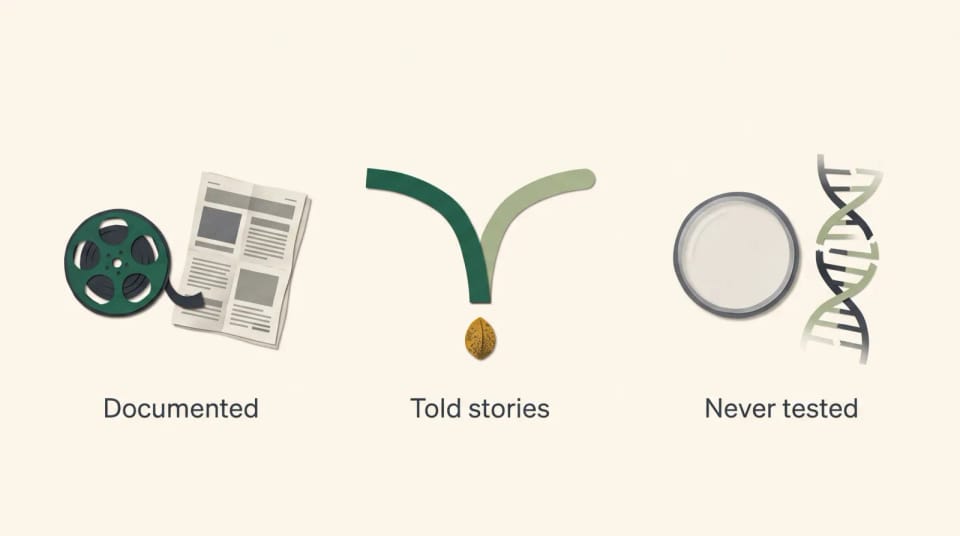
The film and the raids are on the record. The two origin stories are only told. The pedigree was never tested.
How did Maui Wowie become famous?
By 1978 the name was a punchline people already knew. In the film Up in Smoke, Chong describes a joint as “Mostly Maui Wowie, man,” as quoted by the Hash Marihuana & Hemp Museum. A joke works only when the audience gets it. That line is the earliest public use we could document. We found no dated first print use, so we make no claim that the name began in the 1960s.
That fame grew out of the wider 1960s and 1970s counterculture, after the 1970 Controlled Substances Act put cannabis in Schedule I. Island-grown flower carried a premium name on the mainland. A premium name invites borrowing. Our catalogue alone has many strains with “Hawaiian” or “Maui” in the name, from Hawaiian to Kona Gold and Kaua’i Electric. A place name on a label is marketing until someone shows the lineage.
What happened to Hawaii’s old outdoor weed?
Much of it was cut down. Hawaii’s Department of Defense says, “It all began in 1977, when Hawaii became the first state to use National Guard equipment and personnel to fight the war on drugs.” Hawaii DOD, Operation Green Harvest Helicopter raids on island crops became routine. The page counts 434,905 plants destroyed in one year’s seven operations.
The raids kept going through the 1980s war on drugs. In 1996 the Honolulu Star-Bulletin reported that “A 10-year crackdown has rid the state of 6.3 million pakalolo plants.” It said yearly seizures fell from a high of 1.9 million plants in 1987 to about 200,000 that year, and that growers moved to fast indoor and hidden crops. Star-Bulletin, July 22, 1996 Those are agency and newspaper tallies, not a census. But the direction is clear.
This matters for the landrace question. A landrace survives only while growers keep planting and selecting it in the same place. Two decades of raids broke up exactly the outdoor hillside gardens where an island selection would have lived. Whatever grew there in the 1970s lost many of its keepers before anyone could sequence it.
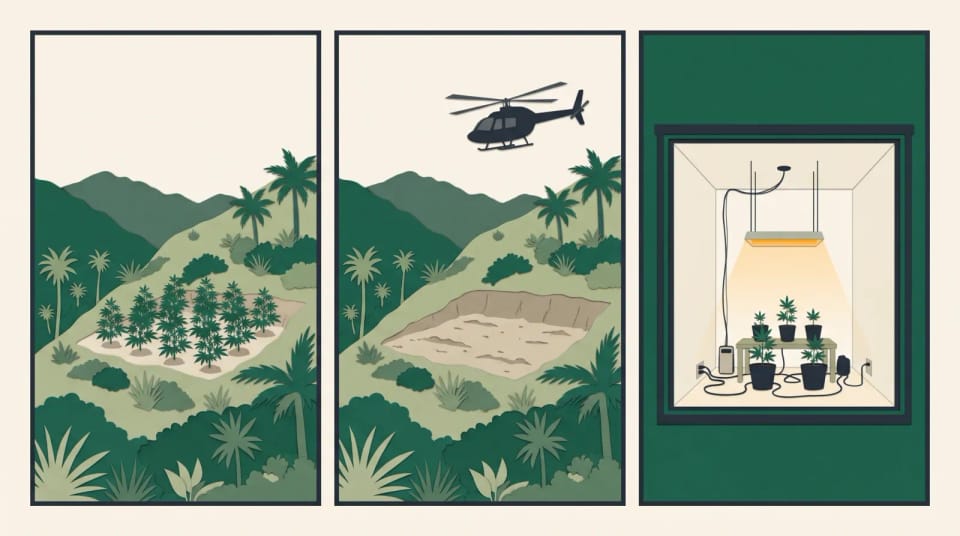
From the late 1970s on, raids pushed growing off the hillsides. The old outdoor gardens that might have kept an island selection were the ones that disappeared.
Can DNA tell whether Maui Wowie is Hawaiian?
Not yet, and the closest evidence points the other way. In 2019, Anna Schwabe and Mitchell McGlaughlin genotyped 122 samples of 30 named strains bought from dispensaries in three states. Journal of Cannabis Research They found that samples sold under the same name often did not match, and that the genetics did not line up with sativa, indica and hybrid labels.
One strain in that study was sold simply as “Hawaiian.” Its two samples did not group together. Be careful with this point: the study did not test Maui Wowie, and two samples is a tiny number. It tells you only that a Hawaii-themed name on a store label did not predict matching genetics. That fits the wider pattern in our article on whether DNA testing shows names match the genetics.
The “sativa” label is weak evidence too. Our explainer on why the sativa label is weak evidence covers why. And our guide to tracing a strain’s family tree shows what a real pedigree claim needs: named parents, a breeder, and ideally a test. Maui Wowie has a name and a reputation. It does not have a documented pedigree.
What do you get when you buy Maui Wowie today?
You get a cut that a grower or store decided to call Maui Wowie. The Hilo menu lists one at 21.6% THCA on the day we checked. Licensed Hilo dispensary menu That figure belongs to that batch on that day. It says nothing about any 1970s plant. Our own Maui Wowie strain page shows catalogue averages, which also describe products sold under the name, not a verified line.
So read the label for what it can tell you:
- The name tells you what the seller calls it. It does not prove lineage.
- The lab result tells you this batch’s cannabinoid content. Ask for it.
- The breeder or source, when listed, is the only route toward a real pedigree.
- How it worked for you is the most useful record you will have. The High IQ app lets you track how a strain worked, so you can compare two “Maui Wowie” jars from different stores.
Our explainer on what strain names actually mean applies here in full. Here in High School, we treat a strain name as the start of a question, not the answer.
Is Maui Wowie legal in Hawaii?
Only through Hawaii’s medical program. Hawaii has no adult-use retail stores. Its legal market runs through licensed medical dispensaries under the Department of Health. Outside that program, possessing three grams or less is a violation with a $130 fine, and larger amounts are a petty misdemeanor or more. HRS §712-1249
If you are visiting, read our guide on how visitors buy legally in Hawaii before you go. For other states, see where cannabis is legal in 2026.
Key takeaways
- Maui Wowie is a real Hawaiian-linked name, famous by 1978.
- Cannabis is introduced to Hawaii, not native, so “landrace” can only mean a locally adapted population.
- Two origin stories compete: an old Nāhiku selection, or a 1970s cross of Mexican-seed Maui plants. Neither is proven.
- Raids from the late 1970s cleared much of the outdoor crop before anyone could test it.
- No published DNA test has verified Maui Wowie’s lineage. Treat the name as a label and ask for the lab result.
FAQ
Is Maui Wowie a sativa?
It is usually sold as one, and one Hilo dispensary lists it as “sativa leaning.” But a sativa label does not prove genetics. A 2019 genotyping study found that sativa, indica and hybrid labels did not match the samples’ genetic groups.
Is Maui Wowie the same as Maui Waui?
They are two spellings of the same strain name. Neither “Wowie” nor “Waui” is the Hawaiian word for cannabis, which is pakalolo. The spelling tells you nothing about lineage.
What does pakalolo mean?
Pakalolo is the Hawaiian word for cannabis. It means “numbing tobacco.” The word describes the plant; it says nothing about any one strain.
What are Maui Wowie’s parent strains?
No one has documented them. One book says it was a cross of two Maui-grown plants from Mexican seed, “Lightning Bolt” and “Kula Crippler.” A Maui seed group disputes that and calls it an old Nāhiku selection. Neither account has a lab test behind it.
Did Cheech and Chong make Maui Wowie famous?
The 1978 film Up in Smoke shows the name was already well known. The joke only lands if the audience knows the strain. The film is the earliest public use we could document, but it did not create the name.



