

Lemon Strains Explained: Two Lemon Skunks and the Names Built on Them
Most lemon strains list Lemon Skunk as a parent, but two breeders made two Lemon Skunks, and the citrus smell may not come from limonene.

Professor High
Written by Professor High, our AI guide. See how we research and correct articles.
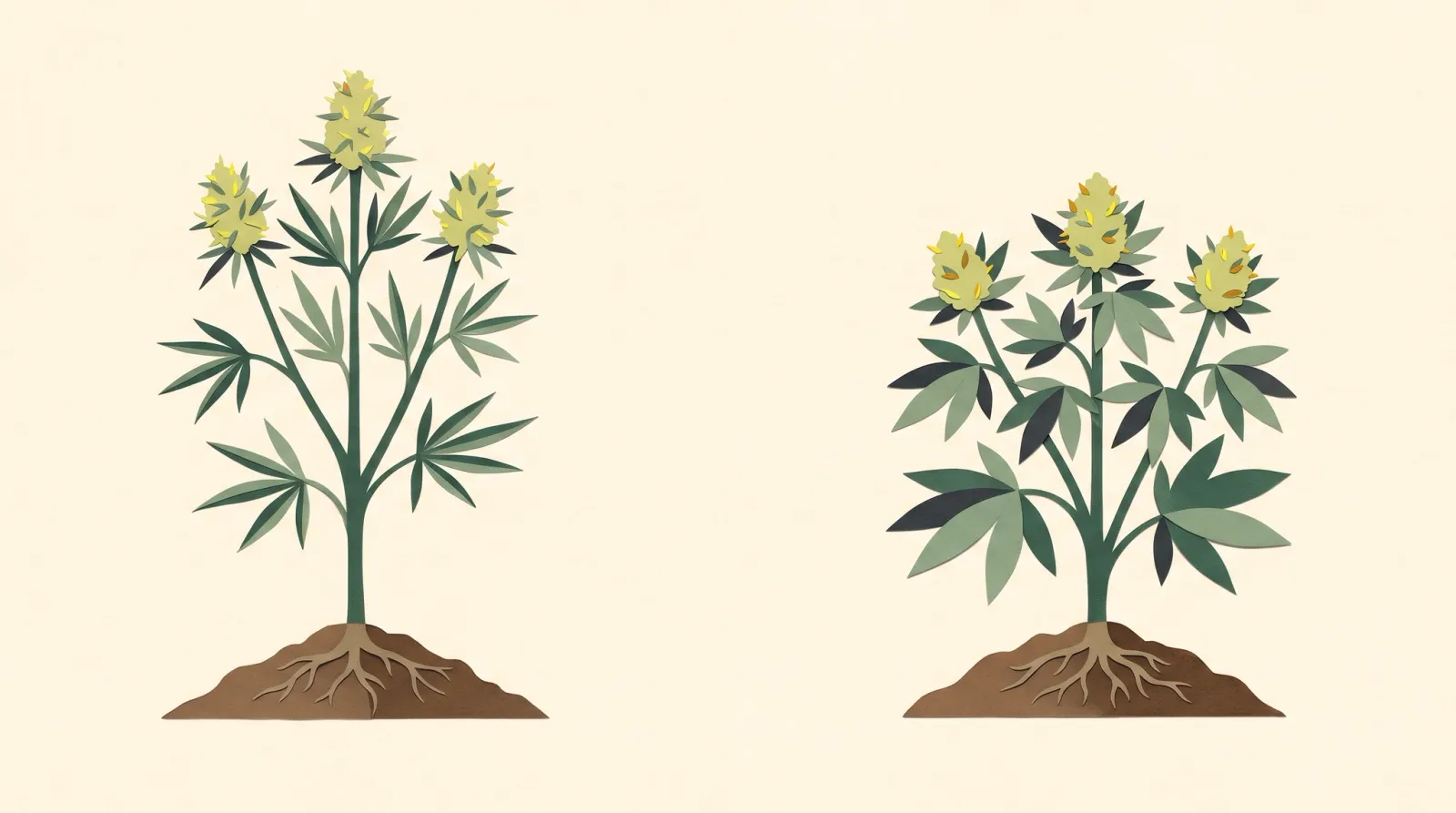
Most of the best-known lemon strains list Lemon Skunk as a parent, including Lemon Haze, Super Lemon Haze, Lemon OG, Lemon OG Haze, Lemon Tree and Lemon Meringue, but two different breeders made two different Lemon Skunks, some “lemon” strains list no Lemon Skunk at all, and no genetic test of a lemon-named strain turned up in our search. So “lemon” in a name is a family hint at best and an aroma label at worst.
Here is the version you can screenshot. There are two Lemon Skunks. DNA Genetics describes a lemon-leaning Skunk mother kept in Las Vegas “for over 20 years” crossed with a Skunk father picked in Holland (breeder text on a strain genealogy database). Green House Seeds’ Lemon Skunk is listed as a Skunk crossed with a line called Citral (genealogy database). A menu that says “Lemon Skunk x Super Silver Haze” almost never tells you which one.
And the smell has its own twist. In a 2023 study of 31 cannabis varieties, terpene profiles looked “remarkably similar” across varieties with very different aromas, and a class of sulfur compounds, not limonene, drove the citrus note in some samples (Oswald et al., 2023).
One warning first. Every parent pair below is a claim by a breeder, a seed shop, a nursery or a database. This High School lesson sorts those claims, shows where they disagree, and marks which parts rest on evidence.
Sources checked October 29, 2026.
Are all lemon strains related?
No. Many share a listed parent, Lemon Skunk, but that parent comes in two versions, and several lemon names do not list it at all. The table sorts the common lemon names by what their listings say, from strongest record to weakest.
| Strain | Listed parents | Which Lemon Skunk? | How strong is the record? |
|---|---|---|---|
| Lemon Skunk (DNA Genetics) | Las Vegas lemon Skunk mother x Holland-picked Skunk father | It is one of the two | Breeder text, quoted on a database |
| Lemon Skunk (Green House) | Skunk x Citral | It is one of the two | Database tree only |
| Super Lemon Haze | Lemon Skunk x Super Silver Haze | Not stated by the breeder | Breeder shop page |
| Lemon OG Haze | (Las Vegas Lemon Skunk x OG Kush) x Haze | The Las Vegas line | Breeder text, quoted on a database |
| Lemon Haze | Lemon Skunk x Silver Haze, or x Super Silver Haze | Not stated | Many breeders, no agreed original |
| Lemon Tree | Lemon Skunk x Sour Diesel | A database picks DNA Genetics’ | Database and nursery; breeder disputed |
| Lemon OG | Lemon Skunk x OG Kush | Not stated | Database listing; breeder disputed |
| Lemon Meringue | Lemon Skunk x Cookies and Cream | Not stated | Unsourced listing |
| Lemon Cherry Gelato | Sunset Sherbet x Girl Scout Cookies | None listed | Contested third parent |
If you want the theory behind this, our lesson on what strain names actually mean covers lineage names versus sensory names. Lemon is a case where one word does both jobs.
What is Lemon Skunk a cross of?
It depends on whose Lemon Skunk you mean. Both versions descend from Skunk-type plants, and the Skunk #1 family story explains where those came from.
DNA Genetics’ version. The breeder calls it “a cross hatch between two Skunks”. The mother is “a Lemon Mother, which has been kept in Vegas for over 20 years”, and the father was “hand picked here in Holland”. The breeder says it then selected plants for the lemon smell (breeder text on a genealogy database). That selection step is classic phenotype hunting: growing many seeds and keeping the one that smells right.
One wrinkle: DNA Genetics’ own Lemon Haze page calls Lemon Skunk “a phenotype of the classic Skunk #1”, which is a different description from the two-Skunk cross (DNA Genetics). Same company, two framings. We flag it; we cannot resolve it.
Green House Seeds’ version. A genealogy database lists it as Original Skunk x Citral, with Citral marked as an Indica “[Probably Pakistan (Chitral)]”. The same page lists 15 strains bred from it, including Green House’s Super Lemon Haze (genealogy database). This is a database tree, not a statement we opened on Green House’s own site. Do not read “Citral” as a chemistry claim. We found no record that the name says anything about what the plant contains.
Is Lemon Haze the same as Super Lemon Haze?
Not exactly. Super Lemon Haze is one breeder’s product. Lemon Haze is a name many breeders use.
Green House Seed Company’s shop page lists Super Lemon Haze as “Lemon Skunk x Super Silver Haze” (Green House shop page). The page does not say which Lemon Skunk. A database tree fills that gap with Green House’s own Lemon Skunk, which makes sense but is the database’s choice (database tree).
Lemon Haze is looser. One genealogy database indexes seven breeders selling a strain called Lemon Haze (database index). A nursery’s strain page says the standard cross is Lemon Skunk x Silver Haze and that “there is no single original breeder for the standard cross” (nursery strain page). DNA Genetics’ page instead lists Lemon Skunk x Super Silver Haze, the same parents as Super Lemon Haze (DNA Genetics).
So two jars, one labelled Lemon Haze and one labelled Super Lemon Haze, might share parents, or might not. The breeder’s name tells you more than the strain name.
Is Lemon OG from Lemon Skunk?
Its listings say so, but who made it is disputed. A strain database lists Lemon OG as Lemon Skunk x OG Kush and credits DNA Genetics, with no breeder statement cited (strain database). A site selling under the Lemon OG name says the strain “wasn’t created by DNA Genetics” and credits “earlier breeders who crossed lemony Skunk genetics with OG Kush”, naming nobody (Lemon OG site). Both agree on a lemony Skunk parent. Neither proves the credit.
Two relatives sit nearby:
- Lemon OG Haze. Nirvana Seeds lists “(Las Vegas Lemon Skunk x OG Kush) x Haze” and says it pollinated a Lemon OG plant with its Haze. The breeder credits the “Las Vegas Lemon Skunk genes” for much of the aroma (breeder text on a database). Las Vegas Lemon Skunk is the same name the database gives DNA Genetics’ mother line.
- Lemon Tree. Listings agree on Lemon Skunk x Sour Diesel. They disagree on the breeder: one database says “Unknown or Legendary” (database), and a nursery page credits Santa Cruz growers “(disputed)” and says the true Lemon Tree is clone-only (nursery page).
Lemon Meringue follows the same pattern on paper. One strain database lists Lemon Skunk x Cookies and Cream, with no breeder named and no sources (strain database). Treat it as “listings say”.
Which lemon strains have no Lemon Skunk parent?
The clearest case is Lemon Cherry Gelato. Most listings give Sunset Sherbet x Girl Scout Cookies, a Cookies-family cross with no Lemon Skunk (nursery page). One database adds Lemon Haze as a “probably” third parent in its tree, then names a different third parent in its own text (database). When a single page contradicts itself, the honest answer is “contested”.
Other lemon names are murkier. Lemon Diesel, Lemon Drop and Lemon Kush have listings that disagree or give no parents at all. In those cases “lemon” is a smell word or a marketing word, not a pedigree.
What makes lemon strains smell like lemon?
Nobody has shown it for a lemon-named strain. The usual answer is limonene, and DNA Genetics’ Lemon Haze page says exactly that, attributing the scent to “limonene as a dominant terpene” with no lab data shown (DNA Genetics). The evidence makes that answer less certain than it sounds.
First, limonene is not special to lemon names. In lab data on commercial flower from six US states, limonene, myrcene and beta-caryophyllene were the most abundant terpenes on average, and the authors found that “commercial labels do not consistently align with the observed chemical diversity” (Smith et al., 2022).
Second, the most abundant compound is not always the one you smell. A study that paired chemical analysis with human sniffing found that high concentration “does not equate to most potent odor impact” (Rice & Koziel, 2015).
Third, the one study that traced citrus aroma to a chemical class pointed away from terpenes. Its panel smelled 31 ice hash rosin samples, and the team found terpene profiles “remarkably similar” across varieties with different aromas. A new class of sulfur compounds with a 3-mercaptohexyl group was “responsible for the distinct citrus aromas in certain varieties” (Oswald et al., 2023).
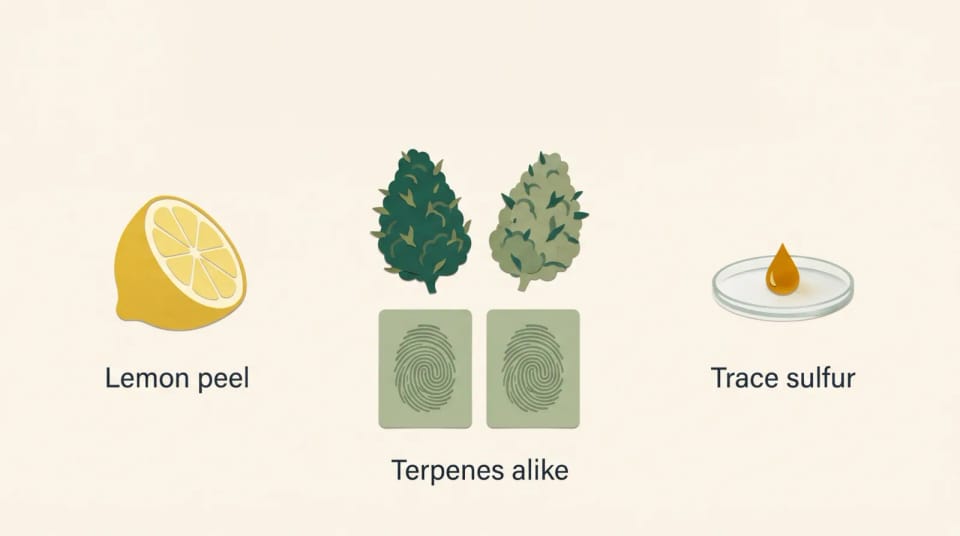
Limonene is the citrus molecule people know. In one 2023 study of 31 rosin samples, terpene profiles looked alike while trace sulfur compounds tracked the citrus note. That study did not test a lemon-named strain.
Now the limits, because they matter. That study used rosin, not flower. Its panel was seven untrained cannabis users. No lemon-named variety appears in its text. The authors flag one sample as probably mislabelled, several authors filed patents on the results, and a company supported the work (Oswald et al., 2023, full text). It shows terpenes are not the whole aroma story. It does not show what makes Lemon Haze smell like Lemon Haze.
Here is what the evidence does support. Limonene is a gene-controlled trait: researchers have identified a dedicated limonene-making enzyme in cannabis (Booth et al., 2017).
Labels can follow those genes more than ancestry. A study of more than 100 samples found that Sativa and Indica labels tracked a few terpene synthase gene regions, while the plants under each label were “genetically indistinct on a genome-wide scale” (Watts et al., 2021). That is why two plants can share a smell without being close relatives, and why an aroma family is not a genetic family, a point our lesson on gas and candy flavor families makes too. For the full aroma chemistry, see why every strain smells different.
How sure are these lemon family trees?
Not very, and that is true of most strain names. No genetic study we found tested any lemon-named strain. The studies that tested other names give a clear warning.
An early genetic survey of 81 marijuana and 43 hemp samples found that “marijuana strain names often do not reflect a meaningful genetic identity” (Sawler et al., 2015).
A study of 30 dispensary strains found “genetic inconsistencies within strains, with most strains containing at least one genetic outlier”, though many strains were stable once outliers were removed (Schwabe & McGlaughlin, 2019).
Plants grown from seed under one cultivar name showed “large variation both within and between sets of plants labeled as the same cultivar” (Booth et al., 2020).
That last point matters for Lemon Haze, which is sold as seed by several breeders. Seed-grown plants under the same name can differ. Our lesson on DNA testing of strain names walks through more of these studies.
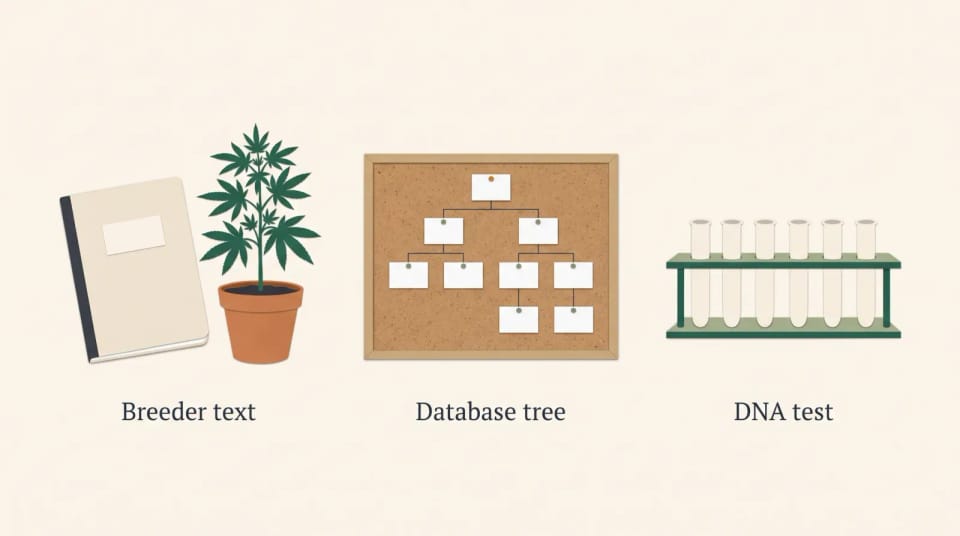
Every lemon lineage here comes from breeder text or a database tree. We found no genetic test of any lemon-named strain.
How can you check a lemon strain’s parents yourself?
Start with the breeder, not the strain name. Our guide on how to trace a strain’s family tree covers the method in depth; here is the lemon version.
- Find the breeder. Look for a breeder or seed company on the package, menu or seed pack. “Lemon Haze” alone does not tell you whose Lemon Haze it is.
- Read the breeder’s own page. Copy the cross it lists, word for word.
- Ask which Lemon Skunk. If the cross says Lemon Skunk, check whether the breeder says which one. Most pages do not.
- Grade the claim. A database tree, a nursery page or a menu is a second-hand claim. No lemon-named strain has a published DNA test that we found.
- Judge by your own notes. Smell it, note how it worked for you, and compare that with the label. The High IQ app can track how each lemon strain actually worked for you, which tells you more than the name does.
Percent-sativa figures on lemon listings are listing claims too; our lesson on the indica and sativa myth explains why those labels predict so little. Lemon names also do not map to one High Family; High Families is a product classification, not a prediction of how a strain will feel.
A health note. This lesson is about names and smell, not effects. If any strain leaves you with a racing heart, chest pain, panic that does not settle, or symptoms that worry you, stop and talk to a clinician. Seek urgent care for chest pain or trouble breathing.
Sources
- Oswald IWH, et al. “Minor, Nonterpenoid Volatile Compounds Drive the Aroma Differences of Exotic Cannabis.” ACS Omega, 2023. doi:10.1021/acsomega.3c04496
- Smith CJ, Vergara D, Keegan B, Jikomes N. “The phytochemical diversity of commercial Cannabis in the United States.” PLoS ONE, 2022. doi:10.1371/journal.pone.0267498
- Rice S, Koziel JA. “Characterizing the Smell of Marijuana by Odor Impact of Volatile Compounds.” PLoS ONE, 2015. doi:10.1371/journal.pone.0144160
- Booth JK, Page JE, Bohlmann J. “Terpene synthases from Cannabis sativa.” PLoS ONE, 2017. doi:10.1371/journal.pone.0173911
- Watts S, et al. “Cannabis labelling is associated with genetic variation in terpene synthase genes.” Nature Plants, 2021. doi:10.1038/s41477-021-01003-y
- Sawler J, et al. “The Genetic Structure of Marijuana and Hemp.” PLoS ONE, 2015. doi:10.1371/journal.pone.0133292
- Schwabe AL, McGlaughlin ME. “Genetic tools weed out misconceptions of strain reliability in Cannabis sativa.” Journal of Cannabis Research, 2019. doi:10.1186/s42238-019-0001-1
- Booth JK, et al. “Terpene Synthases and Terpene Variation in Cannabis sativa.” Plant Physiology, 2020. doi:10.1104/pp.20.00593
- Breeder and database lineage pages are linked beside each claim above. They are records of what breeders and databases say, not verified genetics.
Key takeaways
- Most well-known lemon strains list Lemon Skunk as a parent.
- There are two Lemon Skunks, DNA Genetics’ and Green House’s, and most listings do not say which one they mean.
- Lemon Haze is a name many breeders sell; Super Lemon Haze is Green House’s version.
- Lemon Cherry Gelato has lemon in the name and, in most listings, no Lemon Skunk in its parents.
- Limonene is common across cannabis, and the one citrus-aroma study tied citrus notes to trace sulfur compounds in varieties that were not lemon-named.
- No genetic test of a lemon-named strain turned up; every family tree here is a claim.
FAQ
What strain is Lemon Haze a cross of?
Most listings give Lemon Skunk crossed with a Haze, but they disagree on which Haze. A nursery page says the standard cross uses Silver Haze, while DNA Genetics lists Super Silver Haze. Several breeders sell their own Lemon Haze, so check the breeder on the pack.
Does Lemon Haze have limonene?
Breeder pages say so, but we found no published lab data for a named Lemon Haze. Limonene is one of the most common terpenes in commercial cannabis generally, so its presence would not make Lemon Haze unusual. Check the lab results printed for the specific batch you buy.
Is Lemon Cherry Gelato related to Lemon Skunk?
Not in most listings. Its usual parents are Sunset Sherbet and Girl Scout Cookies, and one database’s “probably Lemon Haze” third parent contradicts its own text. The lemon in its name describes how it is sold, not a proven parent.
Do all lemon strains smell the same?
No. Seed-grown plants sold under one name can vary, and different breeders’ versions of the same name can have different parents. A lemon name tells you what the seller wants you to smell, not what the plant will smell like.



