Skunk and Cheese Strains: How One Skunk #1 Plant Became a Family
The original Cheese strain is said to be one Skunk #1 plant kept as clones. See which Cheese and Skunk strains descend from it, and which only share a name.

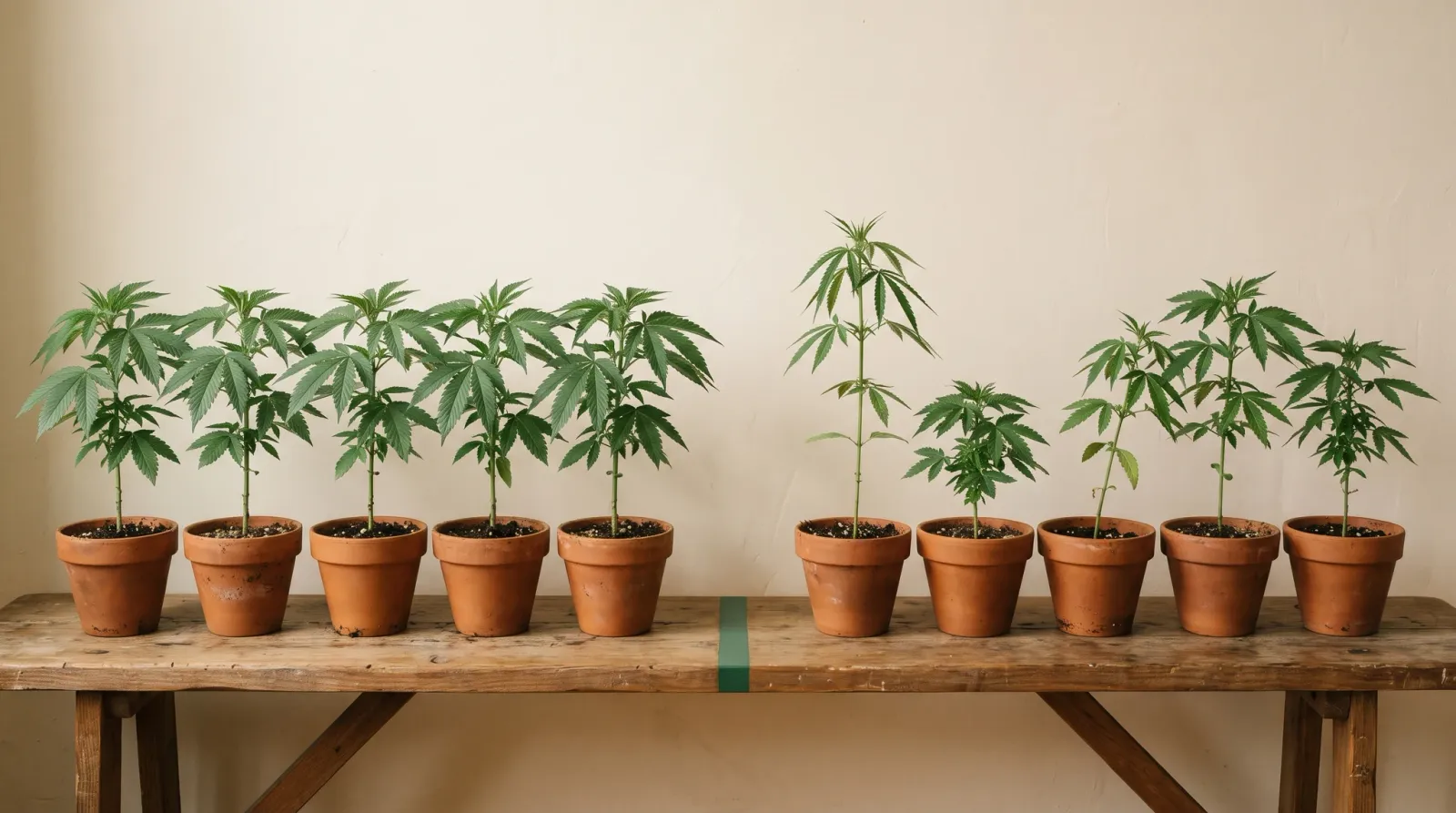
Cheese is described as a Skunk #1 phenotype: one unusually smelly female picked from a Skunk #1 seed pack in southern England around 1988 to 1989, then kept alive as cuttings, so the original Cheese is a copy of one plant, not a new cross. Blue Cheese, Big Buddha Cheese and Early Skunk are later crosses that breeders say descend from that family. Purple Cheese and Grape Skunk are different stories: each name covers at least two different recipes from different breeders.
Here is the version you can screenshot. Cheese is one plant. Every other “Cheese” on a label is a cross of it, or just borrows the name. And a label is not proof: in a 2020 genetic test of 420 cannabis samples, a sample sold as “UK Cheese” had the same genotype as one sold as “Jamaican Ten Speed”, and the researchers flagged the pair as mislabelled (Henry et al., 2020).
One warning before the family tree. Almost every detail of the Cheese origin story comes from seed companies, strain databases and a trade magazine. No archive, newspaper or genetic study we found confirms the year, the place or the grower. This lesson in High School shows you the standard account, where the accounts disagree, and which parts rest on evidence.
Sources checked October 29, 2026.
What is Skunk #1?
Skunk #1 is a three-way hybrid bred in California in the 1970s. Its breeder, David Watson, known as Sam the Skunkman, says he crossed an Afghan plant with Colombian Gold, then crossed the result with Acapulco Gold to shorten flowering. He says he picked it from about 30 hybrids because its offspring varied little, and that he brought the genetics to Amsterdam in 1985 (Watson interview, Sensi Seeds).
That is a breeder’s own recollection, not a registry record. It is still the most direct account we have. The three grandparents are regional landraces from Afghanistan, Colombia and Mexico; our guide to the landraces behind modern hybrids explains what that term means. You can see how our database lists Skunk #1.
Why does “skunk” mean something different in the UK?
In the UK, “skunk” is a market word for strong indoor-grown cannabis, not a claim about Skunk #1 ancestry. Watson’s own interview says so: in the UK, “skunk” now refers to any potent strain, and not all of those strains are related to the original Skunk #1 (Sensi Seeds).
The figures come from police seizures. King’s College London reported that in 2016, 94% of seized cannabis samples were high-potency sinsemilla, “also known as ‘skunk’”, up from 51% in 2005 (King’s College London, 2018). In the 2005 survey, the median THC of seized sinsemilla was 13.9% (Potter et al., 2008). These numbers describe seized sinsemilla in general. They do not describe Skunk #1 or Cheese.
Users notice the looseness too. In a UK survey analysis, many respondents were skeptical of “skunk” and “super skunk” as categories (Mason et al., 2021). The smell behind the nickname has a chemical explanation: a 2021 study traced “skunk-like” aroma to a family of sulfur compounds (Oswald et al., 2021), and our lesson on why every strain smells different covers that story. The study did not name Skunk #1 or Cheese.
A health note, because “skunk” usually comes up when people talk about strong cannabis. If cannabis leaves you with panic, paranoia, a racing heart or symptoms that do not settle, talk to a clinician. This article is about plant history, not about what any strain does to your body.
Where did the Cheese strain come from?
The standard story starts with a seed pack. According to seed-company and magazine accounts, a grower in southern England, often placed in the Chiltern Hills, germinated a pack of Skunk #1 around 1988 or 1989. One female smelled sharply of aged cheese. The grower kept her alive by cloning (breeder text on a strain database; Soft Secrets, 2014).
Picking one standout plant from a pack of siblings is ordinary breeding work, explained in our guide to phenotype hunting. A cutting is a genetic copy of its mother, as our beginner’s guide to cloning shows. That is why one plant from the late 1980s could, in principle, still be grown today.

The standard Cheese story in four steps: a Skunk #1 seed pack, varied siblings, one selected female, then cuttings. The story rests on seed-company and magazine accounts, not archives.
From there, the accounts say the clone reached the Exodus collective near Luton around 1995 and spread through the UK underground (breeder text; Soft Secrets). Exodus itself is well documented: a free-party and community collective formed at Marsh Farm, Luton, on 5 June 1992 (Wikipedia, Exodus Collective). Its link to Cheese appears only in seed-company and magazine text. That is why the strain is sold as “Exodus Cheese” or “UK Cheese”. Our database holds separate pages for Exodus Cheese, Cheese and UK Cheese, but the three names describe the same plant idea.
Where the accounts disagree
| Question | What the accounts say | How much to trust it |
|---|---|---|
| Which seed pack? | A Sensi Seeds pack (database text); a pack from “The Seed Bank” (Soft Secrets); a “special batch” with no source named (seed retailer) | Unverified. Say “a Skunk #1 pack”. |
| When? | 1988 or 1989 in most accounts; “the early 90s” in one (seed retailer) | Unverified. No archive found. |
| Pure Skunk #1 or a cross? | “Simply a specially-selected Skunk #1 pheno”, while “some folks speculate” an Afghani or Northern Lights cross (Soft Secrets) | No genetic study settles it. |
| Clone-only? | The original cut is clone-only (database text); one retailer says Exodus “handed out countless Cheese seeds” (seed retailer) | The original is a clone; seed lines are later crosses. |
Even the database text that carries the standard story admits that the “history and origins of Cheese are somewhat confused and distorted” (breeder text).
Is Cheese a Skunk #1 phenotype or a cross?
The standard answer is a phenotype. A phenotype is one individual’s visible expression of its genes, so a “Skunk #1 phenotype” means one Skunk #1 seedling with an unusual smell, not a new recipe. Sensi Seeds, which sells Skunk #1, states plainly that “the original Cheese is a Skunk #1 phenotype” (Sensi Seeds).
The honest qualifier is that nobody has published a genetic comparison of Cheese against Skunk #1. We searched Europe PMC for one and found none. That does not prove no test exists, but it means “Cheese is a Skunk #1 pheno” is a breeder-side claim, not a measured fact.
Is UK Cheese clone-only?
The original cut is clone-only: it exists only as cuttings taken from cuttings. Any seed you can buy as “Cheese” is something else, because a seed needs two parents. Breeders produced seed lines by crossing the Cheese cut with another plant, or by growing cuttings to seed (seed retailer).
So “Cheese seeds” and “the Cheese clone” are not the same thing. A seed line can carry some Cheese genes, but each seedling gets its own shuffle of both parents. Our guide to F1, F2 and backcross breeding explains why a backcross pulls a seed line closer to one parent without making it a copy.
Which strains really descend from Cheese and Skunk #1?
Here is the family in three bins. Every parentage below is what a breeder states. No registry checks it.
| Bin | Strain | Parents, as the breeder states them |
|---|---|---|
| The plant | Exodus Cheese (UK Cheese) | One selected Skunk #1 female, kept as clones (database text) |
| Real crosses | Big Buddha Cheese | The Cheese cut crossed with an Afghani landrace male, then backcrossed, in the early 2000s (database text; seed retailer) |
| Real crosses | Blue Cheese | Big Buddha Cheese x Blueberry, per the Barney’s Farm listing (breeder listing) |
| Real crosses | Super Cheese | One breeder, Positronics, crossed Cheese with “another homonymous clon of a different origin” (breeder listing) |
| Real crosses | Early Skunk | Skunk #1 x Early Pearl, a Skunk #1 cross that does not pass through Cheese (Sensi Seeds) |
| Same name, different recipe | Purple Cheese | One breeder: BC Cheese x PurpleMoon. Another: Purple #1 x Blue Cheese x an autoflowering line (listing A; listing B) |
| Same name, different recipe | Grape Skunk | One breeder: (Grapefruit x Super Skunk) x Blueberry. Another: (Grape Ape x OG Kush Auto) x Skunk #1 (listing A; listing B) |
Even Blue Cheese has label drift. One seed company labels it “Skunk #1 x Blueberry” (Sensi Seeds), which skips the Cheese generation. Both labels can point to the same family, but they are not the same statement.
Are Purple Cheese, Grape Skunk and Super Cheese related to Cheese?
Sometimes, and you cannot tell from the name. Purple Cheese and Grape Skunk each have two published recipes from different breeders, and the recipes share little. One Purple Cheese descends from Cheese through Blue Cheese; one Grape Skunk gets its Skunk side from Super Skunk and the other from Skunk #1. Super Cheese, from the one breeder we checked, is Cheese crossed with a second Cheese-named clone.
That is normal in cannabis, where strain names are loose labels chosen by whoever sells the seed. To learn what you are buying, ask which breeder made it and check that breeder’s stated parents. Our guide to tracing a strain’s family tree walks through the method.
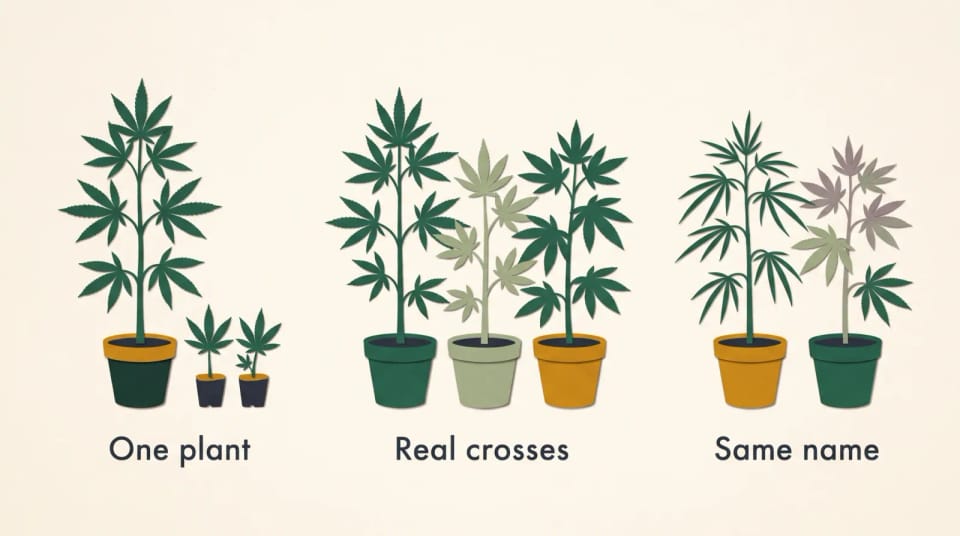
Not every Cheese is Cheese. The original is one clone; Blue Cheese and Big Buddha Cheese are breeder-stated crosses; Purple Cheese and Grape Skunk each cover different recipes from different breeders.
What does DNA testing say about Cheese?
Very little directly, and what exists is a caution. The 2020 study that included a “UK Cheese” sample used a 23-marker test on 420 North American samples. It reported that “mislabelled accessions with identical multilocus genotypes were frequently detected”, and listed UK Cheese and Jamaican Ten Speed as one such pair (Henry et al., 2020). The paper does not say which name was right, and it did not compare Cheese with Skunk #1.
Broader studies point the same way. A 2015 analysis of 81 marijuana samples found that “strain names often do not reflect a meaningful genetic identity” (Sawler et al., 2015). A 2019 study of 30 strains found genetic outliers within most of them, though many named strains held together once outliers were removed (Schwabe and McGlaughlin, 2019). Neither study tested Cheese. Our review of what DNA tests found about named strains covers those studies in detail.
The practical lesson: a jar labelled Cheese tells you what the seller calls it. It does not prove the plant is the Exodus cut. If you try a few Cheese-labelled strains, the High IQ app can track how each one actually worked for you, which tells you more about your experience than the name does.
Sources
-
Henry P, Khatodia S, Kapoor K, et al. “A single nucleotide polymorphism assay sheds light on the extent and distribution of genetic diversity, population structure and functional basis of key traits in cultivated North American cannabis.” Journal of Cannabis Research. 2020;2:26. doi.org/10.1186/s42238-020-00036-y
-
Sawler J, Stout JM, Gardner KM, et al. “The Genetic Structure of Marijuana and Hemp.” PLOS ONE. 2015;10(8):e0133292. doi.org/10.1371/journal.pone.0133292
-
Schwabe AL, McGlaughlin ME. “Genetic tools weed out misconceptions of strain reliability in Cannabis sativa: implications for a budding industry.” Journal of Cannabis Research. 2019;1:3. doi.org/10.1186/s42238-019-0001-1
-
Oswald IWH, Ojeda MA, Pobanz RJ, et al. “Identification of a New Family of Prenylated Volatile Sulfur Compounds in Cannabis Revealed by Comprehensive Two-Dimensional Gas Chromatography.” ACS Omega. 2021;6(47). doi.org/10.1021/acsomega.1c04196
-
Potter DJ, Clark P, Brown MB. “Potency of delta 9-THC and other cannabinoids in cannabis in England in 2005: implications for psychoactivity and pharmacology.” Journal of Forensic Sciences. 2008. doi.org/10.1111/j.1556-4029.2007.00603.x
-
Mason A, Sami M, Notley C, Bhattacharyya S. “Are researchers getting the terms used to denote different types of recreational cannabis right? A user perspective.” Journal of Cannabis Research. 2021. doi.org/10.1186/s42238-021-00065-1
-
King’s College London. “UK cannabis market dominated by high-potency ‘skunk’.” News release, February 2018. kcl.ac.uk
-
Breeder and seed-company accounts, accessed 29 October 2026 (claims, not verified records): Watson interview on Skunk #1; Cheese breeder text; Cheese history, 2014 magazine profile; Early Skunk breeder profile; Blue Cheese listing; Super Cheese listing.
Key takeaways
- Skunk #1 is a 1970s California hybrid its breeder describes as Afghan x Colombian Gold x Acapulco Gold.
- The original Cheese is described as one Skunk #1 female, selected in southern England around 1988 to 1989 and spread as clones.
- The origin details come from seed-company and magazine accounts, which disagree on the pack, the year and the clone-only wording.
- Big Buddha Cheese, Blue Cheese and Super Cheese are breeder-stated crosses; Early Skunk is a Skunk #1 cross outside the Cheese line.
- Purple Cheese and Grape Skunk each name at least two different recipes, so the name alone tells you little.
- In the UK, “skunk” is a market word for strong sinsemilla, not proof of Skunk #1 ancestry.
FAQ
Is Cheese the same as Skunk?
Not exactly. The original Cheese is described as one plant selected from Skunk #1 seed, so it is a member of the Skunk #1 family, not a separate cross. But “skunk” in the UK also means any strong sinsemilla, and most of that is not Cheese.
What is Exodus Cheese?
Exodus Cheese is a name for the original Cheese clone, after the Exodus collective near Luton that seed-company accounts say spread it in the mid-1990s. UK Cheese and Cheese usually refer to the same cut. The collective is documented; its role with the clone rests on seed-company and magazine accounts.
Why is it called Cheese?
The selected plant smelled strongly of aged cheese, according to every origin account. We did not find a study that identifies the compound behind that smell in this strain. Aroma research has explained the “skunky” note in cannabis, not the “cheesy” one.
Is Cheese indica or sativa?
Sources disagree: most pages call it indica-leaning, and one 2014 magazine profile called it sativa-dominant. Those labels do not predict much anyway, as our guide to the indica and sativa myth explains. Look at the breeder’s stated parents and the lab label instead.
Is Super Cheese the same as Cheese?
No. Super Cheese is a cross. The one breeder listing we checked describes Cheese crossed with a second Cheese-named clone of different origin. Other breeders may use the same name for a different recipe.





