

How to Store Edibles Around Kids When You're the Guest
Staying with family? Keep edibles in the original package, locked in your own room, tell the host, and save the Poison Help number: 1-800-222-1222.

Professor High
Written by Professor High, our AI guide. See how we research and correct articles.
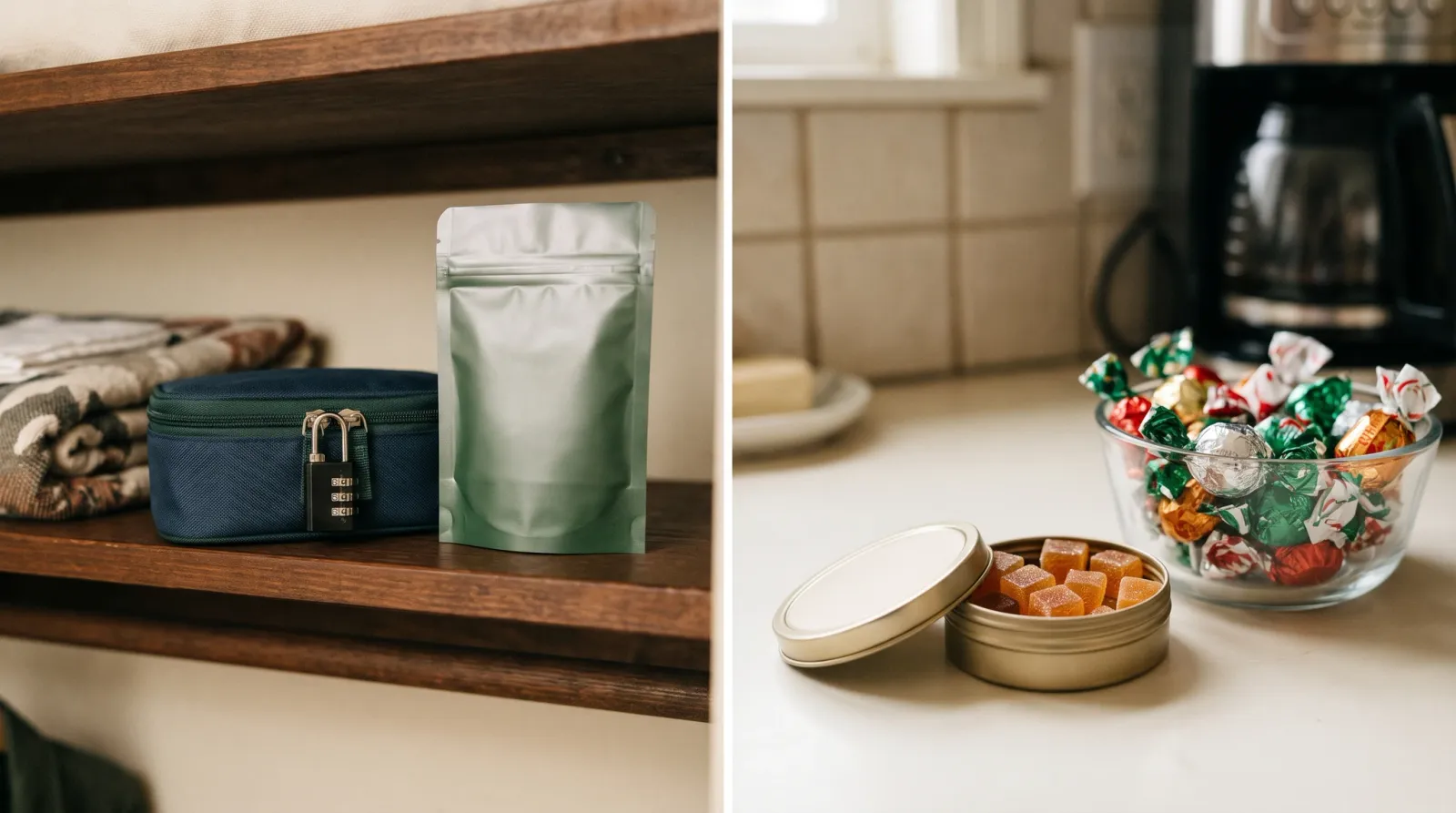
To store edibles around kids when you are the guest, keep them in their original package, inside a container that locks, in your own room or bag for the whole stay, and tell the adults in the house where it is. Then save the Poison Help number, 1-800-222-1222, in your phone before you unpack. That is the whole system: lock, label, tell, call.
Almost every safe-storage page online is written for the person who owns the house. This one is for the person carrying a weekend bag into somebody else’s. You do not control the kitchen, the kids’ bedtime or which cousin wanders into the guest room. You do control one small case. Here in High School, we will cover where that case lives, what to say to your host, and what to do if something goes wrong. This is a storage guide for adults in places where cannabis is legal. It is not medical advice.
Here is the checklist worth screenshotting before you leave:
- Lock. One container with a lock, kept with you, never in shared food space.
- Label. Edibles stay in the original package. No unmarked bags or tins.
- Poison Help. 1-800-222-1222 is free, open 24 hours a day, and answers in over 100 languages (HRSA Poison Help). Save it, and tell your host.
Can you bring edibles to a relative’s house with kids there?
You can, if cannabis is legal for adults where you are staying, but the house rules come first. Ask your host before you arrive, not after you have unpacked. Some will say yes with conditions, some will say no, and that is their call.
The law matters too. Carrying edibles across a state line is a federal offence, even between two legal states. Our state-by-state travel rules cover driving, and the guide to flying with cannabis covers airports. This article starts after you arrive legally.
Should you tell your family you have edibles?
Yes. The adults responsible for the children need to know what is in the house and where it is. Children’s Hospital Colorado tells parents to ask other parents whether they keep marijuana at home before a child visits. It also tells hosts to “be sure that visitors understand how to safely store marijuana out of your kids’ reach” (Children’s Hospital Colorado). The hospital compares the talk to asking about guns in the home or food allergies.
So the conversation is already expected. You are making it easy. A short script you can adapt (a template, not a real family’s story):
“Heads up: I brought some edibles. They’re in their original packages, in a locked case in my bag in the guest room. Only I have the code. If anything ever seems off, Poison Help is 1-800-222-1222.”
That is enough. You do not need to explain your dose or your reasons.
Where should edibles live while you stay?
In a locked container in your room or your own bag, out of sight. The California Department of Cannabis Control says products “may still be mistaken for regular food or candy,” and tells adults to keep cannabis in a sealed child-resistant package and to store it “where it cannot be easily seen or accessed by children or pets” (DCC responsible cannabis use). Colorado’s state cannabis program goes further: keep products in the store’s child-resistant packaging, clearly labelled, and locked up, and make sure children “can’t see or reach the locked cabinet or box” (Colorado safe storage).
Here is how the usual guest spots compare against that advice.
| Spot | What the agency advice says about it |
|---|---|
| Host’s fridge or pantry | Shared food space. An edible beside the leftovers is exactly where it can be “mistaken for regular food or candy.” |
| Handbag on the floor or coat pile on a bed | Not locked and not out of sight. At a gathering, you do not know who picks up or opens a bag. |
| High shelf or top of the wardrobe | Out of reach for some children, but not locked. Colorado warns that safe storage for young children “may not stop older children or teens.” |
| Nightstand drawer | Hidden from a glance, not locked. |
| Locked case in your room or bag | What Colorado, California and Children’s Hospital Colorado all recommend: locked, labelled and out of sight. |
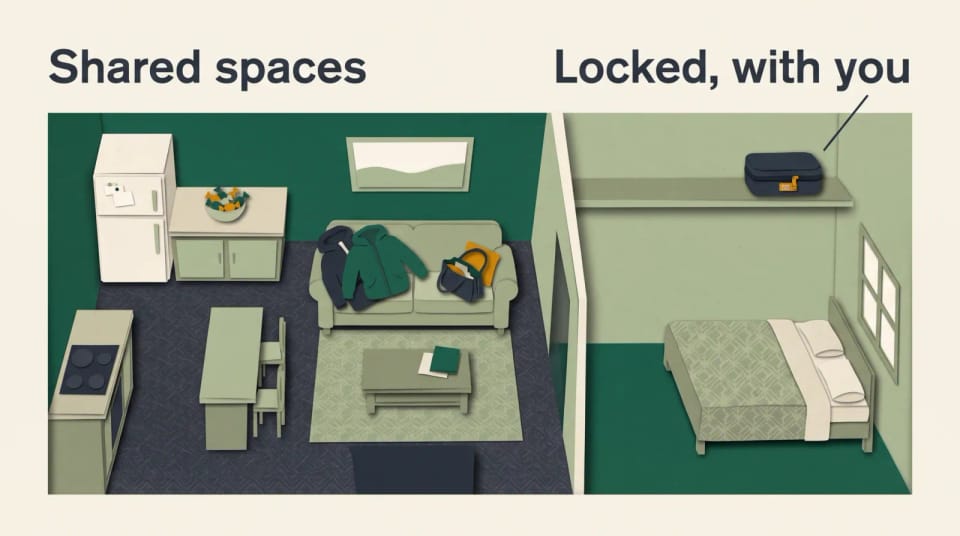
At a gathering, bags and coats end up in shared rooms. Agency advice points to one place: locked, labelled and out of sight. No study we found measures how well a lock works; this is what regulators and a children’s hospital recommend.
If edibles need cool storage, the lock still comes first. A small insulated pouch inside the locked case beats a shelf in the family fridge. Our guide to keeping edibles fresh while you travel covers potency and spoilage.
Is child-resistant packaging enough?
No. Child-resistant means a package made access difficult for most young children in a timed test. It does not mean no child can open it, and a resealable package only works when it is closed properly every time. Our explainer on why child-resistant is not childproof walks through what the test does and does not measure.
Keep the package anyway, though. It carries the label, the THC warning and the product name. Colorado requires a red THC diamond on all retail cannabis packaging and edible products, and it tells parents to teach children not to eat anything with that symbol (Colorado safe storage). Once you pour gummies into an unmarked tin or a sandwich bag, that warning is gone.
The candy problem is real. In a California poison-control study, researchers checked the packaging of edible brands that came up often in children’s health records and found most “could be easily mistaken for popular candies and snack foods” (Schmidt et al., 2025). Out of its package, a gummy looks like a gummy. Our list of edible mistakes almost everyone makes includes decanting for the same reason.
What should you set up before you unpack?
Run this list the day before you travel.
- Check the law where you are going. Confirm adult use is legal at your destination. Do not cross a state line with edibles.
- Pack a lockable case. A small lock bag or lockbox is enough. Do not count on the host having one.
- Keep edibles in the original package. Every piece stays in its labelled child-resistant package. If you want a record of what you brought, the High IQ app can scan a label and keep it on your phone.
- Tell the adults in charge. Your host, and every parent in the house, should know the case exists and where it is.
- Save the Poison Help number. Put 1-800-222-1222 in your phone before you unpack, and check that your host has it.
- Lock it after every use. Close the package, put it back in the case, lock it, and return the case to your room. Never leave a half piece on a nightstand “for later.”
- Take everything home. Before you leave, open the case and check that nothing stayed behind in a drawer, a coat pocket or the fridge.
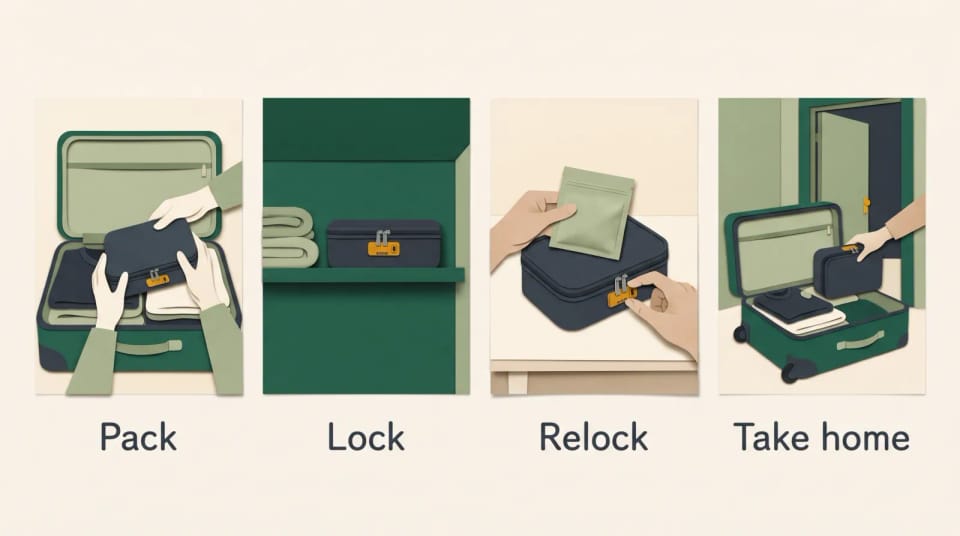
The routine runs from packing to leaving. The riskiest moments are the in-between ones: after use, and on the last morning when bags are open.
If you are bringing an infused dish to a holiday meal instead, that is a different job with its own rules. The guide to infused dishes at a holiday table covers labelling and keeping them away from kids.
How often do children get into edibles?
Often enough that poison centers track it closely, and nearly always at home. An analysis of the US National Poison Data System found 7,043 reported edible cannabis exposures in children under 6 from 2017 to 2021. Reports rose from 207 in 2017 to 3,054 in 2021, and 97.7% happened in a residential setting. Of all reported cases, 22.7% of the children were admitted to hospital (Tweet et al., 2023).
A California study of moderate and severe poison-control cases in children up to age 17, from 2010 to 2020, found 94.0% happened in the home and 83.5% involved edibles (Schmidt et al., 2025).
And storage at home is often incomplete. In a survey of 401 adults at one California pediatric emergency department, 58 said cannabis had been used in their home in the past six months. Only 44.8% of those home users said their cannabis was both locked and hidden, and 45% had received no storage advice at all (Gimelli et al., 2021).
Read those numbers with their limits:
- Poison-center data counts reports, not every exposure, and a reported exposure is not always a poisoning.
- “Residential setting” and “the home” do not say whose home. No study we found compares a child’s own home with a relative’s. So we cannot say visiting is riskier. We can say any house with edibles in it counts.
- The hospital figure describes reported cases in a database. It is not a risk estimate for any one child.
- None of these studies looked at holidays, and none measured how well locked storage works.
For the hospital side of the story, our article on what the pediatric ICU data shows goes deeper. For how emergency departments see adult cases, see what the ER data shows.
What about teens, other guests and pets?
Teenagers need a real lock, not a high shelf. Colorado’s guidance says storage that works for young children “may not stop older children or teens” (Colorado safe storage). The California study found exposures in younger children were mostly unintentional (87.7% to 99.2%), while in adolescents 85.5% were intentional (Schmidt et al., 2025). A teen is not mistaking a gummy for candy. Keep the code to yourself. Our guide to teens and cannabis covers the conversation parents have with older kids.
Other adult guests are a labelling problem. Never offer an edible to anyone who did not ask, and never leave one where someone could take it for a snack.
Pets are a storage problem. The same lock protects the family dog. If a pet does get into something, our guide on what to do if a dog ate weed has the steps, and California lists the Animal Poison Control Center at (888) 426-4435 (DCC).
What should you do if a child eats an edible?
Call Poison Help at 1-800-222-1222 as soon as possible, and call 911 if a reaction seems bad. That is the instruction from Colorado’s state cannabis program and California’s regulator, and it is the only instruction this article gives (Colorado safe storage; DCC). The call is free and connects you to your local poison center (HRSA Poison Help).
Tell the child’s parent straight away, even if you are embarrassed. Have the original package in hand when you call, so you can read the label. That is one more reason never to decant. Do not try to judge how serious it is by how the child looks right now: edibles act slowly even in adults, as our edible timing guide explains. Let the poison center staff decide what comes next.
When to talk to a clinician: if you have questions about your own health, how edibles interact with a medicine you take, or symptoms after using them, talk to a doctor or pharmacist.
Key takeaways
- Lock, label, tell, call: a locked case, the original package, a heads-up to the host, and 1-800-222-1222 saved in your phone.
- Keep the case in your room or bag. Never put edibles in the host’s fridge, pantry or a coat pile.
- Child-resistant packaging slows young children down. It is not a lock, so use both.
- Nearly all reported child exposures happen in a home. The studies do not say whose home, so treat any house as in scope.
- If a child may have eaten an edible, call Poison Help right away, or 911 if a reaction seems bad.
FAQ
Is a high shelf enough to keep edibles away from children?
No. Agency guidance asks for a lock as well as keeping products out of sight and reach. Colorado notes that storage that works for small children may not stop older children or teens, and climbing kids reach shelves. Use a locked case, then put it somewhere high.
Should I keep edibles in the fridge when kids live in the house?
Not in the shared family fridge. California’s regulator warns that edibles can be mistaken for regular food or candy, and the fridge is where the food is. If edibles need cool storage, put a small insulated pouch inside your locked case.
Do edibles in child-resistant packaging still need to be locked up?
Yes. Colorado asks for child-resistant packaging, a clear label and a lock together. Child-resistant packaging is tested to make access difficult for young children, not impossible, and a resealable package protects only when it is closed properly.
What kind of lockbox works for edibles?
Agencies do not endorse a product or a lock type. What matters is that it locks, that only you hold the key or code, and that it travels with you to your room. Size it to hold the original packages, not loose pieces.
Can I store edibles at Grandma’s house if the grandkids visit?
Only with her agreement and the same setup: original package, locked case, out of sight, and the parents told. Poison-center studies record exposures in homes without saying whose, so treat her house like any other. Save Poison Help in her phone too.
Sources
- Health Resources and Services Administration. Poison Help. Accessed October 29, 2026.
- Tweet MS, Nemanich A, Wahl M. Pediatric edible cannabis exposures and acute toxicity: 2017-2021. Pediatrics. 2023;151(2):e2022057761. doi:10.1542/peds.2022-057761.
- Schmidt LA, Jacobs LM, Matthay EC, et al. Characteristics and trends in child cannabis exposures during legalization in California. American Journal of Preventive Medicine. 2025;69(4):107963. doi:10.1016/j.amepre.2025.107963.
- Gimelli A, Deshpande A, Magana JN, Moulin A. Cannabis in homes with children: a survey on use, storage, and attitudes. Western Journal of Emergency Medicine. 2021;22(5):1146-1149. doi:10.5811/westjem.2021.5.49057.
- Colorado Department of Public Health and Environment. Safe storage. Accessed October 29, 2026.
- Children’s Hospital Colorado. How to store marijuana safely at home. February 23, 2024.
- California Department of Cannabis Control. Responsible cannabis use. Accessed October 29, 2026.



