My Dog Ate Weed: Symptoms, Timeline and When to Call a Vet
Dog ate weed what to do: call a vet or a pet poison line now with the product, amount, and time. Symptoms, timeline, and the chocolate risk.

Call a vet or a pet poison line now if your dog ate weed. Do not wait for symptoms, and do not try to handle it at home.
The question “dog ate weed what to do” starts with the phone, not the kitchen. Say what the dog ate, how much is missing, and when it happened. The ASPCA Animal Poison Control Center answers at (888) 426-4435. A consultation fee may apply. The Pet Poison Helpline answers at (855) 764-7661. Its published fee is $89 per incident, and that fee includes follow-up. Your own veterinarian is the other right call. Keep the package in your hand while you dial.
Among dog calls to the ASPCA Animal Poison Control Center, cannabis-related calls rose from 179 in 2009 to 362 in 2014 Howard-Azzeh et al., 2021. That count is a hotline record, not a census of every dog in the country. The same study shows a dip in 2012 before the 2014 peak. In March 2025 the ASPCA said exposures to THC-based drugs are decreasing, and it did not publish a new cannabis call count. The older rise is real. It is not a promise that this year is worse than last year.
This High School guide is the emergency page. A different article covers what veterinary CBD research shows. If your dog just ate cannabis, stay here. This page is an evidence guide for the phone call. The veterinarian makes the medical decision. Nobody on this site reviewed it as a clinician.
What should you do if your dog ate weed?
Do these four things, in this order.
- Call your veterinarian, the ASPCA Animal Poison Control Center at (888) 426-4435, or the Pet Poison Helpline at (855) 764-7661.
- Report the product, the amount that seems to be missing, and the time it happened.
- Do not induce vomiting, and do not give a home antidote, unless that person tells you to.
- Bring the package, the wrapper, and any ingredient list to the clinic.
The three facts are the product, the leftover amount, and the clock. A labeled milligram count can still miss the real content. If the package states a number, read it aloud and say that edible labels can miss the stated milligrams.
The ASPCA marijuana page names Cannabis sativa as toxic to dogs, cats, and horses. It names delta-9-THC as the toxic principle. It tells you to call (888) 426-4435 or a local vet, and it says a consultation fee may apply. The Pet Poison Helpline marijuana page says there is no safe dose of psychoactive marijuana for companion animals. Its fee page lists $89 per incident.
Skip the kitchen experiments. A human night of too much THC is a different problem, covered in why too much cannabis makes you sick. Pepper, a snack, or sleeping it off is advice for a person. It is not a plan for a dog.
What are the symptoms of weed poisoning in dogs?
The signs people notice first are often ordinary and easy to misread. Cornell’s Riney Canine Health Center lists wobbliness, low energy, a dazed look, urine dribbling, extra sensitivity to sound or touch, wide pupils, and vomiting or drooling. The same page also lists agitation, changes in heart rate or blood pressure, trouble holding a normal temperature, tremors, seizures, and coma. That page is clinical guidance. It was last updated on December 22, 2025. It is not a new research count.
A 2022 survey of veterinarians lines up with that list, with an important limit. The numbers below count veterinarians who reported the sign. They do not count animals Amissah et al., 2022.
| Sign the veterinarian reported | Veterinarians who reported it |
|---|---|
| Urine dribbling | 195 |
| Disorientation | 182 |
| Wobbliness | 178 |
| Low energy | 150 |
| Extra sensitivity to touch | 134 |
| Slow heart rate | 112 |
The survey ran online from January 28 to April 30, 2021. Of 251 people who started, 222 finished, and 7 were ineligible. Dogs were the common patient. The authors say the sign list is likely biased toward dogs. The survey definition also included synthetic cannabinoids, so it is not a pure-flower tally.
An older case series of 213 dogs, seen from 1998 to 2002 after they ate marijuana plant, found neurologic signs in 99 percent and gastrointestinal signs in 30 percent Janczyk et al., 2004. The ASPCA plant page adds sleepiness or excitation, a lot of saliva, low blood pressure, low body temperature, seizure, coma, and death, which it calls rare.
A human urine drug screen is a poor way to decide what happened. In one hospital series, 6 dogs with known ingestion still tested negative Meola et al., 2012. Cornell says human urine screens are unreliable in dogs and can read false negative. If you already see signs, or you know the dog ate something, the phone call comes before a home test.
How long after a dog eats weed do symptoms start?
There is no single clock. Use the range from the source that matches the situation, and still call.
| Source | Who was studied | When signs started | How long they lasted | Limit |
|---|---|---|---|---|
| Cornell Riney Canine Health Center, updated Dec. 22, 2025 | Clinical guidance for dogs | 30 minutes to several hours | Up to 72 hours. Many dogs recover in 1 to 2 days. Severe cases can take up to 3 days. | Not a study, and not a promise for one dog |
| Janczyk et al., 2004 | 213 dogs that ate marijuana plant, 1998–2002 | 5 minutes to 96 hours, most within 1 to 3 hours | 30 minutes to 96 hours. The followed dogs recovered. | Plant material, not pure THC. Clinic care, not home care |
A person’s edible clock does not transfer. How long edibles last in people is a human timeline. Do not use it to decide when a dog is “in the clear.”
Janczyk and colleagues also recorded plant amounts from half a gram to 90 grams. The lowest dose tied to signs was 84.7 mg/kg of plant. The highest reported dose was 26.8 g/kg of plant. Those figures are weights of plant, not milligrams of pure THC. They are not a home threshold. The Pet Poison Helpline’s line is the one to keep: there is no safe dose of psychoactive marijuana for a companion animal.
Why are chocolate, xylitol, and butter edibles more dangerous?
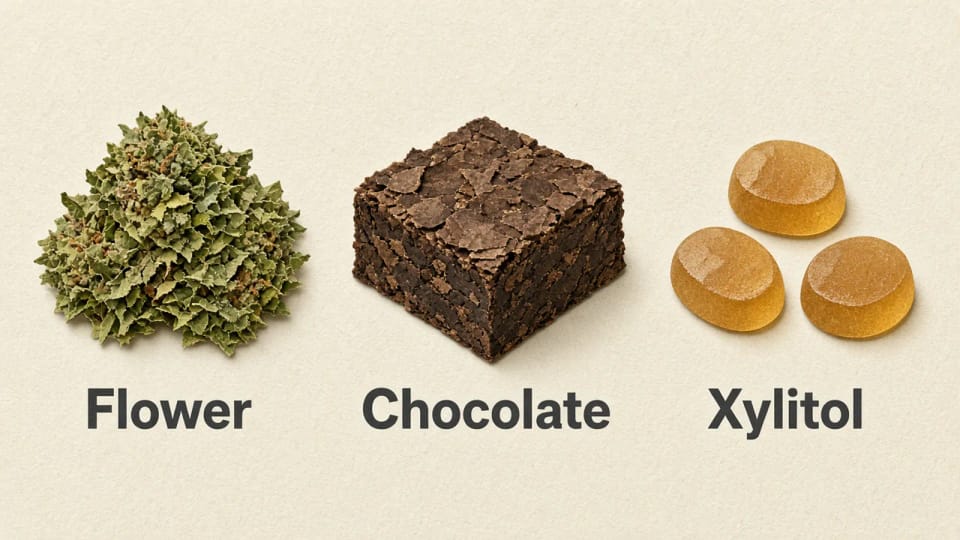
Dried flower is a THC exposure. A brownie, a chocolate bar, or a sugar-free gummy can be two or three exposures at once. Cornell says edibles may also contain chocolate, xylitol, or high-fat butter and oils. Chocolate and xylitol are poisons in dogs on their own. Cannabis butter adds a lot of fat. The picture below is the distinction. It is not a menu.
A human page on whether you can overdose on weed is a different record. It does not clear a dog who ate an edible, and it does not cover chocolate or xylitol.
| What the dog ate | What else may be in it | What to say on the phone |
|---|---|---|
| Dried flower | The ASPCA names delta-9-THC as the plant toxin | About how much plant is missing, and when |
| Chocolate edible or sugar-free gummy | Chocolate, xylitol, or both, on top of THC | The ingredient list, any “sugar-free” wording, and the chocolate type if you know it |
| Brownie or cookie made with cannabis butter | High-fat butter or oil, and sometimes chocolate | Whether the batch used butter or oil, and how much of the pan is gone |
Two deaths in the Colorado hospital series were dogs that ate butter made with medical-grade marijuana and baked into food Meola et al., 2012. That series is 125 client-owned dogs at two hospitals from January 1, 2005, to October 1, 2010. Two deaths are not a rate for every butter edible. They are a reason to name butter when you call.
The 2022 survey is the other caution. Ten of 221 veterinarians reported 16 deaths. The listed events were aspiration pneumonia (5), respiratory arrest (3), euthanasia (2), seizures the clinic could not control (2), coma (2), and pancreatitis (1). The authors say other toxins, chocolate, xylitol, and underlying disease cannot be ruled out. They also say a lethal dose of non-synthetic cannabis in dogs is not established Amissah et al., 2022.
A 1973 lab study is easy to misuse, so here is the dog-specific result and nothing wider. Beagles received large oral doses of cannabinoids in a sesame-oil vehicle. The authors did not observe systemic lethality in dogs given 65.6 to 3,000 mg/kg of delta-9-THC or delta-8-THC. Two dogs still died, and the authors attributed those deaths to aspiration, not to a body-wide poisoning. One of three dogs given 525 mg/kg of delta-9-THC died about 45 minutes later. One dog given 5,000 mg/kg of crude marijuana extract died about 15 minutes later Thompson et al., 1973. Groups were tiny. This is not clearance to wait. It is also not a conversion chart from plant grams to pure THC.
The hotline study that produced the 179-to-362 count included chocolate brownies inside some “cannabis” calls Howard-Azzeh et al., 2021. Tell the line about every ingredient, not only the THC.
What will the vet do?
Cornell says there is no antidote. Once a dog is already showing signs, that page says not to induce vomiting and not to give activated charcoal, because the dog may inhale stomach contents. The Pet Poison Helpline says the same thing in plainer words: do not induce vomiting, and do not give a home antidote, unless a veterinarian or the helpline tells you to.
Clinic care is supportive. Cornell describes intravenous fluids, a quiet place, and stairs blocked off if a veterinarian has already said a milder case can be watched at home. Severe cases may need intravenous lipid emulsion, help with breathing, or seizure medicine. Those are clinic decisions. This article does not include drug doses, because a dose you could copy at home would be the wrong artifact.
The 2004 case series says the clinicians used decontamination, a sedative, fluids, and temperature support Janczyk et al., 2004. That is a hospital note. It is not a shopping list.
In the 2022 survey, the care veterinarians reported most often was outpatient monitoring (182). Pets were most often sent home as outpatients (103). Most hospitalized animals stayed under 48 hours. Most recovered Amissah et al., 2022. “Most recovered” is not a reason to skip the call. The deaths in that same paper are the reason the call comes first.
A narrative review by veterinarians affiliated with Pet Poison Helpline and the University of Minnesota says exposures to marijuana, CBD extracts, and synthetic cannabinoids are rising as access rises, and that clinics need to recognize the signs Brutlag and Hommerding, 2018. This article uses that review at abstract level only. It does not pull extra percentages out of a paper whose full text was not opened.
Are cannabis poisonings in dogs becoming more common?
The best verified national series is the ASPCA Animal Poison Control Center file studied by Howard-Azzeh and colleagues. It covers 2009 through 2014. Of dog calls in that file, 1.12 percent (1,487 of 133,266) were coded as cannabis-related. The share moved from 0.84 percent in 2009 (179 of 21,298) to 1.53 percent in 2014 (362 of 23,588).
| Year | Cannabis-related dog calls | Share of dog calls that year |
|---|---|---|
| 2009 | 179 | 0.84% |
| 2010 | 226 | 1.04% |
| 2011 | 255 | 1.17% |
| 2012 | 219 | 1.00% |
| 2013 | 246 | 1.08% |
| 2014 | 362 | 1.53% |
Read the dip. Calls fell from 255 in 2011 to 219 in 2012, then peaked in 2014. A paid hotline is not every dog in the United States. People who call have already decided the event is worth a fee. The case file mixed raw cannabis (1,315), synthetic cannabinoids (68), THC products (97), CBD (2), hash oil (4), and hemp seed oil (1), often with other foods. Higher odds showed up for smaller dogs, male dogs, and intact dogs, and in states with lower penalties. Veterinarians called more often than owners. The work was funded by an NSERC Discovery grant to David L. Pearl. The authors declared no competing interests. The records stop in 2014 Howard-Azzeh et al., 2021.
A separate Colorado hospital series saw about a fourfold rise in marijuana toxicosis cases at both hospitals across 2005 to 2010. Over the last five years of that window, state medical-marijuana registrations rose about 146-fold. The authors reported a correlation of R = 0.959 (P = 0.002). Correlation is not causation. Two hospitals are not a statewide incidence Meola et al., 2012.
The veterinarian survey adds a later window, with a different method. Reported cases were higher after October 2018 in Canada (p < 0.0001) and in the United States (p = 0.002). The U.S. sample was too small for the country comparison the authors wanted. Most respondents who could be placed practiced in Canada, and 191 of them were in Canada, largely Ontario. Funding was an NSERC Alliance grant (ALLRP 549529) to Jibran Khokhar and a MITACS Accelerate grant (IT27597) in partnership with Avicanna Inc. Coauthor Karolina Urban is an Avicanna employee with stock options. The paper says the funders had no role in design, collection, analysis, or publication Amissah et al., 2022.
The newest ASPCA statement cuts the other way, and it has no replacement number. On March 12, 2025, the organization said its poison center handled more than 451,000 calls in 2024, about 4 percent more than in 2023. Recreational drugs, including marijuana-based drugs and hallucinogenic mushrooms, stayed in 10th place for a third year. They first entered the top ten in 2022. The release says exposures to THC-based drugs are decreasing. Chocolate was 13.6 percent of exposures and was slightly higher than in 2023. There is no 2024 cannabis-only call count in that release. Do not extend the 2009-to-2014 table as if it were still climbing on a chart you cannot see.
What if a cat ate weed?
Call the same numbers. The ASPCA lists cats, and horses, next to dogs. The 2022 survey’s veterinarians mostly described dogs. Cats appear in that paper, along with rare mentions of other species, but the cat count sits in a figure this article does not convert into a made-up rate. Absence of a clean cat percentage is not evidence that a cat is fine.
Smoke is its own path. The Pet Poison Helpline says inhalation can poison pets. Cornell says a dog sharing a room with smoke can develop mild signs. Secondhand cannabis smoke research in people does not answer the pet question. If a cat or a dog is showing signs after being in the room, call.
How do you keep cannabis away from pets?
The emergency is usually an open package, a counter, a purse, or a pan of butter. Put flower, vapes, gummies, chocolate, and infused butter in a closed container, up high, where a dog cannot nose it open. A label on the lid tells the next adult what is inside. It does not stop a pet.
An old edible is still an emergency if a dog eats it. Shelf life answers a freshness question in the edible storage guide. Freshness for people is a different job from access, which is the point of the cannabis storage guide. The same leftover gummy problem shows up for children in what parents need to know about hemp-derived THC. Different species. Same package left out.
Guests count. So does batter in a mixing bowl. If the dog already ate some, go back to the phone. Storage advice is for the next time.
Key Takeaways
- Call a veterinarian or a pet poison line now. ASPCA Animal Poison Control is (888) 426-4435. The Pet Poison Helpline is (855) 764-7661.
- Tell them the product, the missing amount, and the time. Bring the package.
- Do not induce vomiting unless they tell you to.
- Urine dribbling, wobbliness, a dazed look, touch sensitivity, and a slow heart rate are common reports. A human urine test can miss a real ingestion.
- Signs may start within minutes to hours and can last through the next day or longer. A human edible timeline is the wrong clock.
- Chocolate, xylitol, and cannabis butter are extra hazards. Name them on the call.
- ASPCA dog calls coded as cannabis-related rose from 179 in 2009 to 362 in 2014. That series ends in 2014, and the ASPCA has since said THC exposures are decreasing, without a new count.
- The veterinary CBD research article is a different question. This page is the emergency.
FAQ
How do I help my dog come down from a high?
You do not, at home. Call a veterinarian or a pet poison line. This page has no home method for sobering a dog. Cornell says there is no antidote. Do not induce vomiting, and do not give a home antidote, unless the person on the phone tells you to.
Will my dog be ok if he eats weed?
Deaths are in the published record, and they are hard to blame on THC alone. The ASPCA calls death rare. Two dogs in the Colorado hospital series died after eating baked goods made with marijuana butter. Ten of 221 veterinarians in a 2022 survey reported 16 deaths, and chocolate, xylitol, other toxins, and disease were not ruled out. A 1973 lab study did not find a systemic lethal oral dose in dogs up to 3,000 mg/kg, and it still recorded two aspiration deaths. “Most recovered” in the survey is not a reason to skip the call.
How long will my dog be sick after eating weed?
Cornell says signs can last up to 72 hours. Many dogs recover in 1 to 2 days, and severe cases can take up to 3 days. In the 213-dog plant series, signs lasted from 30 minutes to 96 hours, and the dogs who were followed recovered. One animal can fall outside either range. The clinic watching your dog is the authority on that dog.
How long does it take for a dog to recover from weed?
Many dogs in Cornell’s clinical guidance recover in 1 to 2 days. Severe cases can take up to 3 days. The followed dogs in the 213-dog plant series recovered, and that recovery was after clinic care, not a home plan. The veterinarian watching your dog is the authority on that dog.
What if the edible also has chocolate?
Call, and say chocolate out loud. Chocolate, xylitol, and cannabis butter are separate problems from THC. Read the wrapper, including any sugar-free wording, and bring it with you. A labeled THC number does not describe the chocolate dose.
Sources
Checked October 8, 2026. Scholarly records were checked against PubMed or Crossref. Agency pages were opened directly. No source below is a home-dosing guide.
- Howard-Azzeh, M., Pearl, D. L., Swirski, A., Ward, M., Hovdey, R., O’Sullivan, T. L., and Berke, O. (2021). The impact of state cannabis legislation, county-level socioeconomic and dog-level characteristics on reported cannabis poisonings of companion dogs in the USA (2009–2014). PLoS ONE, 16(4), e0250323. PubMed 33861797. DOI.
- Meola, S. D., Tearney, C. C., Haas, S. A., Hackett, T. B., and Mazzaferro, E. M. (2012). Evaluation of trends in marijuana toxicosis in dogs living in a state with legalized medical marijuana: 125 dogs (2005–2010). Journal of Veterinary Emergency and Critical Care, 22(6), 690–696. PubMed 23216842. DOI.
- Quansah Amissah, R., Vogt, N. A., Chen, C., Urban, K., and Khokhar, J. (2022). Prevalence and characteristics of cannabis-induced toxicoses in pets: Results from a survey of veterinarians in North America. PLoS ONE, 17(4), e0261909. PubMed 35442991. DOI.
- Brutlag, A., and Hommerding, H. (2018). Toxicology of Marijuana, Synthetic Cannabinoids, and Cannabidiol in Dogs and Cats. Veterinary Clinics of North America: Small Animal Practice, 48(6), 1087–1102. PubMed 30342565. DOI.
- Janczyk, P., Donaldson, C. W., and Gwaltney, S. (2004). “Two hundred and thirteen cases of marijuana toxicoses in dogs.” Veterinary and Human Toxicology, 46(1), 19–21. PubMed 14748410.
- Thompson, G. R., Rosenkrantz, H., Schaeppi, U. H., and Braude, M. C. (1973). Comparison of acute oral toxicity of cannabinoids in rats, dogs, and monkeys. Toxicology and Applied Pharmacology, 25(3), 363–372. PubMed 4199474. DOI.
- Cornell University College of Veterinary Medicine, Riney Canine Health Center. Cannabis (THC) intoxication in dogs. Clinical guidance, last updated December 22, 2025. cornell.edu.
- ASPCA. Marijuana. Toxic and non-toxic plants. aspca.org.
- ASPCA. Press release, March 12, 2025, on 2024 poison-control calls. aspca.org.
- Pet Poison Helpline. Marijuana. petpoisonhelpline.com. Fee stated on the FAQ.





