Why Didn't I Get High the First Time I Smoked? What the Evidence Says
Didn't get high the first time? It's well documented. Studies point to how much smoke you drew, product strength and learning to notice, not a receptor wait.

Professor High
Written by Professor High, our AI guide. See how we research and correct articles.
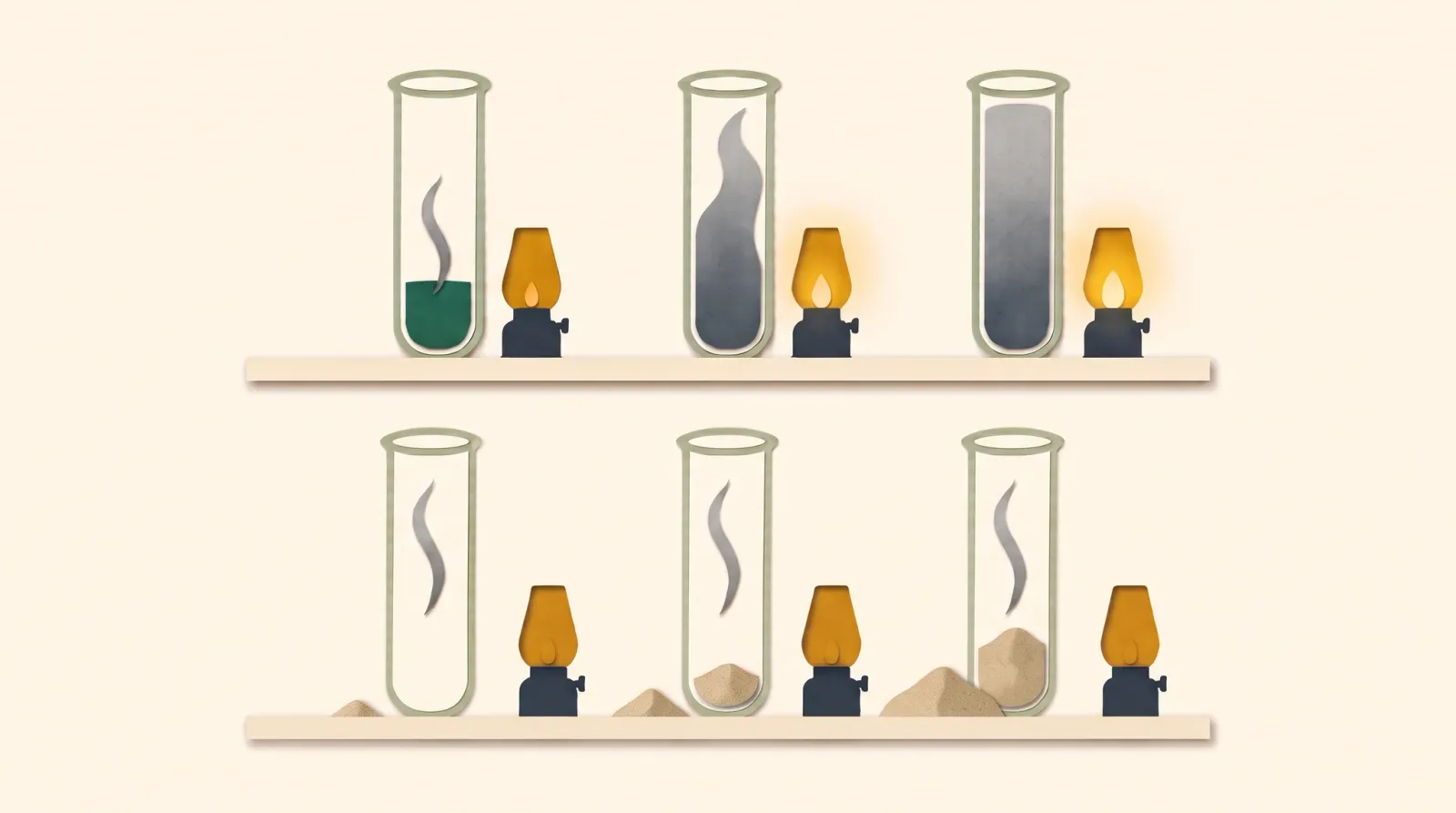
Many people do not get high the first time they smoke cannabis, and researchers have documented that for more than 70 years. The evidence points to three ordinary reasons: too little THC reached your bloodstream, you did not yet recognize the effects, or your body responds differently from your friend’s. The popular idea that your brain must “grow receptors” before weed works has no human evidence behind it in anything we found.
Here is the part worth sending to the friend who swore you did it wrong. In 1953, sociologist Howard Becker wrote that “the novice does not ordinarily get high the first time he smokes marihuana.” Becker, 1953 Four decades later, a controlled lab study changed one thing at a time. The felt high rose with how much smoke people drew per puff, not with how long they held it. Azorlosa et al., 1995
This lesson is for adults where cannabis use is legal. It explains the evidence and public-health guidance. It is not a method for getting high, and deciding not to try again is a perfectly good outcome. If you want the broader orientation first, our first-time cannabis guide covers what the first hour can feel like.
Is it normal to not get high the first time you smoke?
Yes, it is a well-documented experience, though no one has measured how often it happens.
Becker’s account comes from about fifty interviews with 1950s American users, half of them musicians. He said himself the sample was “in no sense random.” His conclusion, reprinted in his 1963 book Outsiders, was that “several attempts are usually necessary” before a new user gets high. Becker, 1953
A 2026 survey of 293 undergraduates points the same way. Students described their first cannabis use, and reactions ranged across enjoyment, discomfort and “no effect.” Dickinson et al., 2026 The abstract gives no percentage for “no effect,” and the paper is still a just-accepted manuscript.
So treat “most first-timers feel nothing” with suspicion. The honest version: feeling nothing is a recognized first reaction, and no study gives you its odds.
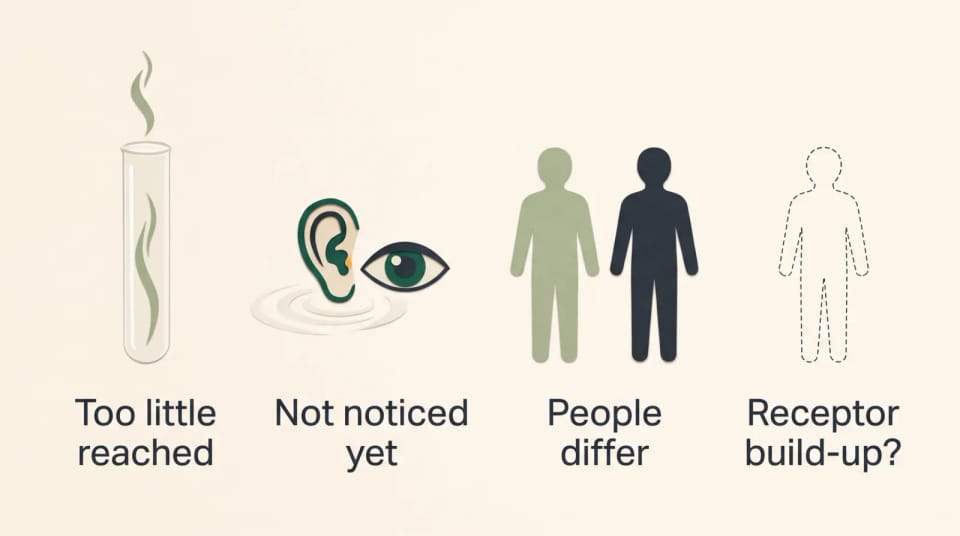
Delivery, noticing and individual differences each have human studies behind them. The receptor build-up idea is the empty box: no human source we found supports it.
Did you smoke it “right”? What controlled studies measured
How you smoke changes how much THC reaches your blood far more than most people expect. A NIDA review put smoked THC bioavailability at 2 to 56 percent, “due in part to intra- and inter-subject variability in smoking dynamics.” The number, length and spacing of puffs, plus inhalation volume, “greatly influences the degree of drug exposure.” Huestis, 2007
Lab studies isolated those variables with a smoking machine and regular users:
| What the lab changed | Blood THC | Rated “high” | Study |
|---|---|---|---|
| Puff volume (30, 60 or 90 ml) | Rose with volume | Rose with volume | Azorlosa et al., 1995 |
| Breath-hold (0, 10 or 20 seconds) | Rose | No reliable change | Azorlosa et al., 1995 |
| Number of puffs (4, 10 or 25) and THC content | Rose with both | Rose in order | Azorlosa et al., 1992 |
Read those numbers with care. Each experiment had seven people, all regular users, and the cigarettes held 1.75 to 3.55 percent THC, far weaker than much modern flower. The settings describe a lab protocol, not a target for you.
The 1995 authors wrote that their results “cast doubt on the common belief that prolonged breathholding” strengthens the high. An earlier study of eight regular smokers also found typical effects at every hold length. Zacny and Chait, 1989 Our article on what breath-holding studies found walks through the full set, including one study that pointed the other way.
Becker’s interviewees believed holding mattered. One said he “didn’t get high the first time” because “I don’t think I held it in long enough.” Becker, 1953 That records what novices were taught, not a test of it.
None of this means you need a bigger or deeper draw. Canada’s public-health guidance says to “avoid harmful practices such as inhaling deeply or breath-holding,” because they push more toxic material into the lungs. Health Canada First-time coughing or a joint that barely draws well can also mean very little smoke arrived at all.
Was the product strong enough, and did you get enough of it?
What you feel tracks the dose that reaches you, not the product label alone. In the 1992 study, different combinations of puff count and THC strength that produced similar blood THC produced similar subjective effects. Azorlosa et al., 1992 A few puffs of a weak product deliver little.
People also smoke the same product differently. In a study of 12 men, puff and inhalation volumes varied between people and shrank with the stronger cigarette. Heishman et al., 1989 So a shared joint does not give everyone the same dose.
There may also be a noticing threshold. In one oral THC study, a lower dose raised “feel drug” ratings in frequent users but had no effect in people who had used 10 times or fewer. Kirk and de Wit, 1999 At the higher dose, the infrequent group felt it more strongly than the frequent group. That cuts both ways: a small dose can slip under the radar, yet newcomers are not simply “less sensitive.” The study used pills, not smoke, and included no true first-timers.
The product itself can be the whole story. A low-THC or CBD-dominant flower may never produce a classic high. Our beginner dosing chart explains how strength is labelled; this article does not recommend taking more.
Could you have been high and not noticed?
Possibly. Becker described a second learning step: noticing the effects and linking them to the drug. Some of his interviewees were high “and didn’t know it” until a companion pointed out the signs. Becker, 1953
Timing matters too. After inhalation, effects start within seconds to a few minutes, peak after 15 to 30 minutes and taper within 2 to 3 hours. Grotenhermen, 2003 Judging a hit after two minutes means judging it before its peak. Our guide on why to wait before judging a hit covers that window.
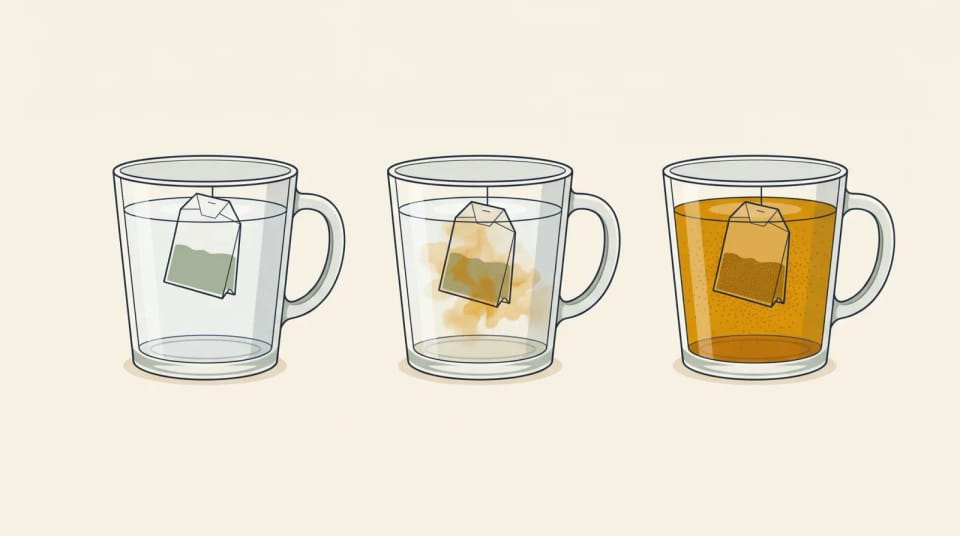
An analogy, not a measurement: an inhaled effect takes minutes to build, so the first two minutes are a poor time to judge a hit.
Does expecting to feel high change what you notice?
Yes, the rating of “how high am I” mixes the drug with your expectations. In a trial of 136 young adult regular users, “active drug and expectancy independently increased subjective intoxication.” Metrik et al., 2012
One plausible reading for first-timers: if you expected something dramatic, a mild real effect may register as nothing. No study has tested that in novices, so hold it loosely. Our lesson on how expectation changes the rating explains the balanced-placebo design behind these results.
Why do two people react differently to the same joint?
Part of the answer is inherited. In 1,299 twin and sibling pairs, additive genetic effects explained 16 to 56 percent of the variation in positive and negative reactions to alcohol, tobacco and marijuana, with drug-specific genetic influences mattering too. Haberstick et al., 2011
That study measured how people rated effects, years later, in a sample with heavy substance involvement. It named no gene and did not study people who felt nothing. Our explainer on genes and cannabis response covers the wider field; no source here shows that one gene explains a quiet first try.
One more caution. In a New Zealand birth cohort, teenagers who used before 16 and had more positive early reactions were more likely to be dependent by 21. Fergusson et al., 2003 That does not mean feeling nothing protects you, and it does not mean you are “meant” to feel something.
What about the “sensitization period” idea?
The claim goes like this: THC makes your brain build extra cannabinoid receptors, so weed only starts working after a few sessions. We found no human study that supports it.
The human imaging evidence points the opposite way for heavy use. PET scans of chronic daily smokers showed fewer CB1 receptors in cortical brain regions, tied to years of smoking. Levels returned to normal after about four weeks of monitored abstinence. Hirvonen et al., 2012
That study looked at long-term heavy smokers, so it cannot say what happens on day one. Our searches found nothing either way for first use, and an absent study is not proof. Tolerance is no better an explanation, because it needs prior exposure; see why tolerance cannot explain a first-time miss.
What does a careful second try look like?
Start with the option public health ranks first. Health Canada says “the most effective way to avoid the risks of cannabis use is to abstain,” and that delaying use until after adolescence reduces harm. Health Canada
If you are an adult where cannabis is legal and you choose to try again, the guidance is about lowering risk, not guaranteeing an effect:
- Pick a milder product. The Canadian guidelines advise “products with low THC content and high CBD: THC ratios.” Health Canada
- Skip the deep breath and the hold. The same guidance names both as harmful practices.
- Wait before judging. Inhaled effects peak 15 to 30 minutes in, so do not stack hits while you wait. Grotenhermen, 2003
- Plan the ride. Do not drive for at least 6 hours after use. Health Canada
- Stay somewhere familiar with a trusted adult. If it turns out stronger than expected, here is how to come down from being too high.
If you do try a specific strain, the High IQ app lets you log how it worked, so the next decision rests on a note instead of a hazy memory.
When to talk to a clinician: get medical help for chest pain, fainting, repeated vomiting or panic that does not settle. If you take prescription medicines, are pregnant, or have a heart or mental health condition, ask a clinician or pharmacist before using cannabis at all.
Key takeaways
- Feeling nothing on a first try is documented back to 1953, but no study gives its odds.
- In lab studies, how much smoke was drawn changed the high; breath-hold time did not.
- Product strength, timing and simply not recognizing the effects all play a part.
- Expectations and inherited differences shape how high people rate themselves.
- No human evidence we found supports a receptor “sensitization period.”
- Choosing not to try again is a valid outcome.
FAQ
Is it normal to not get high the first time you smoke weed?
Yes. Becker’s 1953 interviews described it as the usual pattern for new users, and a 2026 survey listed “no effect” among first-use reactions. Neither gives a percentage, so no one can say exactly how common it is.
Does holding the smoke in get you higher?
Controlled studies found that longer holds raised blood THC but did not reliably raise the rated high. Canadian public-health guidance advises against deep inhalation and breath-holding because they increase toxic intake. See what breath-holding studies found.
Why did it work the second time but not the first?
No study has tracked this directly. The likely candidates are a larger dose actually reaching you, recognizing effects you missed before, a stronger product, or different expectations. Tolerance cannot explain it, because tolerance needs earlier use.
Why do edibles do nothing for me when smoking works?
Oral THC takes a different route, with slower onset and more variable absorption. Grotenhermen, 2003 That is a separate question with its own myths; read the edible version of this question.
Sources
- Becker HS. “Becoming a Marihuana User.” American Journal of Sociology, 1953. Reprinted in Outsiders (1963). DOI 10.1086/221326
- Azorlosa JL, Greenwald MK, Stitzer ML. “Marijuana smoking: effects of varying puff volume and breathhold duration.” J Pharmacol Exp Ther, 1995. PubMed 7853169
- Azorlosa JL, Heishman SJ, Stitzer ML, Mahaffey JM. “Marijuana smoking: effect of varying delta 9-tetrahydrocannabinol content and number of puffs.” J Pharmacol Exp Ther, 1992. PubMed 1313866
- Zacny JP, Chait LD. “Breathhold duration and response to marijuana smoke.” Pharmacol Biochem Behav, 1989. PubMed 2554344
- Heishman SJ, Stitzer ML, Yingling JE. “Effects of tetrahydrocannabinol content on marijuana smoking behavior, subjective reports, and performance.” Pharmacol Biochem Behav, 1989. PubMed 2560548
- Huestis MA. “Human cannabinoid pharmacokinetics.” Chem Biodivers, 2007. PMC2689518
- Grotenhermen F. “Pharmacokinetics and pharmacodynamics of cannabinoids.” Clin Pharmacokinet, 2003. PubMed 12648025
- Kirk JM, de Wit H. “Responses to oral delta9-tetrahydrocannabinol in frequent and infrequent marijuana users.” Pharmacol Biochem Behav, 1999. PubMed 10340534
- Metrik J, et al. “Balanced placebo design with marijuana: pharmacological and expectancy effects on impulsivity and risk taking.” Psychopharmacology, 2012. PubMed 22588253
- Haberstick BC, et al. “Common and drug-specific genetic influences on subjective effects to alcohol, tobacco and marijuana use.” Addiction, 2011. PubMed 20955487
- Fergusson DM, Horwood LJ, Lynskey MT, Madden PA. “Early reactions to cannabis predict later dependence.” Arch Gen Psychiatry, 2003. PubMed 14557149
- Hirvonen J, et al. “Reversible and regionally selective downregulation of brain cannabinoid CB1 receptors in chronic daily cannabis smokers.” Mol Psychiatry, 2012. PubMed 21747398
- Dickinson HG, Kulak JA, Kamper-DeMarco KE, Felicione NJ. “First-Use of Cigarettes, E-Cigarettes, and Cannabis.” J Stud Alcohol Drugs, 2026 (online ahead of print). PubMed 42742593
- Health Canada. “Canada’s lower-risk cannabis use guidelines.” Modified 2020-01-22. canada.ca