Does Holding In Weed Smoke Get You Higher? The Myth Tested
No. Controlled studies found holding smoke in did not make the high stronger. The head rush comes from the breath-hold itself, and it adds smoke exposure.


Someone takes a hit, holds it until their face changes color, exhales, and says, “That one worked.” The room nods. The ritual feels scientific because it produces an obvious sensation: pressure, dizziness, maybe a head rush.
But does holding in weed smoke actually get you higher? The best controlled evidence says prolonged breath-holding does not reliably make the subjective cannabis high stronger. One small experiment did measure higher plasma THC after 10- and 20-second holds, but participants did not report a stronger high. Other controlled studies found little or no meaningful enhancement from longer holds [Azorlosa et al., 1995; Zacny and Chait, 1989; Zacny and Chait, 1991].
That is the important distinction: a detectable change in blood THC is not automatically a noticeable improvement in the experience. Meanwhile, keeping combusted material in the lungs extends contact with smoke. Canada’s evidence-based lower-risk guidelines specifically advise people who smoke cannabis to avoid deep inhalation and breath-holding.
So the short answer is no: holding smoke until you feel lightheaded is not a useful potency trick. It is an unreliable sensation paired with unnecessary smoke exposure.
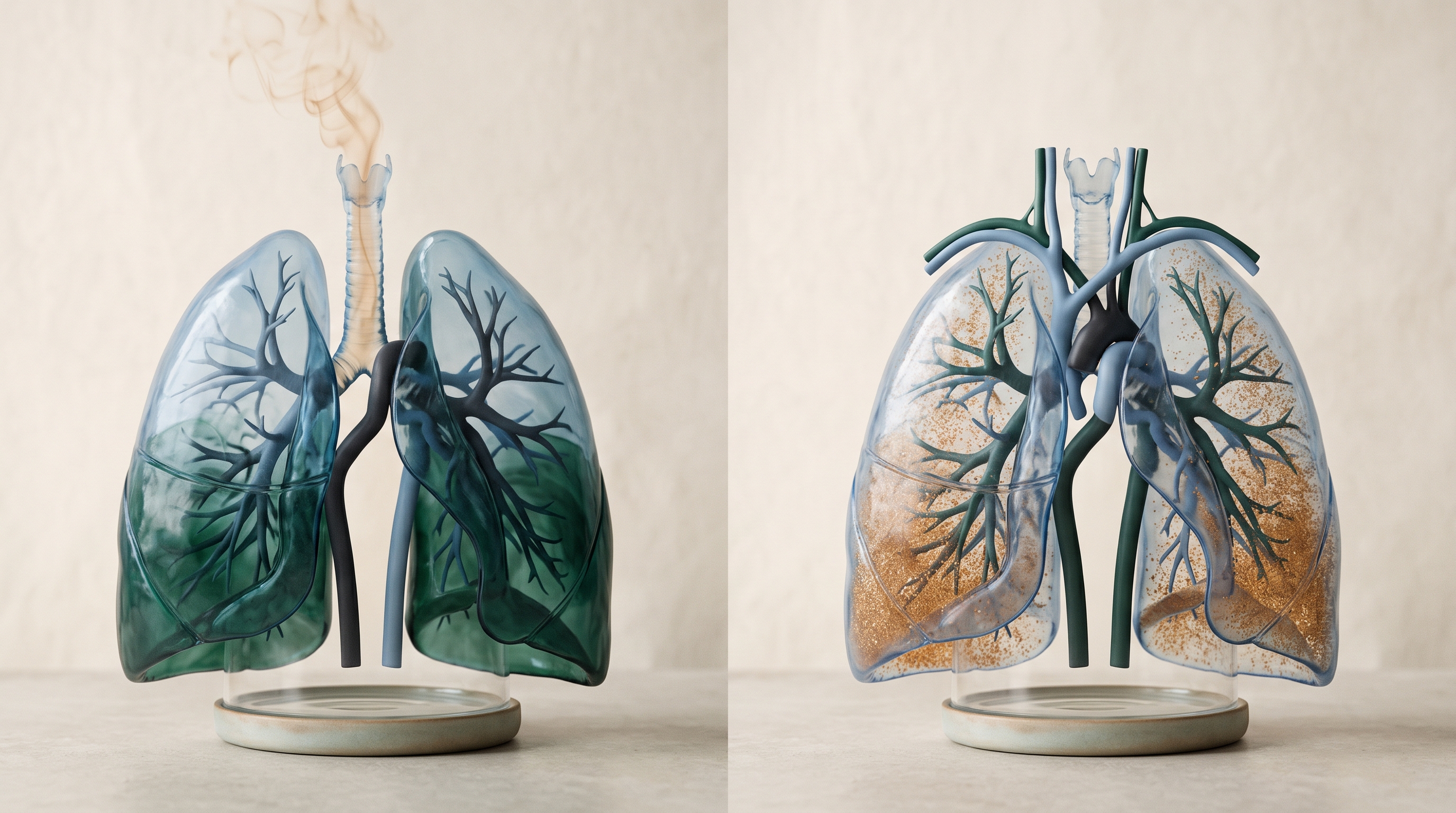
Key Takeaways
- Controlled studies do not show that prolonged breath-holding reliably produces a stronger subjective high.
- A seven-person experiment found higher plasma THC after longer holds with higher-potency research cannabis, but no corresponding increase in reported high.
- Lightheadedness is not a THC meter. Breath-holding, coughing, posture, anxiety, and THC itself can all change how a moment feels.
- Cannabis smoke contains combustion products as well as cannabinoids. A longer hold preserves the exposure, not just the ingredient you want.
- If you inhale cannabis, a normal comfortable inhale followed by a normal exhale avoids the extra breath-holding ritual. No inhaled cannabis method is risk-free.
- Non-inhaled products avoid smoke exposure but introduce different dosing risks, especially delayed onset and accidental redosing.
Why the myth feels so convincing
Holding a hit creates immediate feedback. Your chest tightens. The urge to breathe grows. You may cough hard after exhaling. If you stand up, laugh, or pass the joint at the same time, the moment can feel even more dramatic. Then the psychoactive effects of inhaled THC begin quickly, so the sensations overlap.
Three different things are commonly bundled into one “bigger hit” story:
- Cannabis exposure: THC from inhaled smoke moves rapidly from the lungs into circulation.
- Breath-hold sensations: carbon dioxide rises during a hold, oxygen eventually falls, and the urge to breathe becomes uncomfortable.
- Smoke irritation: particles and chemicals can trigger coughing, chest discomfort, and watering eyes.
Those signals can arrive within the same minute. Only the first is the cannabinoid effect people are trying to judge. The others can feel powerful without proving that more THC reached the brain.
This is similar to the mistaken belief that coughing makes a hit stronger. Intensity is not the same thing as pharmacology.
What happens to THC after you inhale
The lungs are designed for fast gas exchange. Their tiny air sacs, called alveoli, sit beside a dense network of blood vessels. When an inhaled aerosol reaches that region, THC can cross into the blood quickly. A pharmacokinetic review reported that pulmonary THC absorption produces peak plasma concentrations within minutes; the psychoactive effects begin within seconds to minutes and typically peak later [Grotenhermen, 2003].
That fast onset explains why inhaled cannabis feels so different from an edible. It does not mean every molecule of THC is absorbed the instant smoke touches your mouth, nor does it mean holding indefinitely is useful. Real-world bioavailability varies with the product, puff volume, inhalation pattern, combustion losses, side-stream smoke, and the person using it [Huestis, 2005].
Our guide to cannabis bioavailability by consumption method explains why there is no single absorption percentage that applies to every joint or person. The useful question here is narrower: once someone has inhaled, does stretching the breath-hold from normal to 10 or 20 seconds make the experience meaningfully stronger?
Researchers tested that question. The answer was mostly no.
The breath-hold studies, without the folklore
Study one: zero, 10, and 20 seconds
In 1989, James P. Zacny and Louis D. Chait studied eight regular cannabis smokers. The researchers controlled the number of puffs, puff volume, and the volume inhaled after each puff. Participants completed zero-, 10-, and 20-second breath-hold conditions in a randomized-block design [Zacny and Chait, 1989].
Each condition produced expected cannabis effects: heart rate rose, participants reported feeling high, and memory performance was impaired. But there was little evidence that the size of those responses depended on how long the smoke was held.
This experiment was tiny, and the research cannabis was not representative of today’s entire market. Its strength was experimental control: it isolated breath-hold duration more carefully than an anecdote could.
Study two: active cannabis versus placebo
A 1991 follow-up included 10 regular cannabis smokers and compared active 2.3% THC cannabis with placebo cannabis. Participants held smoke for either zero or 20 seconds. The long hold increased expired-air carbon-monoxide uptake for both active and placebo smoke: the reported mean carbon-monoxide boost was 6.9 parts per million after 20 seconds versus 4.4 after no hold [Zacny and Chait, 1991].
The cannabis effects on mood were not consistently strengthened by the longer hold. In other words, the experiment produced a cleaner signal for added smoke exposure than for added reward.

Study three: blood THC changed, subjective high did not
The most interesting nuance arrived in 1995. J. L. Azorlosa, M. K. Greenwald, and M. L. Stitzer ran two controlled experiments with seven regular cannabis users in each. One varied puff volume; the other varied breath-hold duration from zero to 10 to 20 seconds while controlling the other smoking parameters [Azorlosa et al., 1995].
Larger puff volume produced orderly increases in plasma THC, carbon monoxide, and reported high. Longer breath-holding was different. Ten- and 20-second holds increased plasma THC relative to no hold, particularly with the higher-potency research cigarette, but they did not increase subjective high ratings. Twenty seconds also did not provide an additional plasma-THC benefit over 10 seconds in that condition.
This is why “THC is absorbed instantly” is too simplistic. Some additional biological exposure may occur during a longer hold. Yet the outcome people mean by “get you higher” did not improve.
The study also warns against confusing concentration with experience. Blood THC and impairment are related, but the relationship is not a simple one-to-one gauge. Timing, tolerance, prior use, dose, and individual biology all complicate the connection. The same cannabis product can feel different from one session to another, even without changing the breath-hold.
What the studies can and cannot prove
Taken together, these experiments studied only a few dozen regular users with standardized, lower-potency cannabis from decades ago. They do not establish a perfect number of seconds for modern products.
They do answer the myth’s central promise: prolonged breath-holding has not reliably made people feel higher under controlled conditions. The evidence does not support turning 10- or 20-second holds into a recommendation.
Why lightheadedness is not proof of more THC
If a long hold does not reliably increase the subjective high, why can it feel so intense?
Breath-holding changes respiratory gases. Carbon dioxide builds while oxygen is being used. Your urge to breathe rises. Coughing or straining can also create brief pressure changes in the chest. Add THC—which can increase heart rate and alter blood pressure in some people—plus standing, dehydration, heat, or anxiety, and dizziness has several plausible contributors.
You cannot identify the cause by sensation alone. A head rush might overlap with intoxication, but it is not a laboratory measurement of THC absorption. The safest interpretation is simple: if you feel faint, stop, sit or lie down somewhere safe, and breathe normally. Do not repeat the maneuver to “confirm” it.
If someone faints, has chest pain, cannot breathe normally, appears confused, has blue or gray lips, or cannot be awakened, call emergency services. A dramatic reaction is not a cannabis achievement badge.
If the issue is uncomfortable intoxication rather than a breathing emergency, use our calm, practical guide on what to do when you are too high. Severe vomiting or repeated collapse should not be managed as an ordinary bad session; learn the warning signs in our guide to greening out.
What stays in your lungs during the hold
Cannabis smoke is not a THC delivery cloud with harmless scenery. Combustion creates particles, carbon monoxide, and reactive chemicals. A laboratory comparison found many of the same classes of toxic compounds in cannabis and tobacco smoke, although amounts and use patterns differed [Moir et al., 2008].
A 2018 systematic review of 22 studies found low-strength evidence associating cannabis smoking with cough, sputum production, wheeze, and shortness of breath. Evidence about long-term airflow obstruction remained insufficient, which is an important limitation [Ghasemiesfe et al., 2018]. The honest message is not “cannabis smoke equals tobacco in every outcome.” It is that burning plant material creates respiratory exposure, and uncertainty is not proof of safety.
The CDC’s cannabis lung-health guidance says cannabis smoke contains many of the same toxins and irritants as tobacco smoke. Canada’s Lower-Risk Cannabis Use Guidelines advise avoiding deep inhalation and breath-holding because those practices can disproportionately increase toxic-material intake.
For the broader evidence, see what research actually says about cannabis and lung health and our review of secondhand cannabis smoke.
A better harm-reduction rule: do not chase the head rush
There is no inhalation technique that makes smoke safe. If an adult who can legally use cannabis chooses to inhale it, the lower-risk principle is to avoid turning the lungs into a potency experiment.
- Do not use prolonged breath-holding as a dosing tool. Inhale comfortably and exhale normally.
- Avoid giant puffs. The Azorlosa experiments found that puff volume changed THC exposure and subjective effects—but a larger smoke dose also means more combustion exposure.
- Do not stack hits before the first one registers. Inhaled effects begin quickly, but the full subjective effect continues developing after exhalation. Our guide to how long a cannabis high lasts covers the timing.
- Do not combine cannabis with tobacco. Blunts and spliffs add tobacco smoke and may add nicotine; compare the formats in joints versus blunts versus spliffs.
- Stop if a product tastes burnt or causes repeated coughing. Smoothness does not prove safety, and harshness is not proof of potency.
- Never drive while impaired. Breath-holding cannot make a dose predictable enough for driving or other safety-sensitive activity.
If you use a joint, even excellent construction cannot remove combustion exposure. A properly prepared joint may burn more evenly, but rolling technique is a product-use question—not a lung-safety certification. The same goes for cooling smoke: hot versus cold bong water may change sensation without making smoke harmless.

What about vaping or edibles?
Avoiding combustion changes the exposure, but it does not erase risk.
Dry-herb vaporization may reduce exposure to carbon monoxide and some combustion products compared with smoking. It still creates an inhaled aerosol, and evidence does not make every device or product safe. Read our science-based smoking-versus-vaping comparison before treating “vapor” as one uniform category.
Edibles, capsules, and tinctures avoid direct smoke exposure to the lungs. Their major tradeoff is timing. Effects can be delayed, last much longer, and become harder to reverse after an accidental extra dose. Start with how to choose between flower, edibles, and concentrates, then use the two-hour rule for edible beginners. Do not switch routes and assume the dose translates directly.
The lowest-risk option for lungs is not inhaling smoke or aerosol. The lowest-risk option overall is not using cannabis. Harm reduction exists for adults who choose to use despite those risks; it is not a declaration that any route is harmless.
Track the dose, not the drama
A more useful record includes the product, labeled THC and CBD, approximate amount, route, time, onset, peak, unwanted effects, and context. Our approach is to find your ideal high by tracking your own response, not by copying the biggest inhale in the room. If you use High IQ to track personal cannabis patterns, treat the notes as a learning tool—not a reason to escalate a dose.
The Professor High verdict: take the breath-hold myth off the syllabus. The controlled evidence finds little payoff in subjective effects, while respiratory guidance finds a clear reason not to prolong smoke contact. Normal breathing is not “wasting” a hit.
FAQs
How many seconds should you hold in weed smoke?
There is no evidence-based breath-hold time that maximizes a high while making smoke safe. Controlled studies comparing zero, 10, and 20 seconds did not find a reliable subjective advantage from prolonged holding. Inhale comfortably and exhale normally rather than timing a hold.
Is all the THC absorbed in three seconds?
That precise rule is not established. Inhaled THC enters circulation rapidly, and some studies found biological exposure changed with breath-hold duration. But longer holds did not reliably increase the reported high. “Fast absorption” and “instant complete absorption” are not the same claim.
Why do I feel higher after holding a hit?
The cannabis effect may be arriving while breath-hold discomfort, coughing, anxiety, posture, and changes in respiratory gases create additional sensations. Feeling lightheaded cannot tell you how much THC reached your brain.
Does coughing make THC absorb better?
There is no good evidence that coughing itself improves THC absorption. A cough is a protective response to airway irritation. Deliberately provoking it adds discomfort and can make it harder to notice a genuine breathing problem.
Does holding vapor get you higher?
The classic controlled studies tested cannabis smoke, not every modern vaporizer. There is no sound basis for recommending prolonged vapor breath-holds, and aerosol is not harmless. A normal inhale and exhale avoids adding an unsupported ritual.
Is smoking cannabis safe if I do not hold it in?
No. Skipping a prolonged hold removes one avoidable practice; it does not remove smoke, particles, carbon monoxide, or other combustion products. Persistent cough, wheeze, chest discomfort, or shortness of breath deserves medical attention.
Sources
-
Azorlosa, J. L., Greenwald, M. K., & Stitzer, M. L. (1995). Marijuana smoking: effects of varying puff volume and breathhold duration. Journal of Pharmacology and Experimental Therapeutics, 272(2), 560–569. PubMed
-
Zacny, J. P., & Chait, L. D. (1989). Breathhold duration and response to marijuana smoke. Pharmacology Biochemistry and Behavior, 33(2), 481–484. DOI
-
Zacny, J. P., & Chait, L. D. (1991). Response to marijuana as a function of potency and breathhold duration. Psychopharmacology, 103(2), 223–226. DOI
-
Grotenhermen, F. (2003). Pharmacokinetics and pharmacodynamics of cannabinoids. Clinical Pharmacokinetics, 42(4), 327–360. DOI
-
Huestis, M. A. (2005). Pharmacokinetics and metabolism of the plant cannabinoids, delta-9-tetrahydrocannabinol, cannabidiol and cannabinol. Handbook of Experimental Pharmacology, 168, 657–690. PubMed
-
Moir, D., Rickert, W. S., Levasseur, G., Larose, Y., Maertens, R., White, P., & Desjardins, S. (2008). A comparison of mainstream and sidestream marijuana and tobacco cigarette smoke produced under two machine smoking conditions. Chemical Research in Toxicology, 21(2), 494–502. DOI
-
Ghasemiesfe, M., Ravi, D., Vali, M., Korenstein, D., Arjomandi, M., Frank, J., Austin, P. C., & Keyhani, S. (2018). Marijuana use, respiratory symptoms, and pulmonary function: a systematic review and meta-analysis. Annals of Internal Medicine, 169(2), 106–115. DOI

