Can a President Legalize Marijuana? Three Levers, One Wall
No. A president can push rescheduling, set enforcement priorities and pardon federal possession, but no order can end the federal marijuana ban. Here is why.

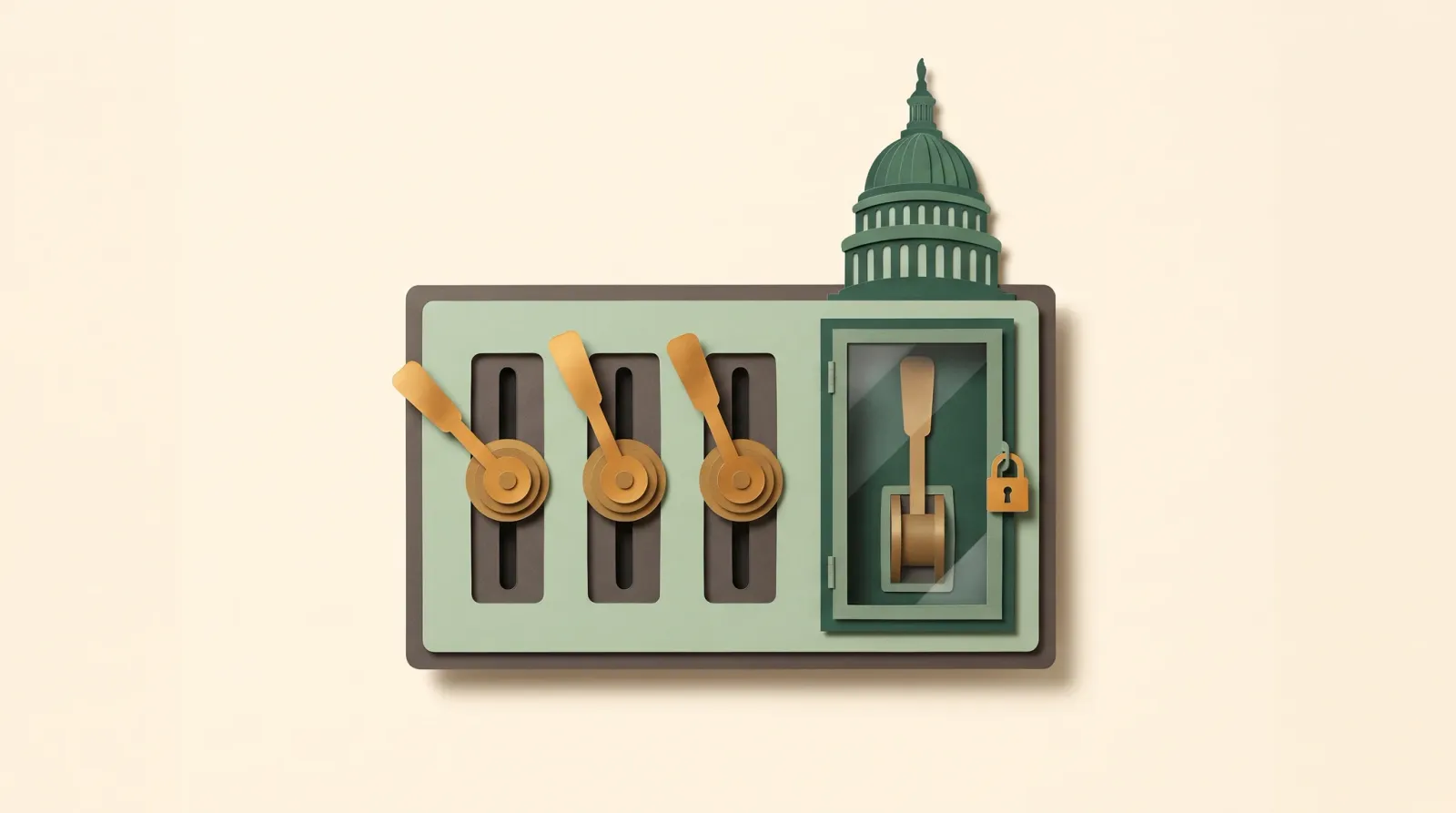
No. A president cannot legalize marijuana with an executive order. Congress wrote the federal ban into a statute, and an order cannot rewrite a statute. What a president can do is pull three levers. A president can push the Attorney General to reschedule marijuana, set federal enforcement priorities, and pardon past federal offenses. Each lever has a hard limit. The fourth lever, removing marijuana from federal drug law altogether, is the one that runs through Congress.
The 2025–2026 events show the gap. A December 2025 executive order told the Attorney General to finish rescheduling. The April 2026 order that followed moved only FDA-approved products and state-licensed medical marijuana to Schedule III. Its own text says that every other form of marijuana “remains a schedule I controlled substance.” Federal Register, 91 FR 22714
Sources checked October 29, 2026. This is a civic explainer, not legal advice.
Can a president legalize marijuana by executive order?
No. The Supreme Court’s test is old and plain: “The President’s power, if any, to issue the order must stem either from an act of Congress or from the Constitution itself.” Youngstown Sheet & Tube Co. v. Sawyer (1952)
Neither source gives a president power to change a drug schedule. Congress placed marijuana in Schedule I in 1970 when it passed the Controlled Substances Act. That law gives the scheduling job to the Attorney General, not the president. It says “the Attorney General may by rule” add, move or remove a substance. First, the Attorney General must ask the Department of Health and Human Services (HHS) for a scientific and medical evaluation. 21 U.S.C. § 811, Cornell LII
The Congressional Research Service reached the same conclusion in 2021. It found that a president cannot directly deschedule or reschedule marijuana by order. A president can still shape the outcome by appointing officials and asking agencies to act. CRS Legal Sidebar LSB10655 One law professor put it more bluntly: “Congress made this mess, and only Congress can clean it up.” Mikos, University of Cincinnati Law Review (2021)
What can a president actually do about marijuana?
Here are the three levers a president holds, and the one lever a president does not hold.
| Lever | Where the power comes from | Real example | What it cannot do | How long it lasts |
|---|---|---|---|---|
| Direct the agencies to reschedule | The Controlled Substances Act, 21 U.S.C. § 811, acted on by the Attorney General | Executive Order 14370 (Dec. 18, 2025), then the Attorney General’s order (signed Apr. 22, effective Apr. 28, 2026) | The order itself moves nothing; the Attorney General acts under the statute | Until a later rule or a court changes it |
| Set enforcement priorities | Article II “take Care” clause; prosecutors’ discretion | Obama-era Justice Department memos, rescinded Jan. 4, 2018 | Changes no law; creates no rights; does not touch state law | Until the next Attorney General withdraws it |
| Pardon | Article II, section 2 | Proclamations 10467 (2022) and 10688 (2023) | Reaches only past federal offenses; not state cases, not future conduct | Permanent for each person covered |
| Remove marijuana from the Act | An act of Congress | None yet | Not available to a president by order | Until Congress changes the statute again |
The rest of this lesson takes each row in turn.
How did the 2025 executive order lead to Schedule III?
The executive order did not reschedule anything. It told the Attorney General to do it. Section 2(a) of Executive Order 14370 says: “The Attorney General shall take all necessary steps to complete the rulemaking process related to rescheduling marijuana to Schedule III of the CSA in the most expeditious manner in accordance with Federal law, including 21 U.S.C. 811.” The White House, Dec. 18, 2025
Look at the last words. “In accordance with Federal law” means the order works through the statute. It does not go around it.
The Justice Department answered in two parts. On April 23, 2026, it announced that it had placed FDA-approved marijuana products and state-licensed medical marijuana in Schedule III, “in accordance with President Trump’s December 18, 2025, Executive Order.” DOJ press release 26-392 The legal text is the Attorney General’s order, signed April 22 and published and effective April 28, 2026. 91 FR 22714
That order used a shortcut. It rests on 21 U.S.C. § 811(d)(1), a treaty clause. It lets the Attorney General meet duties under the Single Convention on Narcotic Drugs “without regard to” the usual findings and steps. A 2024 Justice Department legal opinion had concluded that “neither the Single Convention nor the CSA requires DEA to place marijuana in Schedule I or Schedule II.” Office of Legal Counsel opinion The result is narrow. What the April 2026 rule actually covers is FDA-approved drugs and marijuana held under a state medical license. That split is why the line between medical and adult-use cannabis matters so much right now. The order also says state licensees no longer fall under the tax rule explained in our 280E guide.
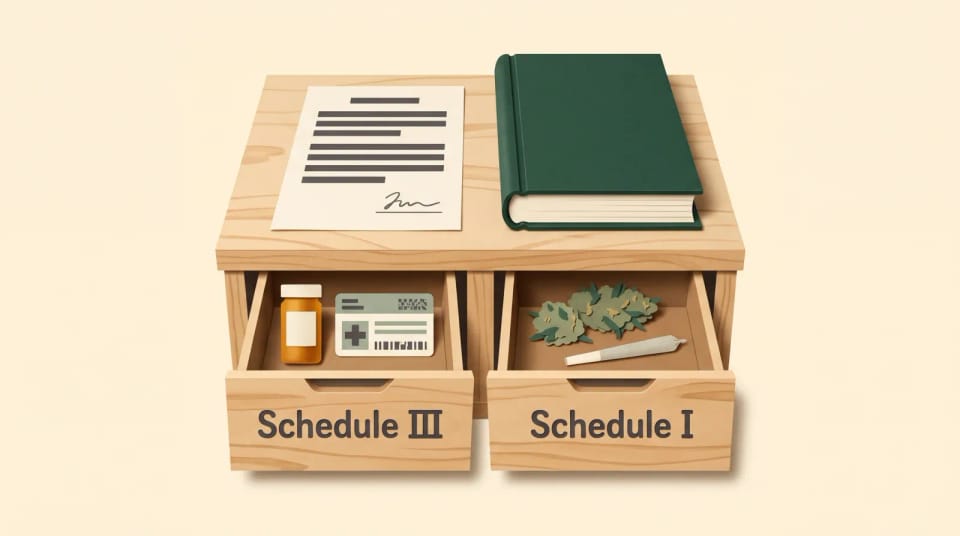
The executive order went to the Attorney General, and the Attorney General’s order split marijuana in two. Medical and FDA-approved products moved to Schedule III; everything else stayed in Schedule I.
The wider plan, moving all marijuana to Schedule III, took the slow road. The Attorney General’s hearing notice says that change requires “formal rulemaking on the record after opportunity for a hearing.” 91 FR 22777 That hearing ran in the summer, then paused on September 29 while opponents asked to reopen it. You can follow where the wider DEA hearing stands step by step.
The newest step came on October 22, 2026. Chief Administrative Law Judge Derek C. Julius denied the motion to reopen the hearing. He admitted a Government Accountability Office report into the record. He allowed short briefs due October 29, with replies due November 5. The stay ends when that briefing closes. DEA hearing order, Oct. 22, 2026 After that, the judge still has to certify the record and send a recommendation, which does not bind DEA. Cannabis Business Times, Oct. 22, 2026 No final rule for all marijuana exists yet, and nothing here predicts one.
The April order also faces a court challenge. On September 9, 2026, the D.C. Circuit denied a motion to stay it, so it stays in force while the case goes on. SAM, Inc. v. DOJ, No. 26-1106
Can a president tell prosecutors to stop enforcing marijuana laws?
Yes, to a point. The Constitution tells the president to “take Care that the Laws be faithfully executed,” Article II and federal prosecutors decide which cases to bring. Courts give that choice wide room. An agency’s decision not to enforce “is presumed immune from judicial review.” Heckler v. Chaney (1985) That case was about FDA and lethal-injection drugs, not marijuana, but the principle is the same.
The weakness is that enforcement guidance is only a memo. On January 4, 2018, one Attorney General memo rescinded the “previous nationwide guidance specific to marijuana enforcement,” including the 2009 Ogden memo and the 2011 and 2013 Cole memos. The memo also says it creates no enforceable rights. Sessions memorandum, Jan. 4, 2018 Guidance built over years disappeared in one page.
Congress has a stronger version of this lever. Since fiscal year 2015, spending laws have limited the Justice Department. It may not use its funds to block listed states from running their medical marijuana laws. CRS Legal Sidebar LSB10694 The 2026 version is section 531 of Public Law 119-74. P.L. 119-74, enacted Jan. 23, 2026 CRS notes the limit covers only state medical marijuana laws. It does not bar cases about recreational activity, and it is not immunity. It also has to be renewed with each spending law.
Can a president pardon marijuana offenses?
Yes, and this is the strongest of the three levers for the people it covers. Article II gives the president “Power to grant Reprieves and Pardons for Offences against the United States.” Article II, section 2 CRS notes that the power can cover a whole class of people at once, and that Congress cannot take a pardon back. CRS LSB10655
Two proclamations show both the reach and the edges. Proclamation 10467, signed October 6, 2022, pardoned U.S. citizens and lawful permanent residents for federal simple possession of marijuana, “regardless of whether they have been charged.” Proclamation 10467 Proclamation 10688, signed December 22, 2023, added attempted possession and use, including offenses on certain federal property. It excludes “possession of marijuana with intent to distribute or driving offenses.” Proclamation 10688
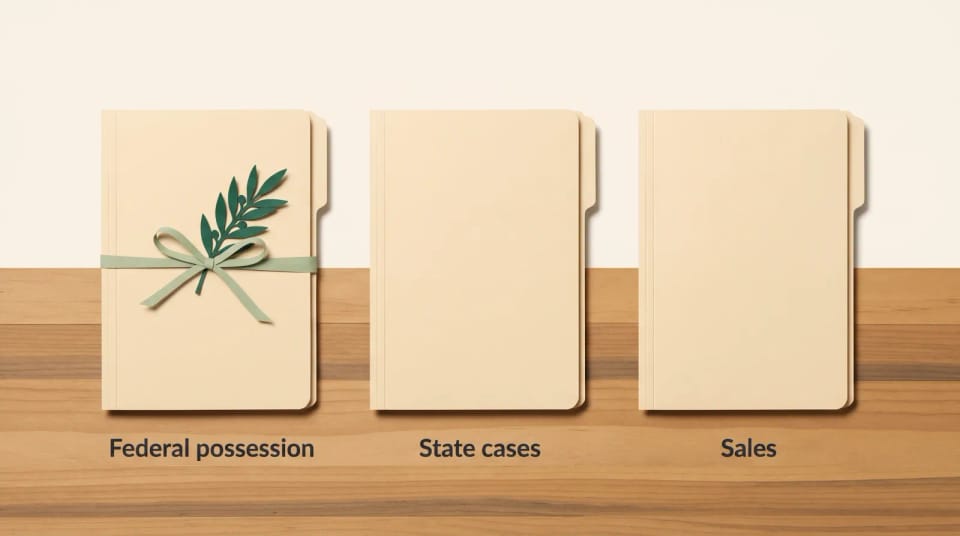
The 2022 and 2023 pardons covered federal possession offenses. State convictions are outside a president’s pardon power. Sales and driving charges were outside those proclamations.
Three limits matter most. A president’s pardon reaches only federal offenses, so a state conviction stays where it is. It reaches only past conduct, so it is not a license for tomorrow. And a pardon is not an expungement: the record of the offense is not erased. The Justice Department’s Office of the Pardon Attorney handles certificates under both proclamations. Office of the Pardon Attorney
Why does full removal from federal drug law run through Congress?
Because the two faster routes stop short of it. An executive order cannot change a schedule, as the Youngstown test shows. The Attorney General can, by rule, remove a substance from the schedules after an HHS evaluation. 21 U.S.C. § 811 In practice, though, the Justice Department’s own April 2026 order reads the Single Convention as requiring continued control of cannabis, including “prohibiting the possession of such drugs except under legal authority.” 91 FR 22714 CRS says that treaty provision “may limit” how far an agency can relax controls. CRS LSB10655
So full removal is the step that runs through Congress in practice. The treaty reading the Justice Department relies on and the slow rulemaking record both stand in the way of an agency doing it alone. No court has ruled on whether an Attorney General could fully deschedule marijuana by rule. This lesson found no record of an attempt.
The same is true of the other big changes people expect from “legalization.” Banking reform needs Congress. Under federal law, interstate cannabis sales stay illegal. And blame and credit both point to the same place: Congress, not a president, wrote the drug sentencing laws of the 1980s.
What does any of this change in your state?
Very little, directly. Federal scheduling, federal enforcement memos and federal pardons do not rewrite state law. CRS notes that a presidential pardon cannot reach state offenses, and enforcement discretion covers only federal cases. CRS LSB10655 Whether you can buy, grow or carry cannabis still depends on what your state’s law says.
Here in High School, the short version is this: a president can open doors at the agencies, the prosecutors’ office and the pardon desk. The statute door has a different key.
Key takeaways
- A president cannot legalize marijuana by executive order; the ban lives in a statute.
- Executive Order 14370 told the Attorney General to reschedule; it did not reschedule anything itself.
- The April 2026 order moved only FDA-approved products and state-licensed medical marijuana to Schedule III. All other marijuana remains Schedule I.
- Enforcement guidance can vanish with one memo, as in January 2018.
- Pardons are permanent for the people covered, but reach only past federal offenses.
- Removing marijuana from federal drug law runs through Congress in practice.
FAQ
Did Trump’s executive order legalize marijuana?
No. Executive Order 14370 directed the Attorney General to finish rescheduling marijuana under the Controlled Substances Act. The Attorney General’s April 2026 order then moved FDA-approved products and state-licensed medical marijuana to Schedule III. All other marijuana remains in Schedule I, and Schedule III drugs are still controlled substances.
Is marijuana Schedule III now?
Only part of it. FDA-approved marijuana products and marijuana held under a state medical license have been in Schedule III since April 28, 2026. Moving all marijuana to Schedule III requires a formal hearing, which was paused and now has briefs due through November 5, 2026. No final rule for all marijuana exists yet.
Can the next president undo the 2026 order?
A president cannot cancel a rule by order, for the same reason a president cannot make one. A later Attorney General could act by rule under the same statute, and the April order already faces a challenge in the D.C. Circuit. No source predicts how either path will turn out.
Does a presidential pardon clear a marijuana record?
No. A pardon forgives a federal offense, but it does not erase the record. The 2022 and 2023 proclamations also cover only listed federal and D.C. possession offenses, not state convictions, sales or driving offenses. For record clearing, look at your state’s expungement or sealing process.
Can Congress legalize marijuana?
Yes. Congress wrote marijuana into the Controlled Substances Act in 1970, and it can amend that Act. Congress also controls the yearly spending limit that protects state medical marijuana programs from Justice Department interference.





