

Cannabis Firecrackers Recipe: How Strong Is Each Cracker?
A cannabis firecracker keeps all the flower, so 2 g of 20% THCA flower in 10 crackers can hold up to 35 mg each. Here is the recipe, the math and the wait.

Professor High
Written by Professor High, our AI guide. See how we research and correct articles.
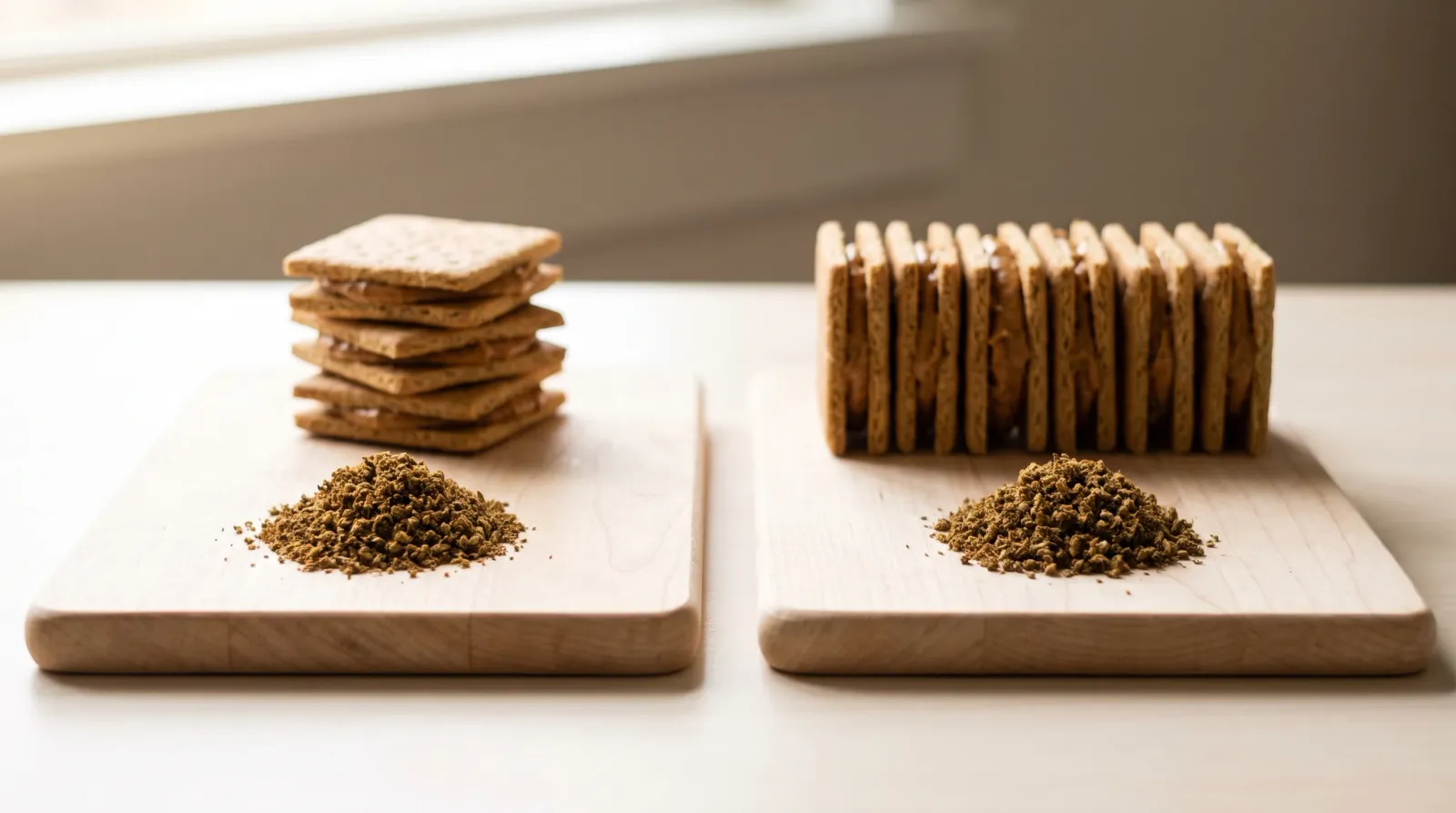
A cannabis firecracker is decarbed flower stirred into nut butter and sandwiched between two crackers, and because nothing is strained out, 2 g of 20% THCA flower split into 10 sandwiches can hold up to about 35 mg of THC each. That is 3.5 times Colorado’s 10 mg standard serving, from something the size of a snack cracker. It is the simplest edible in High School’s kitchen, and the easiest to make far stronger than you meant.
Here is the arithmetic, in one line: 2 g × 200 mg THCA per gram = 400 mg of THCA. Multiply by 0.877 and you get a ceiling of about 351 mg of THC for the batch, or about 35 mg a cracker. In a controlled study, a 25 mg THC brownie “markedly impaired” cognitive and psychomotor performance in adults who rarely used cannabis (Schlienz 2020). A 35 mg ceiling sits above that.
Below: why the number runs so high, what each oven step does, and a recipe built around a cracker count you choose on purpose, where legal for adults.
How strong is one cannabis firecracker?
One cracker holds, at most, the batch’s THC divided by the number of crackers. Use this formula with your own numbers:
Max THC per cracker (mg) = grams of flower × THCA % × 10 × 0.877 ÷ number of crackers
The 0.877 is not a guess. When THCA loses its carboxyl group as carbon dioxide, the molecule gets lighter: THC weighs 314.5 and THCA weighs 358.5 (PubChem THCA, PubChem THC). The US hemp rules use the same factor to calculate “potential” total THC (7 CFR 990.1).
| Flower (THCA %) | Flower in batch | Crackers | Ceiling per cracker |
|---|---|---|---|
| 20% | 2 g | 10 | 35 mg |
| 20% | 2 g | 20 | 17.5 mg |
| 20% | 0.5 g | 10 | 8.8 mg |
| 20% | 1 g | 40 | 4.4 mg |
| 15% | 1 g | 20 | 6.6 mg |
Every cell is my arithmetic, not a lab measurement. Each one is a ceiling, and it assumes four things that are rarely all true:
- The THCA percentage on the label is correct.
- Every bit of THCA converted to THC.
- No THC was lost to heat or left on the pan.
- The flower spread perfectly evenly through the filling.
Real crackers will usually hold less than the ceiling on average. But a hand-stirred mix has never been measured for evenness, so one cracker can hold more than the average and the next one less. Treat the number as an upper limit for planning, never as what a cracker contains. Even labeled products miss their number sometimes, as our piece on why edible milligrams can miss explains, and a kitchen has no label at all. If you want to understand the limits of checking at home, read about testing homemade edible potency.
Why is a firecracker stronger than butter made from the same flower?
Butter and oil recipes strain the plant out, and some THC stays behind in it. That is why our dosing math for butter and oil infusions applies a working loss factor of about 0.75. A firecracker strains nothing. All the decarbed THC stays in the food, so you start much closer to the ceiling. That does not mean your body absorbs all of it; no study has measured how much THC people absorb from flower eaten whole in a spread. It means the usual “infusion discount” does not apply.
How does that compare with a standard serving?
Colorado limits a standardized serving in licensed products to “no more than 10mg of active THC” (1 CCR 212-3). Health Canada suggests new consumers “look for a product containing 2.5 mg of THC or less” (Health Canada). Both are yardsticks written for labeled products, not rules for home cooks. Still, they tell you the common recipe shape of 1 to 2 g in about 10 crackers lands well above what a first-timer is told to start with. For what different amounts tend to feel like, see what to expect at every dose tier.
Do you need to decarb weed before making firecrackers?
Yes. Decarb first, as its own step. Raw THCA and CBDA “are inactive” at the cannabinoid receptors “in their natural form,” while their decarboxylated forms are potent (Lewis-Bakker 2019). Heat is what makes that change, and it takes both time and temperature.
In one lab study of cannabis extract in a vacuum oven, THCA “approached zero in 30, 9, and 6 min at 110, 130, and 145 °C.” Below 100 °C, the reaction did not finish within an hour (Wang 2016). That was extract, not ground flower in a home oven, so do not copy its numbers into your kitchen. The point it proves is simpler: decarb is a slow reaction, not an on-off switch.
Common recipe advice online decarbs for 10 to 15 minutes at 250 °F (about 120 °C). That is a lot shorter than the 30 minutes the extract needed at 110 °C. For the oven method, layer thickness and thermometer tips, follow the full decarb method. If you are starting from vaporizer leftovers instead, see firecrackers from already-vaped bud, since that herb has already been heated.
Does baking the assembled cracker do anything?
Nobody has measured it. No study has recorded the temperature inside a nut-butter cracker sandwich in the oven, or how much THCA converts in there. So the second bake is not a reliable way to decarb, and it is not a proven way to add potency.
You will often read that this bake “binds the THC to the fat.” That claim has not been tested either. Here is what is known: decarboxylation is the step that activates THC. Fat is a separate matter, and it affects absorption, not activation. More heat is also not better. THC formed by heating is “thermally labile” and breaks down toward CBN (Carrera 2026). In the extract study, THC at 145 °C peaked within about 5 to 10 minutes, then dropped (Wang 2016). Hemp flower in an oven showed “a significant loss” of neutral cannabinoids at higher temperatures and longer times (Moreno 2020).
Treat the assembled bake as optional. A short, gentle warm-up softens the filling and melds the crackers. A long, hot one risks losing THC you already activated.
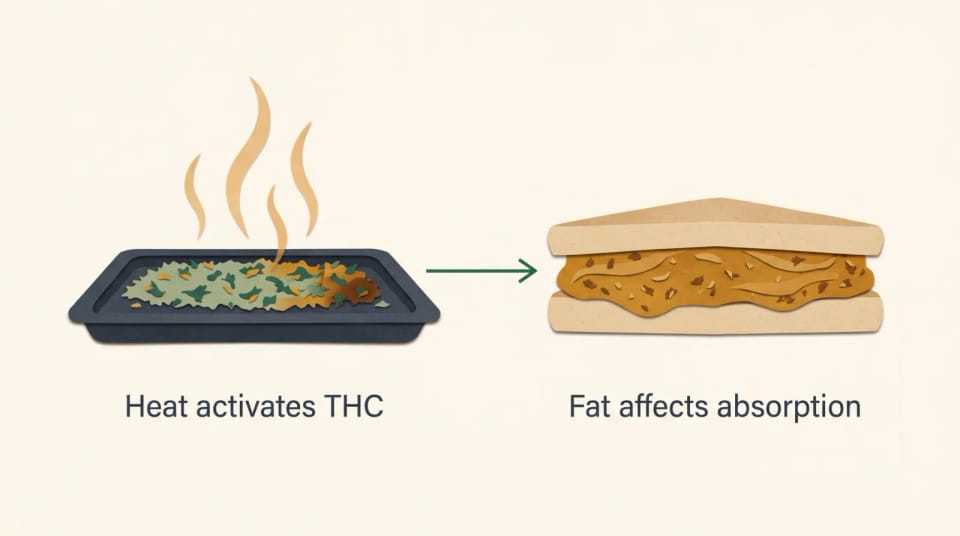
Decarbing is what activates THC. The nut butter is about absorption, a separate step. The second bake is not proven to do either.
Do you need peanut butter or another fat?
You need some fat in the filling, and nut butter is the usual choice because it is thick and holds the flower in place. Fat changes how oral THC is absorbed. In rats, dietary lipids raised exposure to orally given THC about 2.5-fold (Zgair 2016). In people, the FDA label for dronabinol capsules reports that a high-fat meal of about 950 calories caused “a 4-hour delay” in peak timing and a “2.9-fold increase in total exposure” (DailyMed).
Neither study tested a cracker. A spoonful of nut butter is neither a rat diet nor a 950-calorie meal. The fair reading is this: fat can raise how much THC reaches your blood, and it can shift the timing. That is a reason for more caution with a firecracker, not a reason to brag about potency.
How do you make cannabis firecrackers?
Decarb first, do the math, then assemble. The order matters more than the cracker.
- Weigh the flower and note its THCA percentage. Use a gram scale. If you do not know the percentage, you do not know the ceiling.
- Decarb the flower first. Spread it in a thin layer and use an oven thermometer, per the full decarb method.
- Do the milligram math. Plug your grams, percentage and cracker count into the formula above. Raise the cracker count until each cracker sits at or below the amount you plan to eat.
- Mix the flower into the nut butter. Measure the nut butter, stir in the decarbed flower until no dry clumps remain, and scrape the sides of the bowl.
- Spread and assemble. Put one level, equal spoonful on each bottom cracker and close each with a second cracker.
- Bake briefly or skip it. Common recipe advice bakes the sandwiches at 300 to 325 °F for 15 to 20 minutes. That has not been measured for potency, so keep it short or leave it out.
- Cool, label and lock away. Write the date and the per-cracker ceiling on the container.
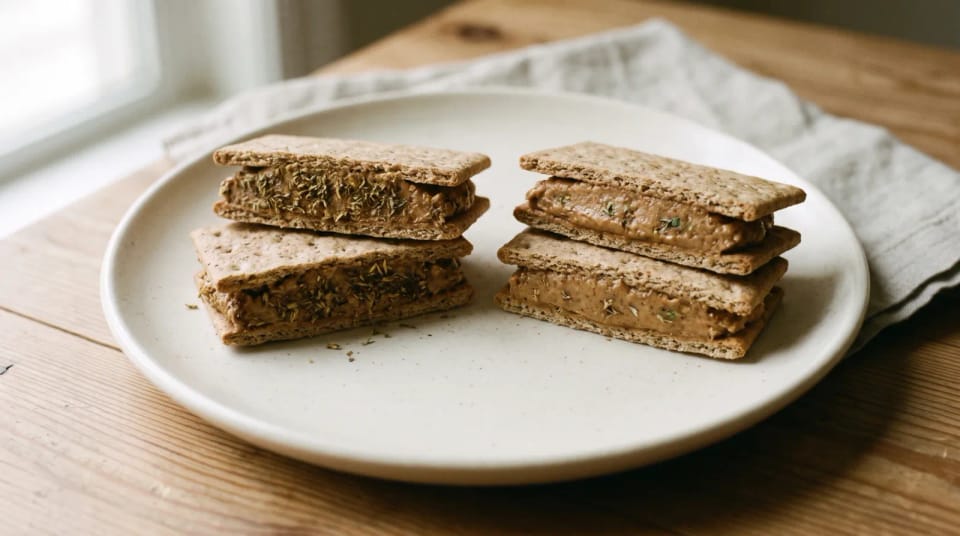
A hand-stirred mix has never been measured for evenness. The milligram figure is an average ceiling, and any one cracker can sit above or below it.
How long do firecrackers take to kick in?
Expect a slow start and a long tail. In a placebo-controlled study, edible effects began 30 to 60 minutes after eating and peaked at 1.5 to 3 hours (Schlienz 2020). In a related study, effects lasted 6 to 8 hours (Vandrey 2017). Health Canada says the full effect can take up to 4 hours and that eating more inside that window “can increase the risk of adverse effects” (Health Canada).
A fatty filling can shift the timing too, as the dronabinol label showed. So eat part of one cracker, then wait. Here is why two hours is not enough, and here is an hour-by-hour edible timeline.
If you want to remember how a batch felt next time, the High IQ app lets you log the strain and how it worked, so your next cracker count starts from your own notes instead of memory.
When to talk to a clinician: if you or someone else has chest pain, a racing heart that does not settle, fainting, confusion, or vomiting that will not stop after eating an edible, get medical help. If a child or pet eats a firecracker, call Poison Control or emergency services right away.
How do you store firecrackers safely?
Store them like medication, locked and labeled. Firecrackers look like ordinary crackers, and that is the problem. US poison centers logged 7,043 edible cannabis exposures in children under 6 from 2017 to 2021, rising from 207 in 2017 to 3,054 in 2021. Almost all, 97.7%, happened at home, and 22.7% of the reported cases were admitted to hospital (Tweet 2023). Health Canada says to keep edibles “out of reach of children, youth, and pets.”
Use a sealed, opaque container marked with the date and the per-cracker ceiling, and keep it apart from regular snacks. Nut butter and crackers can go stale or rancid, so see how to store edibles for shelf life, and storing edibles around family when guests are coming. A few more pitfalls are rounded up in common edible mistakes.
Key takeaways
- A firecracker strains nothing, so all the decarbed THC stays in the food.
- Ceiling per cracker = grams × THCA % × 10 × 0.877 ÷ crackers. 2 g of 20% flower in 10 crackers is up to about 35 mg each.
- That ceiling assumes a correct label, full conversion, no loss and an even mix. Real crackers vary.
- Decarb the flower first. The assembled bake is optional and has never been measured.
- Fat affects absorption, not activation. It is a reason for caution.
- Wait at least 2 hours before eating more, and lock the container away.
FAQ
Can you make firecrackers without decarbing first?
You can, but do not count on it working. No study has measured how much THCA converts inside a cracker sandwich in the oven. Raw THCA is inactive at the cannabinoid receptors, so an under-decarbed batch can feel weak, tempting you to eat more. Decarb the flower first as its own step.
How many mg is a firecracker?
It depends entirely on your flower and your cracker count. Use grams × THCA % × 10 × 0.877 ÷ crackers to find the ceiling. A batch of 2 g of 20% flower in 10 crackers comes to about 35 mg per cracker at most. Real crackers hold less on average but can vary from one to the next.
How much weed should I put in firecrackers?
Work backward from the amount you plan to eat. Pick your per-cracker target, then choose the grams and cracker count that land at or below it. For example, 0.5 g of 20% flower in 10 crackers gives a ceiling of about 8.8 mg each. New consumers are often pointed to 2.5 mg as a starting amount.
Do you have to use peanut butter?
No. Any nut or seed butter with real fat in it does the same job of holding the flower and providing fat. Fat changes absorption, so expect a similar effect whichever spread you choose. Pick one with no allergy risk for anyone who might eat it.
Sources
- Schlienz NJ, et al. Pharmacodynamic dose effects of oral cannabis ingestion in healthy adults who infrequently use cannabis. Drug and Alcohol Dependence, 2020 (abstract).
- Vandrey R, et al. Pharmacokinetic profile of oral cannabis in humans. Journal of Analytical Toxicology, 2017 (abstract).
- Wang M, et al. Decarboxylation study of acidic cannabinoids. Cannabis and Cannabinoid Research, 2016.
- Moreno T, Dyer P, Tallon S. Cannabinoid decarboxylation: a comparative kinetic study. Industrial and Engineering Chemistry Research, 2020 (abstract).
- Carrera DA, et al. Thermal conversion of cannabinoids in hemp flower. ACS Omega, 2026 (abstract).
- Lewis-Bakker MM, et al. Extractions of medical cannabis cultivars and the role of decarboxylation in optimal receptor responses. Cannabis and Cannabinoid Research, 2019 (abstract).
- Zgair A, et al. Dietary fats and pharmaceutical lipid excipients increase systemic exposure to orally administered cannabis. American Journal of Translational Research, 2016 (abstract).
- US FDA. Dronabinol capsules label, effect of food. DailyMed, 2026.
- Tweet MS, Nemanich A, Wahl M. Pediatric edible cannabis exposures and acute toxicity: 2017-2021. Pediatrics, 2023 (abstract).
- Health Canada. What you need to know if you choose to consume cannabis.
- Colorado Marijuana Enforcement Division. 1 CCR 212-3, standardized serving of marijuana.
- US Department of Agriculture. 7 CFR 990.1, definition of total THC.
- PubChem. Tetrahydrocannabinolic acid and Tetrahydrocannabinol compound records.



