Cannabis for Spasticity: The MS and Spinal Cord Science
Spasticity is one of the most disabling symptoms of MS and spinal cord injury. Here is what the science says about cannabis, nabiximols, and relief.

Picture a muscle that will not let go. Not a cramp that passes in a minute, but a leg that locks rigid when you try to stand, a thigh that clenches in the middle of the night, a calf that jumps into a spasm every time you shift in your chair. That is spasticity, and for millions of people living with multiple sclerosis (MS) or a spinal cord injury (SCI), it is one of the most stubborn and life-shrinking symptoms they face.
Cannabis comes up in almost every conversation about spasticity, and for good reason. In 29 countries, a cannabis-based oral spray called nabiximols is an approved prescription medicine specifically for MS spasticity. That is rare. Most of what we cover here on This Is Why I’m High Learn lives in the gray zone of “promising but unproven.” Spasticity is one of the few areas where a cannabis medicine cleared the regulatory bar.
But the story is more interesting and more honest than a simple “it works” headline. The science here contains a genuine puzzle: patients consistently say cannabis helps their stiffness, while doctors measuring that same stiffness with a ruler often see little to nothing. Untangling that gap is the whole game. Let me walk you through it.
A note before we dive in: This article is educational, not medical advice. Spasticity is a serious neurological symptom, and MS and SCI are complex conditions. Cannabinoids interact with other medications and are not right for everyone. Please talk to your doctor or neurologist before changing anything about how you manage spasticity.
What Spasticity Actually Is
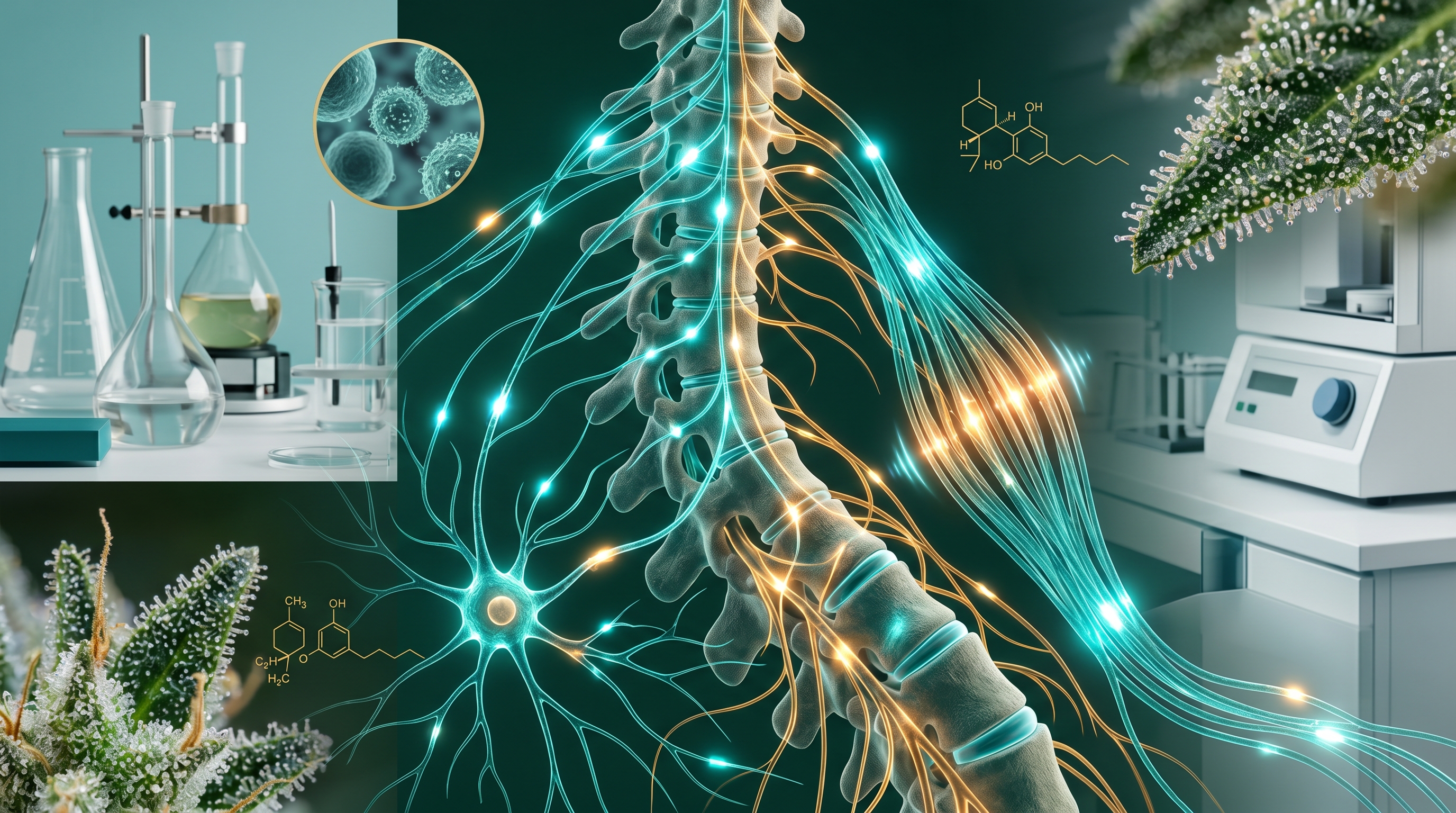
Spasticity is not just “tight muscles.” It is a specific kind of motor problem. It shows up when the nerve pathways that control muscle tone get damaged. Your brain normally sends a steady stream of calming signals down the spinal cord. Those signals keep your muscles relaxed when they should be relaxed. When MS lesions or a spinal cord injury cut into those pathways, the brakes come off. The result is high muscle tone, jumpy reflexes, painful spasms, and stiffness that gets worse the faster you try to move.
In multiple sclerosis, the immune system attacks the protective coating around nerve fibers in the brain and spinal cord. As those signals break down, spasticity creeps in. Studies suggest most people with MS get some degree of spasticity, and for many it grows moderate to severe over time. It tangles up walking, sleep, bladder function, and pain into one frustrating knot. If you want the bigger picture on MS specifically, our companion piece on cannabis for multiple sclerosis and what clinical trials show covers the full disease.
In spinal cord injury, the damage is more localized but the mechanism is similar: the injury cuts the communication line between brain and muscle, the spinal reflex circuits below the injury run unchecked, and tone climbs. Roughly two-thirds to three-quarters of people with SCI develop spasticity. It can be useful in small doses (some people lean on tone to transfer or stand), but when it crosses into painful spasms and rigidity, it becomes a daily obstacle.
Neurologists sort spasticity into a few types: from the brain, from the cord, or from the muscle itself. Most cases trace back to damage in the motor tracts that run down from the brain. That anatomy matters. It tells us where a cannabinoid would have to act to make a difference.
The Endocannabinoid System and Motor Control
Here is where cannabis enters the picture biologically. Your body runs its own internal cannabinoid network, the endocannabinoid system, and it is woven directly into the circuitry that controls muscle tone.
The key player is the CB1 receptor. A 2026 review of cannabinoids in motor control mapped exactly where CB1 receptors sit in the spinal cord, and the locations are telling [Schmitz, 2026]. They appear on the presynaptic terminals of sensory neurons feeding the cord, on inhibitory interneurons in the dorsal horn, on the motoneurons in the ventral horn that drive muscles, and even out at the neuromuscular junction where nerve meets muscle. If you wanted to design a dial for muscle tone, you would put the knobs in roughly these spots. (Curious about the receptors themselves? See CB1 vs CB2 receptors and why location matters.)
The system works through what scientists call retrograde signaling. When a circuit fires hard, the receiving neuron makes endocannabinoids on demand — molecules like anandamide and 2-AG. It then sends them backward across the gap to tap the brakes on the neuron that is over-firing. THC, the main active compound in cannabis, copies those molecules by switching on CB1 directly. (If the idea of a “natural THC” is new to you, our explainer on anandamide, your body’s own cannabinoid is a good primer.)
The theory, then, is clean: activate CB1 receptors at these spinal nodes, dampen the runaway signaling, and muscle tone should fall. In animal models of MS, this is exactly what happens. CB1 agonists reduce spasticity and tremor, and CB1 blockers make those symptoms worse. That mouse data is part of why researchers took the idea to human trials in the first place. Whether the elegant theory survives contact with real patients, though, is another question entirely.
CBD, the non-intoxicating partner compound, works differently. It barely touches CB1, instead nudging targets like TRPV1 channels and contributing anti-inflammatory effects. That is part of why the leading cannabis spasticity medicine pairs the two together.
Nabiximols, CAMS, and MUSEC: What the Trials Found
The most-studied cannabis medicine for spasticity is nabiximols (brand name Sativex), an oromucosal spray standardized to a roughly 1:1 ratio of THC to CBD — about 2.7 mg THC and 2.5 mg CBD per spray. It is sprayed under the tongue or inside the cheek and titrated up slowly. This is the product approved for MS spasticity in 29 countries.
But the journey to that approval was bumpy, and it is worth understanding why.
The CAMS trial (2003) was the big swing [Zajicek, 2003]. Researchers enrolled 667 people with stable MS and muscle spasticity across 33 UK centers, randomizing 630 of them to oral cannabis extract, oral THC, or placebo over 15 weeks. The primary outcome was the Ashworth scale, a clinician’s hands-on rating of muscle tone. The headline result: cannabinoids showed no significant benefit on the Ashworth scale (p=0.40). On paper, a miss.
And yet — when researchers asked the patients, the story flipped. Self-reported spasticity improvement was 61% on cannabis extract and 60% on THC, versus 46% on placebo (p=0.003). Patients also reported less pain and showed objective improvement in mobility. The 12-month CAMS follow-up later picked up a small but significant Ashworth benefit for THC that the short trial had missed [Zajicek, 2005]. So which is it — does cannabis work for spasticity or not? Hold that thought.
The MUSEC trial (2012) was designed around exactly this lesson [Zajicek, 2012]. Instead of leaning on the Ashworth scale, MUSEC made the patient’s rating of muscle stiffness the primary outcome. It randomized 279 people with stable MS to a standardized oral cannabis extract or placebo. The result: patients on the extract were roughly twice as likely to report relief of muscle stiffness as those on placebo, with parallel improvements in spasms, body pain, and sleep. By measuring what mattered to patients, MUSEC found the signal CAMS had buried.
Then came the enriched-design nabiximols trials [Novotna, 2011]. This clever phase 3 study gave 572 people with MS spasticity a 4-week single-blind trial of nabiximols, and only the 241 who responded with at least a 20% improvement continued into the randomized placebo-controlled phase. Among those responders, nabiximols beat placebo decisively on the spasticity numeric rating scale (p=0.0002). A separate randomized-withdrawal study found that taking nabiximols away from long-term responders led to faster treatment failure than staying on it [Notcutt, 2012]. That is strong evidence the benefit was real for the people it worked for.
The takeaway from this body of work: cannabinoids do not help everyone, but for a meaningful subset of MS patients — the responders — the benefit is genuine and durable.

The Subjective-vs-Objective Gap
This is the most important idea in the whole article, so let me sit on it for a moment.
Almost every cannabis spasticity trial shows the same pattern: patients report meaningful improvement, but clinician-measured muscle tone barely budges. This is not cannabis being mysterious. It is a measurement problem, and it cuts in several directions.
The Ashworth and Modified Ashworth scales are the standard clinical tools. A doctor moves your limb and rates the resistance on a 0-to-4 scale. But these scales are crude. They capture just one slice of a complex problem, and they vary from rater to rater. The European Medicines Agency and others have backed away from relying on them as the only measure of spasticity. A RELEASE MSS1 crossover trial published in 2024 deliberately used a rigorous lower-limb Modified Ashworth composite as its primary endpoint in 68 MS patients [Vermersch, 2024]. It found no significant difference versus placebo (p=0.72), even though the very same drug had repeatedly beaten placebo on patient-reported scales. The authors’ own conclusion was that the result “emphasizes the challenges in the evaluation of MS spasticity.”
So the gap might mean cannabis improves the experience of spasticity — the pain, the spasm frequency, the sleep disruption, the felt sense of stiffness — more than it changes the raw mechanical tone a doctor can feel in a clinic. For a patient, that experiential relief is exactly the point. A scale that misses it is the broken instrument, not the patient.
But honesty cuts both ways. Cannabis produces noticeable effects — a bit of a buzz, some relaxation — and that makes blinding hard. If you can tell you got the real drug, your expectations inflate your self-report. Cannabis trials also tend to show large placebo responses. A 2017 systematic review and meta-analysis of 16 trials covering 2,597 patients with MS or paraplegia found only a non-significant trend toward spasticity improvement once you pooled everything together [Torres, 2017]. The standardized mean difference was 0.36, with a confidence interval that crossed zero. A real but modest effect, partly obscured by placebo, is the most defensible reading of the evidence.
The grown-up summary: subjective relief is reasonably well supported; objective tone reduction is weak and inconsistent. Both things are true at once.
Spinal Cord Injury: A Thinner but Encouraging Trail
MS spasticity has dozens of trials. Spinal cord injury has a handful, and they are small — but they lean positive.
The most cited is Hagenbach and colleagues (2007), who studied oral and rectal THC in 25 people with SCI [Hagenbach, 2007]. Active THC significantly reduced the spasticity sum score versus placebo (p=0.001), with roughly 15 to 20 mg of THC per day needed to reach a therapeutic effect. Dropouts from increased pain and psychological side effects complicated the trial, but the spasticity signal was there.
Pooyania and colleagues (2010) ran a randomized, double-blind crossover pilot of nabilone (a synthetic THC-like drug) in people with SCI spasticity [Pooyania, 2010]. Even in just 11 completers, nabilone significantly reduced Ashworth scores in the most spastic muscle group versus placebo. The Canadian SCIRE evidence project rates this as level 1 evidence that nabilone reduces SCI spasticity, supported by level 2 evidence for oral THC (dronabinol).
A 2025 prospective study of nabiximols in chronic SCI patients whose spasticity had resisted conventional treatment found significant improvements at one and two months [Braga, 2025]. Patients saw a 60% drop in Modified Ashworth at one month, and two-thirds reported feeling better overall — though spasm frequency and neuropathic pain did not change much.
The honest counterweight is a 2023 Danish trial that tested THC, CBD, and THC+CBD capsules against placebo in 134 patients with MS or SCI and found no significant difference on pain or spasticity for any arm [Hansen, 2023]. The trial was underpowered (COVID-era recruitment fell well short of its 448-patient goal) and the placebo response was large, but it is a real null result and it belongs in any fair accounting.
Bottom line for SCI: smaller and shakier than MS, but several controlled studies point the same direction, especially for people who have exhausted standard antispastics.
THC:CBD Ratio and Dosing
A few patterns emerge from the trial designs:
- The 1:1 THC:CBD ratio is the most validated formula for spasticity, because it is literally what nabiximols is. The CBD does not cancel the THC; the working theory is that it broadens the effect and may soften some of THC’s less pleasant side effects. To understand why ratios matter so much, see our guides on how to find your ideal THC-to-CBD ratio and the differences between THC and CBD.
- Start low, go slow. Every successful trial titrated the dose upward gradually — nabiximols studies often landed around 6 to 8 sprays a day, SCI THC studies needed 15 to 20 mg daily. Rushing the dose is how you trade spasticity relief for dizziness and a foggy head.
- THC carries the antispastic load. CBD alone has not clearly reduced spasticity in trials. The pairing matters.
- You are aiming for your threshold, not a number on a label. A 20% improvement in self-reported spasticity is considered the minimum clinically meaningful change, and a 30% improvement counts as “much improved.” Tracking against your own baseline beats chasing a strain name. (Our piece on finding your THC:CBD sweet spot from 1,400 pain patients digs into the personalization angle.)
It is also worth noting the role of inflammation and pain, which travel alongside spasticity. The terpene caryophyllene, for example, behaves like a cannabinoid at CB2 receptors and may contribute to the anti-inflammatory side of the equation — see caryophyllene, the terpene that acts like a cannabinoid. Linalool, the calming lavender terpene, may help with the sleep and tension that spasticity disrupts. These are supporting players, not the main act, but the entourage of compounds is part of why whole-plant extracts behave differently from isolated THC.
Side Effects and Cautions
Cannabinoids are not free of cost, and the trials are clear about it. The 2017 meta-analysis quantified the most common adverse events versus placebo: dizziness (more than three times as likely), drowsiness/somnolence (roughly three times), and nausea (a bit over twice as likely). Other reported issues include dry mouth, fatigue, balance problems, and mood or attention changes — and in the SCI trials, those side effects were a leading reason people dropped out.
A few specific cautions:
- Falls and balance. If spasticity already affects your mobility, adding dizziness or sedation can raise fall risk. This deserves real attention with your care team.
- Drug interactions. Cannabinoids are processed by the same liver enzymes as many other medications, including some antispastics and the drugs people with MS or SCI commonly take. Read cannabis and medication interactions and bring it up with your prescriber.
- Cognition. THC can affect short-term memory and attention, which is worth weighing if you are managing a demanding day.
- Not a cure. This is symptom management, full stop. Nothing here slows MS or repairs a spinal cord injury. Cannabis is one tool that may make spasticity more livable for some people — alongside physiotherapy, stretching, and conventional medications like baclofen or tizanidine, not as a replacement for them.
Please Talk to Your Doctor
I will say it plainly because it matters: spasticity in MS and SCI is a medical condition that warrants medical guidance. Nabiximols is a prescription drug for a reason, and the people who do best in the research are those who titrate carefully, track their response, and stay in conversation with a neurologist or rehabilitation specialist. If you are considering cannabis for spasticity, treat it like the medical decision it is. Bring this article, bring your questions, and make the call together with your care team.
Key Takeaways
- Spasticity is a top-tier symptom of both MS and spinal cord injury, driven by damaged motor pathways that let muscle tone run unchecked.
- Nabiximols (Sativex), a 1:1 THC:CBD spray, is approved for MS spasticity in 29 countries — a rare regulatory win for a cannabis medicine.
- The core puzzle: patients reliably report relief, but clinician-measured muscle tone (the Ashworth scale) barely moves. The scale is a poor instrument, and large placebo effects muddy the picture.
- Patient-reported benefit is reasonably well supported; objective tone reduction is weak and inconsistent. Both are true at once.
- SCI evidence is thinner but leans positive, especially for people who have exhausted standard antispastics.
- Start low, go slow, and track your own response. This is symptom management, not a cure — and it is a decision to make with your doctor.
Frequently Asked Questions
Is cannabis actually approved for spasticity anywhere? Yes. Nabiximols (Sativex), a 1:1 THC:CBD oromucosal spray, is approved in 29 countries as an add-on treatment for moderate-to-severe MS spasticity that has not responded adequately to other antispastic medications. Approval status varies by country and is not the same in the United States.
Why do studies say patients feel better but the muscle scores do not change? Because the standard clinical tool — the Ashworth scale — measures one narrow slice of spasticity and is widely considered a poor instrument. Patients report relief from stiffness, spasms, pain, and sleep disruption that the scale simply does not capture well. Some of the patient-reported benefit may also reflect a large placebo response. Both are likely true.
What THC:CBD ratio works for spasticity? The most validated formula is roughly 1:1 THC:CBD, which is what nabiximols uses. THC appears to carry the antispastic effect; CBD alone has not clearly worked. See our THC:CBD ratio guide.
Does it help spinal cord injury spasticity too? The SCI evidence is thinner than the MS evidence but mostly encouraging. Controlled studies of oral THC, nabilone, and nabiximols have shown reductions in SCI spasticity, especially in people who have already tried standard antispastics — though at least one larger trial found no effect. Talk to your specialist.
Can cannabis cure MS or repair a spinal cord injury? No. Current research suggests cannabis does not cure or reverse either condition. Everything discussed here is symptom management — it may make spasticity more tolerable, but it does not fix the underlying cause.
What about chronic pain that comes with spasticity? Spasticity, pain, and sleep problems often travel together, and cannabinoids may help with the cluster rather than spasticity alone. Our deep-dives on cannabis vs opioids for chronic pain, cannabis for fibromyalgia, and cannabis for arthritis and joint pain cover related territory, as does our overview of the best strains studied for pain management.
How long until I would know if it is helping? Trials titrated over weeks, and the nabiximols enriched designs gave responders about four weeks to show a 20% improvement before continuing. If you and your doctor try it, give it a structured trial period and track your own spasticity, spasms, and sleep rather than expecting overnight change. Related: how long a cannabis effect lasts and the endocannabinoid system basics. For other neurological conditions, see cannabis for Parkinson’s disease and cannabis for restless leg syndrome.
Sources
- Zajicek J, et al. Cannabinoids for treatment of spasticity and other symptoms related to multiple sclerosis (CAMS study): multicentre randomised placebo-controlled trial. The Lancet, 2003. DOI: 10.1016/S0140-6736(03)14738-1
- Zajicek JP, et al. Cannabinoids in multiple sclerosis (CAMS) study: safety and efficacy data for 12 months follow up. J Neurol Neurosurg Psychiatry, 2005. DOI: 10.1136/jnnp.2005.070136
- Zajicek JP, et al. Multiple Sclerosis and Extract of Cannabis: results of the MUSEC trial. J Neurol Neurosurg Psychiatry, 2012. DOI: 10.1136/jnnp-2012-302468
- Novotna A, et al. A randomized, double-blind, placebo-controlled, parallel-group, enriched-design study of nabiximols (Sativex), as add-on therapy, in subjects with refractory spasticity caused by multiple sclerosis. Eur J Neurol, 2011. DOI: 10.1111/j.1468-1331.2010.03328.x
- Notcutt W, et al. A placebo-controlled, parallel-group, randomized withdrawal study of subjects with symptoms of spasticity due to multiple sclerosis who are receiving long-term Sativex (nabiximols). Mult Scler J, 2012. DOI: 10.1177/1352458511419700
- A randomized, double-blind, placebo-controlled trial to evaluate the effect of nabiximols oromucosal spray on clinical measures of spasticity in patients with multiple sclerosis (RELEASE MSS1). 2024. PubMed: 39106541
- Hagenbach U, et al. The treatment of spasticity with Δ9-tetrahydrocannabinol in persons with spinal cord injury. Spinal Cord, 2007. DOI: 10.1038/sj.sc.3101982
- Pooyania S, et al. A randomized, double-blinded, crossover pilot study assessing the effect of nabilone on spasticity in persons with spinal cord injury. Arch Phys Med Rehabil, 2010. DOI: 10.1016/j.apmr.2010.01.002
- Martins Braga F, et al. The effects of nabiximols (Sativex) on spasticity and non-motor symptoms in chronic spinal cord injury (SCI): a longitudinal prospective study. Spinal Cord Series and Cases, 2025. DOI: 10.1038/s41394-025-00712-2
- Hansen JS, et al. Cannabis-Based Medicine for Neuropathic Pain and Spasticity — A Multicenter, Randomized, Double-Blinded, Placebo-Controlled Trial. Pharmaceuticals, 2023. DOI: 10.3390/ph16081079
- Lana D, et al. (meta-analysis). Cannabinoids for spasticity due to multiple sclerosis or paraplegia: A systematic review and meta-analysis of randomized clinical trials. 2017. PubMed: 28917371
- Cannabinoids in Motor Control: From Receptor Distribution to Motor Disorders. Biomedicines, 2026. DOI: 10.3390/biomedicines14040844


