Does CBD Oil Help Jaw Pain? Why Gel Studies Cannot Answer That
CBD oil did not beat its control for jaw-muscle pain in a small trial. Positive gel studies cannot establish the same benefit from swallowed oil.


CBD oil has not shown a pain advantage over its control in a small jaw-muscle trial, and positive gel studies cannot establish that swallowed oil works. These studies tested selected patients, different preparations and different outcomes. They do not settle every kind of jaw pain. Reeve et al., 2026, Walczyńska-Dragon et al., 2024
Here in High School, the useful distinction is simple: “people improved” and “CBD beat its comparison” are different claims. Before borrowing a promising number, ask what went where and what researchers measured.
What did the oil and gel studies actually test?
They tested separate interventions, rather than comparing oil directly with gel.
| Study | Preparation and route | Measured result | Main limit |
|---|---|---|---|
| 2026 oil trial | 54 analyzed adults; 20 mg CBD daily, held under the tongue then swallowed, versus CBD-free hemp-seed oil | No between-group pain benefit; jaw-function scores improved over time in both groups without a between-group advantage | Selected jaw-muscle pain; three months; some participants and low-adherence visits excluded |
| 2024 gel trial | 60 completed; 5% or 10% gel applied inside the mouth versus control gel for 30 days | Pain and resting muscle-activity comparisons favored CBD; overnight grinding comparisons were mixed | Small selected sample; no oil arm or absorption measurement |
| 2019 ointment trial | 60 participants; approximately 1.46% CBD-containing ointment on the skin over the chewing muscles for 14 days versus vehicle | Lower pain and resting muscle activity in the active group | Short selected study; did not measure overnight grinding |
Originals: 2026 oil, 2024 gel, 2019 ointment. Amounts identify research conditions, not a personal regimen.
Our patches versus topicals lesson explains the delivery question. A route name or an ingredient list is not a demonstrated benefit for a particular condition.
Didn’t the oil trial improve jaw function?
Yes, but that improvement also occurred in the control group. The randomized trial enrolled 62 people and analyzed 54: 35 assigned CBD and 19 assigned hemp-seed oil. Its primary pain comparison at one month was null, P>.99. Function comparisons between groups were also null. Reeve et al.
A change within one group asks whether its scores changed over time. A comparison between groups asks whether the groups differed. For a treatment claim, those are not interchangeable. Improvement alone cannot identify the ingredient responsible.
That distinction takes nothing away from someone’s experience. A person can report a real change while a study remains unable to attribute it to CBD. Our expectation and placebo lesson explores why a comparison matters; it does not explain away anybody’s pain.
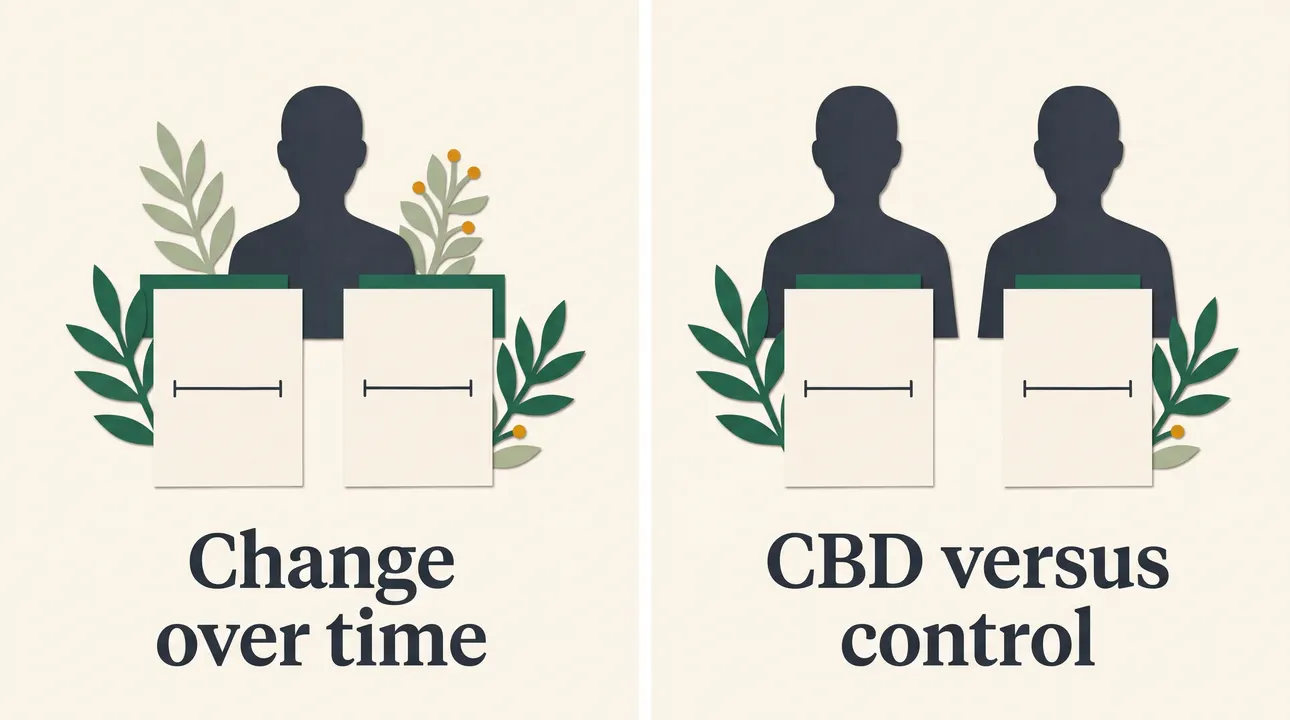
Improvement within a group does not establish an advantage over its control. The diagram names comparisons, not numerical outcomes.
Do positive gel results prove oil will help?
No. A preparation tested on the skin or inside the mouth is not the oil intervention. The table also keeps pain, resting electrical muscle activity and overnight grinding separate. A result for one measurement cannot stand in for all three.
The trials were not head-to-head tests. Differences in participants, formulation, timing and measurement traveled with the route. Comparing their conclusions cannot show that route alone caused the different results. The positive findings deserve attention without turning into an oil recommendation. 2019 original, 2024 original
Our pain intensity and unpleasantness lesson offers another example of keeping a named measurement attached to its answer. “Pain relief” becomes less useful when it quietly changes meaning halfway through the argument.
What does the 51% grinding claim mean?
It describes change within the 2024 study’s 10% gel group, not a 51% advantage over placebo. The final tables contain mixed between-group grinding tests: the main ANOVA and Kruskal comparisons were nonsignificant, while a Kolmogorov–Smirnov distribution comparison was significant. Calling every test positive—or every test null—would lose that distinction. Final original tables 5, 9–11
This is why “compared with what?” belongs beside a percentage. The baseline can be the same group’s earlier score, or another group’s score. Those comparisons answer different questions. A large-looking number can be accurately quoted and still support a smaller conclusion than its headline suggests.
Does the oil result mean CBD can never help?
No. A nonsignificant comparison does not establish universal inefficacy or prove equal responses. It limits what this experiment demonstrates. Nor does a positive result with another preparation repair the missing oil benefit.
The oil trial was small, used patient-reported measures and excluded some data. Product suppliers provided funding and preparations, which the authors disclosed. These details belong alongside the result, not as reasons to erase it or assume the opposite. Reeve et al.
For the broader clinical question, our chronic-pain evidence lesson covers other conditions. A result elsewhere cannot substitute for a jaw-muscle trial.
What should I bring to a dental conversation?
Bring the symptom question as well as the product question. “TMJ” names the joint; TMDs include conditions affecting the joint and chewing muscles. Jaw or facial pain may have another cause, so a doctor or dentist may need to assess it rather than infer a diagnosis from a product response. NIDCR guidance
Ask what condition is being assessed, which outcome matters and whether evidence concerns the preparation you actually use. NIDCR recommends consulting a clinician and starting with simple approaches, with caution about irreversible treatments. These CBD trials do not replace that assessment. NIDCR
If your question concerns an upcoming procedure, our dental-numbing evidence lesson addresses local anesthetic responses. Getting a tooth numb and changing jaw-muscle pain are separate questions.
Key takeaways
- The oil trial did not establish a pain advantage over its control.
- Jaw function improved within both groups; that is not a CBD-specific benefit.
- Positive ointment or gel evidence does not establish swallowed-oil efficacy.
- The 51% grinding figure is within one gel group; between-group tests were mixed.
- Keep the condition, route, outcome and comparator together.
FAQ
Can I use the gel study to choose a CBD oil?
It cannot establish that choice. The trials tested different preparations and did not compare them directly.
Does less resting muscle activity mean less grinding at night?
Not by itself. A clinic resting-muscle recording and an overnight grinding measurement are separate outcomes; the 2019 study did not measure the latter. 2019 original
Does improvement in both groups mean CBD has no effect?
It does not prove that. It means improvement alone cannot demonstrate an advantage for CBD over the control.
Do these studies establish a stronger product works better?
No general stronger-is-better rule follows. The 2024 main comparisons did not establish superiority of 10% over 5%, and a different retail preparation remains a different intervention. 2024 original
Sources
- Reeve GS, Kutler RB, Abel A, An A, Fokaidis V, Insel O (2026). Oral Cannabidiol in the Treatment of Myofascial Pain Disorder of the Temporomandibular Region: A Placebo-Controlled Randomized Clinical Trial. Medical Cannabis and Cannabinoids 9(1):70–79. DOI 10.1159/000551040; PMID 42016900.
- Walczyńska-Dragon K, Kurek-Górecka A, Niemczyk W, Nowak Z, Baron S, Olczyk P, Nitecka-Buchta A, Kempa WM (2024). Cannabidiol Intervention for Muscular Tension, Pain, and Sleep Bruxism Intensity—A Randomized, Double-Blind Clinical Trial. Journal of Clinical Medicine 13(5):1417. DOI 10.3390/jcm13051417; PMID 38592260.
- Nitecka-Buchta A, Nowak-Wachol A, Wachol K, Walczyńska-Dragon K, Olczyk P, Batoryna O, Kempa W, Baron S (2019). Myorelaxant Effect of Transdermal Cannabidiol Application in Patients with TMD: A Randomized, Double-Blind Trial. Journal of Clinical Medicine 8(11):1886. DOI 10.3390/jcm8111886.
- National Institute of Dental and Craniofacial Research. TMD (Temporomandibular Disorders). Current official overview, accessed October 11, 2026.





