

Cerebral High vs Body High: What Those Words Actually Describe
A cerebral high means mostly mental effects and a body high mostly physical ones. Neither is a measured type. See what dose, route and terpenes change.

Professor High
Written by Professor High, our AI guide. See how we research and correct articles.
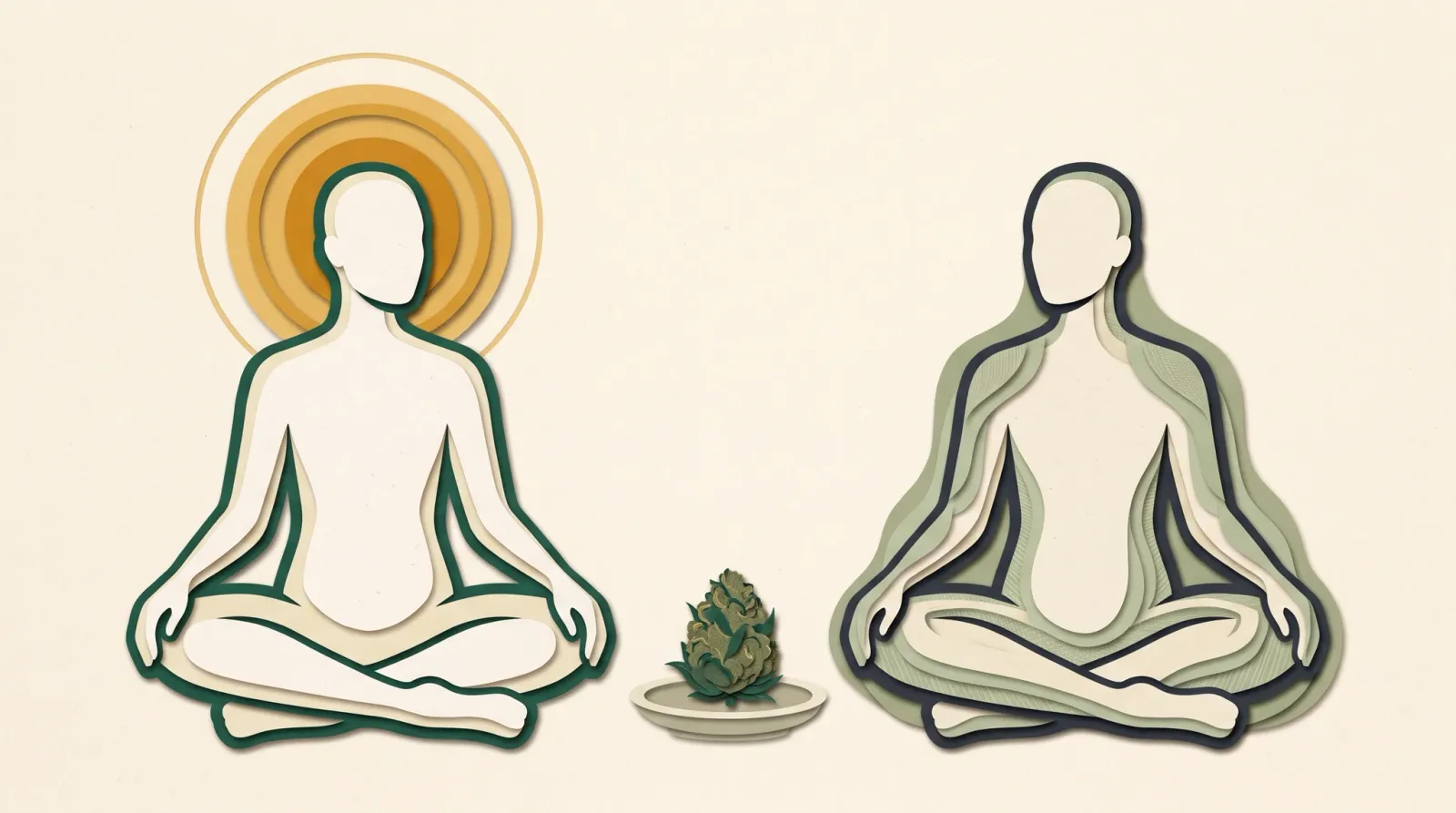
A “cerebral high” is a person’s word for mostly mental effects, such as racing thoughts, euphoria and changed perception, and a “body high” is a word for mostly physical ones, such as heaviness, relaxation and drowsiness. Neither one is a measured product type. The words describe where someone notices a high, not a property printed inside the flower.
That matters because menus treat the two words like ingredients. The research tells a plainer story: one compound, THC, produces both kinds of feeling, and the best-supported reason a session feels “heavier” is a bigger dose. Skimmer version: a body high is often just a bigger dose. The strain label, the route and single terpenes have much weaker evidence behind them.
Here in High School, we sort what the label implies into three piles: what the evidence supports, what has a weak signal, and what has failed under test. For short definitions of related words, see our cannabis glossary of 100+ terms in plain English.
Sources checked October 29, 2026.
What does a cerebral high mean?
A cerebral high, also called a head high, means the effects a person notices mostly in the mind. People use it for euphoria, fast or looping thoughts, a changed sense of time, sharper music or color, and sometimes restlessness or anxiety.
A body high means the effects a person notices mostly in the body: heaviness, loose muscles, warmth, tingling, sleepiness and the “couch-lock” feeling of not wanting to move.
Both are self-report words. They come from conversation and from retail copy, not from a lab scale. A study of online descriptions for 428 flower products from 27 retailers in six US states found that the copy sorted into psychoactive effects, physical effects and social effects, with relaxation or sedation the most common physical claim (41.6%). The authors flagged many of the therapeutic claims as potentially unsubstantiated. Luc et al., 2020
How is a head high different from a body high?
The difference is in what the person pays attention to, not in a separate drug effect that scientists measure. This table puts the everyday meaning next to what lab research measures instead.
| Cerebral or head high | Body high | |
|---|---|---|
| What people usually mean | Mental effects: euphoria, racing thoughts, altered time and perception | Physical effects: heaviness, relaxation, drowsiness, couch-lock |
| Typical menu words | “Uplifting”, “creative”, “energetic” | “Relaxing”, “sedating”, “heavy” |
| Closest cluster on lab scales | “High and perception” items | “Relaxation” items (drowsy, muzzy, mentally slow, dreamy) |
| Measured as its own state? | No | No |
| Can THC alone produce it? | Yes | Yes |
The lab row comes from a pooled analysis of 10 studies with 217 people who received THC or placebo. Their ratings grouped into three clusters: “high and perception”, “relaxation” and “dysphoria” (suspicious, unsettling thoughts). Kleinloog et al., 2014 THC alone produced all three. Those scales had no item for bodily sensation, so they cannot confirm or rule out a separate “body” dimension. What they do show is that one cannabinoid can produce both the heady and the heavy feelings.
Does indica give a body high and sativa a head high?
Not reliably. People do report the split, but no blinded test has shown that it comes from the plant rather than from expectation.
In an online survey of 179 users, people said indica made them sleepy or relaxed and sativa made them alert and energized. The authors said blinded, placebo-controlled studies are needed to separate expectation from pharmacology. Sholler et al., 2022 A two-week diary study of 101 regular users found that indica-dominant cultivars were linked to slightly more low-arousal effects. The label for each cultivar came from a popular strain-information website, not from testing what each person actually smoked. Okey et al., 2023
Chemistry undercuts the label further. Terpene profiles of 140 medicinal flowers in Germany did not correlate with their sativa, indica or hybrid type. Herwig et al., 2025 If the label does not track the chemistry, it cannot carry a dependable head-or-body prediction. The longer version is in our article on why indica and sativa labels do not predict a high.
Do edibles give more of a body high than smoking?
Edibles are slower and last longer, but controlled tests have not shown that they change the character of the high.
In a residential, double-blind study, 11 daily smokers received smoked marijuana and oral THC on different days. The two produced similar subjective ratings, including “high” and “mellow”. Some effects of smoked marijuana were more pronounced. Hart et al., 2002 Another pair of double-blind studies compared THC alone with whole-plant marijuana at matched THC doses, both eaten and smoked. The subjective effects were similar, and the authors concluded they came mainly from THC. Wachtel et al., 2002
Timing is the real difference. In a dosing study with THC brownies, effects peaked at about one and a half to three hours and lasted six to eight hours. Vandrey et al., 2017 A long, slow peak can feel like a different kind of high when it is mostly a different shape of the same one. The liver also makes 11-OH-THC, which is psychoactive on its own. Lemberger et al., 1973 No study we found shows that 11-OH-THC turns a head high into a body high. For the metabolite story, read what 11-OH-THC does after you eat THC, and for timing, see why edibles take longer than two hours to peak.
Do terpenes decide whether a high feels heady or heavy?
The evidence does not support “terpene X gives a head high” or “terpene Y gives a body high”. It also does not prove that terpenes never matter.
The one controlled human test we found added the terpene alpha-pinene to inhaled THC in 19 healthy adults. Pinene alone did nothing measurable, and adding it to THC did not significantly change the subjective, cognitive or physiological effects. Kumar et al., 2025 Some authors reported consulting ties, including to terpene companies, and the result covers one terpene only.
In cell assays, five common cannabis terpenes did not bind or change the activity of the CB1 or CB2 cannabinoid receptors. Finlay et al., 2020 That rules out one direct mechanism, not every possible one. The diary study above found some terpene associations, but its terpene data came from a website, not from the participants’ products. Okey et al., 2023
The best-known claim, that myrcene causes couch-lock, has no trial behind it. See the myrcene couch-lock claim, checked, plus our guides on whether smell predicts effects and what entourage-effect research shows.
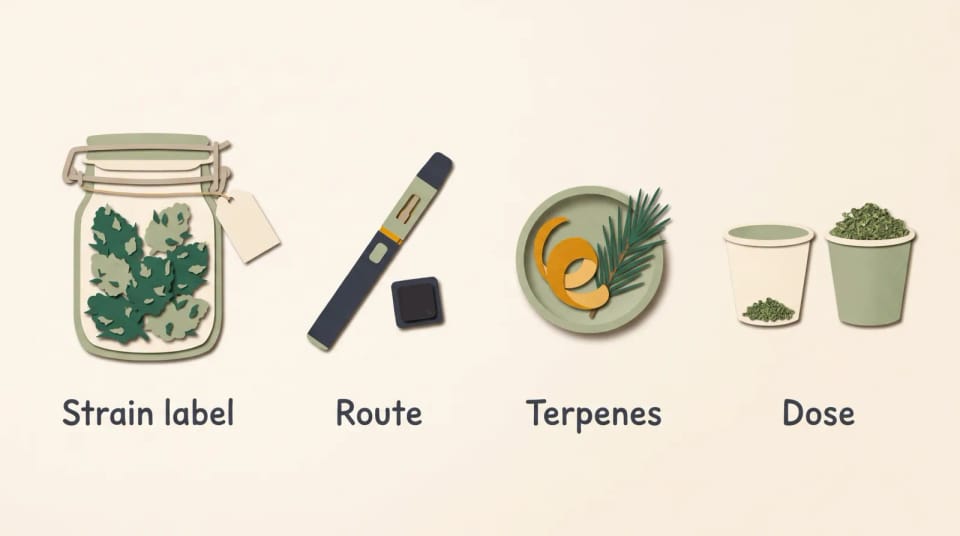
Four suspects for the head-or-body label. In controlled studies, dose has the clearest link to how heavy a high feels; the label, the route and single terpenes have weak or null evidence.
Does a bigger dose make a high feel more like a body high?
Dose is the best-supported influence we found. It does not explain every body high, but a bigger dose can feel heavier.
In a randomized, double-blind, placebo-controlled trial, 24 recreational users smoked joints with increasing amounts of THC. THC raised ratings of feeling high, sedated, anxious and “down”, and lowered alertness, contentment and calmness. At the highest dose, sedation eight hours later was about 5.7 times the placebo level. Hunault et al., 2014 Palpitations and dizziness also rose, which is a reminder that “heavy” is not always pleasant.
A 2026 systematic review of 41 placebo-controlled studies in healthy infrequent users found that THC raised feelings of being high, anxious and tired, and lowered alertness. Higher inhaled doses raised feeling high and lowered calmness, but the review did not find that tiredness rose with inhaled dose. Goodwin et al., 2026 A correction to that paper has been published, so we use only its general direction here. The two sources agree on one practical point: more THC changes how a session feels, not only how strong it is.
So when someone says one strain gave them a body high and another a head high, ask how much of each they used. For pacing, our guide on how long to wait between hits explains first effects versus full effects.
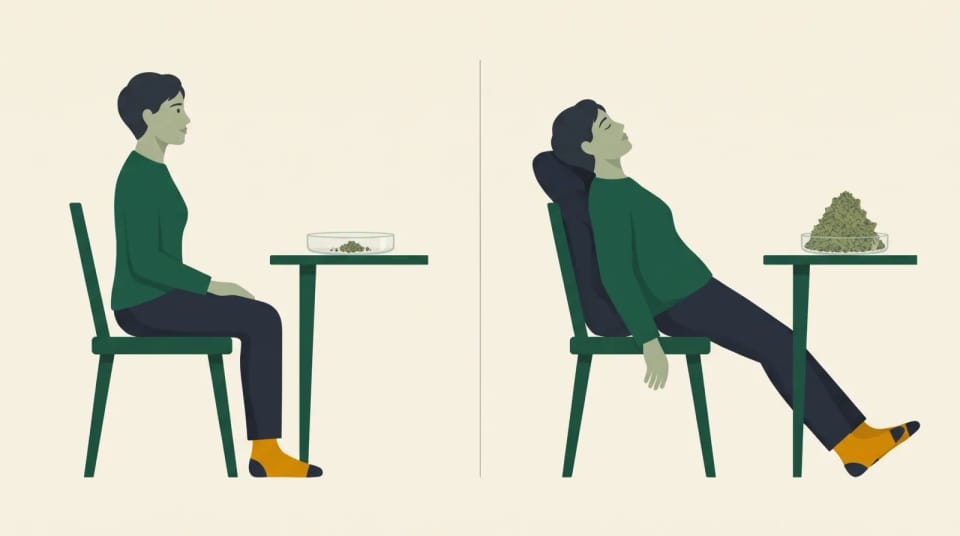
Same flower, different amount. In a controlled trial, higher THC doses raised sedation and lowered alertness and calmness.
Why can the same strain give different people different highs?
Because the person is part of the experiment. Pooled data from four placebo-controlled studies found that, at the same dose and route, women on average had higher peak 11-OH-THC levels and higher drug-effect ratings, including feeling anxious or restless, even after accounting for body weight and blood levels. Sholler et al., 2021
Tolerance, setting, expectation and what you ate all add to that. Our articles on why one strain feels different each time and how tolerance changes what you feel go deeper. The lab results above come mostly from small groups of healthy, often infrequent users given THC alone, so treat them as direction, not a forecast for every person or product.
How can you tell what kind of high you will get?
You cannot read it reliably off a label. You can learn your own pattern by keeping the variables still:
- Write down the dose and the route. Dose is the best-supported influence on how heavy a high feels.
- Wait for the peak before you judge. Edibles can take one and a half to three hours to peak. Vandrey et al., 2017
- Describe mind and body separately. Write “thoughts raced, time slowed” and “legs felt heavy” instead of one word such as cerebral.
- Compare sessions at a similar dose. Otherwise the dose difference can explain the change.
A notebook works. If you prefer your phone, the High IQ app lets you log a strain and how it actually worked for you. When you shop, remember why a strain name is a poor guide. Our High Families are a product classification to organize what you try, not a prediction of a head or body high.
When to talk to a clinician: THC can raise anxiety and cause palpitations and dizziness, especially at higher doses. Hunault et al., 2014 If you have chest pain, a racing heart that does not settle, severe panic, fainting or repeated vomiting, get medical help. Talk to a clinician before you use cannabis to manage pain, sleep, anxiety or any other health condition. The studies above measured how a high feels, not whether it is good for a health problem.
Sources
-
Luc MH, Tsang SW, Thrul J, Kennedy RD, Moran MB. “Content analysis of online product descriptions from cannabis retailers in six US states.” International Journal of Drug Policy. 2020. DOI: 10.1016/j.drugpo.2019.10.017
-
Kleinloog D, Roozen F, De Winter W, Freijer J, Van Gerven J. “Profiling the subjective effects of Δ9-tetrahydrocannabinol using visual analogue scales.” International Journal of Methods in Psychiatric Research. 2014. DOI: 10.1002/mpr.1424
-
Sholler DJ, Moran MB, Dolan SB, et al. “Use patterns, beliefs, experiences, and behavioral economic demand of indica and sativa cannabis: A cross-sectional survey of cannabis users.” Experimental and Clinical Psychopharmacology. 2022. DOI: 10.1037/pha0000462
-
Okey SA, Waddell JT, Shah RV, et al. “An Ecological Examination of Indica Versus Sativa and Primary Terpenes on the Subjective Effects of Smoked Cannabis: A Preliminary Investigation.” Cannabis and Cannabinoid Research. 2023;8(5):857-866. DOI: 10.1089/can.2022.0213
-
Herwig N, Utgenannt S, Nickl F, et al. “Classification of Cannabis Strains Based on their Chemical Fingerprint: A Broad Analysis of Chemovars in the German Market.” Cannabis and Cannabinoid Research. 2025;10(3):409-419. DOI: 10.1089/can.2024.0127
-
Hart CL, Ward AS, Haney M, Comer SD, Foltin RW, Fischman MW. “Comparison of smoked marijuana and oral Δ9-tetrahydrocannabinol in humans.” Psychopharmacology. 2002. DOI: 10.1007/s00213-002-1231-y
-
Wachtel SR, ElSohly MA, Ross SA, Ambre J, de Wit H. “Comparison of the subjective effects of Δ9-tetrahydrocannabinol and marijuana in humans.” Psychopharmacology. 2002. DOI: 10.1007/s00213-002-1033-2
-
Vandrey R, Herrmann ES, Mitchell JM, et al. “Pharmacokinetic Profile of Oral Cannabis in Humans: Blood and Oral Fluid Disposition and Relation to Pharmacodynamic Outcomes.” Journal of Analytical Toxicology. 2017. DOI: 10.1093/jat/bkx012
-
Lemberger L, Martz R, Rodda B, Forney R, Rowe H. “Comparative pharmacology of Δ9-tetrahydrocannabinol and its metabolite, 11-OH-Δ9-tetrahydrocannabinol.” Journal of Clinical Investigation. 1973. DOI: 10.1172/JCI107431
-
Kumar L, Spindle TR, Zamarripa CA, et al. “The Individual and Interactive Effects of Alpha-Pinene and Delta-9-Tetrahydrocannabinol in Healthy Adults.” Medical Cannabis and Cannabinoids. 2025;8(1):144-157. DOI: 10.1159/000547014
-
Finlay DB, Sircombe KJ, Nimick M, Jones C, Glass M. “Terpenoids From Cannabis Do Not Mediate an Entourage Effect by Acting at Cannabinoid Receptors.” Frontiers in Pharmacology. 2020;11:359. DOI: 10.3389/fphar.2020.00359
-
Hunault CC, Böcker KB, Stellato RK, et al. “Acute subjective effects after smoking joints containing up to 69 mg Δ9-tetrahydrocannabinol in recreational users: a randomized, crossover clinical trial.” Psychopharmacology. 2014. DOI: 10.1007/s00213-014-3630-2
-
Goodwin I, Oliver D, Chesney E, et al. “The subjective effects of Δ9-tetrahydrocannabinol: A systematic review and dose-response meta-regression.” Neuroscience and Biobehavioral Reviews. 2026;188:106795. DOI: 10.1016/j.neubiorev.2026.106795 A corrigendum has been published (DOI: 10.1016/j.neubiorev.2026.106920).
-
Sholler DJ, Strickland JC, Spindle TR, Weerts EM, Vandrey R. “Sex differences in the acute effects of oral and vaporized cannabis among healthy adults.” Addiction Biology. 2021. DOI: 10.1111/adb.12968
Key takeaways
- “Cerebral” or “head high” means mostly mental effects; “body high” means mostly physical ones. Both are self-report words, not measured product types.
- THC alone can produce both the heady and the heavy feelings.
- The indica and sativa labels have only a weak survey and diary link to reported arousal, and they do not track terpene chemistry.
- Edibles change timing; controlled tests found similar subjective profiles for eaten and smoked THC.
- The one controlled terpene test we found, for pinene, was null.
- Dose is the best-supported influence: a bigger dose can feel heavier.
FAQ
What is a cerebral high?
A cerebral high is a person’s description of cannabis effects felt mostly in the mind, such as euphoria, racing thoughts and changed perception of time or sound. It is not a medical term or a measured category. Lab studies sort these feelings into a “high and perception” cluster that THC alone can produce.
Is a sativa a head high or a body high?
A sativa label does not reliably predict either. Surveys show that people expect sativa to feel energizing, but no blinded study has separated that expectation from the plant’s effect. Terpene profiles also do not line up with sativa or indica labels.
Can the same strain give a head high and a body high?
Yes. The same product can feel heady at a small dose and heavy at a larger one, and it can feel different from person to person. Controlled research shows THC alone can produce both mental and relaxation effects.
Does a head high mean I can stay functional?
No. A head high is a description of where you notice the effects, not a measure of impairment. THC can reduce alertness and raise anxiety at higher doses, whatever the label says. A “head high” label does not make an activity safer.
What does “cerebral” mean in a strain name?
A product name that contains “cerebral” is branding. It does not show that the product was tested for a particular kind of high. Check the lab label for cannabinoid content and judge the effect by your own dose and response.



