

What Makes a Strain Easy to Grow Indoors? Height, Flower Time and Mold
The best strains to grow indoors stay short after the flip, finish in fewer weeks and skip dense, mold-prone colas. Here is how to check each trait.

Professor High
Written by Professor High, our AI guide. See how we research and correct articles.
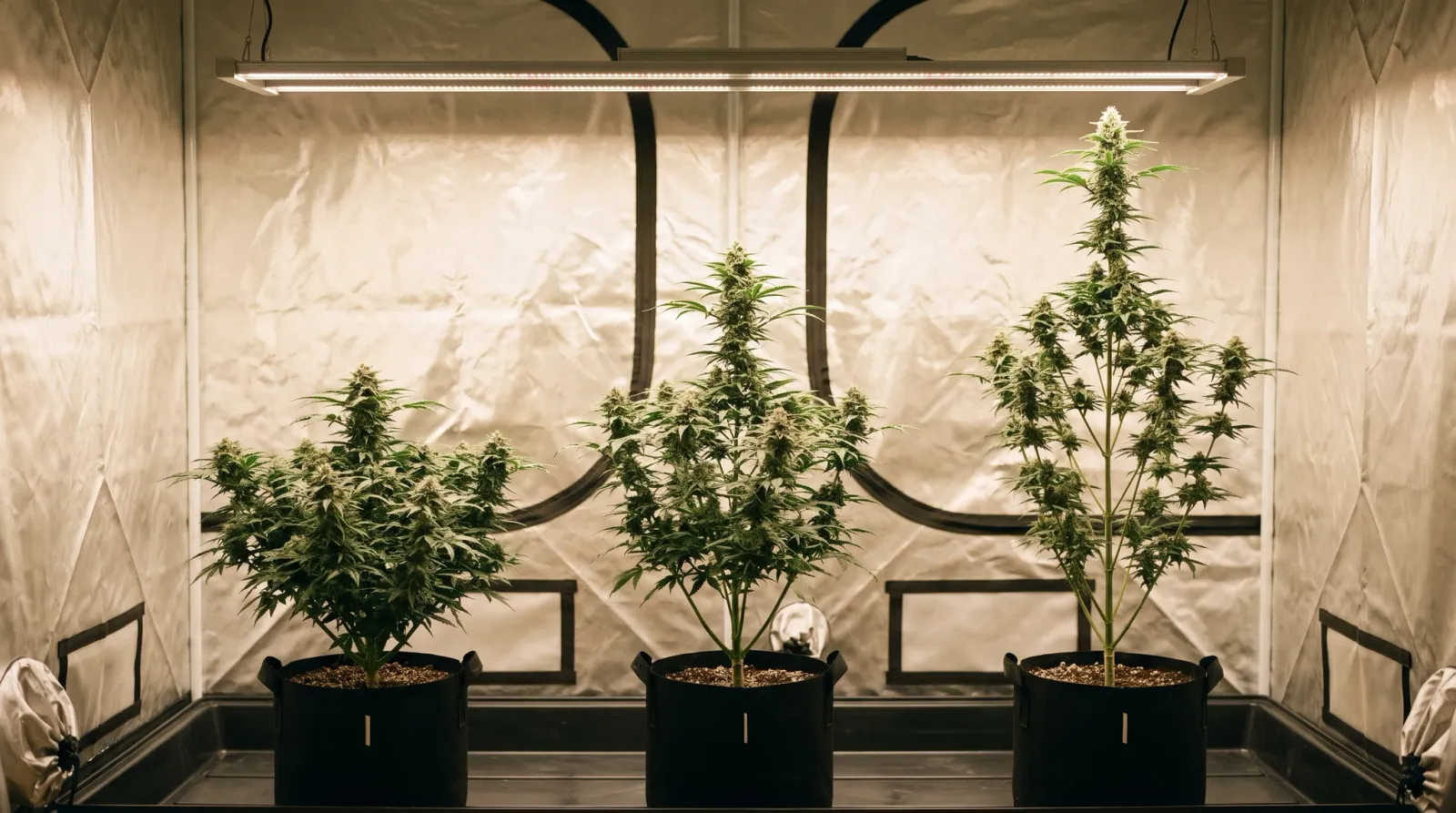
A strain is easy to grow in a tent when it stays short after the switch to flowering, finishes in fewer weeks, and does not build the big, dense colas that went with bud rot in greenhouse comparisons. The strain name predicts none of the three reliably. So choose from the breeder’s stated numbers and, after your first run, from your own logs.
Here is the number worth sending to the friend who swears by one “easy” strain. In a German growth-room trial, three strains grown under the same lamps, on the same schedule, from the same kind of cuttings, finished at 66, 95 and 136 cm tall (Reichel et al., 2021). Same room. More than double the height. The genetics did that, not the grower.
This High School lesson does not give you a ranked list of names. It gives you the three traits behind the adjectives “compact,” “fast” and “mold-resistant,” shows how far each one varies in real trials, and tells you what to ask before you buy seeds or a cutting. For the full start-to-finish process, see the beginner grow guide. Check your local law before you grow at home.
Which traits make a strain easy to grow in a tent?
Three traits do most of the work: final height, weeks of flower, and bud structure as it relates to mold. Everything else (yield, smell, potency) matters less when the plant hits the lamp or rots in week eight.
| Trait | What trials show | How to check before buying | What it does not tell you |
|---|---|---|---|
| Height after the flip | Three strains in one room finished at 66, 95 and 136 cm (Reichel et al. 2021) | Ask for the stated indoor height and plant shape (bushy or tall and narrow) | Your exact height. Light type, veg length and pot size also move it |
| Weeks of flower | 176 legal-market varieties took 70 to 133 days from sowing or cutting to harvest maturity (Lapierre et al. 2023) | Ask for flowering weeks and whether they assume seed or cuttings | That your plant will match the pack. Seed-grown plants ran slower in that trial |
| Bud density and mold | Genotypes with larger, denser top colas were the more bud-rot-susceptible ones in greenhouse comparisons (Mahmoud et al. 2023) | Ask how dense the colas get and whether the line has mildew or bud rot history | That a strain is immune. Resistance varies by pathogen and by plant |
None of those trials took place in a home tent. They are greenhouse and growth-room studies. They show how much the traits vary, not what your plant will do.
How tall will a strain get after the flip?
Taller than it was, but mostly in the first two weeks. A photoperiod plant switched to 12 hours of light goes through a burst of stem growth, which growers call the stretch. In a controlled study of one medical cultivar, the internodes and main stem elongated rapidly between days 5 and 10 of short days. Then new internodes stopped lengthening and the flower cluster condensed (Alter et al., 2024). Plants on 12/12 grew faster for about 14 days, then levelled off.
That paper studied one cultivar, and its authors say results may vary across cultivars. The 66-to-136 cm spread above shows how much they can vary. Canada’s regulator describes cannabis as “highly variable in height depending on genetic constitution and environmental factors” (CFIA).
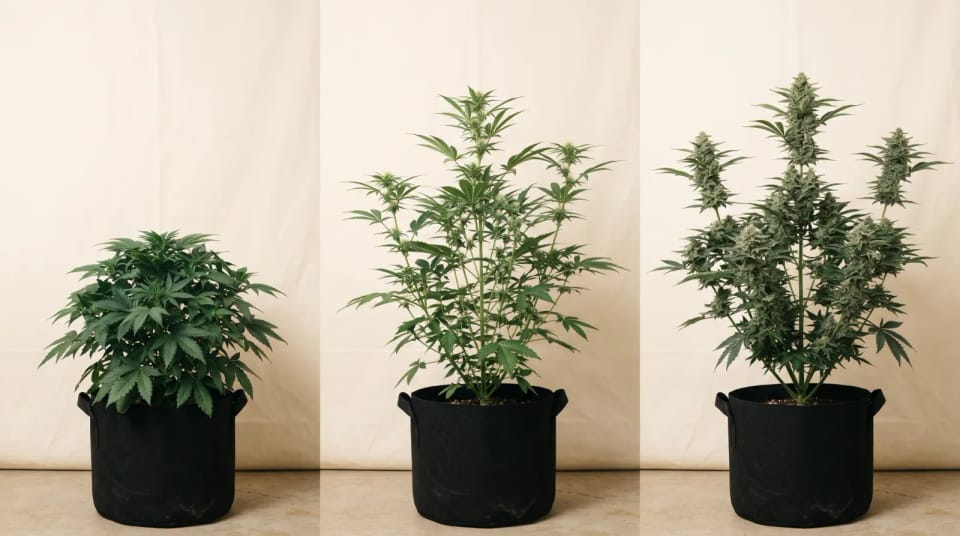
Most of the stretch comes in the first weeks after the switch to 12 hours of light. After that, the plant puts its growth into flowers, not height.
You will see “plants stretch two to three times after the flip” repeated across forums. We searched for a peer-reviewed per-strain stretch ratio and did not find one. That does not prove none exists, but treat any multiplier as a rough rule from growers, not a measurement.
Light also moves height. In the same German trial, plants grew taller under a ceramic metal halide lamp than under two LED sources (Reichel et al., 2021). So a breeder’s height figure is a starting point for your room, not a promise.
What you can control:
- Veg length. A photoperiod plant flipped earlier enters the stretch smaller.
- Training. Low-stress training spreads a tall plant sideways instead of up.
- Space planning. Your tent height and lamp hanging distance set the ceiling. For very small spaces, micro grows push every one of these levers.
How many weeks of flower should you plan for?
Plan around the range, not the number on the pack. In a Canadian greenhouse study of 176 drug-type varieties from the legal market, the time from sowing or cutting to harvest maturity ran from 70 to 133 days (Lapierre et al., 2023). Dried flower per plant ranged from 6.02 to 177.03 g. Plants grown from seed took on average 27 days longer to reach sexual maturity than plants from cuttings.
The same data hold a trade-off worth knowing. Taller plants at harvest tended to yield more (r = 0.64), and varieties that took longer to mature tended to yield less (r = -0.55). So “short” and “big yield” can pull against each other, while “fast” and “big yield” did not in this set. The study was industry-funded and ran in a greenhouse. The varieties were anonymous, so it says nothing about any named strain.
Weeks matter for mold too. Bud rot shows up late in flower. Greenhouse researchers scout for it daily from week six. They note that harvesting at six weeks instead of eight can cut bud rot, but could cost yield and potency in genotypes that are not close to maturity (Buirs and Punja, 2024). A strain that finishes sooner spends fewer weeks exposed.
Are autoflowers the shortcut?
Sometimes. An autoflower starts flowering with age instead of a light change. That is a genetic trait: in hemp populations, autoflowering behaved as a recessive trait at a single locus called Autoflower1 (Toth et al., 2022). Read more about where the autoflower trait comes from.
In one New York greenhouse, autoflowers averaged 64.54 cm tall against 126.30 cm for photoperiod plants. They had lower biomass and lower THC content (Vergara and Ruterbories, 2026). That was not a matched test: different varieties, different time in the greenhouse, and the author owns a cannabis research company. Researchers at a licensed producer also describe low cannabinoid content and poor flower quality as the trade-off for photoperiod insensitivity (Leckie et al., 2024). So autoflowers are not proven weaker, and not proven equal. They are shorter and faster, with less room to fix mistakes. Compare them properly in autoflower versus photoperiod, and see feminized, autoflower and regular seeds before you buy.
Which strains resist mold?
No name guarantees it, but bud structure is a clue. Bud rot, caused by Botrytis cinerea, “can destroy cannabis inflorescences rapidly” when relative humidity is above 70% and temperatures are moderate, about 17 to 24 °C (Mahmoud et al., 2023). In that group’s greenhouse comparisons, the genotypes with larger, denser top colas were the more susceptible ones. Three susceptible genotypes carried 96 to 128 small leaves inside each top cola. A less susceptible one carried 68.
Here is the twist. The trait many growers chase, big dense colas, is the trait that went with the loss. That is an association from a handful of genotypes, not proof that density causes rot. The authors say the mechanism is unknown. They also found that terpene levels did not track susceptibility, so smell is no guide.
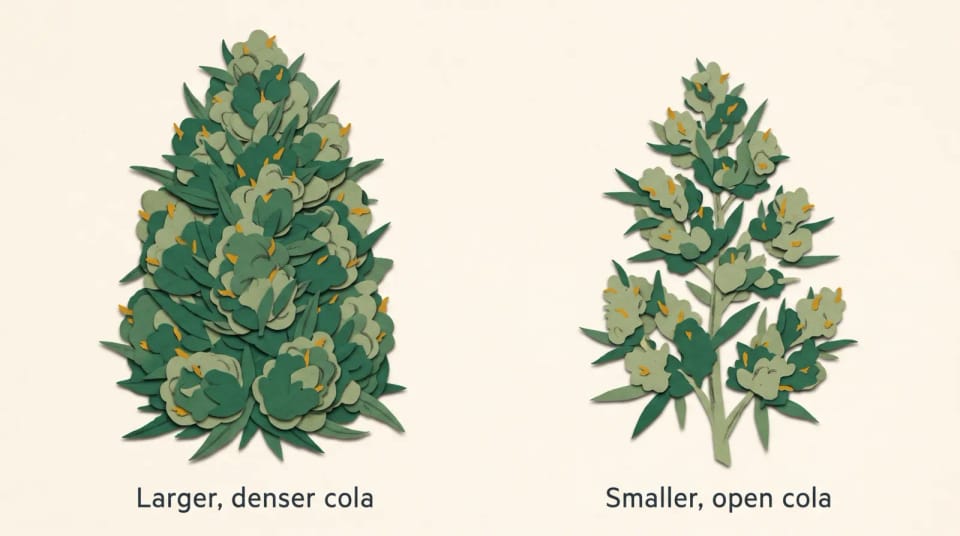
In small greenhouse comparisons, the genotypes with bigger, denser, leafier colas were the bud-rot-prone ones. It is an association, not proof that density causes rot.
Mildew resistance is real, but it varies plant by plant. In Cornell and USDA screening of 70 to 98 hemp entries, disease severity ranged widely among and within entries, and a few showed little or no powdery mildew across years (Vignale et al., 2026). Greenhouse scouting of six drug-type genotypes found one with low susceptibility to four pathogens, while others were highly susceptible to powdery mildew. The authors add that breeding for yield and THC means “some high-yielding genotypes frequently show high susceptibility” (Buirs and Punja, 2024).
So for a tent, the practical rule is about your room as much as the plant. If you cannot hold late-flower humidity down, skip genetics sold on giant, rock-hard colas. Read humidity and temperature targets, VPD, and the guides to bud rot and powdery mildew.
When to talk to a clinician: do not smoke bud with visible mold. If you have a weakened immune system or lung disease, or you get breathing symptoms after using cannabis, ask a clinician. Our guide to telling mold from trichomes helps you check a harvest.
Does the strain name tell you any of this?
Not reliably. A genetic study of 30 strains from dispensaries in three U.S. states found significant genetic differences within samples sold under the same name. Most strains had at least one genetic outlier (Schwabe and McGlaughlin, 2019). An earlier study concluded that “marijuana strain names often do not reflect a meaningful genetic identity” (Sawler et al., 2015). Canada’s regulator notes that strain names are not accepted as cultivars under the international naming code (CFIA).
So two packs sold as Northern Lights are not guaranteed to grow the same plant. The indica or sativa label is no better: the 2019 study found no clear genetic support for those labels. You will read that “indicas stay short and sativas stretch.” No source we opened tests that. Read more in DNA testing of strain names.
Two things narrow the gap. A breeder that publishes numbers for a specific seed line tells you more than any name. A cutting is a copy of one mother plant, so a known cut repeats that plant more closely than seeds do. See cuttings versus seed. Our High Families describe the terpene profile of finished flower. They classify the product, not how the plant grows.
How do you choose a strain for your tent?
Use these five steps before you spend money on genetics.
- Measure your usable height. Measure from the top of the pot to the lowest safe distance below the lamp. That number caps how tall the plant can finish.
- Choose autoflower or photoperiod. An autoflower flowers on its own age and stays small. A photoperiod plant lets you set veg length, which is your main height dial.
- Ask for the breeder’s numbers. Ask for the stated indoor height, flowering weeks, and whether the figures come from seed or cuttings. Treat “compact,” “easy” and “mold-resistant” as marketing until numbers back them.
- Match bud structure to your humidity control. If late-flower humidity is hard to control in your space, avoid genetics described as forming very large, dense colas.
- Log every run. Record height at the flip, height at harvest, weeks of flower, and any bud rot or mildew. After two runs, your log beats any list on the internet.
Once the harvest is dried and cured, the High IQ app can track how that strain actually worked for you. That is the other half of the log: how it grew, and how it felt.
Key takeaways
- Easy indoor genetics stay short after the flip, finish sooner, and avoid big, dense, leafy colas.
- In one trial, three strains in the same room finished at 66, 95 and 136 cm.
- In a controlled study of one cultivar, most stretch came in the first two weeks of flower. No per-strain multiplier is established.
- Strain names and indica or sativa labels do not reliably predict height, timing or mold.
- Ask breeders for numbers, then trust your own grow log.
FAQ
What is the best strain to grow indoors for beginners?
No single strain is best, because names do not guarantee the same plant. Look for a seed line or cutting with a stated short indoor height and fewer flowering weeks, and avoid lines sold on giant dense colas if humidity is hard to control. An autoflower is a common starting point because it stays small and finishes on its own schedule.
Which strains stay short for a small tent?
Choose by the breeder’s stated indoor height and plant shape, not the indica label. In a controlled trial, three strains in one room finished at 66, 95 and 136 cm, so genetics vary widely. Flip a photoperiod plant earlier, train it sideways, or use an autoflower to keep it short.
Are autoflowers better for beginners?
They are simpler on space and time. In one greenhouse comparison, autoflowers were about half the height of photoperiod plants, but made less biomass and less THC. That comparison was not matched, so treat it as a trend from one site, not a rule.
How long does it take to grow weed indoors?
In a study of 176 legal-market varieties, sowing or cutting to harvest maturity took 70 to 133 days, before drying and curing. Plants from seed took longer than plants from cuttings. Plan around the breeder’s flowering weeks plus your veg time, and expect your plant to differ.
Sources
-
Reichel P, Munz S, Hartung J, et al. “Impact of three different light spectra on the yield, morphology and growth trajectory of three different Cannabis sativa L. strains.” Plants (Basel). 2021;10(9):1866. DOI: 10.3390/plants10091866
-
Lapierre É, de Ronne M, Boulanger R, Torkamaneh D. “Comprehensive phenotypic characterization of diverse drug-type cannabis varieties from the Canadian legal market.” Plants (Basel). 2023;12(21):3756. DOI: 10.3390/plants12213756
-
Mahmoud M, BenRejeb I, Punja ZK, Buirs L, Jabaji S. “Understanding bud rot development, caused by Botrytis cinerea, on cannabis (Cannabis sativa L.) plants grown under greenhouse conditions.” Botany. 2023;101(7):200-231. DOI: 10.1139/cjb-2022-0139
-
Alter H, Sade Y, Sood A, et al. “Inflorescence development in female cannabis plants is mediated by photoperiod and gibberellin.” Horticulture Research. 2024;11(11):uhae245. DOI: 10.1093/hr/uhae245
-
Schwabe AL, McGlaughlin ME. “Genetic tools weed out misconceptions of strain reliability in Cannabis sativa: implications for a budding industry.” Journal of Cannabis Research. 2019;1:3. DOI: 10.1186/s42238-019-0001-1
-
Sawler J, Stout JM, Gardner KM, et al. “The genetic structure of marijuana and hemp.” PLoS One. 2015;10(8):e0133292. DOI: 10.1371/journal.pone.0133292
-
Vergara D, Ruterbories KA. “High-THC Cannabis sativa in a New York greenhouse: yield and economic factors.” Journal of Cannabis Research. 2026;8. DOI: 10.1186/s42238-026-00429-5
-
Buirs L, Punja ZK. “Integrated management of pathogens and microbes in Cannabis sativa L. (cannabis) under greenhouse conditions.” Plants (Basel). 2024;13(6):786. DOI: 10.3390/plants13060786
-
Toth JA, Stack GM, Carlson CH, Smart LB. “Identification and mapping of major-effect flowering time loci Autoflower1 and Early1 in Cannabis sativa L.” Frontiers in Plant Science. 2022;13:991680. DOI: 10.3389/fpls.2022.991680
-
Vignale L, Schwartz JA, Stansell Z, et al. “Screening diverse Cannabis sativa germplasm for resistance to Golovinomyces ambrosiae.” Plant Disease. 2026;110(7):2636-2642. DOI: 10.1094/PDIS-07-25-1591-RE
-
Leckie KM, Sawler J, Kapos P, et al. “Loss of daylength sensitivity by splice site mutation in Cannabis pseudo-response regulator.” The Plant Journal. 2024;118(6):2020-2036. DOI: 10.1111/tpj.16726
-
Canadian Food Inspection Agency. “The biology of Cannabis sativa L. (cannabis, hemp, marijuana).” Government of Canada, modified 2021. CFIA biology document



