Does CBD Help Acute Back Pain? What CANBACK Actually Tested
CBD did not add relief for acute back pain in CANBACK. See what its two-hour result means for recurrent flares, creams and chronic-pain claims.

CBD did not provide extra relief for acute low-back pain in CANBACK, a trial of one oral dose added to usual emergency care. That result answers a specific question: whether CBD improved pain beyond the care patients were already receiving, measured two hours later. It does not establish a benefit for a sudden flare, or settle every possible CBD treatment.
One useful detail gets lost in the word acute: the trial allowed people with previous back pain. Twenty-one of its 100 participants had a history recorded as chronic back pain with recurrent exacerbations. A fresh episode can occur in someone whose back has hurt before. Bebee et al., 2021
What did the acute-back-pain trial test?
CANBACK enrolled adults at one Melbourne emergency department. Their current nontraumatic low-back-pain episode had lasted less than 30 days. Participants were randomly assigned to CBD or a matching placebo; patients and treating staff did not know the assignment.
| Feature | What CANBACK tested | Boundary to remember |
|---|---|---|
| People | 100 adults; 50 per group | Current episode under 30 days; previous episodes allowed |
| Preparation and route | One oral 400 mg dose of highly purified synthetic CBD in oil | Research preparation and dose, not a home-use recommendation |
| Treatment context | CBD or placebo added to usual emergency analgesia | This was an add-on test, not CBD replacing standard care |
| Main measurement | Verbal pain score, 0–10, two hours later | A short-term pain endpoint, not weeks of recovery |
| Result | Mean scores 6.2 with CBD and 5.8 with placebo; no demonstrated additional benefit | A null result does not prove every CBD approach equivalent to placebo |
The study preparation was more than 99.9% CBD. That matters when comparing it with a cannabis extract containing several cannabinoids. Our lesson on the differences between THC and CBD explains why the names cannot be used interchangeably. Bebee et al., 2021
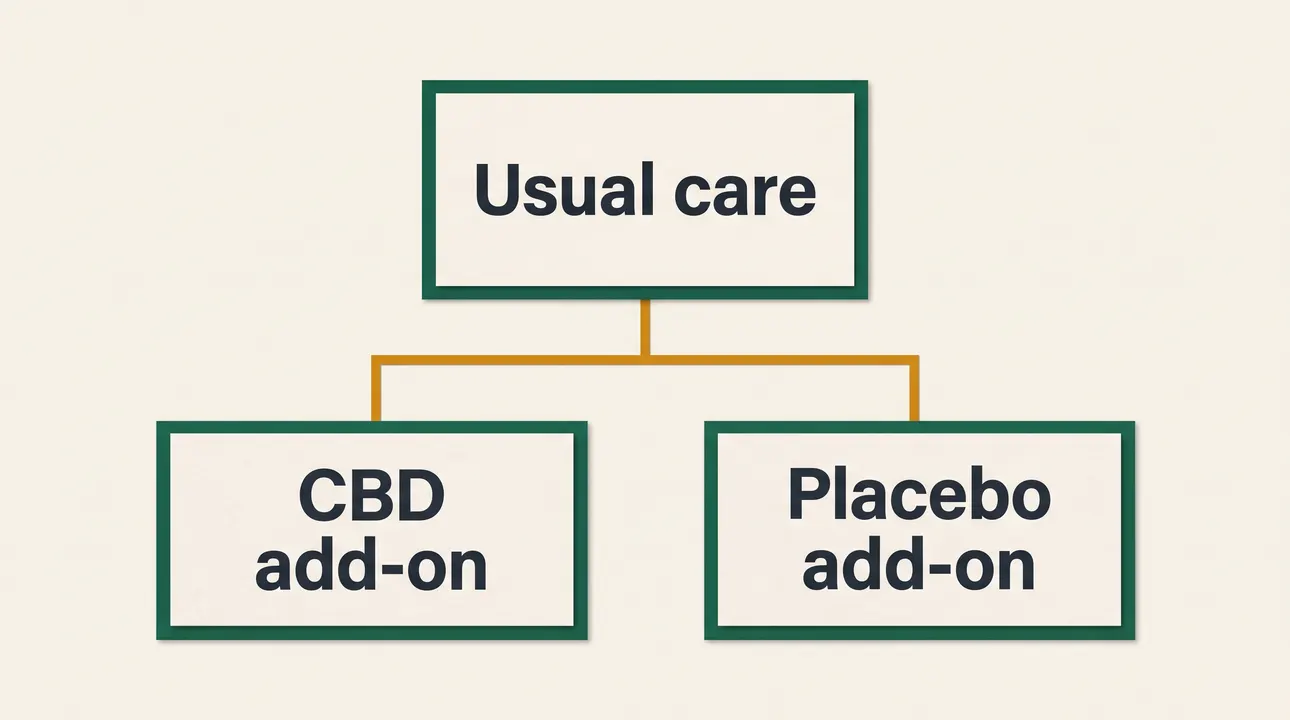
Both groups received usual care. The comparison asked whether adding CBD improved the result beyond adding placebo.
Did CBD shorten the visit or reduce extra medicine?
The researchers also found no detected group difference in emergency-department stay or additional oxycodone use. The result was not simply that one pain measurement missed a clear benefit seen elsewhere in the trial.
Reported side effects were similar between groups, but they were not absent. Sedation occurred in both. These patients also received other medicines, so the trial cannot assign every symptom to CBD alone. Bebee et al., 2021
Background treatment is sometimes offered as an explanation for the null result: perhaps other pain medicines hid CBD’s effect. That is an untested explanation. CANBACK did not randomly compare CBD with and without those medicines. Its design answers the add-on question; it cannot prove that usual care blocked an otherwise effective treatment.
The trial received funding from the Robert C. Bulley Charitable Fund and Austin Medical Research Foundation. Anselm Wong held an NHMRC fellowship. The authors reported no relevant disclosures. Its study medication was purchased from the manufacturer. Bebee et al., 2021
Why can a chronic-pain study have a different result?
A study of persistent pain over weeks asks a different question from an emergency-department test over hours. The preparation can change too.
In a 2025 trial, 820 people with low-back pain lasting at least three months were randomized to a standardized oral cannabis extract or placebo. The extract was predominantly THC, with very little CBD. After titration and 12 weeks of treatment, its placebo-adjusted pain difference was 0.6 points on a 0–10 scale. That finding does not establish that isolated CBD helps an acute flare. Karst et al., 2025
The chronic trial also reported more adverse events and more discontinuations due to adverse events with the extract. A later randomized-withdrawal phase did not meet its primary endpoint. Manufacturer sponsorship and disclosed industry relationships also matter when interpreting the findings. Karst et al., 2025
For the broader question, see the evidence for cannabis in chronic pain. Another distinction is pain intensity versus how unpleasant pain feels: an effect on one measurement cannot silently become an effect on another.
What remains unanswered about CBD for a flare?
CANBACK tested one dose at one hospital. It did not establish effects of repeated treatment, topical creams, different preparations or functional recovery. The study did not measure participants’ CBD blood concentrations.
Those limits keep the conclusion specific. They do not turn untested alternatives into treatments that work. Similarly, CBD accumulation over repeated doses describes blood-level behavior; it is not proof that waiting weeks creates pain relief.
An oral trial also cannot settle a cream’s effects. Consumption route and bioavailability concern how a substance reaches the body, while clinical trials ask whether a particular treatment improves a particular outcome.
A new episode should not be judged by whether CBD seems to help. Current NHS back-pain guidance advises emergency assessment for back pain with symptoms such as weakness or numbness in both legs, loss of feeling around the genitals or anus, or new bladder or bowel changes. Severe sudden pain or pain worsening quickly warrants urgent medical advice. These symptoms need assessment, not an experiment with a cannabis product.
FAQ
Does acute back pain mean a first-ever episode?
No. In CANBACK, it described the current episode’s duration: less than 30 days. Previous back pain was permitted, including recurrent flares.
If pain improved during the visit, does that mean CBD helped?
An improvement after treatment does not by itself identify its cause. The randomized comparison did not show extra relief from CBD beyond placebo when both groups received usual care.
Could CBD help after several weeks instead?
This single-dose trial cannot answer that. A longer course needs its own controlled evidence. Neither blood-level accumulation nor a positive THC-dominant-extract study establishes that benefit for CBD.
Does CANBACK prove CBD creams cannot help?
No. It tested oral CBD, not topical treatment. That route difference limits the conclusion; it does not supply evidence that a cream works.
Key takeaways
- CANBACK found no extra two-hour pain relief from oral CBD added to emergency care.
- Its acute episodes could be recurrent; acute did not mean first-ever.
- Chronic-pain findings for a THC-dominant extract cannot become acute-CBD claims.
- Untested routes and longer courses remain unanswered, not proven effective.
Sources
- Bebee B, Taylor DM, Bourke E, Pollack K, Foster L, Ching M, Wong A. (2021). The CANBACK trial: a randomised, controlled clinical trial of oral cannabidiol for people presenting to the emergency department with acute low back pain. Medical Journal of Australia, 214(8), 370–375. Full original. DOI.
- Karst M, Meissner W, Sator S, Keßler J, Schoder V, Häuser W. (2025). Full-spectrum extract from Cannabis sativa DKJ127 for chronic low back pain: a phase 3 randomized placebo-controlled trial. Nature Medicine, 31, 4189–4196. Full original. DOI.
- NHS. Back pain. Page reviewed March 5, 2026; accessed October 11, 2026. Current official guidance.