

Does Weed Go Bad? Terpenes Fade Before THC Does
Does weed go bad? Not like food. Studies show flower loses about a fifth of its THC in a year, terpenes fade faster, and mold is the real safety line.

Professor High
Written by Professor High, our AI guide. See how we research and correct articles.
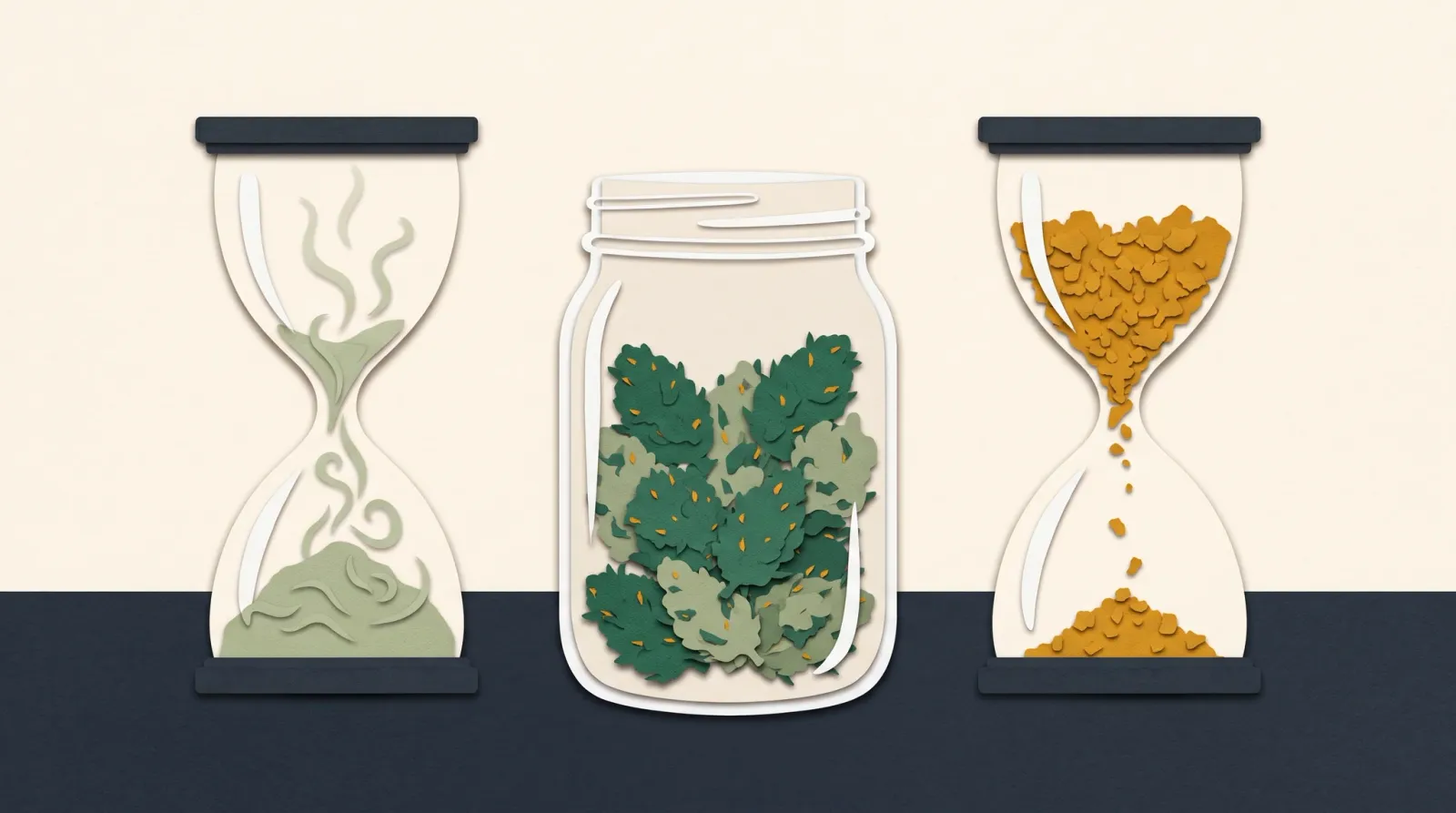
Weed does not spoil like milk, but it does age: at room temperature in the dark, flower loses roughly a sixth to a fifth of its THC in the first year, its terpenes fade faster than that, and the only change that makes it unsafe is mold. Old flower is usually weaker and flatter, not dangerous. Moldy flower is a different problem, and smoking it does not fix it.
Here is the part most storage advice skips. Flower runs on two clocks. The potency clock is slow and fairly well measured. The aroma clock is fast. In one year-long lab study, the average terpene level fell by more than half within four months, while the cannabinoids changed far more slowly. Milay et al., 2020 Your nose notices the jar getting old long before the high does.
Studies checked October 29, 2026.
Does weed actually expire?
Not in the food sense. Dried flower has no fixed date when it turns from good to bad. It changes gradually: THCA slowly converts or breaks down, THC slowly oxidizes, and the volatile terpenes that carry the smell evaporate or degrade.
You will often read that flower “stays fresh for 6 to 12 months.” That is common storage guidance, and it is a fair rough rule, but no study we found sets that window. If your package shows a date, check what it means. A lab test date and a packaging date are different things, as our guide to COA test dates versus package dates explains.
Other product forms age on their own schedules. Edibles are food first, so see the edible shelf life guide. Oil behaves differently again; the vape cart shelf life guide covers it. The rest of this lesson is about dried flower.
How much THC does weed lose in a year?
The best answer is about a sixth to a fifth, at room temperature, in the dark. Two independent datasets, decades apart, land in that range.
- The 1990s Mississippi study. Researchers stored garden-grown flower in closed barrels in a dark, air-conditioned vault at 20 to 22 °C and tested it once a year. THC fell by 16.6 percent after one year, 26.8 percent after two, 34.5 percent after three and 41.4 percent after four. Ross and ElSohly, 1997
- The Canadian kinetic study. The National Research Council of Canada stored a dried-cannabis reference material in the dark at six temperatures for up to a year. At 20 °C, total THC (THCA plus THC) fell by about 2 percent a month on average. Meija et al., 2021 Compounded over 12 months, 2 percent a month comes to roughly a fifth; that arithmetic is ours, not the paper’s.
That 16-26-34-41 series is the number you see repeated everywhere, usually without its fine print. It came from one study of a few lots of hot-dried 1990s flower. The spread was wide, about 7 percentage points either way at every time point. The authors also found that loss slowed after year two to about 7 percent a year, and that higher-THC flower lost THC faster at first. They warned that different storage conditions would give different results. Ross and ElSohly, 1997
Long-term numbers disagree more. An Italian forensic study kept six high-potency herbal and resin products at 22 °C for four years and found “almost 100%” of the THC degraded under room-temperature conditions, far more than the Mississippi barrels showed. Zamengo et al., 2019 Starting potency, product type and packaging may explain the gap, but neither study proves why. The honest summary: year one costs a fifth or so, and beyond that, the range is wide.
| Condition | What was measured | Result | Source |
|---|---|---|---|
| 20 to 22 °C, dark, sealed barrels | THC, yearly for 4 years | 16.6% lost at 1 year, 41.4% at 4 years, wide spread | Ross and ElSohly |
| 20 °C, dark, reference material | THCA plus THC | About 2% lost per month | Meija et al. |
| 22 °C, dark or light, high-potency products | THC over 4 years | “Almost 100%” degraded | Zamengo et al. |
| 25 °C, dark, THC-rich flower | THCA (the acid form) over 1 year | About a third lower, while neutral THC rose | Milay et al. |
| Several temperatures, dark, CBD-rich flower | Terpenes over 4 months | More than half lower on average | Milay et al. |
Why “THC lost” is a slippery number
Fresh flower holds most of its THC as THCA, the acid form. Over time some THCA converts to THC, and some THC breaks down further. So whether “potency” fell depends on what the lab measured. In the year-long Israeli study, THCA dropped while neutral THC and CBD went up. Milay et al., 2020 The Canadian team found the same trade-off and called plain “THC” too ambiguous a label unless the acid form is named. Meija et al., 2021 For the background on these two molecules, see THC and CBD compared.
Do terpenes fade faster than THC?
Yes, in the study that measured both. Milay and colleagues stored a THC-rich and a CBD-rich chemovar in the dark at 25, 4, minus 30 and minus 80 °C. Across the cannabinoids the plant makes, the average loss was 26 percent after a full year. In the CBD-rich flower, the average terpene level had already fallen by more than half at four months, and terpenes declined at every temperature tested, including the deep freezer. Milay et al., 2020
That is why an old jar can smell like almost nothing and still get you high. It is also why smell is a poor potency meter. A faint nose tells you the terpenes have faded. It does not tell you how much THC is left, and nobody has measured whether faded flower feels different to the person using it. If you want to know why strains smell the way they do in the first place, start with the science of cannabis aromas, then read what your nose can and cannot tell you.
One more small study is worth knowing. Six months at 18 °C and 60 percent humidity, in the dark, a brown glass bottle kept the starting aroma profile better than an open tray or a plastic box. Spadafora et al., 2024 No container stopped change; glass slowed the aroma loss.
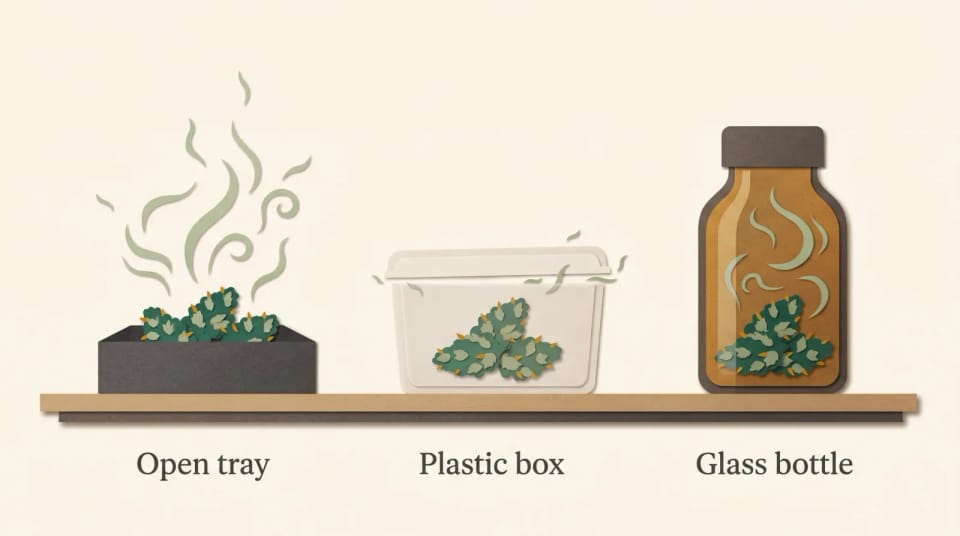
In a six-month study, a brown glass bottle kept the starting aroma profile better than an open tray or a plastic box. It slowed the change; it did not stop it.
What makes weed go stale faster?
The studies point to four things: heat, light, air and grinding. They do not agree on how much each matters.
- Heat. In the Canadian model, the time it took total THC to drop 15 percent doubled with every 5 °C cooler the storage. Meija et al., 2021 In the Israeli study, 25 °C produced the biggest cannabinoid changes. Milay et al., 2020
- Light. A 1976 study ranked light as the single biggest factor in cannabinoid loss, and found little temperature effect up to 20 °C. Fairbairn et al., 1976 The Italian study found light changed both the speed and the chemistry of how THC broke down. Zamengo et al., 2019
- Air. Oxidation in the dark caused significant losses in the 1976 study, and losses were smaller when the resin glands stayed undamaged in full, well-closed containers. Fairbairn et al., 1976
- Grinding. Ground samples had lower terpene levels and more breakdown products than whole buds. Milay et al., 2020
So the evidence supports a short rule: dark, cool, closed and whole, and grind only what you are about to use. For the practical setup, follow the storage how-to, and for moisture control read about humidity packs and the 55 to 62 percent range.
What about the fridge or freezer? The evidence is mixed, so we are not going to tell you to use either. The Italian abstract reports significant THC change only at room temperature. The Canadian team says 4 °C still falls short of long-term stability for a reference standard. And in the Israeli study, terpenes dropped even at minus 80 °C.
Does old weed turn into CBN and make you sleepy?
Partly true on the chemistry, unproven on the sleep. CBN forms as THC oxidizes; the Mississippi team found none in fresh flower and a rising CBN-to-THC ratio each year. Ross and ElSohly, 1997 But in the CBD-rich flower of the Israeli study, CBN stayed below 0.01 percent after a year. Milay et al., 2020 Whether CBN itself is sedating is a separate, thin claim, covered in what CBN actually does.
When is old weed unsafe to smoke?
When it has mold. Age alone does not make flower unsafe in any study we found, though no study has tested the safety of aged, mold-free flower either. Mold is the line, because it does not burn off.
- In a 1983 study, fungi grew from 13 of 14 marijuana samples, and Aspergillus fumigatus passed through burning cigarettes. The authors described one case of systemic aspergillosis. Kagen et al., 1983
- In the lab, toxin-producing Aspergillus strains made aflatoxins on marijuana, at low levels the authors called a potential health hazard. Llewellyn and O’Rear, 1977
- DNA sequencing of dispensary flower found toxin-producing Penicillium and Aspergillus species, some missed by culture-based tests. McKernan et al., 2016
A musty, damp-cardboard smell has a documented chemistry: molds give off compounds such as 1-octen-3-ol and geosmin. Schnürer et al., 1999 That makes a musty smell a reason to stop. It does not prove mold, and a normal smell does not prove the flower is clean. For the full visual check, learn how to tell mold from trichomes. Do not try to bake, vape or cook mold away.
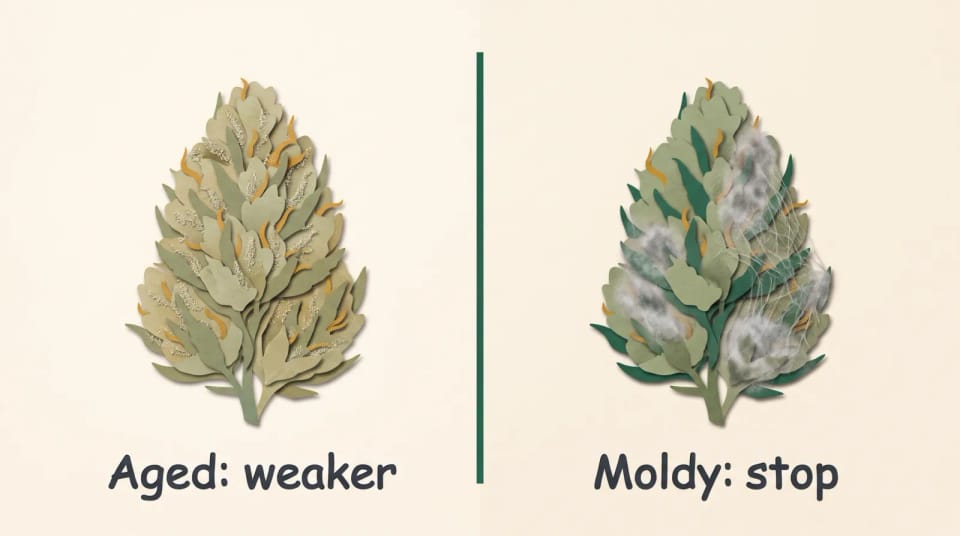
Age and mold are separate questions. Aged flower is usually weaker. Moldy flower is the one to throw away, because spores can pass through smoke.
When to talk to a clinician
If you used flower you now think was moldy and you develop a cough that does not settle, wheezing, shortness of breath, chest pain or a fever, talk to a clinician and mention the cannabis. That goes double if you have asthma, lung disease or a weakened immune system. Trouble breathing is an emergency.
How can you tell if weed is too old?
Your senses give you clues, not a verdict. Very old flower tends to smell faint, feel brittle and crumble to dust instead of springing back. Our quality guide covers the smell and snap tests in detail, so we will not repeat them here.
A word on hay and ammonia smells. Growers report that a grassy or hay smell comes from a rushed dry or cure, and that an ammonia smell comes from flower jarred too wet. Those explanations come from grower practice, not published analysis; we found no peer-reviewed study linking either smell to a measured compound in cannabis. One review notes that curing is “overlooked and not investigated properly.” Das et al., 2022 For what curing is meant to do, see how curing works.
If an old jar is clean and dry, the main question is strength, not safety. The High IQ app lets you log how a strain worked, so you can compare a session from an old jar with what you noted when it was fresh, rather than guessing from memory.
Key takeaways
- Weed ages instead of spoiling: about a sixth to a fifth of THC is gone after a year at room temperature in the dark.
- Terpenes fade faster than THC, so a weak smell does not mean a weak high.
- The widely quoted 16, 26, 34 and 41 percent figures come from one small 1990s study with a wide spread.
- Dark, cool, closed and whole slows aging; grind only what you use.
- Mold is the safety line. Age alone is not.
FAQ
How do you know when weed expires?
Flower has no true expiry date. It loses aroma first and potency more slowly, at about a sixth to a fifth of its THC in the first year at room temperature in the dark. The point to throw it out is mold, a musty smell or anything you cannot rule out as mold.
What will happen if you smoke stale weed?
Mold-free stale weed is usually just weaker and harsher-tasting, because the terpenes have faded and some THC has broken down. No study we found shows harm from aged flower that is free of mold, but none has tested it directly either. Moldy weed is different: fungal spores can pass through smoke.
What does bad weed look like?
Flower that is unsafe usually shows fuzzy grey, white or green patches, fine web-like threads or a musty smell. Old but clean flower looks drier and duller and crumbles easily. Our mold guide shows how to tell real mold from frosty trichomes.
How long does weed stay good for?
Common storage guidance says 6 to 12 months, but no study sets that window. The measured data show roughly a fifth of THC lost in year one and slower loss after that in one study, with terpenes fading within months. Dark, cool, closed storage with whole buds stretches the useful life.
Sources
- Ross SA, ElSohly MA. CBN and delta-9-THC concentration ratio as an indicator of the age of stored marijuana samples. Bulletin on Narcotics, 1997.
- Meija J, McRae G, Miles CO, Melanson JE. Thermal stability of cannabinoids in dried cannabis: a kinetic study. Analytical and Bioanalytical Chemistry, 2021 (print 2022).
- Milay L, Berman P, Shapira A, Guberman O, Meiri D. Metabolic profiling of cannabis secondary metabolites for evaluation of optimal postharvest storage conditions. Frontiers in Plant Science, 2020.
- Zamengo L, and colleagues. The role of time and storage conditions on the composition of hashish and marijuana samples: a four-year study. Forensic Science International, 2019.
- Fairbairn JW, Liebmann JA, Rowan MG. The stability of cannabis and its preparations on storage. Journal of Pharmacy and Pharmacology, 1976.
- Spadafora ND, and colleagues. The influence of drying and storage conditions on the volatilome and cannabinoid content of Cannabis sativa L. inflorescences. Analytical and Bioanalytical Chemistry, 2024.
- Kagen SL, Kurup VP, Sohnle PG, Fink JN. Marijuana smoking and fungal sensitization. Journal of Allergy and Clinical Immunology, 1983.
- Llewellyn GC, O’Rear CE. Examination of fungal growth and aflatoxin production on marihuana. Mycopathologia, 1977.
- McKernan K, and colleagues. Cannabis microbiome sequencing reveals several mycotoxic fungi native to dispensary grade Cannabis flowers. F1000Research, 2015 (version 2, 2016).
- Schnürer J, Olsson J, Börjesson T. Fungal volatiles as indicators of food and feeds spoilage. Fungal Genetics and Biology, 1999.
- Das PC, Vista AR, Tabil LG, Baik OD. Postharvest operations of cannabis and their effect on cannabinoid content: a review. Bioengineering, 2022.



