E-Nails and E-Rigs: The Beginner's Setup Guide
New to electric dabbing? Learn what e-nails and e-rigs are, how to set one up, dial in temperature, take your first dab, and clean it like a pro.

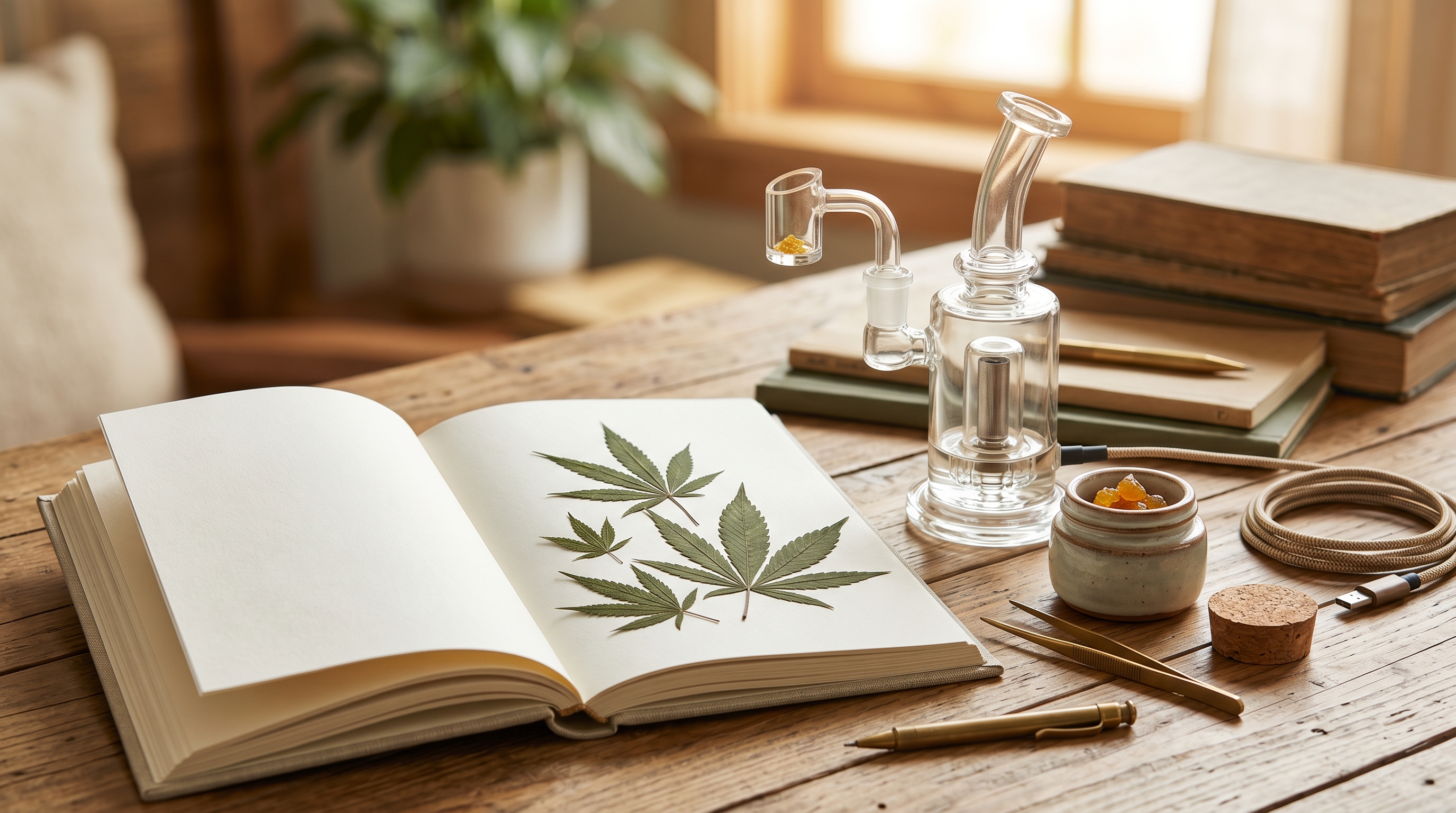
If you have ever held a butane torch to a glass banger, watched it glow, counted “one Mississippi, two Mississippi” in your head, and then taken a dab that either tasted like burnt rubber or barely vaporized at all, I have good news. There is a better way, and it does not involve guessing.
That guessing game is exactly what e-nails and e-rigs were built to eliminate. Instead of eyeballing a glowing piece of quartz and praying you nailed the timing, you punch in a number, let the device do the work, and get the same result every single time. For a lot of people, it is the difference between dabbing being a stressful little ritual and dabbing being something they actually look forward to.
This is your full beginner’s walkthrough: what these devices are, how they differ from a torch, what the parts do, how to set one up, how to pick a temperature, how to take your first dab without wasting your concentrate, and how to keep the whole thing clean. If you are brand new to concentrates entirely, start with our dabbing 101 guide first, then come back here for the electric upgrade.
E-Nail vs E-Rig vs Torch: What’s the Difference?
These three terms get tossed around interchangeably, but they describe genuinely different setups. Getting them straight before you spend money will save you a lot of confusion.
A torch-and-nail setup is the original method. You have a dab rig (a water pipe built for concentrates), a quartz or titanium nail, a butane torch, and a carb cap. You heat the nail with the open flame, wait for it to cool to your target, then dab. It is cheap, simple, and portable, but every session involves guesswork and an open flame. If you want the full picture on these, our dab rigs buyer’s guide breaks down the glass side of things.
An e-nail (short for “electric nail”) replaces the torch with electronics. It is a standalone heating system made of three parts: a temperature controller box, a heating coil, and a nail or banger that attaches to your own water piece. You set a temperature on the box, the coil wraps around the nail and heats it electrically, and a sensor keeps it locked at that number indefinitely. No flame, no timing, no reheating between dabs.
An e-rig (electric rig) is the all-in-one version. The atomizer, heating element, battery, and water path are integrated into a single portable device. Think Puffco Peak, Dr. Dabber Switch, or the Focus V Carta. You charge it, press a button, and dab. No separate glass, no wall plug, no coil to position.
Here is the simple way to choose:
- Torch + nail: Cheapest entry point, fully portable, but imprecise and uses an open flame.
- E-nail: Best for the home connoisseur who wants total control, can use any glass and any nail material, and runs forever off wall power.
- E-rig: Best if portability and grab-and-go convenience matter most.
If you are still deciding whether concentrates are even your lane versus flower or edibles, our guide on choosing between flower, edibles, and concentrates is worth a read. And if you want to see where dabbing fits in the bigger toolkit picture, the cannabis gear guide zooms all the way out.
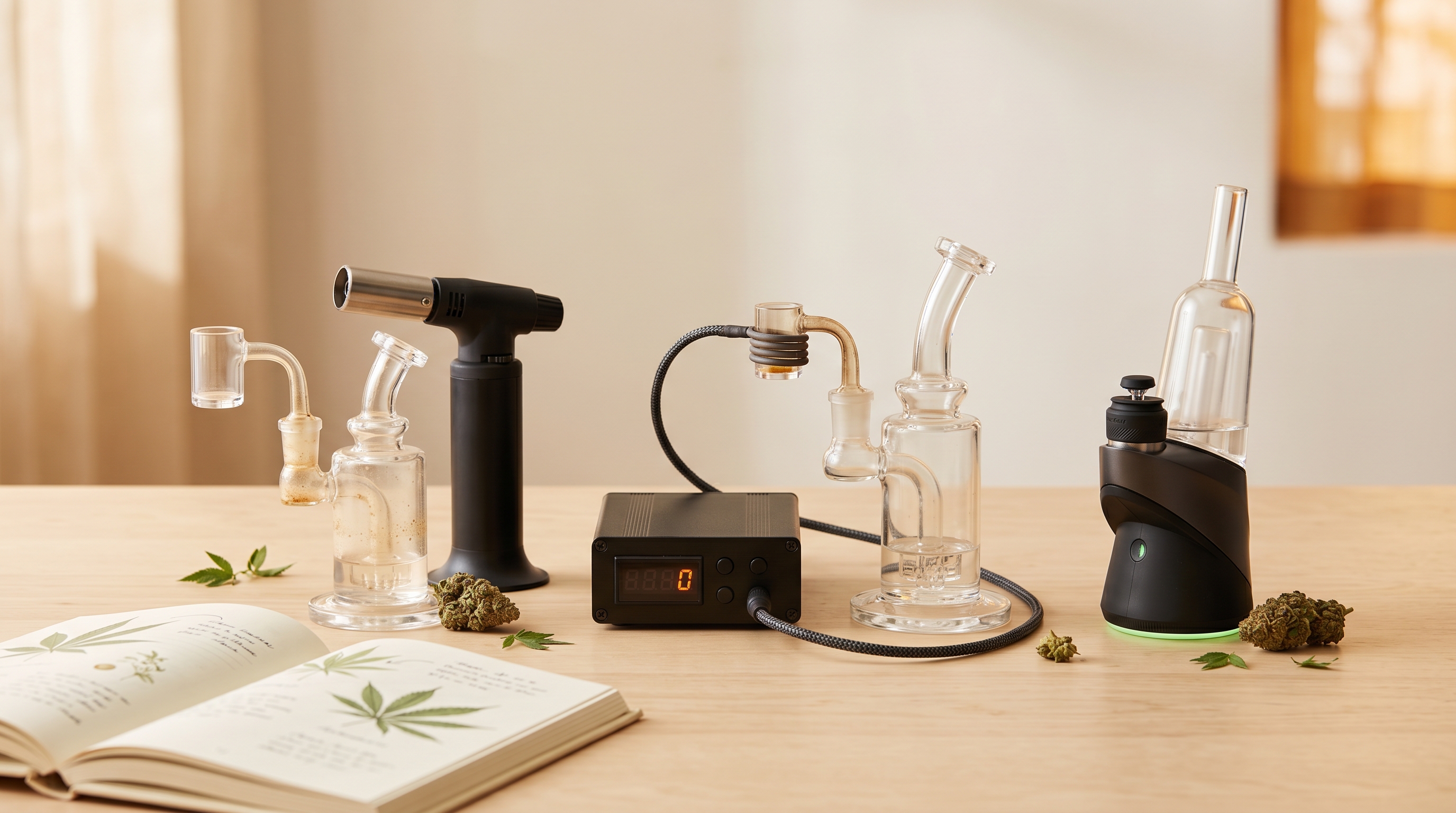
The Components, Explained
If you go the e-nail route, you are assembling a few parts. Understanding what each one does makes setup and troubleshooting far less mysterious.
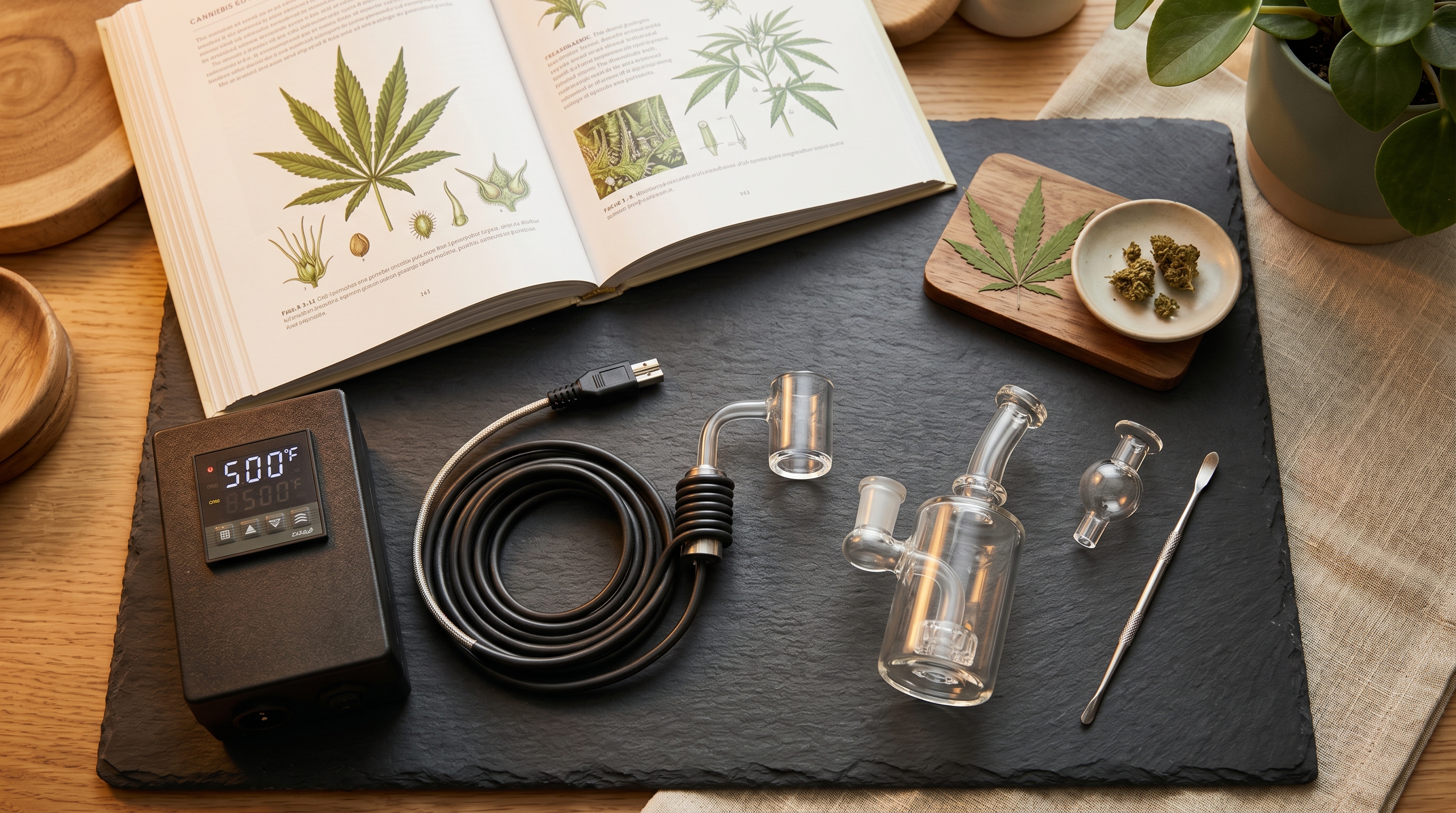
The controller box (the brain). This plugs into a wall outlet and shows a temperature on a digital display. You use up and down buttons to set your target. Inside, quality units run a PID controller — short for proportional-integral-derivative. That is a fancy way of saying the controller reads the temperature many times per second and constantly nudges the power up or down to hold your number within a few degrees. Budget boxes use simple on/off switching and tend to overshoot by 10 to 20°F before correcting. A real PID anticipates that overshoot and holds steady. When buying, look for a UL or CE safety certification.
The heating coil. This is a resistive wire wound into a cylinder that wraps around the body of your nail. When the controller sends power, the coil heats up and transfers that heat into the nail. Coils come in standard inner-diameter sizes (10mm, 16mm, 20mm, 25mm, 30mm), and the coil size must match your nail. A 20mm coil on a 25mm nail will sit loose, make poor contact, and heat unevenly. The coil also contains a thermocouple — the thin temperature-reading wire. Type K is the industry standard; if you mix a Type K coil with a controller set to read Type J, your temperature readings can be off by 50°F or more. Match them.
The nail or banger. This is the surface your concentrate actually lands on. Material matters a lot, and we will get into that below.
Your water piece. With an e-nail you bring your own rig. Most 14mm and 18mm joints work fine — just match your nail’s joint to your glass. A smaller rig intensifies flavor; a larger one cools the vapor more.
The carb cap. A small lid you place over the nail after dropping your dab. It restricts airflow, which lowers the pressure inside the banger and lets your concentrate vaporize at a lower temperature than it otherwise could. For low-temp dabbing, a carb cap is not optional — it is essential.
Banger and Atomizer Materials
The material your concentrate touches shapes both flavor and how the thing behaves. Here is the quick rundown:
- Quartz is the flavor champion and the most popular choice. It is non-porous, so it tastes clean from day one, heats up fast, and cools fast. The tradeoff is durability — it can crack or “chazz” (cloud up permanently) if abused.
- Titanium is nearly indestructible and heats fast, making it great for travel and clumsy hands. Look specifically for Grade 2 titanium, which is biocompatible; avoid cheap “Grade 5” mystery alloys. The downside is a faint metallic taste if you run it too hot or skip seasoning.
- Ceramic holds heat the longest, acting like a thermal battery for long, low-temp sessions. It heats slowly and is the most fragile of the three.
- Silicon carbide (SiC) inserts are a newer option prized for incredible heat retention.
For most beginners, a quartz banger is the right call. It rewards clean habits with the best flavor and is the easiest material to “read.” If you want to understand why flavor lives in the concentrate’s terpenes, our cannabis terpenes guide covers the science.
Step-by-Step Setup
Setting up an e-nail the first time takes about five minutes. Here is the sequence.
- Clear and prep your space. Set the controller box on a flat, stable surface away from water and clutter. Fill your rig with enough water to bubble without splashing into the mouthpiece.
- Install the nail on your rig. Seat your quartz or titanium nail fully into the joint. Match joint sizes — do not force a mismatch.
- Slide the coil onto the nail. The coil should hug the nail’s body snugly — not loose, not forced. Tuck the thermocouple into its groove or against the side of the nail so it actually reads the nail temperature.
- Connect the coil to the controller box. Plug the coil’s connector into its port. Make sure all five pins seat properly; a misaligned coil can throw an error code, which usually means a thermocouple connection problem, not a broken unit.
- Plug the controller into a wall outlet. Confirm every connection is firm before powering on.
- Set your target temperature (more on choosing that number next) and wait for the system to stabilize. A good PID box will reach temp in under five minutes and hold tight. Budget boxes may oscillate for longer.
One important nuance: the thermocouple reads the temperature of the nail body, not the dish surface where your concentrate lands. Depending on coil placement and nail geometry, the actual dish surface can run 30 to 80°F cooler than the number on the display. This is why “500°F on my e-nail” does not translate perfectly to “500°F on yours.” Treat the display as a reliable starting reference, then dial in by taste.
Seasoning a New Nail
Before your first real dab, season the nail to burn off manufacturing residue. For titanium this is non-negotiable; for quartz it is less critical but still smart.
A simple protocol: run the nail at around 300°F for 10 minutes (lets manufacturing oils cook off), bump to 500°F for another 10 minutes, then apply a thin smear of concentrate or reclaim and let it vaporize completely without inhaling. Repeat that wipe two or three times. For titanium specifically, many people coat the surface with a tiny bit of coconut or hemp oil during seasoning to build a protective layer that kills the metallic taste. Let everything cool fully before your first actual dab. The flavor difference is immediate and obvious.
Temperature Guide: Dial It In by Effect
Temperature is the single biggest lever you control, and it changes everything about your dab. The core principle is simple: terpenes (flavor) vaporize at lower temperatures than cannabinoids, and they burn off if you go too hot. Pinene starts vaporizing around 311°F, limonene around 349°F, and most terpenes are gone by roughly 430°F. THC itself boils around 315°F. Go low and you taste the strain; go high and you torch the flavor in exchange for bigger clouds.
The numbers below are general targets for a quartz banger. Titanium tends to hit harder at the same setting, so drop 20 to 30°F. Ceramic shines on the low end. Remember that surface temp runs cooler than your display, so treat these as starting points.
| Temp Range (°F) | Experience | Best For |
|---|---|---|
| 380–450 | Maximum flavor, smooth, smaller clouds, may leave a puddle | Live rosin, live resin, terp-forward extracts |
| 450–520 | Best flavor-to-vapor balance; “home base” for most | Everyday dabbing, most concentrate types |
| 520–580 | The sweet spot many experienced dabbers settle on; fuller vaporization | Daily drivers, balanced sessions, denser material |
| 580–650 | Big clouds, strong fast hit, harsher, terps mostly gone | Cloud chasing, older or darker concentrate, high tolerance |
| 650+ | Not recommended — burns concentrate, harsh, can chazz your banger | Nothing good |
A few practical notes. Low-temp dabbing absolutely requires a carb cap — without restricted airflow, your concentrate vaporizes too slowly and you are forced into a high-temp dab by necessity. The relationship between temperature and which compounds you actually inhale connects directly to the flavor families you taste; if you like geeking out on that, gas vs candy: the two flavor families is a fun rabbit hole.
Your concentrate type matters too. Solventless extracts like rosin are loaded with delicate terpenes and reward the low end — our breakdown of live resin vs live rosin and the broader guide to cannabis concentrates explain why. If you press your own, the DIY rosin guide pairs nicely with low-temp electric dabbing. For more refined extracts, see rosin vs distillate.
The effect side is real too. Lower temps tend to feel brighter and more functional, while higher temps can feel more sedating (partly because you just roasted your lungs). Tracking which temperature pairs with which feeling is exactly the kind of personal data that the High Families framework is built around — the same extract can land differently depending on how you consume it.
Your First Dab, Step by Step
You have it assembled, seasoned, and set to a starting temperature (I would recommend somewhere around 500°F on quartz for your very first try). Here is the walkthrough.
- Let it reach temperature and stabilize. After the display hits your number, give the nail or banger another minute or two to fully soak up the heat. Dabbing too early leaves your concentrate pooling unvaporized.
- Scoop a small dab. Use your dab tool to pick up a piece about the size of a grain of rice. Seriously, start small — concentrates are potent, and you can always take more. If you are coming from flower, the intensity will surprise you; our guide on how long a high lasts is a good reality check.
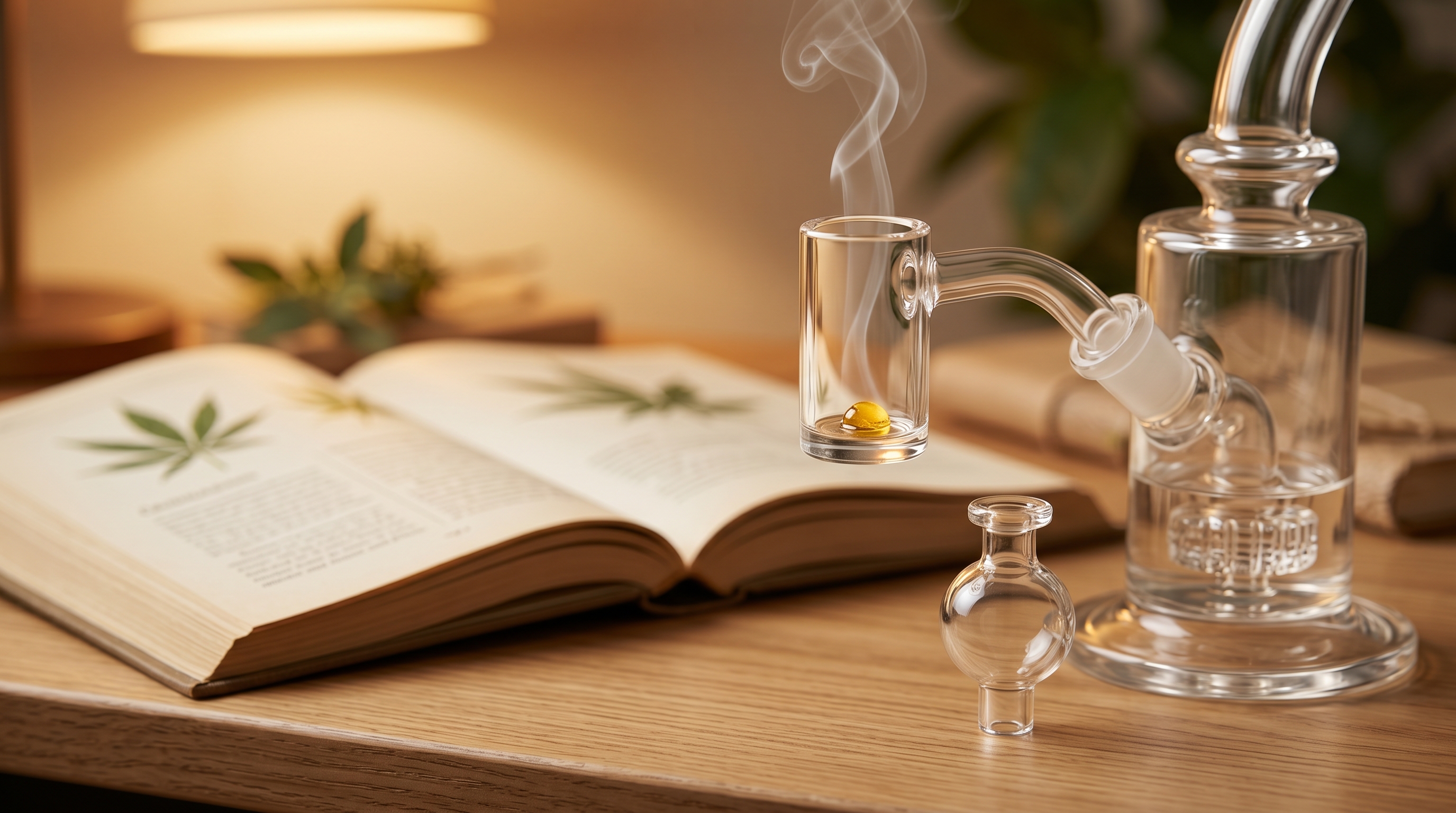
- Apply it to the dish. Touch the concentrate to the bottom of the heated surface and let it start to melt and run.
- Cap it. Place your carb cap over the nail. This traps the heat and airflow and is what makes a low-temp dab actually vaporize.
- Inhale slowly and steadily through the mouthpiece. Slow draws give the concentrate time to fully vaporize and produce smoother, tastier vapor. If you have a directional cap, give it a gentle spin to push the puddle around the dish and vaporize every last bit.
- Exhale and assess. Too harsh and burnt-tasting? You came in too hot — drop 20 to 30°F next time. Lots of leftover puddle and a weak hit? Too cool — bump it up. This is the dialing-in process, and writing your numbers down genuinely helps.
If you ever overshoot and end up uncomfortably high, don’t panic — our how to sober up from being too high guide has you covered.
Cleaning and Maintenance
A clean setup is a flavorful setup. Residue throws off both your taste and your temperature accuracy, so build a simple routine.
After every dab, swab the warm (not scorching) banger with a cotton swab dipped in 91%+ isopropyl alcohol. Doing this while the dish is still warm — not hot — wipes away reclaim before it hardens. This single habit does more for flavor than anything else.
The cardinal safety rule: always power off and unplug the controller, and let every part cool completely, before disconnecting or deep-cleaning anything. Keep alcohol and water away from the electrical components.
For the quartz banger, beyond the daily swab you can do periodic deep cleans: gently scrape only loose crusty bits with a wood or plastic pick (never metal on quartz), then soak in warm ISO for 20 to 40 minutes, swab stubborn spots, rinse with warm water, and air dry fully before reheating. Never dunk a hot banger into cold ISO or water — the thermal shock can crack it instantly. The same gentle ISO-and-patience approach applies to your rig itself, much like cleaning any water piece; see our bong cleaning guide.
For the heating coil, unplug and let it cool 10 to 15 minutes, then gently wipe with an ISO-dampened swab using light pressure — wipe, don’t scrub, since the sheath is thinner than it looks. Rotate around each coil ring to reach the inner face that touches the banger. Never use abrasives (coils have a protective coating), and let it dry 15 to 20 minutes before running a quick burn-off cycle to clear any trace alcohol. Don’t dab on that first post-cleaning heat.
Avoiding the big mistakes keeps your gear alive: don’t torch tools red-hot to clean them, don’t run above 650°F, don’t let reclaim build up for months, and don’t ignore a loose coil. A little consistency means a coil that lasts well over a year instead of failing in six months. Proper storage helps too — the same care principles in our cannabis storage guide apply to keeping your concentrates fresh.
Safety Notes
E-nails and e-rigs are meaningfully safer than torches because they remove the open flame. That said, a few common-sense points: buy gear with UL or CE certification, never leave a cheap controller running at full dab temp unattended (quality controllers cut power if the thermocouple opens, but budget ones may not — turn it down to a low hold temp if you step away), and keep water away from the electronics. None of this is medical advice; how cannabis affects you is individual, and concentrates are potent, so go slow.
Frequently Asked Questions
Should a beginner get an e-nail or an e-rig? If you mostly dab at home and want maximum control and flavor for the money, an e-nail paired with a quartz banger is hard to beat. If you value grab-and-go portability and one-button simplicity, an e-rig is the friendlier choice.
What temperature should I start at? Around 500°F on a quartz banger is a sensible starting point. Go down toward 450°F for more flavor, up toward 550°F for bigger clouds, adjusting in 10 to 20°F increments.
Why is my e-nail at 500°F but producing barely any vapor? Either your coil is loose (heat isn’t transferring), your banger has a thick bottom (the surface is cooler than the coil), or you simply need more heat — bump it up 50°F. Always use a carb cap at low temps.
Why is my banger turning black immediately? You are running too hot. Drop the temperature by 50°F and clean the banger before it permanently chazzes.
Can I use my existing dab rig with an e-nail? Usually yes — most 14mm and 18mm joints work. Just match your nail’s joint size to your glass and your coil size to your nail.
Do I have to season a new banger? Titanium: yes, always. Quartz: not strictly, but a heat-and-cool cycle to clear manufacturing dust improves that first-dab flavor.
Key Takeaways
Electric dabbing takes the most stressful part of concentrates — the guessing — and turns it into a number you set once. Get a quality PID controller, match your coil to your nail, season it properly, start around 500°F on clean quartz with a carb cap, take rice-grain dabs, and swab after every session. Do that and you will be getting cleaner flavor and more consistent hits than most torch users ever manage.
The real magic, though, is in the dialing-in. Pay attention to how each temperature feels, jot down what works, and you stop chasing someone else’s “perfect dab” and start finding your own. That is the whole philosophy behind knowing exactly why you’re high — and tracking it in the High IQ app makes the patterns obvious. Now go fire up that coil. The Professor approves.
Sources
- E-Nail.com — “E-Nail vs Torch: The Ultimate Comparison” and “Enail Beginners Guide: How to Dab with and Use an Enail.” https://e-nail.com/blog/enail-vs-torch-the-ultimate-comparison/
- Camouflet — “E-Nail Dab Rig Setup Guide: Everything You Need.” https://camouflet.com/blogs/vaporizer-guide/e-nail-dab-rig-setup-guide
- Puffco — “E-Nail vs Torch: Which Dabbing Tool Is Right for You?” and “Dab Temperature Guide.” https://www.puffco.com/blogs/cannabis-knowledge-base/dabbing-temperatures-guide
- Herb — “The Complete Dabbing Temperature Guide (2026).” https://herb.co/guides/dabbing-temperature-guide
- Oil Slick — “Dab Temperature Guide” and “Quartz vs Titanium vs Ceramic Dab Nail Guide 2026.” https://oilslickpad.com/blogs/news/quartz-vs-titanium-vs-ceramic-dab-nail-guide-2026
- Grasscity — “Quartz vs. Titanium vs. Ceramic: Which Dab Nail is Best?” https://www.grasscity.com/blogs/guides/guides-quartz-titanium-ceramic-guide
- Smoke Cartel — “Seasoning Your Dab Nail: Quartz & Titanium Care.” https://www.smokecartel.com/blogs/guides/seasoning-your-dab-nail-quartz-titanium-care
- Fogging Fun — “The Ultimate Dabbing Temperature Chart” and “How to Clean Your E-Nail Heating Coil.” https://foggingfun.com/blogs/enail_knowledge/dabbing-temperature-chart-guide


