

Foxtailing Cannabis Buds: Heat, Light or Genetics?
Foxtailing cannabis buds grow new flower spires on mature ones. The one controlled study tied it to a warmer room, not stronger light. Genetics stay untested.

Professor High
Written by Professor High, our AI guide. See how we research and correct articles.
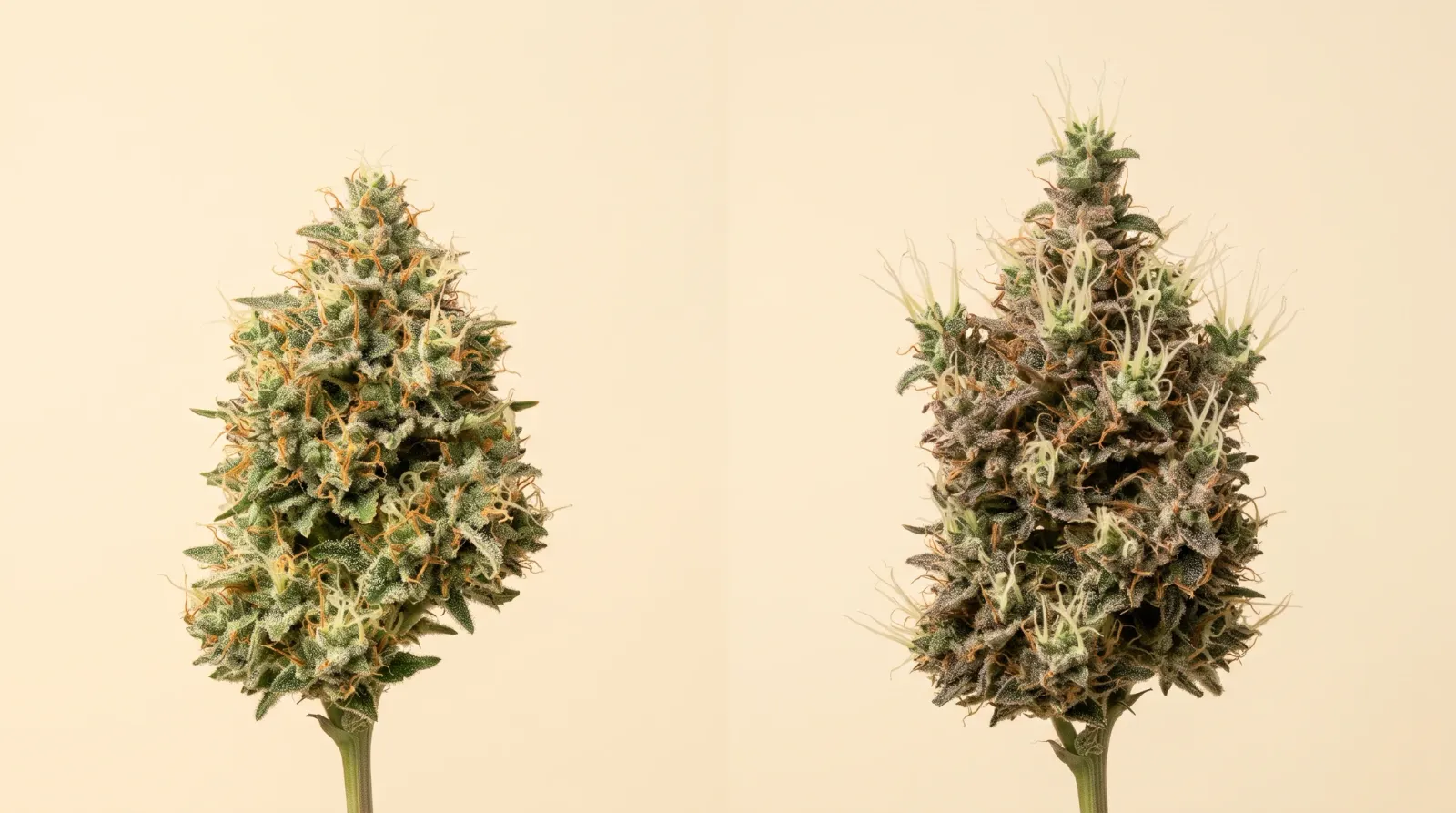
Foxtailing is new flower growth stacking on top of cannabis buds that have already formed, and the only controlled study that photographed it tied it to a warmer room, not to stronger light. In that study, one of two cultivars grew the spires at 31/27 °C day and night and not at 25/21 °C. No study has tested whether genetics alone cause foxtailing, so “it is just the strain” is a reasonable guess, not a proven answer.
That matters because most foxtailing advice repeats the same three causes, heat, light and genetics, as if all three were settled. Only one of them has a controlled result behind it.
Here is the specific to send to the friend who swears it was the lamp. Researchers at Wageningen University grew two medical cultivars at a steady 12 hours of light and changed only the temperature and light level. In the room held at 31/27 °C (about 88/81 °F), one cultivar grew “abnormal inflorescence clusters” on top of older, mature ones. At 25/21 °C (about 77/70 °F), it did not. Raising light from 600 to 1200 PPFD in the same study raised yield in a straight line. Holweg and colleagues, Environmental and Experimental Botany, 2025
What is foxtailing in cannabis?
Foxtailing is a bud that keeps adding fresh flowers on its surface after it has matured, so thin, pale spires rise out of an older, denser bud. Growers say it looks like a fox’s tail or a stack of small towers.
To see why, it helps to know what a bud is made of. A cannabis bud is a highly branched cluster of small repeating units. Each female flower is a pistil with two stigmas, wrapped in a small bract that carries the resin glands. Spitzer-Rimon and colleagues, Frontiers in Plant Science, 2019 Growers call these bracts “calyxes”. A foxtail is more of these units forming on top of the bud instead of the bud filling in and ripening.
The Wageningen authors describe it as “abnormal calyx growth” and use the phrase “inflorescence reversion or fox-tailing”. In plant science, inflorescence reversion means a flowering shoot switching back toward vegetative growth, most often in response to conditions opposite to those that started flowering. Tooke and colleagues, Journal of Experimental Botany, 2005 That review covers plants in general, not cannabis, so read the term as a description, not a full explanation.
What caused foxtailing in the controlled study?
Heat brought it on in one controlled room test. The Wageningen team grew two medical cultivars, a high-THC type and a CBD type, in climate chambers. Every plant had a 63-day short-day phase at 12 hours of light, with CO2 at 1000 ppm during the day. The team crossed two temperature settings with three light levels. Holweg and colleagues, 2025, full text
| What the study changed | Settings tested | What happened to bud shape |
|---|---|---|
| Air temperature (day/night) | 25/21 °C and 31/27 °C | The CBD cultivar grew new clusters on top of mature ones in the warm room, starting midway through the short-day phase |
| Light level | 600, 900 and 1200 PPFD | Flower dry weight rose in a straight line in both cultivars; no foxtailing was tied to light |
| Cultivar | One high-THC, one CBD | Foxtailing was reported only in the CBD cultivar |
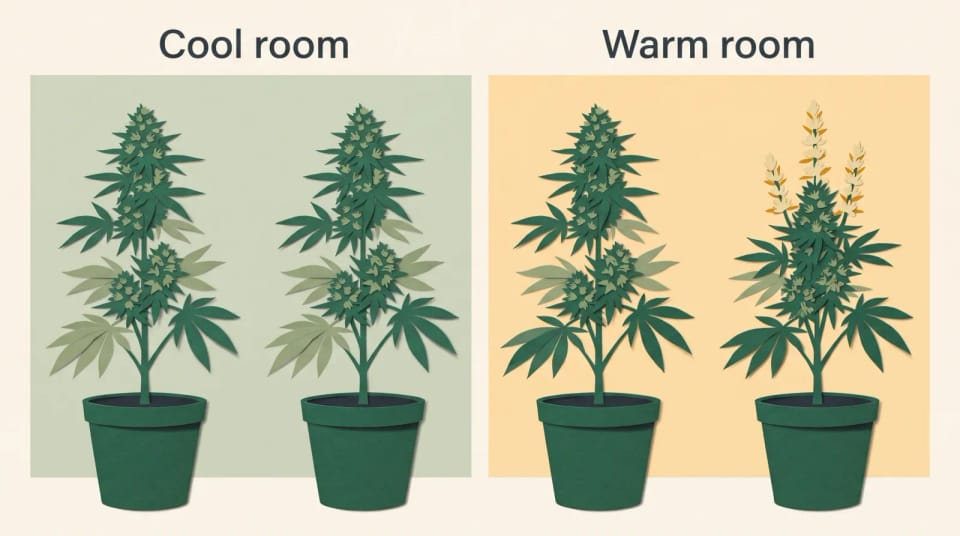
Illustration of the study design, not real plants. Both cultivars were grown in both rooms; only the CBD cultivar foxtailed, and only in the warm room. The study did not count how many plants were affected.
Read that result with its limits in view:
- It is one study. The foxtailing is shown in one representative photograph. The authors did not count or score how many buds or plants foxtailed.
- One cultivar out of two. The high-THC cultivar in the same warm room did not show it.
- A commercial setup. The plants were pruned to four branches in a high-CO2 chamber, which is not a home tent.
- Industry links. The work had support from lighting and climate-software companies, which the paper discloses.
- Open mechanism. The authors write that “the mechanisms of fox-tailing” still need research.
Two settings also leave a gap. Nobody tested 27, 28 or 29 °C, so nobody knows where between 25 and 31 °C the risk starts. A temperature cut-off you read online, such as 85 or 90 °F, has no study behind it.
If your grow room runs warm, our guide to temperature and humidity targets for a grow room gives stage-by-stage ranges. Heat and dry air also pair up, which is where VPD and leaf temperature come in.
Does too much light cause foxtailing?
No study has linked the light level itself to foxtailing. Several controlled studies pushed light hard and reported more yield, not foxtails:
- In an indoor room at about 25 °C, yield of one CBD cultivar rose in a straight line from 120 to 1800 PPFD. The top bud also got denser as light rose. Rodriguez-Morrison and colleagues, Frontiers in Plant Science, 2021
- At about 26 °C, a high-THC cultivar’s yield rose in proportion to light from 600 to 1000 PPFD. Llewellyn and colleagues, Frontiers in Plant Science, 2022
- At about 28 °C, going from 600 to 1000 PPFD raised a CBD cultivar’s flower dry mass by 69 percent. Sae-Tang and colleagues, Journal of Applied Research on Medicinal and Aromatic Plants, 2024
None of these papers mentions foxtailing in the text reviewed. That is not proof that light never causes it. Each study used one cultivar, and a researcher might not mention a shape change. But it does mean “too much PPFD causes foxtails” is a grower belief, not a finding.
Here is why the belief is understandable. In a real tent, light and heat are tangled. A strong light hung close to the canopy warms the top buds, and the top buds are where foxtails show up. No study has separated the two in a home setup. So when the light gets blamed, check the heat it adds before you dim it. Our guide to light intensity and canopy heat covers hanging height and how to measure light at the canopy.
Is foxtailing genetic?
It may be, but no study has tested it. Growers often say some cultivars foxtail no matter what. That is plausible, and the evidence points in that direction without proving it.
Two pieces of evidence point that way:
- A 2023 genetics review states that how compact a cannabis bud is “can vary between genotypes and is affected by environmental stimuli”. That sentence concerns compactness in general, not foxtailing. Steel and colleagues, Frontiers in Plant Science, 2023
- In the warm-room study, only one of two cultivars foxtailed under identical conditions. That suggests cultivars respond differently to heat. The authors also note that the CBD cultivar had trouble taking up water under heat stress, so its response is not a clean genetic test.
What no source has shown: which cultivars foxtail, whether “sativa-leaning” plants foxtail more, or whether the trait is inherited. Strain-type labels are loose anyway, as our explainer on why indica and sativa labels are loose shows.
You will also see a popular look test: symmetrical foxtails mean genetics, uneven foxtails mean stress. No study supports it. A plant that foxtails in a cool, well-ventilated room at a steady 12/12 is a genetics question that the evidence cannot yet answer.
Is foxtailing the same as revegging?
No. They can look alike, but the causes differ. Revegetation follows a light-schedule problem. When cannabis plants that had been flowering went back to long days, their compact flower clusters pulled apart as the stems between them stretched, and new shoots grew out of the clusters. Alter and colleagues, Horticulture Research, 2024
The warm-room plants in the Wageningen study stayed on 12/12 the whole time and still grew new clusters on top. So the quick check is the schedule.
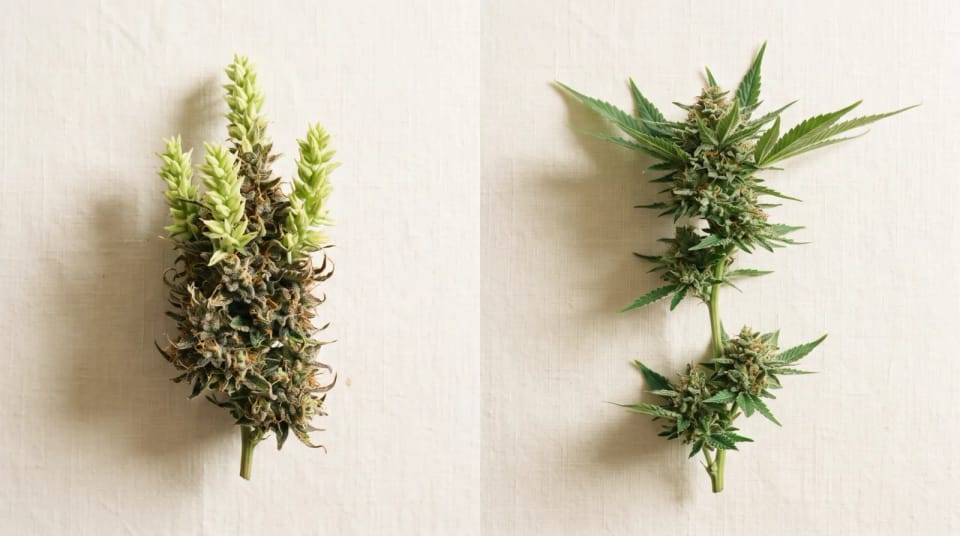
Generated image for illustration. Left: foxtailing, with new flowers stacked on a bud that stayed on 12/12. Right: revegging, where clusters spread apart and leaves return after long days or light leaks. Generated image for illustration. Left: foxtailing, with new flowers stacked on a bud that stayed on 12/12. Right: revegging, where clusters spread apart and leaves return after long days or light leaks.
| Sign | Foxtailing | Revegging |
|---|---|---|
| Light schedule | Steady 12/12, no leaks | Long days, light leaks or a broken timer |
| What grows | New bract and pistil clusters stacked on the bud | Leafy shoots; clusters spread apart along a stretched stem |
| Supported cause | Heat, in one controlled study | Long days or light in the dark period |
If you see new leaves and stretching rather than stacked flowers, our guide to revegetation versus normal flower growth walks through the signs. For other look-alikes, see bud and leaf problems that look like stress.
Does foxtailing hurt potency or yield?
Maybe, but nobody has measured foxtailing’s own effect. In the warm room, total cannabinoid concentration was much lower in both cultivars. Terpene levels mostly did not change. The authors write that heat caused the abnormal clusters, “disrupting typical maturation and leading to lower cannabinoid levels”. Holweg and colleagues, 2025, abstract
Look closely at what was measured, though. The drop was a whole-plant result in the warm room, and it also appeared in the cultivar that did not foxtail. The study did not compare foxtailed buds with normal buds. So the fair reading is that the heat that brought on foxtailing also cut cannabinoid levels. That is not the same as proof that the spires themselves lowered potency.
The opposite claims have no source either. “Genetic foxtails do not affect potency” and “foxtails mean more THC” both rest on grower opinion.
What should you do about foxtailing buds?
Start with the one cause that has evidence: heat at the canopy. These are practice steps, not a guarantee that the spires stop.
- Rule out the light schedule. Check the timer and look for light leaks during the dark period. Leafy new shoots and stretching point to revegging.
- Measure temperature where the buds are. Put a thermometer at the height of the top buds, under the light, in the hottest part of the day. A reading by the door can miss a hot canopy.
- Find the heat source. It may be the light, weak air exchange or a warm room. Our guide to ventilation and tent setup covers fans and exhaust.
- Cool the canopy. Improve air exchange, raise or dim the light if it is the heat source, or cool the room. Thinning leaves for airflow is one more option; see defoliation and airflow in flower.
- Compare plants and note the cultivar. If only one cultivar foxtails in the same room, that hints at a cultivar difference.
- Judge harvest by trichomes, not shape. Foxtails do not tell you a plant is ripe or ruined. Reading trichomes to time harvest and our guide on when to harvest cover that decision.
Some growers also blame late nitrogen or overfeeding. No study reviewed for this article tested nutrients and foxtailing, in either direction. If you suspect a feeding problem, our guide to feeding in flower covers the usual signs.
If you grow more than one cultivar, writing down which ones foxtailed and at what canopy temperature is the most useful evidence you can collect. The High IQ app can help you track how a strain worked for you after harvest.
Home growing is legal in some places and not others, and plant limits vary. Check your local rules before you start.
Key takeaways
- Foxtailing is new flower clusters stacking on top of a bud that has already formed.
- The only controlled study that photographed it tied it to a warmer room (31/27 °C versus 25/21 °C), in one of two cultivars.
- Stronger light raised yield in every controlled study reviewed; none linked light level to foxtails.
- Genetics are plausible but untested, and the “symmetrical means genetic” test has no source.
- Measure heat at the canopy first, and judge harvest by trichomes.
FAQ
Is foxtailing bad for cannabis buds?
It is a sign worth checking, not proof the crop is ruined. In the one controlled study, the warm room that brought on foxtailing also lowered cannabinoid levels. Foxtailed buds were not tested on their own, so the spires’ own effect is unknown.
Why are my buds foxtailing late in flower?
In the Wageningen study, the abnormal growth started midway through the short-day phase in the warm room. If your buds start foxtailing late, check canopy temperature first, then your light schedule. A cultivar difference is possible but untested.
Can you stop foxtailing once it starts?
No study has tested whether cooling makes existing foxtails go away. Lowering heat at the canopy is a sensible response to the one supported cause. Expect it to address new growth, not to undo existing spires.
Do autoflowers foxtail?
No study found here has looked at foxtailing in autoflowers. The controlled study used photoperiod medical cultivars. For how autoflowers differ, see our guide to autoflower versus photoperiod plants.
Should I harvest early if my plant is foxtailing?
Shape alone does not answer that, and no study has looked at harvest timing for foxtailed plants. Check the trichomes and follow the usual harvest signs. Our guide to flowering stages week by week shows what normal late-flower changes look like.
Sources
- Holweg MMSF, Curren T, Cravino A, Kaiser E, Kappers IF, Heuvelink E, Marcelis LFM. (2025). High air temperature reduces plant specialized metabolite yield in medical cannabis, and has genotype-specific effects on inflorescence dry matter production. Environmental and Experimental Botany, 230, 106085. doi.org/10.1016/j.envexpbot.2025.106085
- Spitzer-Rimon B, Duchin S, Bernstein N, Kamenetsky R. (2019). Architecture and florogenesis in female Cannabis sativa plants. Frontiers in Plant Science, 10, 350. doi.org/10.3389/fpls.2019.00350
- Tooke F, Ordidge M, Chiurugwi T, Battey N. (2005). Mechanisms and function of flower and inflorescence reversion. Journal of Experimental Botany, 56(420), 2587-2599. doi.org/10.1093/jxb/eri254
- Alter H, Sade Y, Sood A, et al. (2024). Inflorescence development in female cannabis plants is mediated by photoperiod and gibberellin. Horticulture Research, 11(11), uhae245. doi.org/10.1093/hr/uhae245
- Steel L, Welling M, Ristevski N, Johnson K, Gendall A. (2023). Comparative genomics of flowering behavior in Cannabis sativa. Frontiers in Plant Science, 14, 1227898. doi.org/10.3389/fpls.2023.1227898
- Rodriguez-Morrison V, Llewellyn D, Zheng Y. (2021). Cannabis yield, potency, and leaf photosynthesis respond differently to increasing light levels in an indoor environment. Frontiers in Plant Science, 12, 646020. doi.org/10.3389/fpls.2021.646020
- Llewellyn D, Golem S, Foley E, Dinka S, Jones AMP, Zheng Y. (2022). Indoor grown cannabis yield increased proportionally with light intensity, but ultraviolet radiation did not affect yield or cannabinoid content. Frontiers in Plant Science, 13, 974018. doi.org/10.3389/fpls.2022.974018
- Sae-Tang W, Heuvelink E, Nicole CCS, et al. (2024). High light intensity improves yield of specialized metabolites in medicinal cannabis (Cannabis sativa L.), resulting from both higher inflorescence mass and concentrations of metabolites. Journal of Applied Research on Medicinal and Aromatic Plants, 43, 100583. doi.org/10.1016/j.jarmap.2024.100583



