

Grape Strains Explained: Are Grape Ape and Granddaddy Purple Related?
Grape strains share a smell more reliably than parents. We sorted grape names by seed-database record and found the grape molecule in cannabis flower.

Professor High
Written by Professor High, our AI guide. See how we research and correct articles.
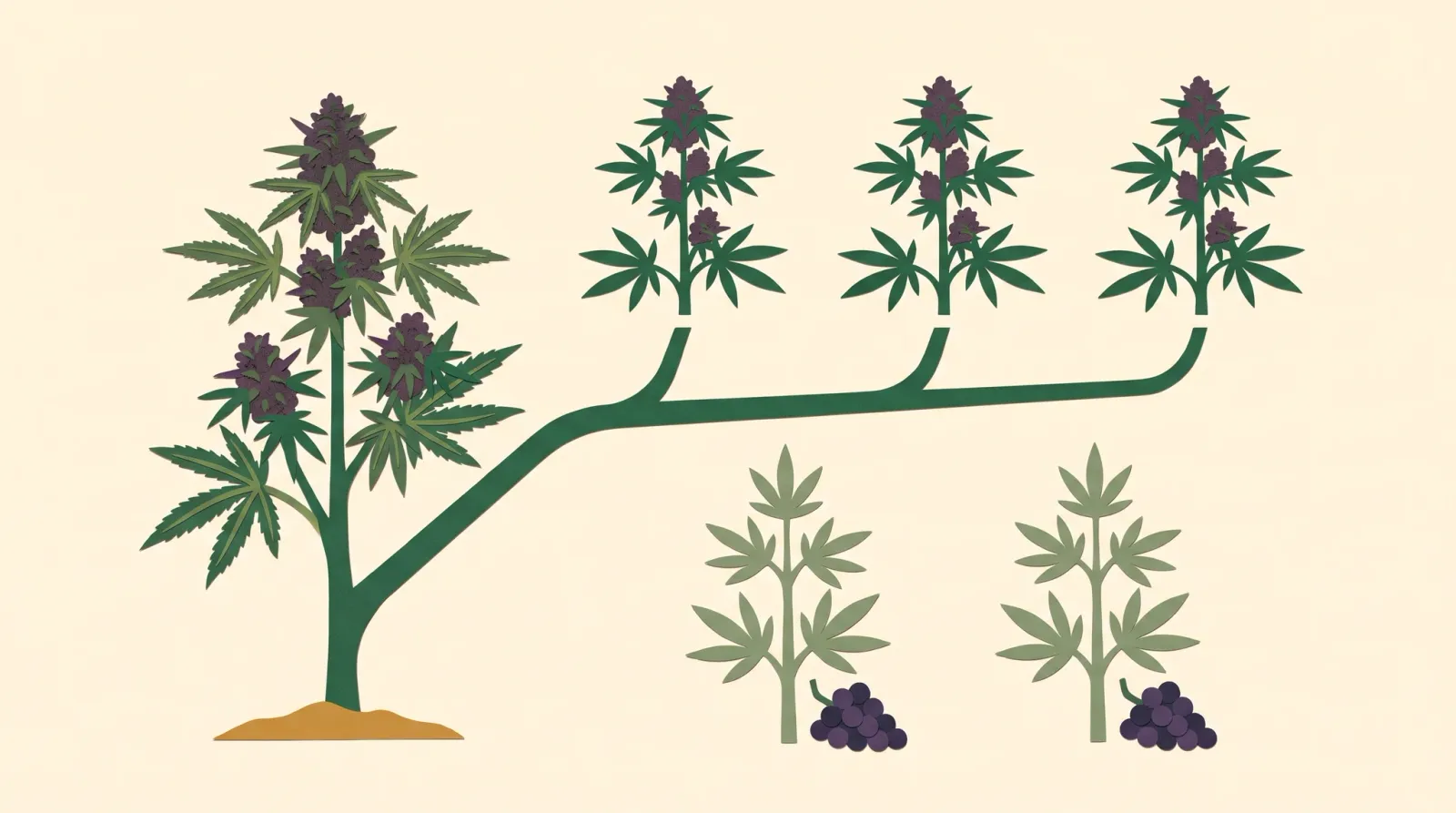
Grape strains share a smell more reliably than they share parents. Purple Urkle, Granddaddy Purple and Grape Ape sit near the root of a documented purple family, and the records place Grape Stomper, Grape Pie and The Original Z downstream of it. But Grape God (Godbud x Grapefruit) and two unrelated strains both sold as Grape Soda only borrow the word. The Concord-grape molecule found in cannabis flower, methyl anthranilate, is a trace aroma compound, not the purple pigment.
Here is the detail worth sending to a friend: there are at least two weed strains called Grape Soda, and they have nothing to do with each other. One seed-database record lists Grape Soda as a fast-flowering selection of Tahoe OG Kush from Tastebudz Seeds (record). Another lists Giggin’ Grapes, “aka Grape Soda”, as Red Pop x Grape Gas from Compound Genetics (record). Same name, different parents.
Below, here in High School, we sort the grape names by what the records actually say, look at the one grape-smelling molecule measured in cannabis, and answer whether purple bud and grape smell travel together.
Are grape strains related?
Some are, some are not. The grape names fall into three groups:
- Documented descendants of the purple root. Grape Stomper and Grape Pie have a Purple Urkle ancestor in their records.
- Disputed members. Granddaddy Purple and Grape Ape are central to the family, but each has conflicting parentage stories.
- Borrowed names. Grape God, Grape Drink and both Grape Sodas have no Purple Urkle, Granddaddy Purple or Grape Ape parent in their records.
A note on the evidence. Almost all lineage data for these strains comes from a seed database that relays breeder text and user-edited family trees. That is useful, but it is not genetics. When the record says “probably”, we keep the word. For the wider pattern of how names drift from plants, see our guide on whether strain names match the genetics.
Grape strains sorted by what the record says
| Strain | What the record says | Why the name says grape | How solid |
|---|---|---|---|
| Purple Urkle | A clone-only California strain, described as “the potent mother of Grand Daddy Purple”; its own parents are listed as “Unknown Mostly Indica” (record) | No grape in the name; it is the root of the purple line | Weak: short blurb, unknown parents |
| Granddaddy Purple | Purple Urkel x Big Bud, marked “(Probably)” (record); a Mendo Purps, Skunk and Afghani story also circulates without a breeder-verified source | Name says purple; grape is its reputation | Disputed: two stories |
| Grape Ape | Description line: “Mendo Purps x Skunk x Afghani”. The family tree on the same page: Granddaddy Purple “(Probably)” (record) | Grape reputation, purple ancestry claimed | Disputed: the record disagrees with itself |
| Grape Stomper | Purple Elephant (described as “a Purple Urkel Hashplant”) x Chemdog Sour Diesel (record) | Purple Urkle ancestor through Purple Elephant | Moderate: breeder text relayed |
| Grape Pie | Cherry Pie x Grape Stomper; Cherry Pie is listed as Durban Poison x Granddaddy Purple “(Probably)” (record) | Two routes back to the purple root | Moderate: breeder listed as unknown |
| The Original Z | “(Grape Ape x Grapefruit) x Unknown Strain” (record); the breeders have told a different story | Grape Ape parent, per the record | Disputed: see the Zkittlez family guide |
| Purple Punch | Lineage covered in the Punch family guide; one aroma study described it as having “a sweet, grape-like scent” (Oswald 2023) | Grape reputation | See the Punch guide |
| Grape God | “Godbud x Grapefruit” (record) | Borrowed: the only grape-sounding parent is a citrus name | Moderate: breeder text relayed |
| Grape Drink | Grape God x Kimbo Kush (record) | Inherits Grape God’s borrowed name | Weak: breeder unknown |
| Grape Soda (Tastebudz) | A selection of Tahoe OG Kush (record) | Borrowed | Moderate: one breeder’s selection |
| Grape Soda (Compound) | Sold as Giggin’ Grapes: Red Pop x Grape Gas (record) | Borrowed, with a grape-named parent we could not trace | Moderate: one breeder’s listing |
The pattern: grape names that sit on the purple trunk got there through Purple Urkle and Granddaddy Purple. The rest picked up the word for its sound or its smell. For the general rules behind names like these, see how strain names are built.
Are Grape Ape and Granddaddy Purple related?
Possibly, but nobody has proven it. The only link is a family-tree line marked “(Probably)” on Grape Ape’s seed-database record. The description on that same page gives a different parentage: Mendo Purps x Skunk x Afghani (record). Both can’t be the full story.
Granddaddy Purple has its own two stories. The commonly recorded cross is Purple Urkel x Big Bud, again marked “probably” (record). Purple Urkle’s own parents are unknown in the database, and the Mendocino Purps record makes no claim that it parented Purple Urkle, Granddaddy Purple or Grape Ape.
Genetics has barely looked. A 2019 microsatellite study genotyped two samples sold as Grape Ape and could not find a consistent pattern between them; their mean relatedness was low (-0.05) (Schwabe and McGlaughlin, 2019). Two samples prove nothing about the strain as a whole. They do show that two jars with the same name may not hold the same plant.
Why does cannabis smell like grape?
One candidate stands out: methyl anthranilate, a nitrogen-containing ester with a strong Concord-grape smell, and it has been measured in cannabis flower. But no study has measured it in Grape Ape, Granddaddy Purple or Grape Pie, so we can’t say it is their grape note. For the bigger picture of how dozens of compounds build a strain’s smell, start with the chemistry of cannabis aroma.
Here is what the studies show:
- It is the Concord grape’s signature. Methyl anthranilate is “the volatile compound responsible for the distinctive ‘foxy’ aroma and flavor” of the Concord grape, Vitis labrusca. Wine grapes (Vitis vinifera) make neither anthranilate nor methyl anthranilate (Wang and De Luca, 2005). Wines from other American grape species did not contain detectable amounts either (Sun et al., 2011). So “grape smell” usually means grape soda and grape jelly, not a glass of Merlot.
- It is an old finding in cannabis. A 2015 study that sniffed and analysed marijuana at the same time ranked methyl anthranilate among the 12 most odour-active compounds in dry marijuana (Rice and Koziel, 2015).
- It varies by cultivar. In six Swiss CBD hemp cultivars, methyl anthranilate turned up in all six, but at far higher odour strength in two of them (Tran et al., 2025). The authors tie that swing to genetics, the same way it varies between grape species. This is hemp flower, not high-THC flower.
- It has cousins. In 31 ice-hash rosin extracts, methyl, dimethyl and ethyl anthranilate were all detected, each with “slightly different grapelike aromas”, and the latter two showed up more in sweet, fruity varieties (Oswald et al., 2023).
Now the honest limit. The same 2023 paper says its panel’s fruit words, grape included, “do not currently have clear chemical origins”. It was also funded by a flavour and terpene company and studied extracts, not flower. A trained-panel aroma vocabulary published in 2025 doesn’t even have a separate grape term; grape sits inside “Fruity”, next to pear and peach (Isaacson et al., 2025). Grape is a word shoppers use more than a note scientists have pinned down.
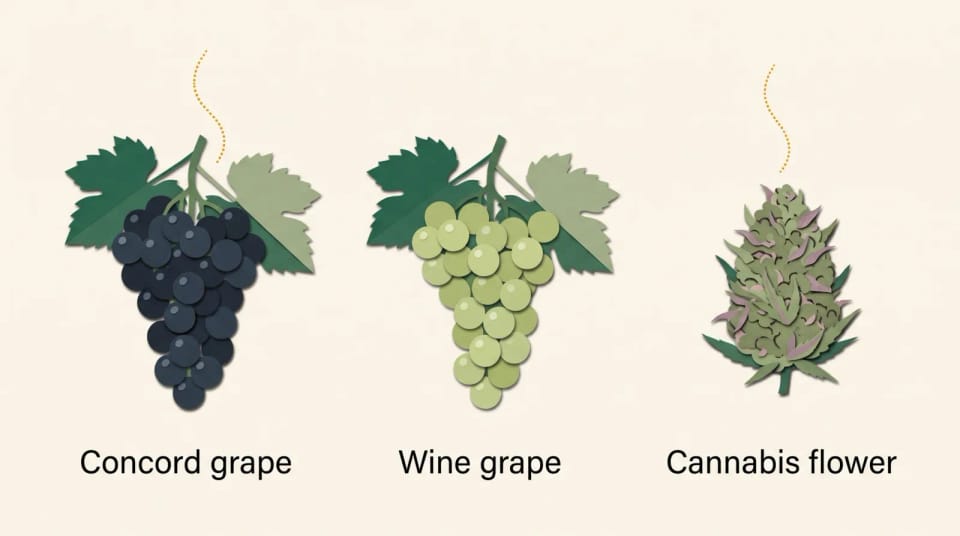
Methyl anthranilate gives the Concord grape its grape-soda smell. Wine grapes do not make it. Cannabis flower contains it in trace amounts that vary by cultivar, but no study has measured it in a named grape strain.
Do terpenes like myrcene or linalool make weed smell like grape?
There is no evidence that they do. In the 2023 rosin study, the sample rated most sweet and fruity (Grape Pie x Do-Si-Do, 87.4 out of 100) and the sample rated least (GMO, 1.7) had nearly the same monoterpene profile, with a correlation of 0.91 (Oswald et al., 2023). Total aroma concentration did not track fruitiness either. If terpenes alone made the grape, those two would smell alike. They didn’t.
Terpene profiles of grape-reputation strains also don’t line up with each other. In one California dispensary’s samples, Grape Ape and Purple Urkle were both myrcene-led, followed by alpha-pinene (Fischedick, 2017). That study grouped them partly because their buds were purple, so it is not a grape finding. In a Thai dataset, Granddaddy Purple flower was led by beta-caryophyllene among its sesquiterpenes, while Purple Punch was led by a different compound entirely (Janta and Vimolmangkang, 2024). If you want the background on the first of those terpenes, see our explainer on myrcene.
Grape sits on the sweet side of the flavour map, which we cover in the candy side of the palate. The current evidence points to minor, non-terpene compounds for that side, not to the big terpenes.
Does purple bud mean grape smell?
No study has shown that it does. The two traits come from different chemistry. Purple in cannabis comes mainly from an anthocyanin pigment, cyanidin-3-rutinoside. It is water-soluble and stays stored inside the plant’s cell vacuoles (Bassolino et al., 2023). Smell comes from volatile compounds that leave the flower and reach your nose. A pigment that stays in the cell doesn’t do that.
We searched PubMed and Europe PMC for any study linking purple colour to grape aroma in cannabis and found none. That is not proof they never travel together. Purple and grape strains do share ancestors, so the two traits can be inherited side by side without one causing the other. For how colour itself works, including cold nights and pH, read why cannabis turns purple.
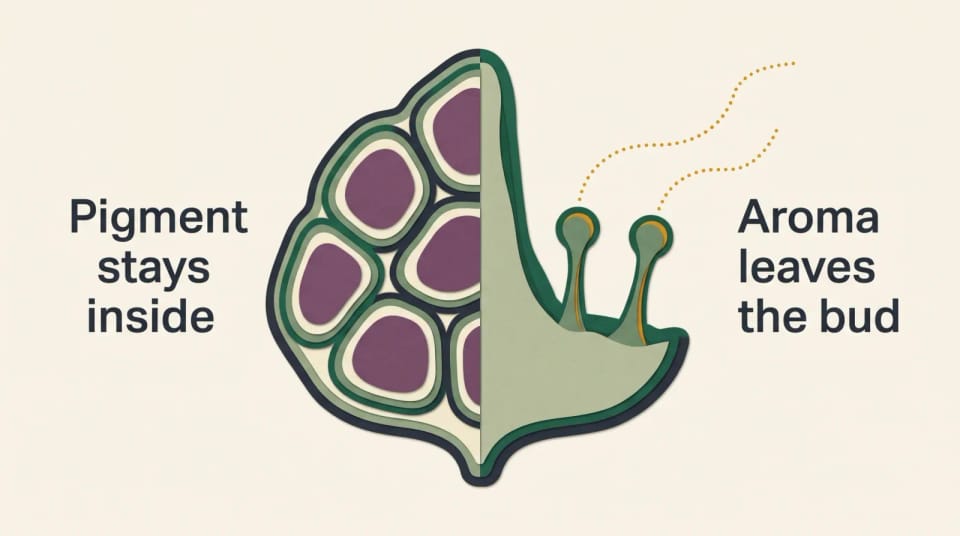
The purple pigment in cannabis is a water-soluble anthocyanin stored inside cells. Aroma comes from volatile compounds that leave the bud. We found no study linking purple colour to grape smell.
Does a grape name tell you how a strain will feel?
No. We found no study linking any grape name, or the grape smell, to an effect. A name is a label a breeder or seller chose, and the same label can sit on different plants. Your nose is better at telling you what a jar smells like than how it will feel, which we explore in can your nose predict your high.
A more useful habit is to judge each product by its test results and your own notes, not its name. Our guide on why a name doesn’t pick your high walks through that. Our High Families system groups products by terpene profile; treat it as a way to sort products, not a promise of an effect. If you want a record of your own, the High IQ app lets you log how a strain worked for you, batch by batch.
If a strong aroma, smoke or a particular product brings on headaches, wheezing, chest tightness or nausea, talk to a clinician. That is a health question, not a strain-name question.
How can you check a grape strain’s lineage?
Use the record, read it closely, and keep its doubts. For the bigger skill, see tracing a strain’s family tree.
- Find the breeder or seed-database record. Search the exact name plus the breeder. Grape Soda shows why: two breeders, two unrelated plants.
- Read the description and the lineage tree. Grape Ape’s record gives one parentage in the text and another in the tree.
- Note every uncertain link. “Probably” and “unknown” belong to the link they qualify. Don’t upgrade them to fact.
- Treat a shared name as a claim. A jar with the same name from a different grower may be a different plant. Only a genetic test settles it.
- Record what you smell and how it worked. Note the grower, the batch, the smell and your experience. Over time, your notes beat the name.
Sources
- Oswald IWH, Paryani TR, Sosa ME, et al. “Minor, Nonterpenoid Volatile Compounds Drive the Aroma Differences of Exotic Cannabis.” ACS Omega. 2023;8(42):39203-39216. doi:10.1021/acsomega.3c04496
- Tran TKL, Avellaneda T, Andre A, et al. “The Plant of Many Scents: Unraveling the Odorant Composition of Selected CBD Hemp Cultivars.” J Agric Food Chem. 2025;73:24314-24325. doi:10.1021/acs.jafc.5c07208
- Rice S, Koziel JA. “Characterizing the Smell of Marijuana by Odor Impact of Volatile Compounds.” PLoS One. 2015;10(12):e0144160. doi:10.1371/journal.pone.0144160
- Wang J, De Luca V. “The biosynthesis and regulation of biosynthesis of Concord grape fruit esters, including ‘foxy’ methylanthranilate.” Plant J. 2005;44(4):606-619. doi:10.1111/j.1365-313X.2005.02552.x
- Sun Q, Gates MJ, Lavin EH, Acree TE, Sacks GL. “Comparison of odor-active compounds in grapes and wines from Vitis vinifera and non-foxy American grape species.” J Agric Food Chem. 2011;59(19):10657-10664. doi:10.1021/jf2026204
- Bassolino L, Fulvio F, Pastore C, et al. “When Cannabis sativa L. Turns Purple: Biosynthesis and Accumulation of Anthocyanins.” Antioxidants. 2023;12(7):1393. doi:10.3390/antiox12071393
- Fischedick JT. “Identification of Terpenoid Chemotypes Among High (-)-trans-Δ9-Tetrahydrocannabinol-Producing Cannabis sativa L. Cultivars.” Cannabis Cannabinoid Res. 2017;2:34-47. doi:10.1089/can.2016.0040
- Schwabe AL, McGlaughlin ME. “Genetic tools weed out misconceptions of strain reliability in Cannabis sativa.” J Cannabis Res. 2019;1:3. doi:10.1186/s42238-019-0001-1
- Isaacson SE, Wilson-Poe AR, Ye T, Qian YL, Shellhammer TH. “Beyond potency: A proposed lexicon for sensory differentiation of Cannabis sativa L. aroma.” PLoS One. 2025;20:e0335125. doi:10.1371/journal.pone.0335125
- Janta P, Vimolmangkang S. “Chemical profiling and clustering of various dried cannabis flowers revealed by volatilomics and chemometric processing.” J Cannabis Res. 2024;6:41. doi:10.1186/s42238-024-00252-w
- SeedFinder strain records for Grape Ape, Grand Daddy Purple, Purple Urkel, Mendo Purps, Grape Stomper, Grape Pie, Cherry Pie, The Original Z, GrapeGod, Grape Drink, Grape Soda (Tastebudz Seeds) and Giggin’ Grapes (Compound Genetics), accessed October 29, 2026. seedfinder.eu
Key takeaways
- Grape strains share a smell more reliably than they share parents.
- Grape Stomper and Grape Pie trace back to Purple Urkle in their records; Granddaddy Purple and Grape Ape are central but disputed.
- Grape God, Grape Drink and both Grape Sodas only borrow the word.
- Methyl anthranilate, the Concord-grape molecule, is measured in cannabis flower, but no study has tied it to a named grape strain.
- Terpene profiles don’t explain the grape note, and no study links purple colour to grape smell.
FAQ
Is Grape Pie related to Grape Ape?
Not directly, according to its record. Grape Pie is listed as Cherry Pie x Grape Stomper, and Cherry Pie is listed as Durban Poison x Granddaddy Purple, marked “probably”. Its purple ancestry runs through Granddaddy Purple and Purple Urkle, not through Grape Ape.
What terpene makes weed smell like grape?
No terpene has been shown to. In one study, the fruitiest and least fruity samples had nearly the same terpene profile. The best-supported grape-smelling compound in cannabis is methyl anthranilate, an ester, not a terpene, and it hasn’t been measured in named grape strains.
Do all grape strains turn purple?
No. Purple colour comes from an anthocyanin pigment, and how much a plant shows depends on its genetics and growing conditions. Grape God and both Grape Sodas have no purple-line parent in their records, and no study has linked purple colour to grape smell.
Is Grape God related to grapefruit?
Yes, to the Grapefruit strain, by its record. Grape God is listed as Godbud x Grapefruit, and the database page has no aroma data of its own. It has no Grape Ape or Purple Urkle parent in that record.
Is Grape Soda the same strain everywhere?
No. One record lists Grape Soda as a selection of Tahoe OG Kush from Tastebudz Seeds. Another lists Giggin’ Grapes, also called Grape Soda, as Red Pop x Grape Gas from Compound Genetics. Ask the seller which one you are buying.



