

How to Roll a Blunt: Steps, Wrap Types, and the Nicotine Catch
To roll a blunt, open the wrap, fill it along the middle, roll it evenly and seal it. An emptied cigar wrap still holds nicotine; here is why.

Professor High
Written by Professor High, our AI guide. See how we research and correct articles.
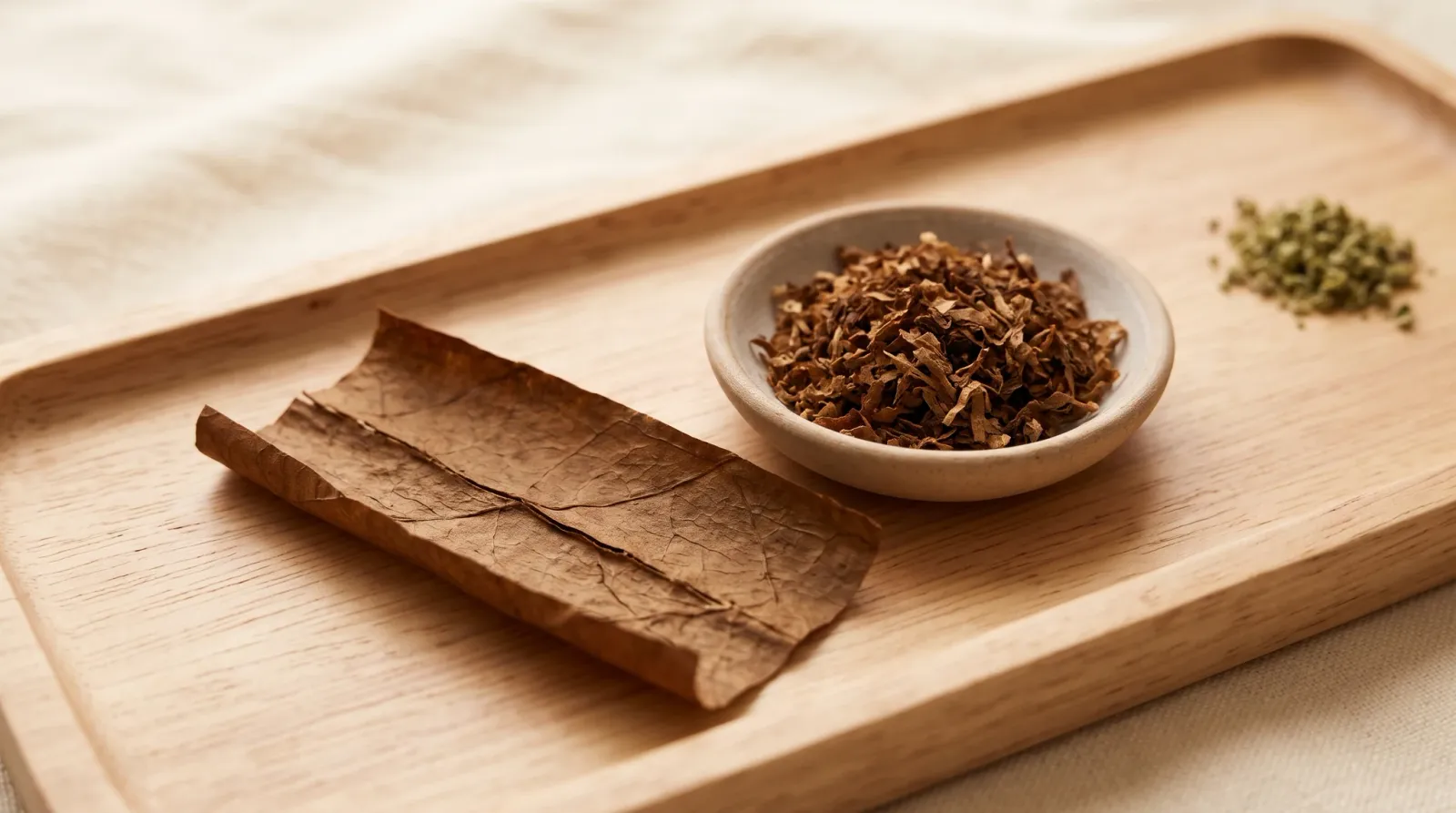
To roll a blunt, you open a wrap, empty any cigar tobacco, soften the wrap lightly, spread ground cannabis down the middle, roll it with even tension, seal the seam and let it dry before lighting. That is the whole method. The part most guides skip is what the wrap still contains when you are done.
Here is the catch in one sentence: emptying a cigar does not empty the nicotine. In a lab test of five cigar products often used for blunts, every wrapper still held 1.2 to 6.0 mg of nicotine after the filling was removed. Peters et al., 2016 That is nicotine content in the leaf, not the dose a person absorbs, and it is a small, preliminary test. It still settles the common belief that a gutted cigar is “just weed.”
This guide covers the rolling method and the wrap choice. If you first want the definitions, our explainer on what separates a joint, a blunt and a spliff handles them. Here in High School, we keep the steps honest: they are common practice, not a tested technique.
Sources checked October 29, 2026.
What do you need to roll a blunt?
You need a wrap, ground cannabis, and a clean flat surface. Most people also use a grinder, a lighter and something to keep the wrap from drying out while they work.
- A wrap. Either a cigar or cigarillo that you split and empty, or a pre-made wrap. Pre-made wraps come in tobacco leaf and in materials sold as tobacco-free, such as hemp, palm, banana leaf and rose petal. Kong et al., 2024
- Ground cannabis. A grinder gives a more even texture than fingers. Our guide to grinder choice and grind coarseness covers the options.
- A tray. Loose flower and tobacco crumbs travel. It helps to set up a rolling tray first.
- A lighter.
One legal point applies before you buy anything. In the United States, a cigar is a tobacco product, and the federal minimum age to buy any tobacco product, including cigars, is 21. FDA Cannabis laws vary by state and country, so check the rules where you live.
Which wrap should you use for a blunt?
The wrap decides whether your blunt contains tobacco. Historically, every blunt wrap was a tobacco wrapper. Today, wraps sold as tobacco-free exist, so a blunt can be tobacco and cannabis together or cannabis alone. Morean et al., 2023
| Split cigar or cigarillo | Pre-made tobacco leaf wrap | Wrap sold as tobacco-free | |
|---|---|---|---|
| What the wrapper is | Tobacco leaf, or a substance containing tobacco | Tobacco leaf | Hemp, palm, banana leaf, rose petal or similar |
| Nicotine in the wrapper | Yes; measured in all five products tested | Expected, because it is tobacco | Not by design; we found no independent lab test confirming it |
| Extra prep | Split it and remove all the loose filling | Unroll it | Unroll it |
| What to check | That you are 21 or older to buy it | The package says tobacco | The package, and that nothing else goes in with the cannabis |
A note on the last column. “Tobacco-free” describes the wrap, not the finished blunt. Some people add tobacco to tobacco-free wraps. In a survey of Connecticut high school students who had used blunts, 12.4 percent of tobacco-free wrap users reported doing so. Morean et al., 2025 That is a youth sample, not an adult one, but the lesson carries: the label covers the leaf only.
If a wrap feels like too much work, paper is the other route. Our guide to rolling a joint with paper instead walks through it, and the buyer’s guide to papers and cones, if a wrap feels like too much compares sizes and materials.
How do you roll a blunt step by step?
The method below is how people describe doing it, not a lab-tested procedure. In interviews with 40 young adult cigarillo users, people described splitting the wrapper (some products have perforated lines that make this easy), removing the tobacco, wetting the wrap until it turned pliable, and rolling it back together. Giovenco et al., 2017 The finer tips, such as how fine to grind and how long to dry, are hands-on convention. We searched for tests of them and did not find any.
- Grind the cannabis. Aim for an even, medium grind. Very fine powder packs tight and can block airflow; big chunks leave gaps.
- Open the wrap. On the cigar route, split the cigar or cigarillo along its seam from end to end. On the wrap route, unroll a pre-made wrap.
- Empty and flatten. On the cigar route, remove all of the loose tobacco filling. Lay the wrapper flat and smooth out creases with a fingertip.
- Soften the wrap lightly. Moisten the wrapper just enough that it bends without cracking. A damp fingertip is usually enough. A soaked wrap tears and burns unevenly.
- Fill along the middle. Spread the cannabis in an even line down the center. Keep the ends as full as the middle so the blunt does not taper.
- Roll with even tension. Tuck the near edge over the filling, then roll from one end to the other. Keep the pressure even along the length; a loose spot burns faster than a tight one.
- Seal the seam. Lightly moisten the outer edge and press it closed along the full length.
- Let it dry, then light evenly. Give it a few minutes to dry. When you light it, turn it slowly so the end catches all the way around.
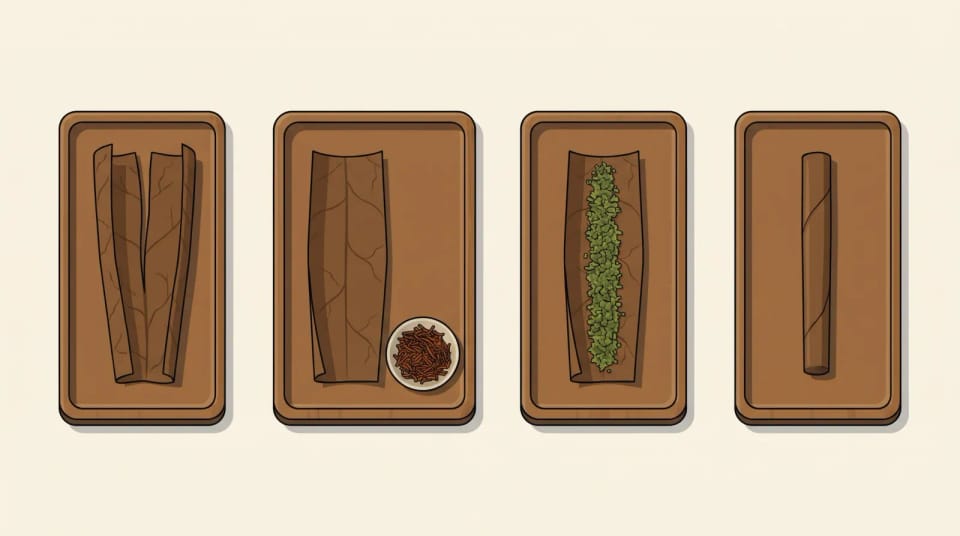
The same wrapper through the four stages of the common method. Splitting and emptying applies only to the cigar route; a pre-made wrap starts at the flat stage.
How much weed goes in a blunt?
No tested amount exists, and none is needed. The right amount depends on the size of the wrap and on how strong the flower is. Fill the wrap so it closes around the cannabis without straining the seam. If you are new to blunts, roll smaller than you think you need.
Weight is not dose. A gram of one flower can carry very different THC than a gram of another. Our explainer on flower weight versus THC amount shows why, and the cannabis quantities visual guide helps you picture the amounts.
Does a blunt wrap still have nicotine after you empty it?
Yes, if the wrap is tobacco. The 2016 product test split five commonly used cigar products (three large cigars and two cigarillos) and measured the wrapper alone. The wrapper made up 8 to 18 percent of each cigar’s weight. All five wrappers held measurable nicotine, from 1.2 to 6.0 mg per cigar. Peters et al., 2016
Three limits matter. It was five products. It measured what is in the leaf, not what reaches a person when the blunt burns. And the authors called it preliminary. So it tells you the nicotine is there. It does not tell you how much you absorb.
Field data point the same way. In a 2026 study of young Black men aged 18 to 30 who reported smoking blunts and no tobacco use, 54.3 percent of the 46 who gave saliva samples had at least one sample above 10 ng/mL of cotinine, a marker the body makes from nicotine. Higher levels went with smoking more blunts and rolling their own. D’Anna et al., 2026 The sample was small, the design shows association rather than cause, and the published abstract does not break results down by wrap type.
What the nicotine does to the high is a separate question. Our article on what one controlled study found about tobacco and the high covers it. We will not repeat the common claim that blunts “hit harder because of nicotine”; we found no evidence that shows it.
Is a hemp wrap really tobacco-free?
It is sold that way, and that is as far as the evidence goes. Wraps made of hemp, palm, banana leaf and rose petal are marketed for cannabis and made without tobacco, according to their makers. Kong et al., 2024 We found no independent lab test of their nicotine content. Read the package, and buy from a seller you trust.
The rules for these wraps are also unsettled. Researchers at Yale argue that current FDA tobacco language does not explicitly cover tobacco-free wraps, and that some are sold under cigar-style names. Kong et al., 2024 A similar name on the shelf does not tell you what the wrap is made of.
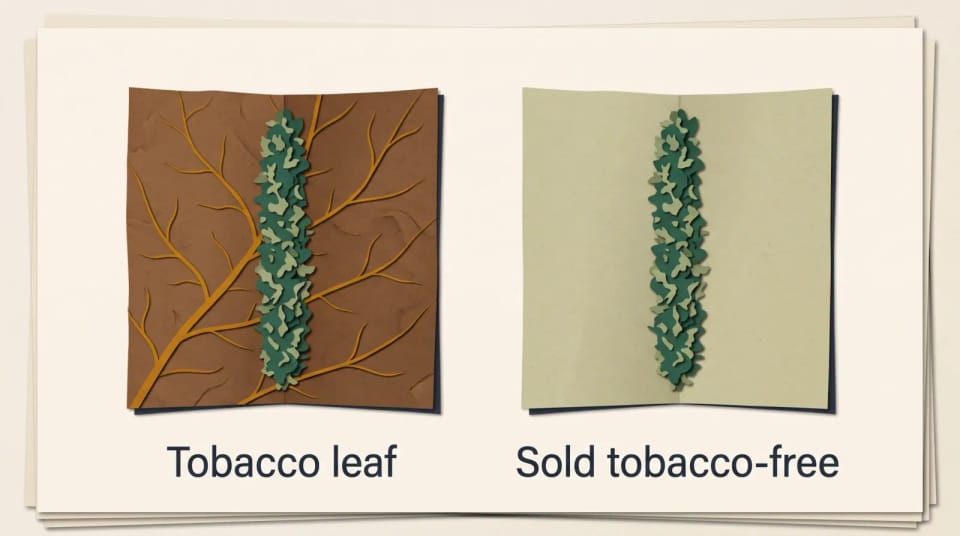
The wrap decides whether tobacco is in the leaf. The label covers only the wrap, so what goes inside is still your call, and no wrap makes smoke harmless.
Why does my blunt burn unevenly or keep going out?
Uneven tension and uneven moisture are the usual suspects. These tips come from hands-on practice; we found no tests of them.
- One side races ahead. The roll is looser on that side, or the wrap is damper on the other side. Re-roll tighter next time, and moisten lightly and evenly. For more, see why a roll burns on one side.
- It keeps going out. The wrap may still be wet, or the filling may be packed so tight that air cannot move. Let it dry longer, and grind a little coarser.
- The seam opens. The edge was too dry to stick, or too wet to hold. Use a light touch and press along the full length.
- It cracked while rolling. The wrap was too dry. Soften it a little more before you fill it.
Is a blunt harsher on your lungs than a joint?
No wrap makes smoke safe. Smoked cannabis can harm lung tissue no matter how it is smoked, and the smoke contains many of the same toxins, irritants and cancer-causing chemicals as tobacco smoke. CDC A blunt with a tobacco wrap adds tobacco smoke on top of that.
People who smoke blunts tend to have higher breath carbon monoxide, but the evidence comes mostly from observational studies with inconsistent definitions. Meier and Hatsukami, 2016 A systematic review of 45 studies linked mixing tobacco and cannabis with nicotine and cannabis dependence, but again mostly through observation, not experiment. Schauer et al., 2017 For the bigger picture, read what research shows about smoke and lungs and our look at secondhand cannabis smoke.
When to talk to a clinician. See a doctor or nurse if you have a cough that will not go away, wheezing, chest pain, shortness of breath or coughing up blood. Also talk to one if you notice nicotine cravings you did not expect. If you want to cut back on both, our guide to quitting cannabis and tobacco together summarizes what the research says about withdrawal.
If you compare flowers from session to session, the High IQ app lets you track how a strain worked, which is easier than trying to remember next week.
Key takeaways
- The common method: open the wrap, empty any cigar filling, soften lightly, fill down the middle, roll evenly, seal, dry, light evenly.
- These steps are common practice. Fine points like grind and drying time are untested convention.
- An emptied cigar still has a tobacco wrapper. In one five-product test, every wrapper held nicotine.
- “Tobacco-free” describes the wrap, not the finished blunt. Check the package and what goes inside.
- No wrap makes smoke safe for your lungs.
FAQ
Can you roll a blunt without tobacco?
Yes. Use a wrap sold as tobacco-free, such as hemp, palm, banana leaf or rose petal, and fill it only with cannabis. Researchers note that since these wraps arrived, a blunt can be cannabis alone rather than always tobacco plus cannabis. Morean et al., 2023 A split cigar or cigarillo cannot be tobacco-free, because the wrapper itself is tobacco.
Do hemp wraps get you high?
The high comes from the cannabis you put inside. A hemp wrap is sold as a wrapper, not as a source of THC. We found no independent testing of what hemp wraps contain, so treat any claim about them, either way, as the maker’s claim.
What is the best way to smoke a blunt?
There is no tested “best” way. If you choose to smoke one, light it evenly and take small puffs, then wait to see how you feel before taking more. Our guide to smaller puffs with stronger cannabis explains that approach, and holding smoke in longer does not add much, as our breath-holding explainer shows.
Do blunts hit harder than joints?
The evidence does not settle it. A systematic review linked mixing tobacco with cannabis to stronger reported cannabis effects, but those findings are mostly observational. Schauer et al., 2017 We found no evidence for the popular claim that the wrapper’s nicotine makes the high stronger. Flower amount and potency also vary from roll to roll, which makes any comparison hard.
Sources
- Peters EN, Schauer GL, Rosenberry ZR, Pickworth WB. “Does marijuana ‘blunt’ smoking contribute to nicotine exposure? Preliminary product testing of nicotine content in wrappers of cigars commonly used for blunt smoking.” Drug and Alcohol Dependence, 2016. PubMed 27639129
- D’Anna LH, Chang K, Owens J, et al. “Hidden nicotine: Cotinine levels among young adult Black men who smoke cannabis blunts.” Drug and Alcohol Dependence, 2026. Abstract
- Giovenco DP, Miller Lo EJ, Lewis MJ, Delnevo CD. “‘They’re Pretty Much Made for Blunts’: Product Features That Facilitate Marijuana Use Among Young Adult Cigarillo Users in the United States.” Nicotine & Tobacco Research, 2017. PMC5896518
- Morean ME, Kong G, Bold KW, et al. “Accurately classifying cannabis blunt use as tobacco-cannabis co-use versus exclusive cannabis use.” Drug and Alcohol Dependence, 2023. Abstract
- Morean ME, Ponte V, Li W, et al. “Putting the ‘Tobacco’ in Tobacco-Free Blunt Wraps.” Nicotine & Tobacco Research, 2025. PMC12723212
- Kong G, Morean ME, Davis DR, et al. “Tobacco-free blunt wraps: a regulatory conundrum.” Tobacco Control, 2024. PMC10879446
- Meier E, Hatsukami DK. “A review of the additive health risk of cannabis and tobacco co-use.” Drug and Alcohol Dependence, 2016. PubMed 27476751
- Schauer GL, Rosenberry ZR, Peters EN. “Marijuana and tobacco co-administration in blunts, spliffs, and mulled cigarettes: A systematic literature review.” Addictive Behaviors, 2017. PubMed 27654966
- U.S. Food and Drug Administration. Cigars, Cigarillos, Little Filtered Cigars. Accessed 29 October 2026.
- Centers for Disease Control and Prevention. Cannabis and Lung Health. Accessed 29 October 2026.



