

Stronger Cannabis, Smaller Puffs: Does It Fully Compensate?
Cannabis self-titration can change how much people smoke without equalizing THC exposure. See why smaller amounts and a similar high answer different questions.

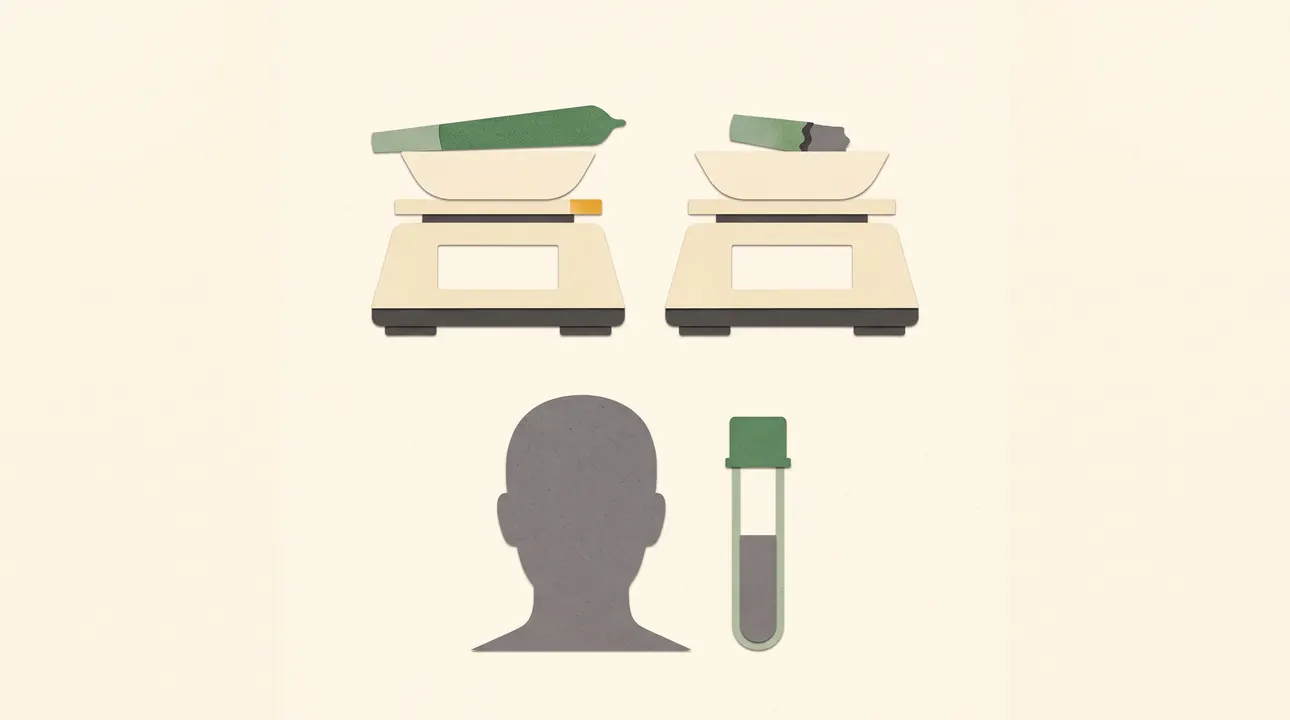
People can reduce how much they smoke with stronger cannabis, but that adjustment does not necessarily equalize THC exposure. Smaller amounts, smaller puffs and a similar reported high are three different observations. None alone proves complete compensation.
Here in High School, the useful follow-up to “people self-titrate” is what changed, and what was measured? A product can last longer without delivering the same exposure as a weaker product.
The opening diagram separates measuring material used from measuring exposure in a person. It supplies no dose or potency comparison.
What does cannabis self-titration mean?
Self-titration means adjusting consumption toward a desired effect. Someone might use less material, take fewer inhalations or stop a session earlier. The term describes adjustment; it does not specify how successful that adjustment was.
Keep three claims separate:
| Claim | What it means | What would establish it? |
|---|---|---|
| Partial compensation | Consumption changes in a direction that offsets some increase in strength | Behavior measured alongside product potency |
| Complete exposure compensation | The adjustment leaves comparable THC exposure | A direct exposure comparison with enough precision |
| Similar felt effect | People report a similar level of intoxication | Ratings of experience; these do not replace exposure measurements |
Our joint THC calculation lesson separates starting content from delivery. This question adds behavior: does the adjustment offset the difference in strength?
Did stronger joints lead to smaller puffs?
A 2014 Dutch study measured 98 frequent users smoking their own joints, usually mixed with tobacco. Researchers measured cannabis mass, potency and puff patterns with a portable device. People using stronger joints inhaled less total smoke and smoked at a slower pace. They also put more cannabis into joints when their cannabis was stronger. Van der Pol et al., 2014
The important correction: lower total smoke volume was significant; individual puff volume, puff count and puff duration were not. “Everyone took smaller puffs” would overstate the finding. The authors judged the overall compensation incomplete. Original Table 3 and discussion
| Endpoint | Exposure tested | Result and limit |
|---|---|---|
| Smoke volume and pace | Self-prepared smoked joints; no assigned THC dose | Lower with stronger joints; comparisons between different people |
| Individual puff measures | Same sessions | No significant potency association for puff size, count or duration |
| Internal THC exposure | Not measured in blood | Incomplete compensation inferred from material and smoking measures |
This was not a trial making the same person switch strengths. Tobacco, tolerance and existing preferences complicate interpretation. Its estimated monthly THC measure also stopped predicting later dependence severity after adjustment for baseline severity. That null does not establish that potency is harmless. Full paper
Do people use less concentrate than flower?
Often, in reported amounts. A 2025 analysis combined four US online surveys with 8,158 past-month users. Among people reporting both flower smoking and concentrate dabbing, most reported more flower than concentrate in comparable units. This supports adjustment across product types. Borodovsky et al., 2025
But the answer changed when researchers compared different people using the same product type. Higher-potency flower was associated with more reported consumption. Concentrate associations pointed in the same direction, but several were not statistically significant. “Higher strength always means less use” misses this distinction. Study Tables 2–4
These were reported typical hits, grams and percentages, not observed puff sizes or blood measurements. The study could not track one person’s response to different strengths of the same product. Most participants used daily; motives and tolerance could help explain who selected stronger products. The findings do not show that stronger cannabis caused heavier use.
The smaller amount of concentrate is also not a conversion rule. Our THC-per-vape-puff lesson explains why a hit count cannot supply a universal milligram dose. This survey specifically studied dabs, rather than prefilled oil cartridges.
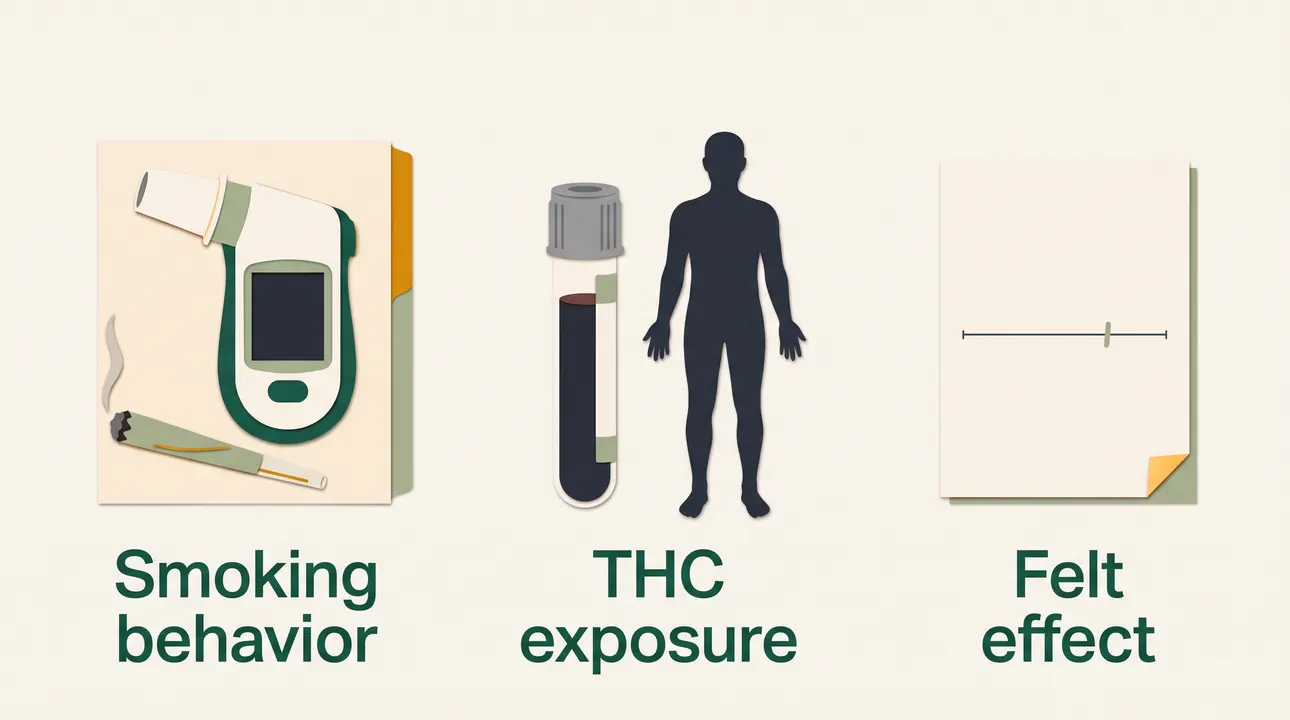
Adjustment, exposure and experience require different observations. These are measurement symbols, not numerical study results.
Does a similar high mean the same THC exposure?
No. A 2020 study analyzed 121 regular users: flower users received 16% or 24% THC products, concentrate users 70% or 90%. Potency was randomized within each existing user group; people used their preferred amounts and methods. Bidwell et al., 2020
Concentrate users had higher plasma THC, without significantly greater reported intoxication. Within each product type, higher assigned potency did not produce a detected difference in plasma THC. That pattern is compatible with compensation in those selected users. It does not prove universal equivalence or explain the mechanism.
Delayed verbal recall and a balance measure worsened after use. People were not randomized between flower and concentrates, and there was no placebo. Participants already had experience with the highest strength they could receive without an adverse reaction. The findings cannot establish what would happen in unfamiliar users. Methods and results
For a broader distinction between feeling and other responses, read our THC tolerance by effect lesson.
What would prove full compensation?
A strong test would compare the same people’s responses to different strengths, record what they consumed, and measure exposure at defined times. It would also specify how close the results must be to count as comparable.
Counting fewer puffs only answers part of that test. Finding no statistically significant exposure difference also does not automatically prove equality. The study’s size and uncertainty matter.
Keep route attached to the question. Smoking flower, dabbing and swallowing an edible are different exposures; our consumption-method and absorption comparison explains that background. These studies supply no personal puff ratio for switching products.
A cannabis journal can record the product, session and noticed effects. Keep an unknown absorbed dose unknown; a careful record does not turn it into a laboratory measurement.
Key takeaways
- Self-titration describes adjustment; complete compensation needs a separate test.
- Lower total smoke volume does not necessarily mean smaller individual puffs.
- Comparing flower with concentrates can give a different answer from comparing strengths within flower.
- A similar reported high does not establish equal exposure or equal risk.
FAQ
Do all cannabis users take smaller puffs with stronger weed?
No universal pattern follows from these studies. The Dutch study found lower total volume with stronger joints, but did not find a significant individual puff-size association. It compared different users, rather than testing everyone at multiple strengths.
Does smoking half as much fully cancel a stronger product?
A smaller amount does not by itself establish full compensation. Product strength, delivery and human exposure would need to be compared. These findings supply no reliable personal fraction or puff-count rule.
Why can flower and concentrates give different answers?
They are different product categories with different consumption patterns. Comparing categories can show less concentrate use, while comparing people within flower can show more use among those selecting stronger flower. Those comparisons answer different questions.
Does feeling equally high prove equal impairment?
No. A rating describes experience, while performance tasks measure particular abilities. Similar ratings cannot substitute for testing those abilities or establish safety.
Sources
- Van der Pol, P., et al. (2014). Cross-sectional and prospective relation of cannabis potency, dosing and smoking behaviour with cannabis dependence: an ecological study. Addiction, 109(7), 1101–1109. DOI.
- Borodovsky, J. T., et al. (2025). Self-titration of cannabis consumption: An epidemiological perspective. Journal of Psychiatric Research, 191, 527–534. DOI.
- Bidwell, L. C., et al. (2020). Association of Naturalistic Administration of Cannabis Flower and Concentrates With Intoxication and Impairment. JAMA Psychiatry, 77(8), 787–796. DOI.





